
Question of the day: Why do people eat fad diets?
Before we get to our multiple choices, let’s define the term. These days, a reasonable definition of a fad diet is a dietary regimen that becomes popular by making claims of substantial benefits while employing unconventional eating rules that are inadequately supported by scientific evidence. The word fad, of course, also implies a passing fancy, as Merriam-Webster says, “a practice or interest followed for a time with exaggerated zeal.”
Hence, a fad diet is one that the nutritional authorities assume will be short-lived— here today, gone next year—or the zeal for it will be. Folks will fall off the diet as fast as they, well, fall off every other unconventional diet (and perhaps, also and regrettably, the conventional diets that are promoted by the authorities themselves).
So why do it? Why even try it?
Because you’re a frivolous person (impolite as that might be to suggest), and this is the kind of thing frivolous people do.
Because you lack the critical skills necessary to understand why our nutrition authorities know better than to take such a diet seriously?
Because you’ve been living with a seemingly intractable health issue for far too long (excess weight being the most common) and the conventional dietary approaches have failed you.
Because a relative, friend, co-worker, TikTok influencer, or maybe even (heaven forbid) your doctor suggested it might cure what ails you, and so, what the hell? Why not?
If you work for the New York Times, the correct answers may appear to be 1 and 2, as we’ll discuss. I’d go for 3 and 4, maybe because I’ve been steeped in this fad diet world as a journalist for the past quarter century. My understanding is people try fad diets because the conventional approaches—eating less of a well-balanced, if not plant-based, diet, and exercising—have failed them, and so they have nothing to lose by trying something different. Maybe the diet will cure what ails them?
And if it does, why not keep eating that way, bizarre and unconventional as it may be?
My favorite line to that extent comes from Carrie Diulis, an Ohio spine surgeon who has struggled with obesity and diabetes (type 1), and said to me in 2017 about her vegan ketogenic diet, “It’s not a religion; it’s about how I feel.”
That kind of thinking makes a fad diet sound more like a dietary therapy—a good thing, not a frivolous one. But if so, why are the authorities so dismissive? Surely somebody, somewhere, as usual, is missing something?
These are the issues raised by a New York Times Magazine article this weekend, in which the author, Willy Staley, describes the experience of eating for a week like Robert F. Kennedy, Jr., and his Republican colleagues, J.D. Vance, Howard Lutnick, and Sean Duffy. All of these men are following the same unconventional dietary prescription, described a bit hyperbolically by the magazine’s headline writers as “eating only steak and sauerkraut.”
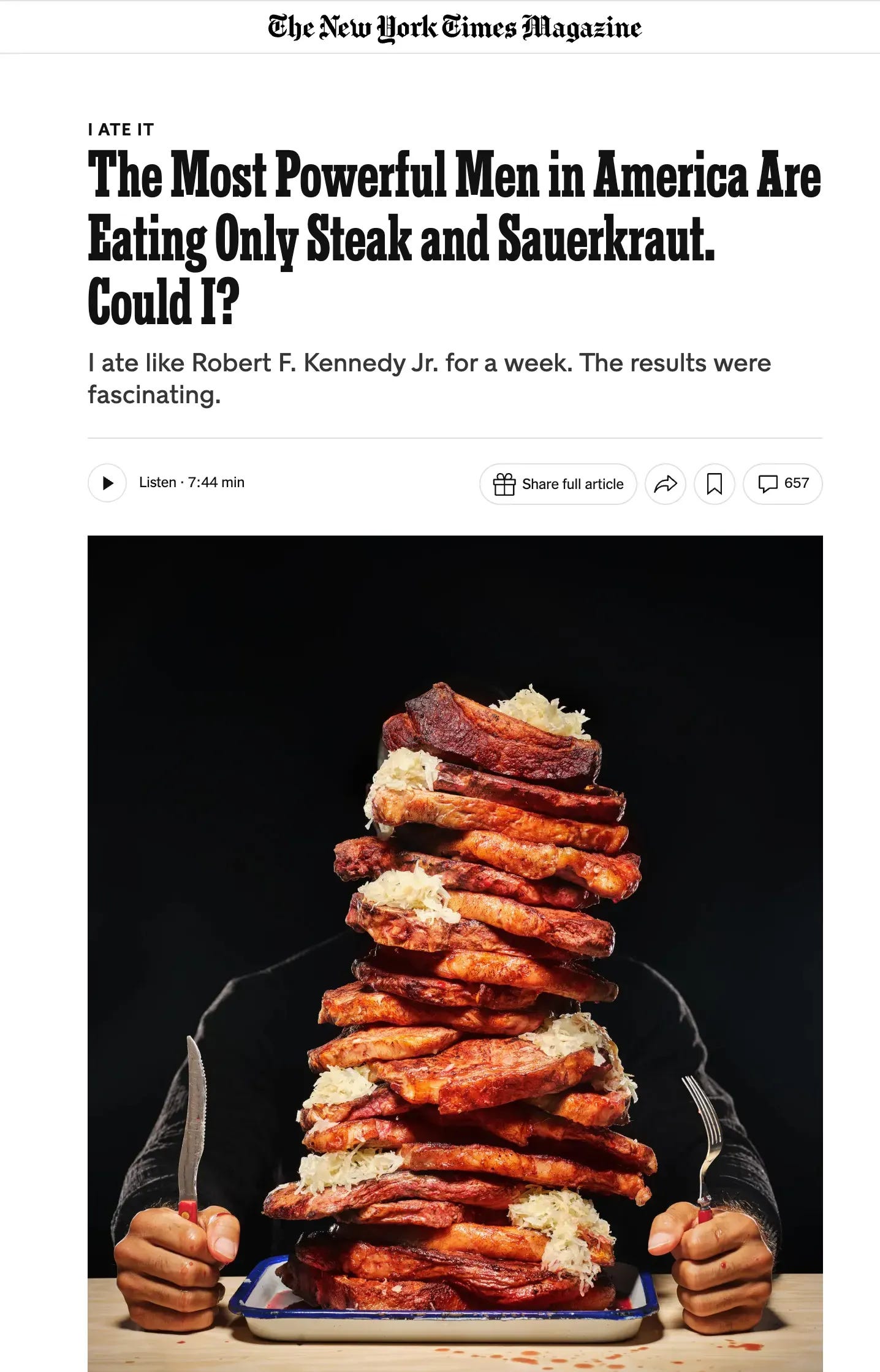
Staley is an editor for the magazine, and his résumé writing about diets or nutrition is thin. His article is clever, if not laugh-out-loud funny in places, largely because it’s scatological, with considerable discussion of both urine and feces—aka poop, in the Times' non-technical language. Staley is not exactly ridiculing RFK Jr and his Republican colleagues for eating as they do, but he’s certainly discussing their unconventional diet in a context that invites ridicule.
Staley’s article also avoids using the term “fad diet,” but it is heavily implied. RFK Jr et al., after all, are following the prescription of a single physician, Sean O’Mara, who has only recently begun promoting it publicly. And O’Mara is not advocating for a menu of options even vaguely resembling plant-based Mediterranean cuisine.
Comments
Nothing yet. Say the first thing.
Sign in to join the conversation.