
China will soon be the first electrostate, a country whose economy is completely electrified. If Europe wants to remain relevant over the next 50 years, it must seriously embark on the journey to become an electrocontinent - this shift can't wait any longer.
My buddy Chris edited this version of Unbeaten Path having just returned from the rolling green fields of rural Ireland 🍀
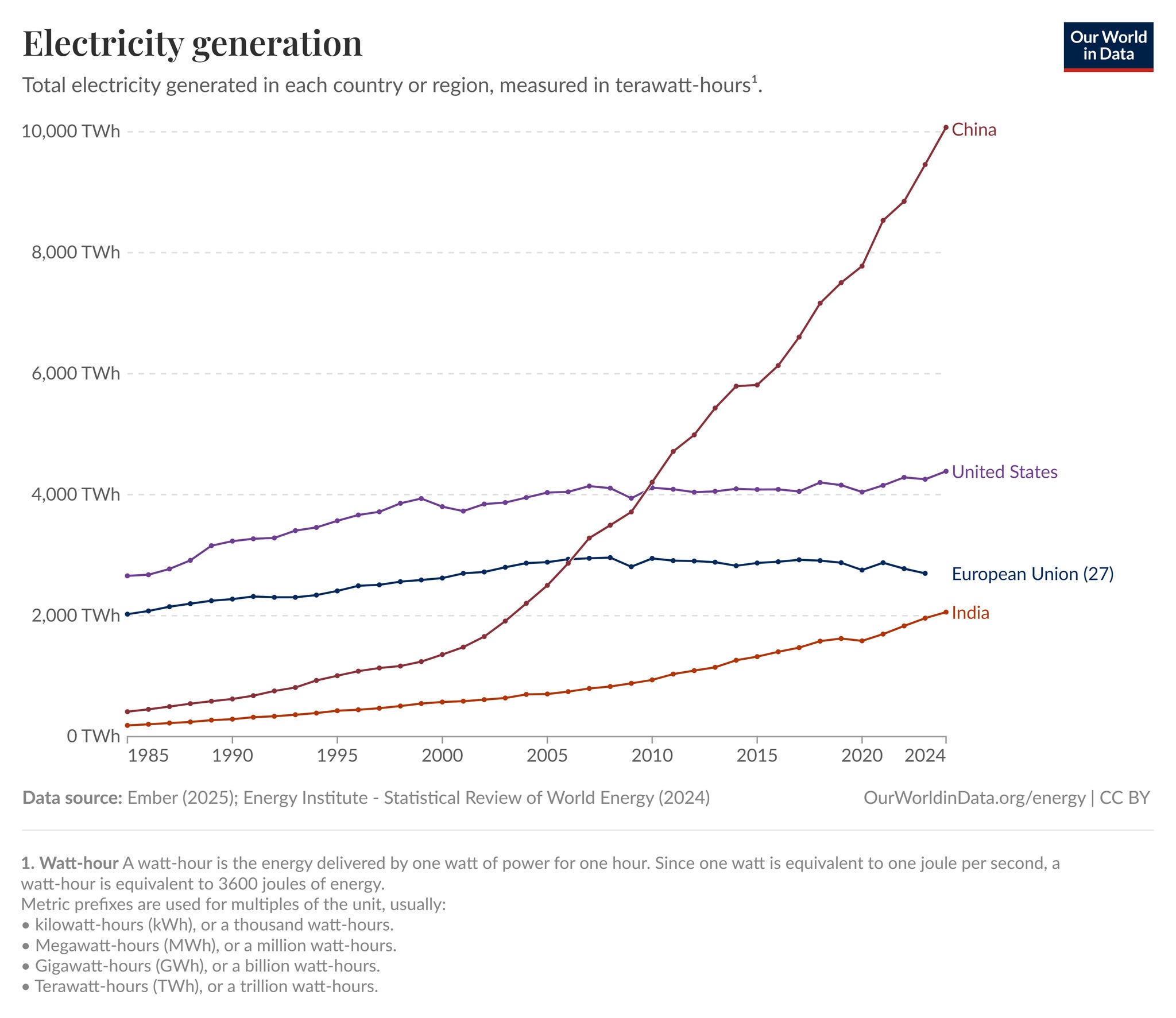
Over the past weeks, variations of this graph have flooded my Linkedin.
I am not sure why people are only now realizing that China is miles ahead in electricity generation. China overtook the US in 2010… but it’s a good hook to talk about something close to my heart: there's not a single reason why we should reduce energy consumption.
In fact, if anything, it should be a primary goal of governments to be sure that citizens have access to abundant energy in the most reliable way possible, at the lowest possible price.
The reason why is pretty straightforward:

In the last decade, energy has been discussed mostly in the context of the Paris Agreement and the Net Zero 2050 plans. Unfortunately, when discussed under the climate lens, energy consumption has been demonised and consumers have been held responsible for something they didn’t really have much power over. No pun intended.
Given the huge momentum behind it, the Paris Agreement was a big opportunity for Europe to realize that its dependency on fossil fuels was extremely dangerous and for governments to invest in new ways of producing energy.
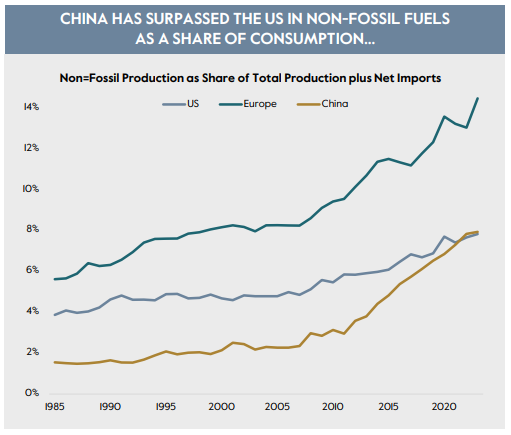
Despite leading the way in non-fossil energy production, Europe didn’t do enough and still relies too much on imported energy:
The fact is that, for a very long time, we lived in a world where relying on imports wasn't a problem. In that world, imagined in Bretton Woods after WW2 and powered by US dollars, fossil fuels were the ideal source of energy - easy to transport and to transform into electricity or work. This held true as long as the US was a net importer of fossil fuels, and thus it was in their interest to protect global trade with their military might.
This world ended in 2019 when, thanks to the Shale Revolution, the US became a net exporter of fossil fuels.
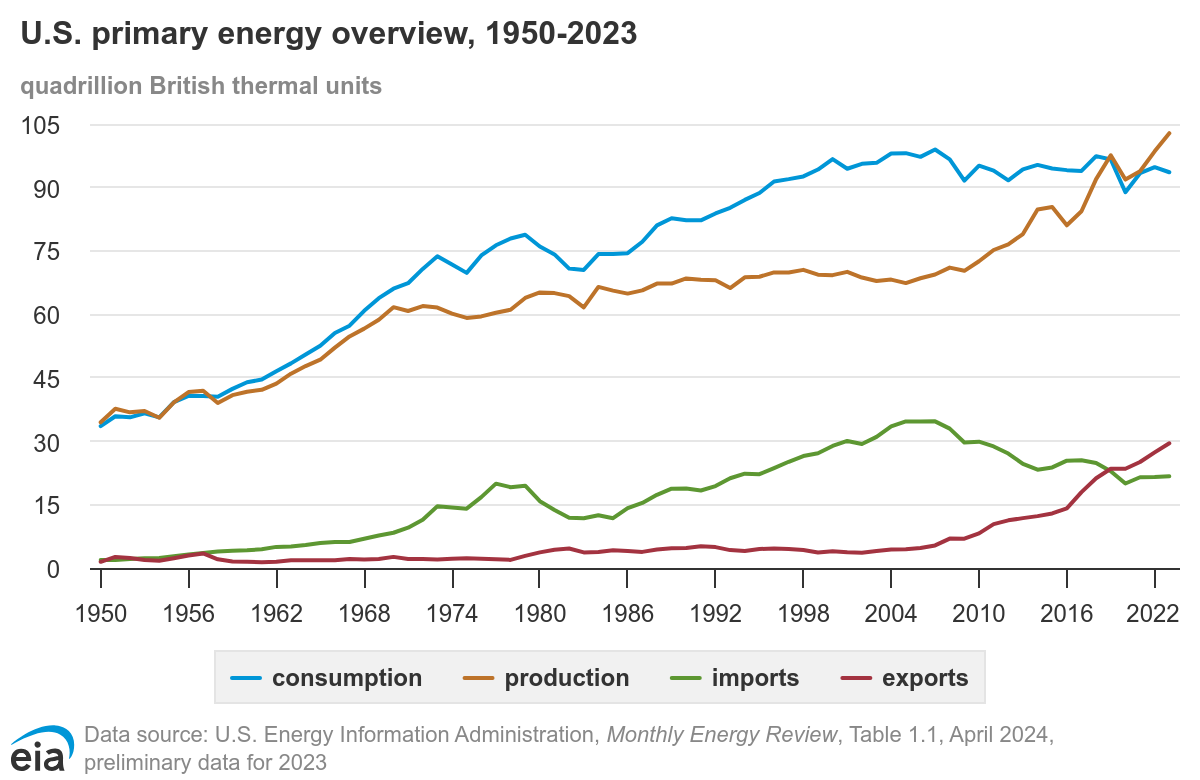
As the United States transitioned to a net oil exporter post Covid, its incentive to protect global shipping lanes waned
This was the nail on the coffin of a system that was already shaking under the pressure of the growing US debt, and that culminated in Trump’s recent approach to international relations.
As I’ve said multiple times, we are living through a geopolitical inflection point that will reshape the global economy. This is a big, big opportunity for many who want to provide new solutions to new problems.
Energy is no different. For Europe, the economic argument, the security argument, and the environmental argument are now well aligned and pushing for more local and sovereign energy production.
For a long time, green energy has suffered a green premium compared to fossil fuels. It had to account for expensive infrastructure and inefficient production. However, in recent decades, renewables have become much more affordable and fossil fuels have become more expensive because of tariffs.
Moreover, the primary source of fossil fuel for Europe, Russia, has brought war back to European soil and our friends in the US, from whom we buy a lot of gas, have become unreliable. The security argument is now stronger than ever, and it’s not by chance that most European countries are openly talking about nuclear now - something that Net Zero didn’t even go close at doing.
The interesting part of this situation is that concerns over security might end up having a bigger effect on the energy transition than concerns over climate change.
Often chaos can be a positive force of change, and in this case these three forces push in the same direction in something that looks like a win-win-win situation.
Mind you, it’s not going to be easy. There are many problems to be solved.
The first problem is that of raw materials: China has a near-monopoly of many of the materials needed for the energy transition, and has already started using it as a negotiation tool to reduce tariffs imposed by the US.
China is on its way to becoming the world’s first “electrostate”, with a growing share of its energy coming from electricity and an economy increasingly driven by clean technologies. It offers China a strategic buffer from trade decoupling and rising geopolitical tensions with the US. The country is not only rapidly advancing towards self-sufficiency in energy from secure domestic sources, but also wields vast power over the markets for the resources and materials that underpin technologies of the future.
Magnets are essential for any energy production technique that implies turning movement into electricity, and if we want to step up local energy production in Europe we need to have reliable and cheap sources of the materials needed.
An additional problem is that of infrastructure. In a fossil fuel-powered world, the metric to track to understand how good an energy production means was used to be the levelized cost of energy. This is the average cost of electricity generation over the lifetime of an energy asset.
It made sense because shipping was straightforward and without losses, so produced energy was more important than delivered energy. When energy is produced directly in the form of electricity, which is very hard to store and needs to be distributed immediately at the highest efficiency possible, delivered energy becomes the metric to track.
Not only does The New Joule Order put an emphasis on security as a key driver, but it also emphasizes delivered energy to consumers in the form of joules. Delivered energy holds greater value than produced energy, which emphasizes return on equity (ROE) as opposed to achieving the lowest levelized cost of energy (LCOE)
What does this mean in practice? Infrastructure, infrastructure, infrastructure.
We need to become good at planning, authorizing, and building infrastructural projects to support local production of energy.
The final question that comes to mind is how to finance these projects.
While there is certainly a case for VCs to provide a part of the financing, at least at the earliest stages, we are talking about huge numbers here - $68T according to BlackRock’s Larry Fink:
As we enter our century’s second quarter, there's a growing mismatch between the demand for investment and the capital available from traditional sources.
Governments can’t fund infrastructure through deficits. The deficits can’t get much higher. Instead, they’ll turn to private investors.
Meanwhile, companies won’t rely solely on banks for credit. Bank lending is constrained. Instead, businesses will go to the markets. […] Throughout history, infrastructure has driven a surprising amount of economic growth. […] Today, we're standing at the edge of an opportunity so vast it's almost hard to grasp. By 2040, the global demand for new infrastructure investment is $68 trillion
It's an immense opportunity that requires a new kind of investor, those that Brett Bivens and William Godfrey call “Production Capitalists”, firms that mix venture and credit and that can back companies in the long run through the different needs that growth brings.
Although it’s not going to be easy, and the challenge ahead of us is big and scary, we should not forget that energy drove what was the first attempt at a European common market, the European Coal and Steel Community - the EU as we know it now was born from the enlargement of the ECSC.
I consider the EU the biggest experiment of democracy, prosperity, and peace our world has seen so far, and it has its roots in energy.
As scary as it can be, I believe we are up to the challenge - let’s do it again, together.
Comments
Nothing yet. Say the first thing.
Sign in to join the conversation.