
This is part 2 of a series on the GB electricity wholesale market. You can find part 1 here.
Last time we discussed the origins of the electricity wholesale market in the 2000s. I now want to bring you forward in time to the early 2010s, the era of Cameron, the London Olympics, Mumford & Sons and the Great British Bake Off1.

While the country prepared for what turned out to be a final flourish of self-confidence before Brexit, deep in the bowels of Whitehall the Government had a problem. The 2010 election had seen all the major parties commit to a revival of nuclear power, but a path for doing so that didn’t fall foul of the EU’s State Aid rules was not clear. The Non-Fossil Fuels Obligation, used to support the legacy nuclear fleet after privatisation, had awarded its final contracts in 1998. Its successor, the Renewables Obligation, had provided considerable support to wind farms but would be overwhelmed by a single gigawatt-scale nuclear power station. Carbon pricing, implemented under the EU’s emission trading scheme, was judged to be too subject to political whims and therefore unbankable.
The Government took inspiration from the contracts used to finance the generators built during the 1990s and the so-called ‘dash for gas’. These private contracts agreed a ‘strike price’ at which a supplier would buy the output from a power station, giving the investors in that stations a guarantee of income. Because the wholesale price would vary and create a differential with the strike price, these contracts were dubbed ‘Contracts for Difference’ (CFD).
For the Government version of a CFD, the revenue attached to the strike price would be guaranteed but the power plant would still need to find a buyer in the market. Given that the plant would always be able to sell its power at a discount to the wholesale price - because it would get the strike price regardless of what the wholesale price was - it could guarantee a customer for its electricity. And because it was a contract rather than a scheme, it could be scaled to the size of a nuclear power plant.
Of course, this didn’t entirely solve the State Aid problem, because this was very clearly an intervention aimed at nuclear power rather than low carbon power more generally. To demonstrate that this was not a nuclear scheme, CFDs were made available to renewable generators and the Renewables Obligation was wound down.
In one of the ironies of history, the CFD turned out to be a much more successful tool for deploying renewables than it was for nuclear power (Figure 1).
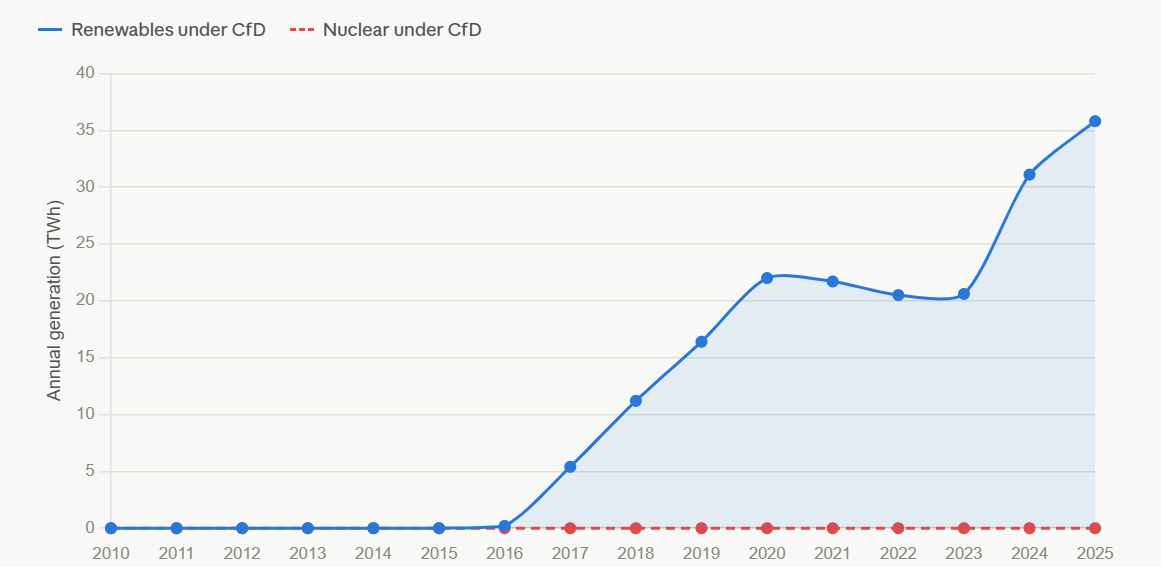
Part of the reason for this success was how they were allocated. Unlike the bilateral negotiations used to establish nuclear CFDs, renewables were allocated CFDs through an auction process. The auction determined the strike price, and drove cost reduction in the sector. That cost reduction created social licence for ever greater ambition on renewables roll-out. The most recent round saw a record 14.7GW of capacity issued a CFD. By 2030, over half the generation in the GB market will hold a CFD.
The reader will recall that the NETA design relies on a price differential between generators so the market can pick the cheapest set of generators to satisfy demand. What happens if every generator bids in at zero, there is an oversupply of generation and market participants need to pick which generators they buy from?
This is quite an important question. By 2030 we may have more wind and solar output than we can consume during 13-20% of the hours in the year, even after factoring in storage and exports. The overwhelming majority of these generators can still make money even when the wholesale price is zero or below. Below zero prices are already happening.
Older renewables were brought onto the system under the Renewables Obligation (RO). This gives them a top-up payment per megawatt-hour (MWh) of electricity produced. By 2030, this will likely be between £75-150/MWh depending on the banding of the generators involved. This means that they can bid in at anything up to the negative value of their top-up payment, after taking any marginal costs into account. This gives them considerable scope to bid negative to ensure they dispatch during periods of oversupply.
CFD generators are in a slightly different position. If the wholesale price goes below £0 for more than one to six hours depending on the age of the contract then their top-up payment is not provided. Moreover, the top-up payment is hard capped at the difference between zero and their strike price; even if the price goes negative for a short period they are paid as if it were zero.
This provides a tremendous incentive to do side deals to hold the price at zero while still getting paid the top-up payment. You will recall from our discussion in the last post about the relative levels of freedom generators and suppliers have to truck and barter. Even though CFDs are paid out on the wholesale price, nothing prevents a generator agreeing a trade with a supplier who buys their electricity at a discount to the wholesale price. The generator gets a lower payment overall, but lower beats zero if the market is oversupplied. Rather counterintuitively, the generators with the most scope to do this are the ones with the highest strike price, who cost consumers the most. They can provide the highest discount.
You would be forgiven at this point for being rather lost. Our original simple-but-complex market design that used prices to pick out a least cost generation mix is now a mess of side deals that mostly benefit the most expensive generators. It really doesn’t matter if renewables are cheap or not if our market design forces us to buy from the most expensive versions of them.
It gets worse, however. If a generator is doing a side deal with a supplier then they’re not selling in the wholesale market, so supply is lower and prices rise. This is helpful for CFD generators as it reduces the risk that RO generators will drive the price negative. But if the price looks like it’s going to rise above zero, then why do the side deal? Why not return to the wholesale market and get the full top-up payment?
What this means is that the hours before a period of oversupply will see a series of frantic trades and re-trades as people try to figure out the configuration of generators that will let the most expensive assets make the most money. No-one will benefit from this besides the traders, of whom we will speak more in a future post. The net result, however, is that consumer bills will benefit a lot less than we currently expect. I am aware that right now a lot of time is being spent on gaming out bidding behaviour with a view to ensuring those nasty cheap renewables get forced out of the market at every juncture.
This was never the idea.
The original thinkers behind the CFD assumed it was a stopgap, a temporary support necessary to ensure that costs could come down and, eventually, the market would return to normal. But because CFD assets can bid in more cheaply than anything else, they have essentially poisoned the market for anything other than a small number of merchant projects.
The Government belatedly woke up to this during its Review of Electricity Market Arrangements. It began to consider alternatives to the CFD as it stands, but far, far, too late. There is now no scope to switch generators to an alternative mechanism - or simply return to the market - while still delivering enough generation to meet the Clean Power 2030 target. There is still time, however, to correct trading arrangements that will increase consumer bills.
In the next part we will look at the unexpected consequences of another 2010s-vintage reform: the Capacity Market.
Please replace these selections with your preferred cultural phenomena.
No posts
Comments
Nothing yet. Say the first thing.
Sign in to join the conversation.