
If you could put your ear really close to an electrical cable and switch your hearing to the subatomic level, you would hear a faint buzz. This is the sound of electrons changing direction, every fiftieth of a second.
If you could listen even more closely, picking up on the fluctuations in the electric ether, you might hear a discordancy. A sense that something, somewhere, is going wrong, somewhere deep within the structures of the market.
Of course, you get exactly the same sense whenever it comes to pay your electricity bill. Power continues to be pricey. There’s plenty of great work out there on how to cut costs by moving levies off bills, but I want to think about what we could do to ensure that the market is working as efficiently as possible.
As part of this, I have been talking to professionals across the sector. What I’ve heard is a sense of wrongness. People cannot always put their finger on it, but there is a real feeling that a market that has been a reliable route for efficient price discovery is no longer so, and that there is a risk that very large amounts of rent are being extracted in entirely legal ways as a function of pockets of market power.
The problem is that the market is incredibly complicated, and diagnosing based on vibes is not easy. To avoid confronting you, the reader, with pages upon pages of dense prose, I am going to split this post up into a series. Today we’re going to look at a brief history of the electricity market and how we got to where we are.
Once you’ve generated a current in a circuit it is everywhere all at once. Electricity travels at the speed of light. This means that the task of any electricity market is to ensure that the market is balanced in real time. The amount of electricity sold by all the generators on the system has to match the demand from all that system’s customers.
A delay to a generator coming online isn’t like a fuel lorry being late to the depot: the demand that generator would’ve met is now not served, and everyone in the system gets slightly less power. ‘Slightly less power’ means that electrons go back and forth less frequently - the frequency drops - and anything that is sensitive to a frequency drop either stops working or works less efficiently.
Perhaps you have been in a hotel somewhere overseas with a more nascent electricity grid. When you return in the evening, you may notice a faint hum from light bulbs that are growing measurably brighter, and a clatter from fans speeding up. That is a symptom of leaving generators online too long; not matching demand as it happens.
Electricity wholesale markets are how this matching happens, where generators sell to suppliers who subsequently sell it on to us. Our wholesale market for electricity, in its current form, dates to the early 2000s and what were dubbed the New Electricity Trading Arrangements (NETA). ‘New’ because the trading arrangements put in place post privatisation had proved amenable to gaming and considerable capture of value by market participants.
NETA solves the problem of demand matching supply by making suppliers and generators responsible for it. Each has an ‘energy wallet’ that every half hour either has a negative value for demand or a positive value for generation. Suppliers have to ensure they fill up their wallet to zero, and generators have to make sure they empty their wallet to zero. This has to be done before real time. If they fail to do this with thirty minutes to go, the System Operator steps in and contracts to make up the difference via the Balancing Mechanism.
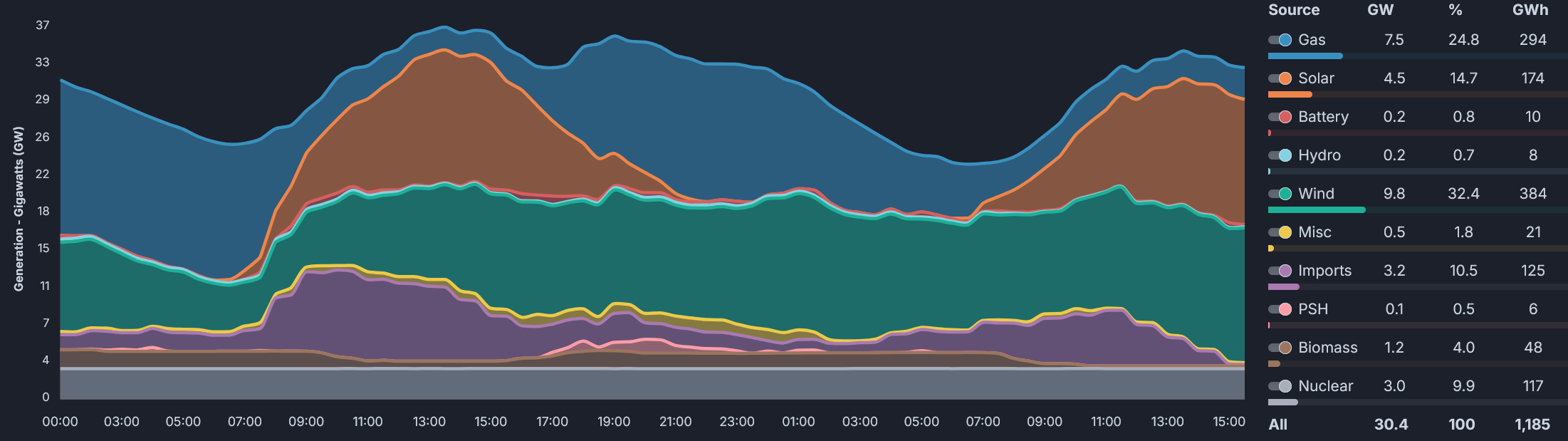
All market participants are largely free to figure out how they contract and buy. This can be through forward contracts, offering a supply of electricity months ahead of real time. If you have a fixed tariff, your supplier has likely bought the power to service that tariff like this so they can guarantee they make money on that tariff. At the same time, we don’t know how demand will change during the day all that time in advance, so we’ll buy some power on the day-ahead market and perhaps the intraday too. Figure 1 shows the demand profile and generation mix arising from trading over the last couple of days.
In the 2000s, a trading strategy for a supplier might look like this. You buy the bulk of your power on the forward markets from nuclear or coal power stations perhaps a season in advance. These are stations that are most efficiently run as always on and so prefer to trade ahead. You top up on the day ahead market, buying from gas power stations that are more flexible.
You bought the cheap plant first, and then topped up with the expensive plant last.
The point of this design was price discovery. You don’t know what the cheapest plant will be on any given day, given maintenance and the cost differential between gas and coal. You therefore discover the optimum configuration for the system by what charges you the least to turn on last.
That sounds quite simple and straightforward. Whether it is in fact simple is unclear, as in practice almost all trades are private.
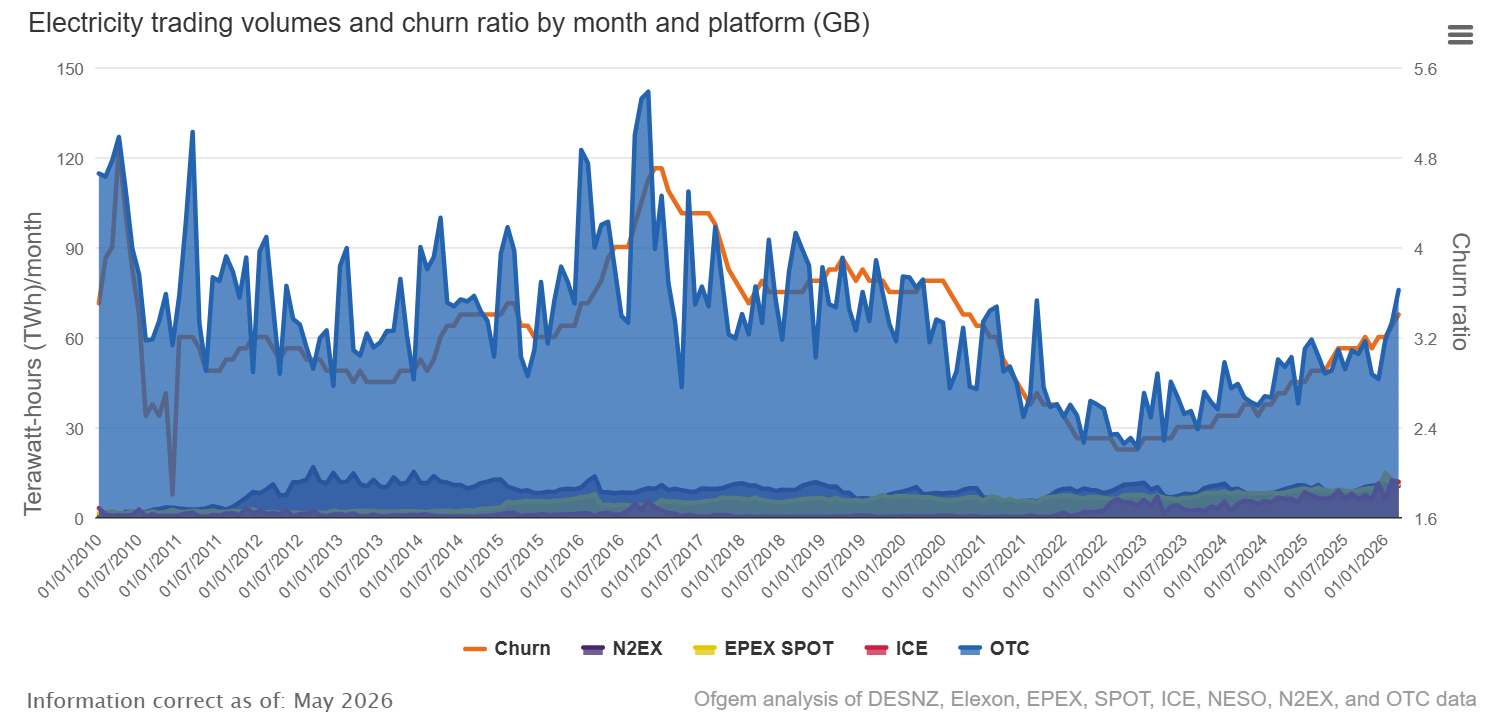
Figure 2 shows the volume of trades undertaken on public exchanges - N2EX, EPEX, and ICE - as well as the volume of private trades. These are dubbed ‘OTC,’ which stands for ‘Over the counter,’ which is just lovely. However, unlike buying sweets in a corner shop, no-one can see when you buy a wind farm’s output three months ahead via a private contract. Typically two thirds of all trades are private. Ofgem can compel market participants to provide data on their trades, but is currently not doing so.
Normally when the wholesale price of electricity is referred to by policymakers they mean the day-ahead price. But as should be clear, in reality there are multiple prices in the market. This is not a problem by itself - arbitrage between all these prices should see convergence on the underlying ‘real’ price.
Should.
In the next part of this series, we’ll look at how interventions in the market in the 2010s changed this picture, and how the original design of NETA is struggling to accommodate new types of generation.
No posts
Comments
Nothing yet. Say the first thing.
Sign in to join the conversation.