
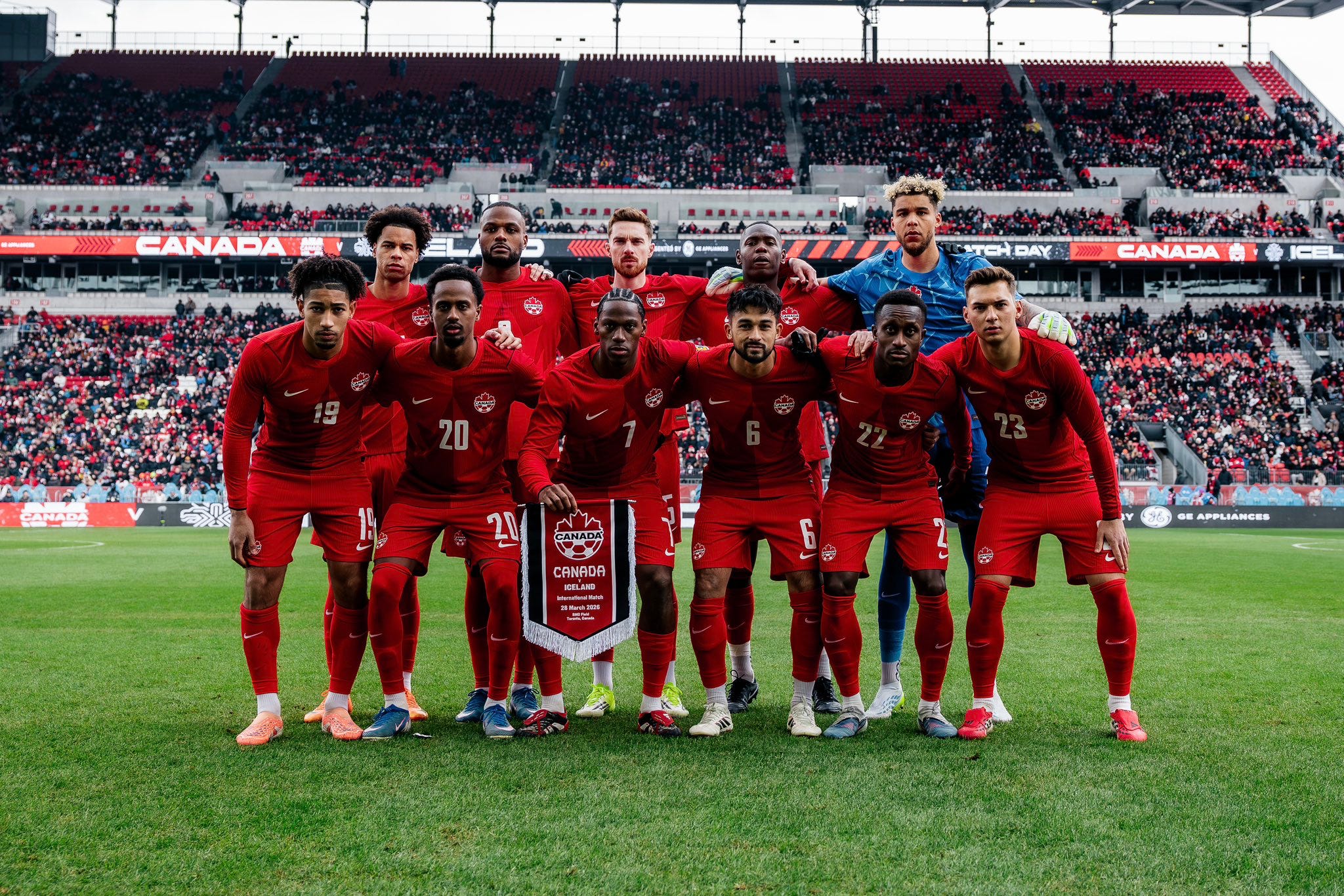
The Canadian men’s national team fought back from a two-goal deficit to draw 2-2 with Iceland on Saturday at BMO Field in Toronto.
Orri Óskarsson scored both goals for the Icelandic side in the first half, capitalizing on some defensive miscues from Canada, but Jonathan David replied twice from the penalty spot in the second half to share the spoils.
Here are some thoughts mixed with reactions from the side:
Canada was too ponderous in the first half
Kristian Jack brought up an interesting stat in his OneSoccer Sit Down with Jesse Marsch – well worth a watch. It was about the time between regaining possession and scoring a goal for Canada with the majority coming within 15 seconds. I don’t have the specific numbers on hand, but what was more noteworthy was Jesse Marsch’s response: he was thinking more like 10 seconds from gaining the ball and the final action.
Impressive, but the other side of that is that Canada really struggle to create from sustained pressure – that was evident on the day where they bossed long stretches of the game but were not able to create many clear cut chances.
Canada are best in transition, no doubt. Breaking down compact, organized teams is one of the hardest things in the game. Both of Iceland’s goals came against the run of play, but there was a lot of hesitancy from Canada.
Three touches when two would have sufficed, two touches when there was only time for one. Most of it was too slow – think Ali Ahmed’s blocked shot after a turnover: the ball from Matheiu Choinière needed a bit more pace, the window evaporated as it bobbled; Ahmed was indecisive after a sombrero and driving running from Jonathan David to scythe through the middle of the park, Nathan Saliba took an extra touch to settle a layoff from David that saw the shooting chance close.
“That’s what I was saying at halftime.” said Marsch post-match. “We need to play, first of all, with more tempo and urgency, and then we need to have more dynamic movement behind the because it’s the only way to pull a back-line apart.”
“If you move the ball too slow and you don’t run behind and you’re always thinking about balls to feet, then it’s hard to break them down. We had a couple moments that were good in the first half, but not enough,” he continued. “But right away in the second half you could see more verticality, more dynamic movement, more dynamic play. That’s a good lesson for us.”
The absences of Stephen Eustáquio and Ismaël Koné was a factor – with the wide midfielders, Tajon Buchanan and Ali Ahmed so attack-minded it puts a lot on the central midfield to keep a measure of control in that area of the pitch. The Choinière and Saliba partnership is not the same.
Good teams make the most of mistakes
Both of Iceland’s goals came from Canadian mistakes. Whether it was Kamal Miller’s back-pass, letting a bouncing ball in midfield evolve into a quick break, Niko Sigur missing a tackle, or any of the myriad shortcomings on the second goal, mistakes happen, I’m not worried about that.
Neither is Richie Laryea.
“Both of them are plays that we usually make,” he said. “It’s football, it happens.”
“We go to pass the ball back and it gets stuck a little bit and the guy scores,” Laryea detailed. “Second one we mistime a second ball and they’re down the other way. Easy fixes, we’ll fix them.”
What does worry me, in particular about the group stage match against Switzerland, is that the best teams don’t need a handful of chances. They only need one.
At the 2022 World Cup in Qatar, Canada went toe-to-toe with Belgium in the opener, some would even say they outplayed them, but were ultimately undone by not taking their chances. Although the results were more lopsided against Croatia and Morocco, Canada created enough opportunities but were not as clinical as their opponents in all three matches.
Offensively you’ve got to take the chances when the come; defensively you absolutely cannot give such free looks to quality teams, they will punish you.
Marsch knows that.
“Switzerland is a very good team on the ball, like really good,” he noted, asked about how a European opponent like Iceland was good prep for the future opponent. “There’s some comparison in terms of the structure that Iceland plays with, but in terms of the quality on the pitch, there’s a lot of big differences.”
“Watching Switzerland is like watching a horror movie, trying to think about how to deal with what they’re going to challenge us with,” joked Marsch, “But if we can play dynamic, if we can press them at the right times, if we can force them to have to defend our speed and our quality play in combination, we can find success against them as well.”
If you don’t start strong, you better have a good response
We’ve all known the World Cup was coming for years, but it has started to feel very real. Maybe it’s playing at a renovated BMO Field a few months out, maybe it’s all the extra hoopla around the game, maybe it’s knowing that the window to state your case to be in the squad is closing, whatever, there were hints of nerves out there.
Add in a pair of gut punches in the opening 20 minutes of a game and it’s only natural to feel deflated – there was certainly a bit of that in the Supporter’s Section where I was watching the game with my pops.
And yeah it was thanks to some penalty decisions that Canada got back into the game, but in the second half there was only one team that was going to make something happen – even when reduced to ten following the red card, Canada were the more positive side.
Plays, calls, the crowd, things will go against you at the World Cup. A team needs to have some backbone, some belief in what they’re doing and what they’re about. Canada showed that in the second half.
“We got back to being who we are,” underlined Dayne St. Clair. “Playing the ball forward, being aggressive, fighting – all those things that we talked about, our principles and our identity as a team, is what we leaned into.”
“Our team camaraderie showed,” he stressed, “Because when you go down early like that, it’s easy to just crumble or turn on each other, but we all looked at each other and believed that we could fight back.”
The Iceman Cometh
Granted they were both from the spot, but getting the best out of David is going to be key to Canada’s hopes at the World Cup. The debate over who will be his strike partner is as much about how they bring David into the game as it is about what they bring individually to the attack.
Marsch has said he likes David playing in that deeper position, more a second striker that drops off to link up before arriving into spaces in the box. It’s a good idea, but too often over the past year it has seen him not getting into the goal-scoring positions that Canada needs him in.
We still don’t know who that will be – Cyle Larin’s turn of form is encouraging, Daniel Jebbison looked good in his cameo and won one of the PKs, we know what Tani Oluwaseyi brings to the mix, Promise David, in his race to be fit, brings something entirely different. Whoever gets the role, it’s about letting Johnny be Johnny.
Aside from that one turn-and-shoot at the top of the box, which was barely a half-chance, his only real quality look came from that slipped Ahmed ball down the left-side of the box. Elías Ólafsson was alert, quick off his line to close it down, but Canada need to get David into those positions more regularly.
That said...
Canada has their penalty taker
Some coaches name a taker, some leave it to the guys on the field to make that decision. I prefer the former and it had better be David.
He took both well, even with some shoving on the edge of the box delaying the first one substantially.
To anyone who has watched David play for Canada it was no surprise.
“His nickname is ‘the Iceman’ for a reason, right? I don’t think anything gets to him,” said St. Clair. “To be able to show the composure in that moment – when you take a second one, it becomes even more of a mind game.”
Even the new guy gets it: “We knew he was going to bury both,” said Marcelo Flores.

If Marsch had any doubts, they best have been cleared.
“I looked at the staff and the team that was on the bench, I’m like, ‘Do we have someone else take the second one? Everyone looked at me like, are you crazy?” relayed the coach. “I said, ‘John, you wanted the second one, right?’ And he said, ‘Yeah, I wanted it. I was good.’”
The Third Heat
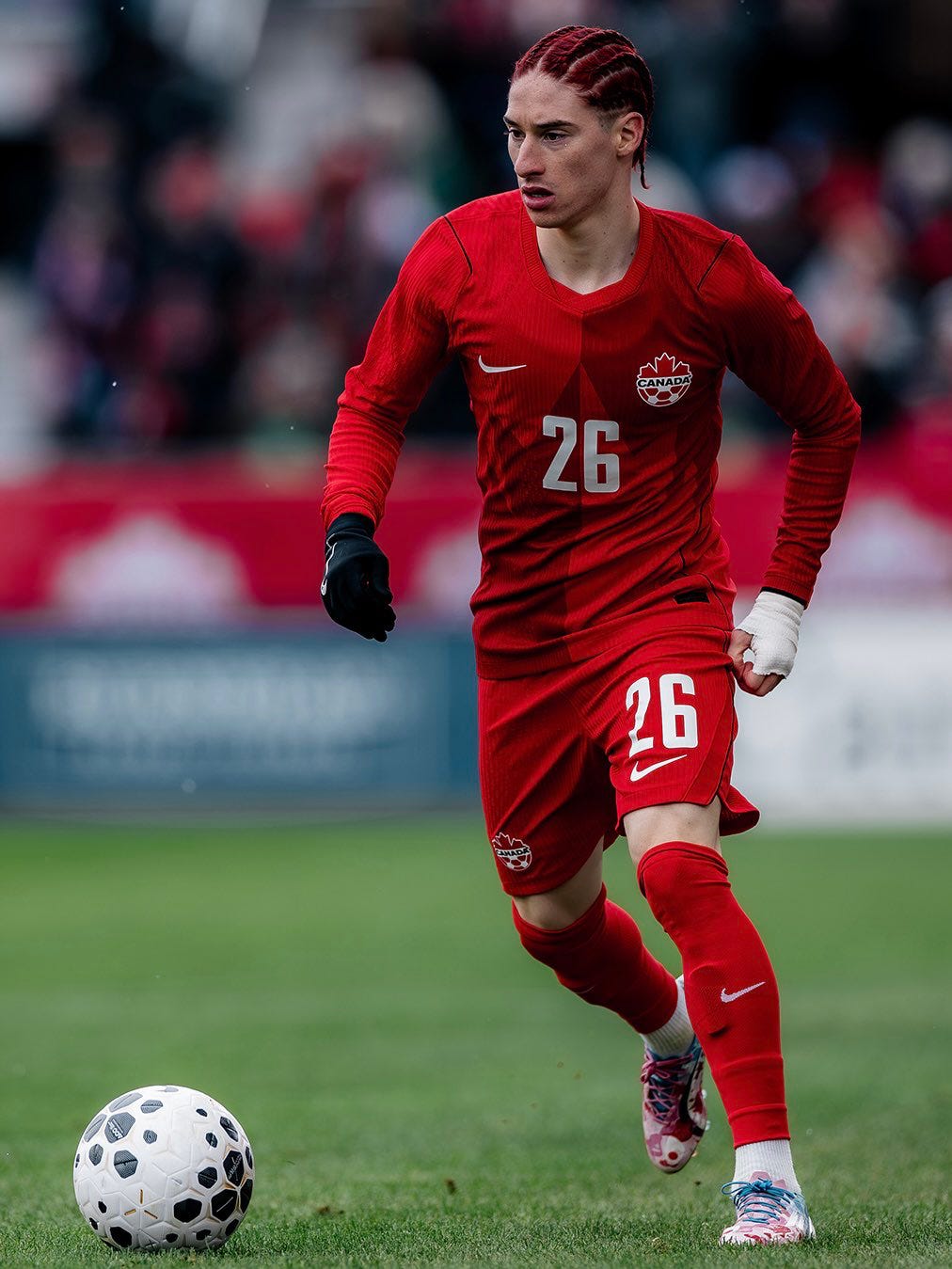
Canadian fans have had to be patient to see what Marcelo Flores can bring to the attack. Called into the January camp, he was not eligible to take the field until his one-time switch from Mexico was filed so Saturday was the first chance to see what the young man could do.
And he did not disappoint.
Direct, tricky, relentless, but perhaps most importantly, central. Canada can be devastating in the wide areas. Buchanan, Ahmed, Alphonso Davies when he’s back, Laryea, Jacob Shaffelburg, the list goes on – actually that’s most of it, for now.
Though playing as one of those wide attackers, Flores was constantly driving in-field.
“His comfort in tight spaces and his ability to see little plays and not lose balls under pressure,” listed Marsch. “He’s really clean and quick and clever, initiating little combinations. Whether he plays on the right, whether he plays on the left – he can play like a second striker for us at times – that’s something that we don’t necessarily have.”
“The team’s got to learn how to play with him,” he added. “Then we can use him as a real weapon. Marcelo was good.”
Yes, yes he was.
“I just tried to carry out the game plan, do my best, try to get on the ball, be energetic, try to do something to change the game,” Flores said post-match. “Trying to make the most of my first opportunity. Hopefully next week I’ll have another chance.”
Disciplinary Issues?
Four red cards in the last nine matches: in reverse order Buchanan (Iceland), Koné (Venezuela), Ahmed (Ecuador), and Shaffelburg (Guatemala).
Marsch pushed back on his team developing a reputation: “It’s not a malicious elbow that gets thrown. I don’t think Ismaël’s is a red and I don’t think Ali’s is a red. Shaff’s is a double yellow, so I understand that one.”
“We’re not a dirty, nasty team,” he said. “We work hard, we were physical, we play hard, but we’re not a dirty team, so I’m not worried about developing a reputation. But certainly cards like that can change momentum in tournaments so we have to find a way to eliminate picking up those red cards.”
Laryea called Buchanan’s supposed elbow, ‘just a bump’.
For me, that one and Koné’s were decisions by the referee on the day – what I mean by that is that if you put 100 referees in a room and made them watch the play, half would give it and half would not. It’s down to the individual calling the shots as to whether it is a sending off or not.
Ali’s high boot was probably reckless, but hardly a sign of overly aggressive play. Shaffelburg’s too was also fair, but not intentional for me – I think he braced himself for contact as he ran through that never came.
Straddling that line between being aggressive and physical, but not giving referee’s the chance to go to their back pocket is tricky. Canada need to find that level.
While I wouldn’t count on it, St. Clair made an interesting point about this current rash of reds: “You’ve got VAR in the World Cup, so how many of these red cards would stand?”
Canada are back in action on Tuesday when they meet Tunisia at BMO Field. I expect we’ll see a handful of changes to the starting lineup. As always, it should be fun.
No posts
Comments
Nothing yet. Say the first thing.
Sign in to join the conversation.