
Over the past several weeks, I published a three-part dialogue between a “Janitor” and an “Architect”—basically, two design archetypes arguing about the nature of design practice, in software & digital UX at this pivotal moment. Then a “Stranger” shows up partway through, but refuses to let either of them off the hook…
This post collects all three parts in one place for easy reference.
The series actually began as a graphic novel concept—I took an evening course earlier this year on graphic novel creation via Stanford Continuing Ed, which involved scripting out scenes. So this dialogue was my first attempt at applying that to design discourse. 😊 Eventually I’d like to develop it further: full typographic layout, maybe some pencil-sketch panels, something closer to its original form.
For now, here it is as a trilogy of essays. Enjoy! 🙏🏽
The Janitor and the Architect are deep in debate: maintenance vs. monument, craft vs. vision—when the Stranger arrives and names the real problem: they’ve been asking what kind of designer they are, instead of what the situation actually requires.
Revealed tensions: Identity as costume vs. design as orientation. 🤔
The question addressed: What are you performing, and what are you actually reading?
The Stranger introduces three levels of design practice—the artifact, the conditions of making, and the world the work makes possible. Most designers live at one level. Visit another when forced. And call their avoidance of the third one realism, or politics, or someone else’s job.
Critical tensions: Accountability vs. answerability. The deliverable vs. the conversation that shaped what was even possible to deliver. 🤨
The bit question tackled: Which level have you been avoiding—and what have you been calling that avoidance?
The Stranger returns one final time. This is where pathfinding, sensemaking, and the architectonic nature of design practice come into full view. The compass isn’t a map—it doesn’t tell you what to build or where to go. Instead it orients you toward what you’re choosing to be responsible for. But nobody gives you permission to work at that level. You gotta take the responsibility! 🙌🏽
Key tensions: Range vs. role. The conversation before the brief as the first architectural act—not an obstacle before the work begins. 🫠
The deeper question addressed: What are you currently designing that you haven’t fully admitted you’re responsible for?
Sample AI-generated storyboards via the scripts:
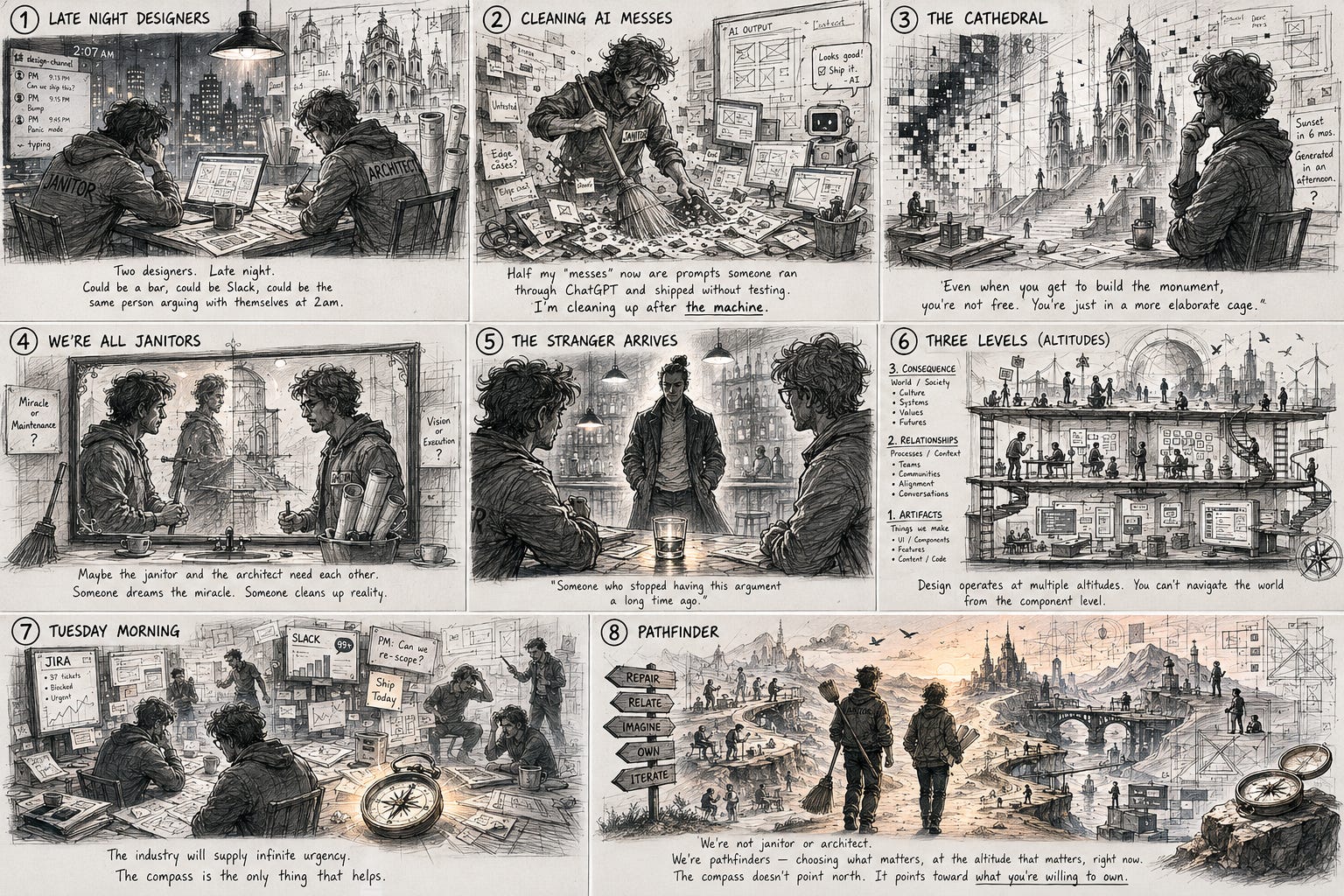
AI Prompt: (style) rough graphite pencil storyboard sketch, existential graphic novel aesthetic, cinematic composition, monochrome, architectural notebook style, moody lighting, unfinished hand-drawn lines, philosophical sci-fi atmosphere, indie comic book storyboard, emotional expressions, minimal shading, visual metaphor, sketchbook texture
No posts
Comments
Nothing yet. Say the first thing.
Sign in to join the conversation.