
It’s already mid-June 2026. You’re six months into whatever you started in January—a new job, a new job search, some new AI project, or a new version of yourself as a designer. And if you’re like most folks, you’re probably doing one of two things:
Totally ignoring the fact that half the year is gone lol 😆
Frantically reviewing your goals and feeling a bit anxious 😬
Here’s a third option that’s a bit more productive: looking at what's happening inside you as you do this work. The hidden layers that shape whether you're becoming a leader with conviction—or simply accumulating titles and Figma files genAI prompt files.
Back in November, I wrote about design leadership as an existential practice—about how true leadership emerges from wrestling with values being contested, not from climbing a ladder. About how truly anyone can be a leader, even a junior designer, if they’re willing to step outside themselves and take ownership of moving others toward a horizon worth reaching. 🙌🏽
That piece was borne from watching this UX/Tech industry fracture & devolve—design regressing from strategic partnership to fast pixel production, from problem-solving to prompt-generating. Six months later, that fracture has only deepened. 😑
Which makes this mid-year check-in kinda crucial! Because if you’re aspiring to lead—to be confident, consequential, with authority and conviction—you need to know whether you’re building the foundations for that, or simply going through the motions in the optimized code factory of a UX job.
I think the difference shows up in four particular layers that most designers maybe rarely examine together: personal / emotional / spiritual / pragmatic.
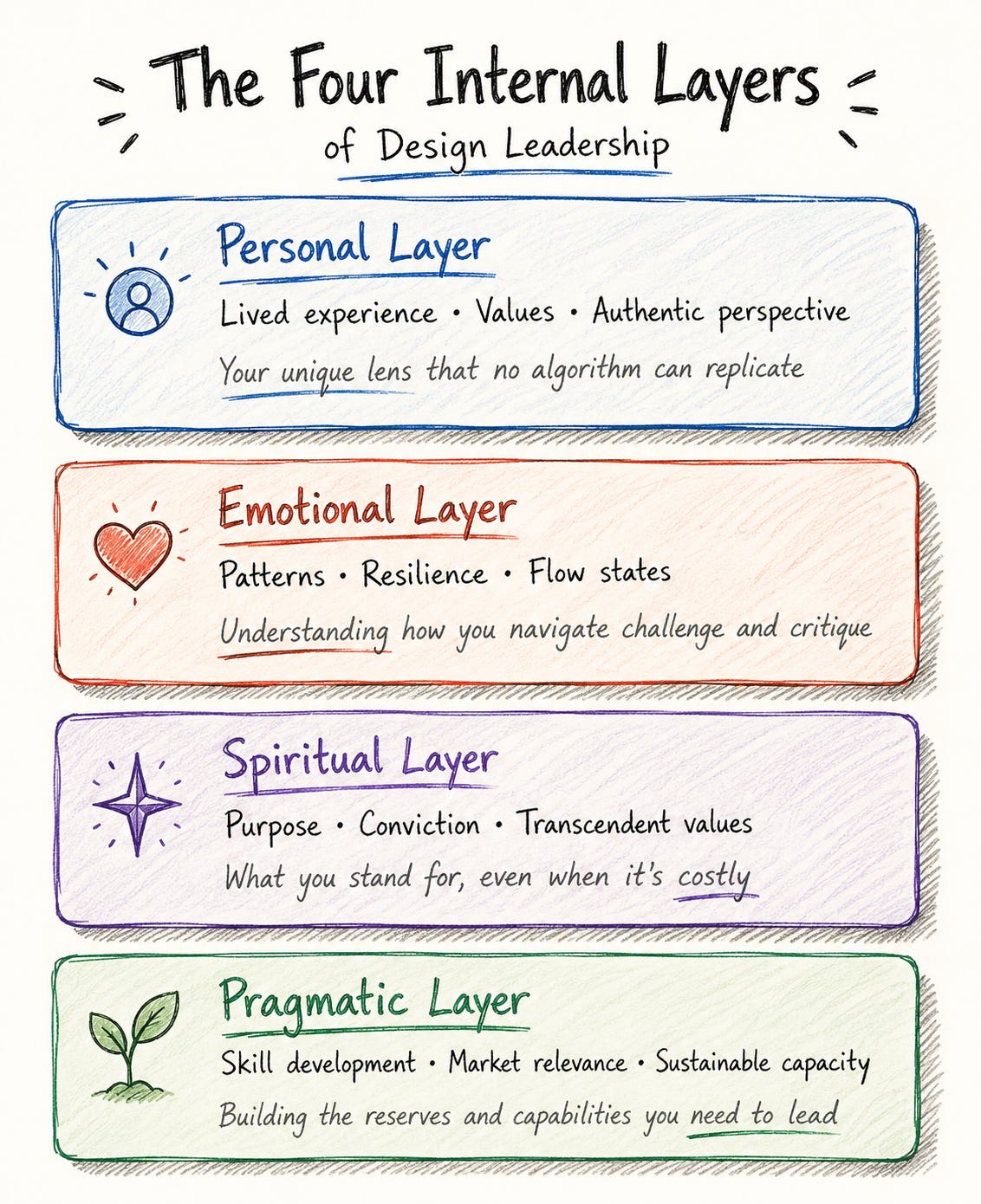
The question: How has your lived experience shown up in your design decisions these past six months?
Remember: design leadership is a kind of phase-change into something the organization didn’t realize it needed, but you knew was necessary because the situation demanded it. That knowing comes from somewhere. It really comes from you—your particular lens, your unique perspective, your lived experience and informed expertise. 🙃
This is about recognizing that every choice you make—from color palettes to interaction patterns to which battles you pick—is filtered through who you are. So think about a recent design decision where you felt strongly about something. Not because the data said so. Not because the PM wanted it. But because something in your background, your experiences, your particular way of seeing the world told you it mattered.
That’s your lived experience talking. And in an age where AI can generate dozens of variations of “good enough,” this is increasingly what separates thoughtful leadership from algorithmic execution.
Try this:
Pick 2-3 design decisions from the last 6 months that felt distinctly yours.
Ask: What in my background or experience made me see this differently than others might?
Notice patterns: What problems do you naturally gravitate toward solving? What values do those choices reveal?
If you can’t identify any decisions that felt personally driven, that’s worth examining, too. 🤔 Are you executing without conviction? Are you disconnected from your values? Or are you simply too early in your career while still building that internal compass? Hey, that’s all good. But knowing which one is crucial, because leadership requires knowing what you stand for.
The question: What are your emotional patterns around the work, and what are they telling you about your capacity to lead?
Here’s what I wrote in November:
Being a leader takes “more than an iota of courage, humility, and a willingness to fail forward.” It demands resilience through multi-lateral thinking amid mind-blowing change.
But resilience isn’t built in a vacuum. It’s built through pattern recognition of your own emotional rhythms.
Design is emotional work. We just pretend it isn’t. You get frustrated when feedback feels off-target. You get energized by certain types of problems. You hit flow states at specific times doing specific work. You feel protective of certain design decisions. You get annoyed by certain constraints, etc. etc. etc. We’re human! 😅
These aren’t idiosyncratic errors or bugs in your professional demeanor. It’s all data about your leadership capacity. 🤔
I mean, I’ve had those late-night design sessions where something just clicks—where you create something that feels like an extension of your beliefs about quality or character. I’ve also had soul-crushing syncs where carefully considered work gets reduced to rote production tasks. I’ve borne scars from value conflicts where my beliefs collided with organizational realities. (and often simply walked away)
That’s all part of the emotional texture of leadership work. The question is: what are you learning from it?
Try this:
When did you hit creative flow in the last 6 months? What enabled it?
What consistently frustrated or drained you? What energized you?
How did you handle feedback that challenged your work? Did you defend your values with conviction, or fall into accommodation?
If you’re thriving on challenge & iteration, you’re building resilience. If you’re finding it increasingly demoralizing, that’s also useful information—maybe about the feedback quality, maybe about the work culture’s misalignment with your values, maybe about whether this is the right context for your leadership right now.
Leaders need to know their emotional patterns well enough to navigate value conflicts without losing themselves. 🫠
The question: When did you feel connected to a horizon beyond the immediate task?
Leadership is anchored in your North Star. What do you stand for? What will you not compromise? What future are you designing toward?
In the last 6 months:
When did you advocate for something that went beyond minimal reqs?
What design principles would you defend even when they complicated the project?
When did you choose to push back? When did you pause? What values guided those choices?
Leaders operate from conviction. These are the moments when that conviction forms.
Try this:
What values are you defending in your corner of this fractured landscape?
What horizon are you helping others see?
If you haven’t had these moments in the last 6 months, you might be in pure survival or execution mode, thus needing that necessary space to identify & connect to what you truly care about. It might be a bit scary, but knowing that can help you forge the conviction that guides you as a leader.
The question: Are you building sustainable capacity for leadership?
Leadership requires inspiration AND execution. You can’t just do architectonic thinking all day long.
In the last 6 months:
What capabilities did you genuinely develop (not just use)?
Are these making you more able to navigate complexity & maintain conviction under pressure?
Is your pace sustainable? Can you maintain it while doing the deep thinking leadership requires?
Try this:
List three capabilities that enhance your leadership potential.
Are you learning and growing, or grinding without development?
Leaders need reserves of energy, of perspective, of resilience.
Here's what makes this 4-Layer framework powerful: these layers interact to create leadership capacity. Consider the following situations:
Strong personal clarity + deep spiritual conviction but poor pragmatic positioning? You might be principled but ineffective—unable to translate your values into organizational action.
Great skill development + sustainable pace but minimal emotional self-awareness or lack of personal investment? You’re a competent executor, not a leader with conviction. You’ll manage projects but you won’t move people toward new horizons. 🙃
All spiritual purpose & emotional intensity but little pragmatic grounding? You can be a passionate idealist but missing useful fruits of labor. Leaders need both inspiration and execution.
Personal values + pragmatic skills but disconnected from transcendent purpose? You might climb the ladder, but you’ll never truly lead. You’ll confuse altitude with aptitude, position with purpose. 😬
The goal isn’t perfection across all four layers. It’s awareness of where you are, whether that’s serving your leadership development, and what needs attention.
So this is where it gets really interesting: these four layers don’t exist in a vacuum. They actually manifest differently depending on where you sit in your career. 🤔
I posted earlier this year about clarifying your altitude, scope, and value—three interrelated models for growing as a design leader. And here’s how they intersect with the layers you’re examining:
At the tactical altitude (pixels, flows, features), your personal & emotional layers are most visible. You’re building taste, learning to handle feedback, understanding your design values through immediate decision-making.
At the conceptual altitude (systems, frameworks, strategy), your spiritual, North Star-driven layer becomes critical. This is where you’re defending design principles that go beyond requirements, advocating for user needs and design virtues even when they complicate the roadmap.
At the strategic altitude (platforms, organizational culture, influence across boundaries), all four layers matter—but especially your pragmatic layer. Can you sustain yourself while navigating complex tradeoffs? Can you maintain personal values while operating at organizational scale? Can you help others move forward while managing the cognitive load of holding multiple POVs simultaneously?
Your scope matters too. If you’re expanding into product lines or platform-level thinking, you may want to think about your spiritual layer: what are you willing to defend? Where is your influence most needed?
And if you’re navigating influence across multiple stakeholder groups—sustained empathy under pressure, as I called it—you’re doing all four layers at once: grounded in who you are (personal), aware of your emotional patterns (emotional), clear about what you stand for (spiritual), and strategic about your energy and capacity (pragmatic). Whew, it ain’t easy! 😅
So this check-in via a layered approach is really about understanding where you are in your altitude, scope, and influence—and whether your internal layers are supporting the leadership work that level demands. That’s the key.
BTW, I created a nifty interactive worksheet you can try out, and print/save a PDF of your responses: https://v0-layersxaltitudes.vercel.app/ Give it a shot!
To conclude, those hidden, internal layers are operating right now, whether you’re paying attention or not. Your lived experience shapes your decisions. Your emotional patterns reveal your resilience. Your connection to purpose shows up in your conviction. Your pragmatic development determines your capacity.
Together, they’re building—or eroding—your foundation for leadership. 🙏🏽
Designers who move through this work most effectively don’t do it in isolation. They have someone in their corner—a coach, a mentor, a trusted advisor—helping them see patterns & possibilities they might miss alone.
If you’re serious about building toward leadership, I’m available for coaching conversations. Let’s talk.
No posts
Comments
Nothing yet. Say the first thing.
Sign in to join the conversation.