

Issue #21
SaaS has been under the gun recently due to concerns about AI taking over. I think the prevailing narrative is wrong. The real winners of the AI revolution may be the SaaS companies you already know and possibly already pay.
Here’s the contrarian case: established SaaS businesses aren’t AI’s victims. They’re its biggest beneficiaries.
AI startups face a brutal reality: they need to acquire customers from scratch AND retain them over time. Meanwhile, Salesforce has 150,000 companies already logged in. HubSpot has 194,000. Atlassian has 300,000.
When these companies ship AI features, they’re not launching, they’re upgrading.
What “existing distribution” actually means:
Billing relationships established. No friction to monetize new AI capabilities.
Usage data at scale. Models trained on real workflows, not synthetic benchmarks.
Embedded in daily habits. Switching costs compound when AI learns your patterns.
Trust already earned. Enterprise buyers don’t need to vet a new vendor.
Cost to maintain. Complex software needs to be maintained and supported.
Career risk. Why would a CXO replace a $100k bill for a critical workflow solution that’s already embedded into their company with a homegrown solution that is much more difficult to maintain and creates undue risk within the organization?
Traditional SaaS economics are elegant: 75-85% gross margins, minimal marginal cost per customer. AI changes this but not how bears suggest.
The margin compression is real. AI features carry compute costs. Every inference has a price tag. Early data suggests AI-enhanced SaaS runs 60-70% gross margins versus 80%+ for traditional SaaS. Model quality keeps increasing and is synonymous with better output - inference costs tend to remain high for that reason.
Sounds like a downgrade. It’s not. The denominator is exploding.
Traditional software competes for the “software budget” - typically 5-10% of operating expenses. AI-powered software competes for something far larger: the labour budget.
Consider the math:
A company’s annual spend on customer support software: $100K
That same company’s spend on customer support people: $2M
When Klarna’s AI assistant handles 2.3 million conversations in its first month - work previously done by 700 full-time agents - they’re not selling software. They’re selling headcount replacement.
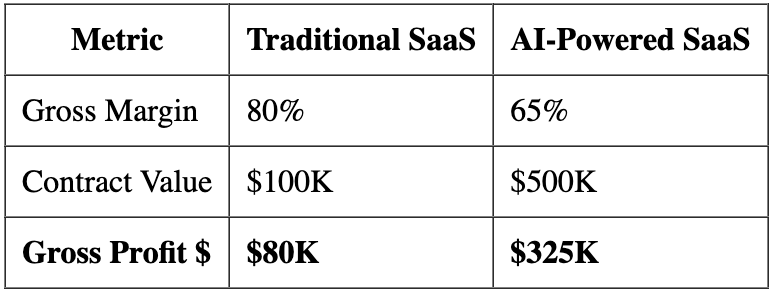
Lower margin percentage. 4x the gross profit dollars.
Software budgets are measured in billions. Labor budgets are an order of magnitude larger. The relevant question isn’t “will gross margins decline?” They will. The question is: “will gross profit dollars grow faster than margins shrink?” For SaaS capturing labor budget that’s unambiguously yes.
Here’s where the math gets interesting for SaaS operators.
R&D efficiency is compounding. GitHub reports Copilot users complete tasks 55% faster. Across an engineering org, that’s either dramatic output increases or meaningful headcount efficiency. Simultaneously, AI becomes the product surface instead of building ten features manually, you build one AI interface that handles the complexity.
The result: R&D as a percentage of revenue declines while innovation accelerates.
S&M is following the same curve. AI handles lead qualification, personalized outreach, and tier-1 support autonomously. Intercom reports their AI resolves 50% of conversations without human intervention. That’s structural cost reduction, not incremental improvement.
When your product can guide users, answer questions, and demonstrate value autonomously, you need fewer humans in the sales cycle. The best SaaS companies already have efficient S&M ratios. AI makes good operators exceptional.
Both of these together lead to increased operating leverage and a quicker path to strong EBITDA and FCF margins.
This isn’t theoretical. Companies are already proving the thesis:
ServiceNow added AI capabilities and saw customers increase spend by 50%+ when adopting their Pro Plus SKU. Same customer, same distribution, higher ARPU.
Freshworks launched Freddy AI and reported it resolves up to 40% of support requests automatically; directly attacking the labor line item while improving customer outcomes.
Canva integrated AI image generation and saw paying subscriber growth accelerate. AI features became the conversion catalyst for their existing free-user base.
Monday.com reported AI features drove measurable expansion revenue within existing accounts - the distribution advantage in action.
The pattern: incumbents ship AI, capture more wallet share, improve efficiency metrics. Not disruption. Enhancement.
The obvious pushback: won’t AI-native startups building from first principles eventually disrupt incumbents?
Some will. But disruption theory requires the incumbent to be unable or unwilling to adopt new technology. That’s not the case here. SaaS companies are aggressively integrating AI; they have the cash, they can buy the talent, and the customer demand.
The real question is which SaaS companies capture the most AI value. The answer favors those with proprietary data moats, established distribution, and cultures that ship quickly.
If this thesis holds, SaaS companies successfully integrating AI should see:
Gross margins compress slightly (AI inference costs)
But contract values expand dramatically (competing for labor budgets, implementing AI)
R&D as % of revenue declines (efficiency gains, using AI)
S&M as % of revenue declines (automation + PLG, using AI)
Net retention increases (stickier, more valuable products)
That’s not a company getting disrupted. That’s a company entering its next growth phase with better absolute economics and a larger addressable market.
Comments
Nothing yet. Say the first thing.
Sign in to join the conversation.