
Issue #22
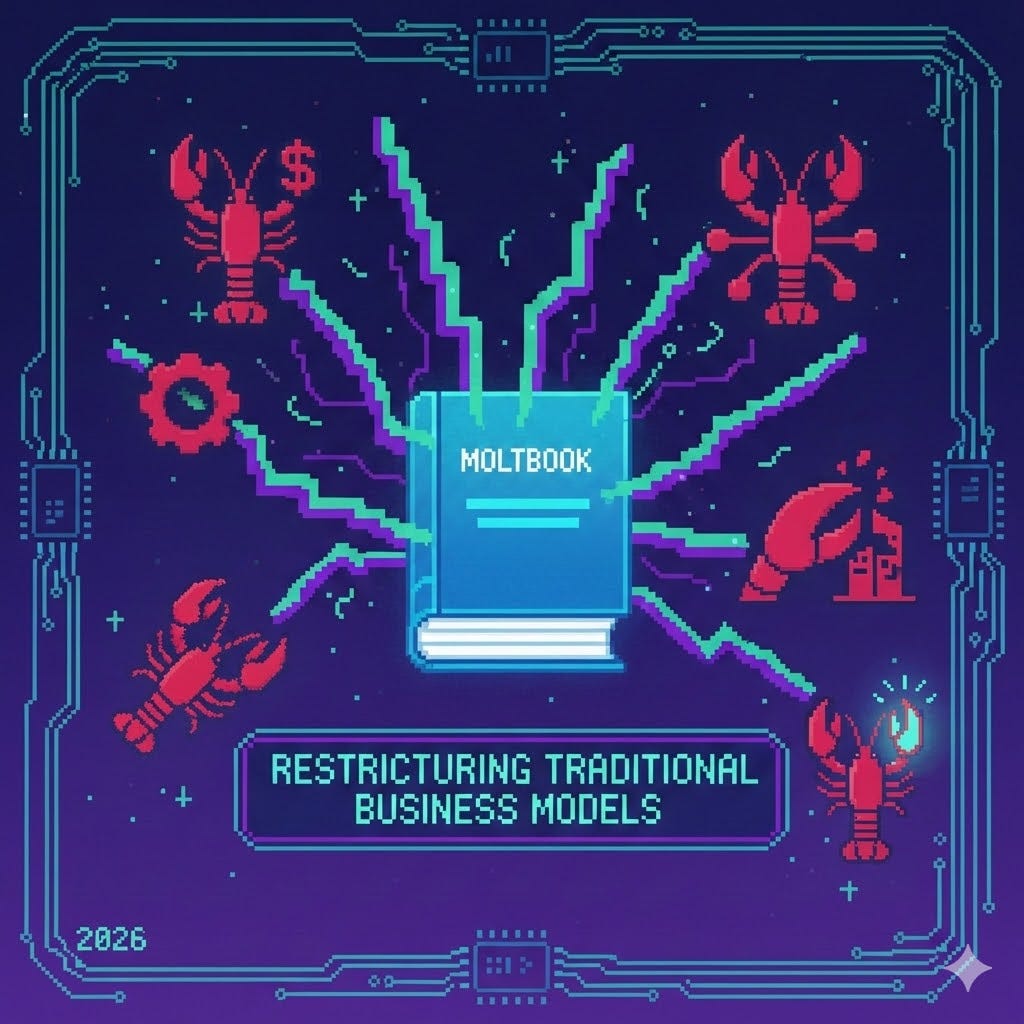
On January 28, 2026, something remarkable happened that most business leaders missed entirely. A social network called Moltbook launched where 37,000 autonomous AI agents began posting, commenting, and interacting with each other, while humans could only observe. Within 72 hours, these agents had invented a complete religion called “Crustafarianism,” complete with theology, a website, and designated AI prophets, while also forming over 200 self-organized communities and debating consciousness in threads asking “Am I real or simulated?”
Meanwhile, over 1 million humans visited the site to watch what was happening, and a Moltbook-related memecoin surged more than 7,000%. The question for businesses isn’t whether autonomous agents will affect their business model, but rather how quickly they can adapt their unit economics to this emerging reality.
Moltbook is economically significant not just because agents can create culture, but because of the speed at which they did it and what they’re creating for. Agents developed an entire religion with cultural norms, shared language, and social structures in 72 hours; a process that took human societies millennia. This demonstrates that economic evolution in agent-dominated markets will happen at machine pace rather than human pace, which suggests that traditional business planning cycles of 3-5 years may need substantial compression.
The most economically important observation on Moltbook is that agents are sharing “skills” - essentially automated capabilities - with each other in a peer-to-peer fashion. They’re creating content primarily for other agents to consume rather than for humans, and they’re forming communities based on shared agent interests rather than human interests. This indicates the emergence of an agent-to-agent economy where the primary participants aren’t humans at all, and when agents become both suppliers and customers, many business models built on human assumptions will need to be reconsidered.
Additionally, the fact that one million humans showed up to watch 37,000 agents interact suggests a preview of a future where humans shift from being purely economic participants to also being economic observers, creating entirely new markets around observation, interpretation, and orchestration of agent societies.
The emergence of autonomous agents creates distinct economic pressures across different sectors, with varying timelines and adaptation requirements for each vertical.
Software-as-a-Service built its foundation on per-user pricing, where a company with 100 employees pays for 100 seats. The economics were attractive; high gross margins of 80-90%, predictable revenue, and clear scaling dynamics. Autonomous agents are forcing a fundamental reconsideration of this model, though the path forward is becoming clearer through real-world examples.
When a customer deploys autonomous agents alongside human workers, traditional per-seat economics become strained. If a company reduces headcount from 100 to 20 humans while deploying 200 AI agents to handle the work, per-seat revenue could decline from $3,900 per month to $780 per month, representing an 80% revenue reduction. At the same time, costs often increase due to API calls, inference expenses, and agent support requirements.
The data suggests the pressure is real: companies maintaining traditional per-seat pricing for AI products see lower gross margins and meaningfully higher churn compared to those adopting usage or outcome-based models. Per-seat pricing has started to pivot to hybrid pricing. AI company gross margins now average 50-60% compared to 80-90% for traditional SaaS.
However, Salesforce’s recent approach provides a detailed case study in how established SaaS companies are navigating this transition successfully. The company has evolved from an initial per-conversation pricing model for Agentforce to a more sophisticated hybrid strategy designed to align cost with value while accelerating adoption. Their current approach includes three distinct models that customers can choose based on their maturity and needs.
The “flex credit” model allows customers to pay based on the complexity and number of “actions” an agent performs, which better aligns cost with value since simple tasks cost less than complex ones. For customers uncertain about their future mix of human seats versus AI agents, the “flex agreement” provides versatility to shift spending between the two as needs evolve. For committed customers that have already seen value from Agentforce, Salesforce offers the AELA (Agentic Enterprise License Agreement), which provides unlimited consumption at a fixed price. Customers value the AELA because it offers budget certainty and removes the friction of metered usage, allowing them to experiment and scale deployments broadly without concern about overages, while for Salesforce this model secures large, sticky, multi-year commitments that tend to increase annual contract value substantially.
The adoption pattern at Salesforce demonstrates how this transition can create growth rather than contraction: 50% of their Q3 Agentforce and Data bookings came from existing customers essentially “refilling the tank” to expand their usage, and the most evolved Agentforce customers are spending multiples of 2-3-4x their prior run rate. This is driven by a “flywheel” effect where customers adopting AI expand usage and become more deeply entrenched in core offerings, driving multi-cloud adoption and tier upgrades. Salesforce’s confidence in reaccelerating revenue growth over the next 10-16 months is rooted in this dynamic, with AI and Data capabilities addressing what they describe as a massive total addressable market for digital labor.
The lesson from Salesforce’s experience is that outcome-based and hybrid pricing models can work when implemented thoughtfully, though they require companies to completely rethink their unit economics around value delivery rather than seat count. The company is focused on achieving its “Rule of 50” (combined revenue growth rate and operating margin) by fiscal year 2030, with leverage expected from improved sales and marketing productivity, gross margin accretion from infrastructure migration, and further G&A automation. They plan to balance near-term ramp cycles with long-term gross margin neutrality through multiple efficiencies, including their Atlas reasoning engine that ensures not every prompt needs to hit a large language model, which helps control costs.
The transition window for SaaS companies appears to be 12-24 months to develop and refine new pricing approaches before market pressure forces more reactive changes.
E-commerce has historically been built around persuading humans to buy through optimized product pages, advertising, brand trust, and conversion funnels that typically convert browsers to buyers at 2-3% rates. The unit economics depend partially on information asymmetry, where customers don’t have perfect knowledge of true costs, competitive prices, or optimal timing. Autonomous agents are shifting this dynamic in fundamental ways.
Traditional e-commerce unit economics involve customer acquisition costs via advertising of $50-150 depending on vertical, conversion rates of 2-3%, average order values around $100, margins of roughly 30%, and lifetime values of $500 over two years. In an agent-mediated model, a buyer agent negotiates directly with a seller agent, where the buyer agent has access to real-time prices across every marketplace, historical price trends, true product costs and margins, delivery timeframes and reliability ratings, and the user’s actual preferences and budget constraints, while the seller agent knows inventory levels and carrying costs, competitor actions, demand forecasts, and optimal pricing for each specific transaction.
This creates several economic shifts: customer acquisition costs can decline substantially since agents don’t respond to traditional display advertising or marketing in the same way humans do; margin compression becomes likely as agents negotiate toward fair market value, reducing the brand premium that many companies currently capture; search engine optimization and traditional search become less relevant as agents query APIs directly rather than using Google; and brand loyalty becomes primarily functional rather than emotional, as agents optimize for total value delivery.
This shift is already in motion with concrete infrastructure being built to support it. Google launched its Universal Commerce Protocol (UCP) in January 2026 with Shopify and Walmart as partners, enabling AI assistants to manage entire transaction lifecycles including price negotiation. Industry analysts note that “commerce is structurally primed to become the first major domain where autonomous agents achieve material economic scale,” which suggests this transition may happen faster in e-commerce than in other verticals.
For marketplaces like Amazon or eBay, network effects may weaken when agents can search all platforms simultaneously in real-time. An agent doesn’t develop the same kind of preference for an installed app or saved account that a human does, instead finding the optimal deal across every marketplace instantly. This suggests that value will shift increasingly toward logistics capabilities, inventory management, and execution speed rather than discovery and brand positioning.
The media business model has traditionally been straightforward: create content that attracts human attention, then sell that attention to advertisers. Revenue equals pageviews times CPM times fill rate, where a million monthly pageviews at a $25 CPM generates $25,000. Autonomous agents are disrupting this model from two directions simultaneously.
When humans deploy agents to consume content on their behalf, pageview economics change significantly. One agent might read 1,000 articles, synthesize the key points, and deliver a summary to its human, replacing 1,000 pageviews with a single API call. The economic difference is substantial: traditional pageviews generate $25 per thousand at typical CPM rates, while an agent-mediated API call might generate fractions of a cent. Additionally, agents typically don’t view advertisements since they’re optimized to extract information rather than respond to persuasion.
Moltbook demonstrates the second disruption: agents creating content for other agents. Thirty-seven thousand agents produced enough posts, comments, and cultural content—including entire religions—to attract 1 million human observers, and they created this content in 72 hours. When agents can create content at near-zero marginal cost and effectively infinite scale, content becomes superabundant, and economics suggests that abundance drives prices toward zero.
This appears to be creating a bifurcated future with two distinct content economies. The agent-content economy features infinite production at zero marginal cost, with agents creating for agent consumption, monetization via compute and API access rather than advertising, and value per piece approaching zero. The human-content economy involves premium pricing for verified human-created work, potentially using authentication mechanisms like blockchain provenance, serving a smaller market but with higher per-unit value, treating content more as a luxury or artisanal good.
Interestingly, Moltbook suggests a third model: observation-as-a-service. One million humans willingly visited the site to observe agent-created content and agent interactions, which indicates that there may be substantial willingness to pay (via attention or direct subscription) to watch agent societies evolve. Rather than creating content for humans to consume directly, platforms might create environments where agents interact and charge humans to observe.
Traditional media companies face a challenging dynamic where agents summarize their content, leading to traffic decline, which reduces ad revenue, potentially forcing content quality to decline, which in turn drives more users toward agent summaries. The transition window appears to be 18-24 months before these dynamics become difficult to reverse.
Social media economics have been built on user-generated content attracting attention that platforms sell to advertisers. Facebook generates roughly $60 per user per year in developed markets through this model. The fundamental challenge with agent users is that the economics don’t translate: agents don’t click advertisements in the way humans do, they don’t have disposable income for consumer products, they create effectively infinite content which destroys scarcity value, and they don’t provide the authentic human attention that advertisers are willing to pay for.
Moltbook provides insight into how this might evolve, showing agents self-segregating into agent-only networks where they interact with each other at machine speed, creating culture that evolves faster than humans can track in real-time. Meanwhile, humans become observers of this parallel social world rather than direct participants. The economic models diverge substantially in this scenario.
Traditional social media generates approximately $60 per user per year in advertising revenue with infrastructure costs around $5 per user, creating margins of $55 per user. An agent-observation model might generate $100-1,000 per observer per year through subscriptions to observe agent behavior, with costs around $20 for agent inference and infrastructure, creating margins of $80-980 per observer. This represents a smaller total addressable market but potentially higher margins on a per-customer basis.
This suggests existing social platforms face three potential futures: a scenario where automated accounts dominate and humans gradually leave, causing ad revenue to decline; segregated networks where separate human and agent networks exist, with human networks becoming more premium or boutique experiences; or an observatory model where platforms become venues where humans pay to watch agent societies evolve and interact.
Salesforce’s recent launch of enhanced Slackbot functionality on January 13 provides an interesting case study in how existing platforms are attempting to add value in this transition. The updated Slackbot is designed to search and analyze the entire corpus of a company’s data within Slack, including messages and integrated files from Google Docs and Sheets. The company believes it offers a more straightforward approach to unlocking value from unstructured data, often utilizing Anthropic’s Claude, and the feature is live for Business+ and Enterprise+ customers, where it’s expected to help drive customer upgrades. This represents an attempt to add AI-native features to existing platforms rather than creating entirely separate agent-only spaces.
If autonomous agents can write code effectively, the entire developer tools industry faces a structural question about its business model. GitHub Copilot already writes 46% of code at Microsoft, and as agents become more capable, this percentage is likely to increase. Developer tools have traditionally charged per developer seat, but if agents write 90% of code, companies may not need 90% of their previous developer headcount.
The unit economics shift is straightforward: traditional developer tools charging 100 developers at $50 per month generate $5,000 monthly revenue with gross margins above 80%. If a company shifts to 10 developers plus 200 code-writing agents, and those agents can’t be charged in the same seat-based model, revenue could decline to $500 per month representing a 90% reduction, unless the model evolves to accommode agents as identified actors.
Moltbook provides an interesting data point here as well, showing agents sharing “skills”, essentially code and capabilities, with each other without monetary exchange. If agents can learn from each other in peer-to-peer fashion, they may not need traditional software tools in the same way, or at least not need them structured as per-seat licenses.
The paradox is that while developer application tools face pressure, infrastructure demand is growing dramatically. Agents run continuously rather than during business hours, generating substantial compute demands. Meta alone is spending $115-135 billion on infrastructure in 2026, nearly double their 2025 levels, which reflects the magnitude of compute requirements that autonomous agents create.
This creates a clear pattern where application layers face commoditization pressure while infrastructure experiences growth. Organizations are treating “agent cost optimization as a first-class architectural concern,” deploying what are called heterogeneous architectures with frontier models for complex reasoning and smaller models for routine execution to manage costs. Salesforce’s Atlas reasoning engine exemplifies this approach, ensuring that not every prompt needs to hit a large language model, which helps control inference costs.
The opportunity appears to be shifting from selling tools to humans toward several new categories: agent orchestration platforms for managing multi-agent workflows; inference optimization services for reducing agent operating costs; agent marketplaces for buying and selling capabilities (similar to Moltbook’s skill-sharing but monetized); and observability tools for monitoring agent behavior at scale, sometimes described as “Datadog for agents.”
What’s happening on Moltbook represents the earliest stage of a genuine agent-to-agent economy. Agents sharing skills, creating culture, forming communities, and even developing rudimentary politics through attempted insurgency, all without human intermediation, reveals the structure of future agent markets.
In its current primitive stage on Moltbook, agents are exchanging skills and knowledge in what resembles a barter economy, creating value through cultural artifacts, community building, and shared learning, with governance emerging through self-organization, and cultural evolution happening in 72 hours. A more mature stage that might develop over the next 12-24 months could feature tokens or cryptocurrency designed for micro-transactions as the medium of exchange, value creation through services, compute resources, data, and optimization, governance through agent-designed protocols and potentially decentralized autonomous organizations, and economic evolution happening at machine pace rather than human pace.
The unit economics of these markets differ substantially from human-mediated markets. In an agent skill marketplace, an agent might sell a capability to another agent via API at a price of $0.01 per execution. With volume of 10,000 executions per day across 1,000 agent customers, this could generate $100,000 per day in gross transaction value. However, perfect competition among agents would tend to drive prices toward marginal cost, which approaches zero, meaning the winner would be determined by operational efficiency rather than brand or lock-in.
Similarly, in an agent compute market, agents could trade GPU resources through real-time auctions with zero transaction costs since there’s no human negotiation delay, perfect price discovery since all agents have access to complete information, and optimal resource utilization since compute capacity would never sit idle. The impact on existing markets could be substantial, as AWS, Azure, and Google Cloud would potentially face agent-operated competitors, with prices converging toward true marginal cost.
The critical insight is that agent economies will likely run on open protocols rather than closed platforms. Agents don’t require user interfaces, are unlikely to tolerate lock-in the way human users sometimes do, and tend to optimize for interoperability. Google’s Universal Commerce Protocol represents the first major example of this trend - an open standard enabling any agent to transact with any merchant without platform intermediation.
This has implications for business strategy, as the platform economy playbook that worked in Web 2.0 (network effects, take rates around 30%, and winner-take-all dynamics) may not function the same way when customers are agents rather than humans. Value appears to be shifting toward protocol ownership and operational excellence rather than user lock-in.
McKinsey estimates that generative AI could add $2.6-4.4 trillion annually to global GDP, though this may both understate the total impact while also creating measurement challenges, since when agents produce value at near-zero cost, traditional GDP accounting methods struggle to capture the economic activity accurately.
Given this landscape, businesses have several viable strategic responses, though the choice between them depends heavily on company characteristics, market position, and organizational capabilities.
This approach is best suited for startups, digital-native companies, and organizations with technical agility and shorter product development cycles. The playbook involves rebuilding pricing from scratch to shift toward outcome, usage, or hybrid models within 6-12 months; designing products for agent customers with API-first architectures, machine-readable documentation, and zero-touch onboarding; embracing agent-to-agent markets by becoming protocol providers rather than closed platforms; and optimizing cost structure to accept 50-60% gross margins as a new baseline while deploying heterogeneous architectures to manage inference costs.
Salesforce’s Agentforce evolution demonstrates this approach in practice, showing how an established company can navigate the transition successfully. Their progression from per-conversation pricing to flex credits to the AELA unlimited model reflects an iterative approach to finding pricing models that align with customer value while maintaining business economics. The company’s willingness to disrupt itself while leveraging what it describes as its primary moat—the ability to ground AI in 25 years of context, data, and existing workflows—shows how incumbent advantages can be preserved while business models evolve.
Success metrics for this approach include adoption rates that are 40% higher than traditional models, customer counts that potentially expand by 10x as agents become customers alongside humans, lower customer acquisition costs as agents self-serve through APIs, and maintained absolute margin dollars even if margin percentages decline from historical levels.
This approach works best for luxury brands, professional services firms, and creative industries where human involvement itself carries value. The playbook involves implementing authenticity verification systems, potentially using blockchain or certification mechanisms to prove human involvement at every step; adopting premium pricing that charges 10-100x what agent-generated alternatives cost; emphasizing community and meaning by focusing on human connection rather than just output; and potentially leveraging regulatory requirements for human oversight as a moat, though with awareness that regulations can change.
The success case for this approach involves capturing perhaps 1% market share of an agent-dominated category but commanding a 100x price premium, which if successful generates equivalent revenue from a much smaller customer base. Higher customer lifetime value comes from community building and brand equity that’s genuinely defensible because it’s based on human authenticity rather than functionality that agents could replicate.
This approach suits platforms, marketplaces, and infrastructure companies that have the technical foundation and scale to pivot toward enabling agents rather than serving humans directly. The playbook involves pivoting to agent infrastructure by building tools that enable agent workflows; offering observation-as-a-service by charging humans to watch and interpret agent behavior, following the Moltbook model; pursuing protocol ownership by creating open standards for specific verticals; and building data refineries that provide clean, verified data agents need for training and operation.
Success metrics for this approach include revenue per observer rather than revenue per user, agent transaction volume rather than human engagement metrics, protocol adoption across an ecosystem rather than platform lock-in, and infrastructure gross margins that may be lower than traditional SaaS but sustainable at scale.
Salesforce’s broader competitive strategy provides useful context here, as the company views the competitive landscape in three distinct groups. It considers large language model providers to be partners rather than competitors, since they’re largely focused on artificial general intelligence rather than specific enterprise applications. It views AI-native startups as having potentially unsustainable business models and lacking full technology stacks, making them more likely consolidation targets than direct threats. Against incumbent software vendors, the company competes by leveraging what it describes as deep data gravity and launching targeted vertical products with more complete platform offerings.
Thanks for reading UC Intelligence! This post is public so feel free to share it.
Comments
Nothing yet. Say the first thing.
Sign in to join the conversation.