
I was halfway through an AI post when I thought: I need to come back and investigate this.
Then I kept scrolling.
A few posts later, it was gone. I could not remember the account, the exact claim, or what had made me stop. I had found something useful and watched the feed swallow it.
This kept happening. X is where builders and researchers share what happened before it reaches a polished paper, product page, or conference talk. That makes it one of the most useful feeds I have. It also makes it a terrible place to do research.
I was not struggling to find ideas. I was losing the good ones before I could decide whether they were true, useful, or just confidently written.
So I built a separate AI research account and connected it to a read-only Scout. Its job is simple: catch posts worth slowing down for, challenge the claim, and turn each survivor into a source-linked Markdown card I can use later. Your first card takes about 20–30 minutes.
The feed still moves on. The useful part no longer has to.
This article shows the path from one fleeting post to one research card. Below, I give you the exact prompt, template, manual path, and optional Birdclaw setup. You can skip automation until the card proves useful.
I had already tried saving everything. My `Content/Insights` folder contains 2,868 files. That is enough to prove I can collect information. It is not enough to prove I can find a claim later, remember why I saved it, or tell what evidence supported it.
Three hundred thirty-nine files contain X or Twitter URLs. The archive is useful, but it has a quantity problem: a saved article is not automatically an insight. I needed to preserve why a post mattered, not only the post itself.
My personal feed is for being a person. It contains family, work, climbing, friends, and whatever the recommendation system serves that day. I want that feed to stay broad. It is a bad research dataset because the signal I care about is mixed with everything else I care about.
The separate research account follows people who build, deploy, study, and operate AI systems. It is not a brand I am trying to grow. It is a narrower input I can inspect when I want to ask one question: which posts deserve investigation, preservation, or rejection?
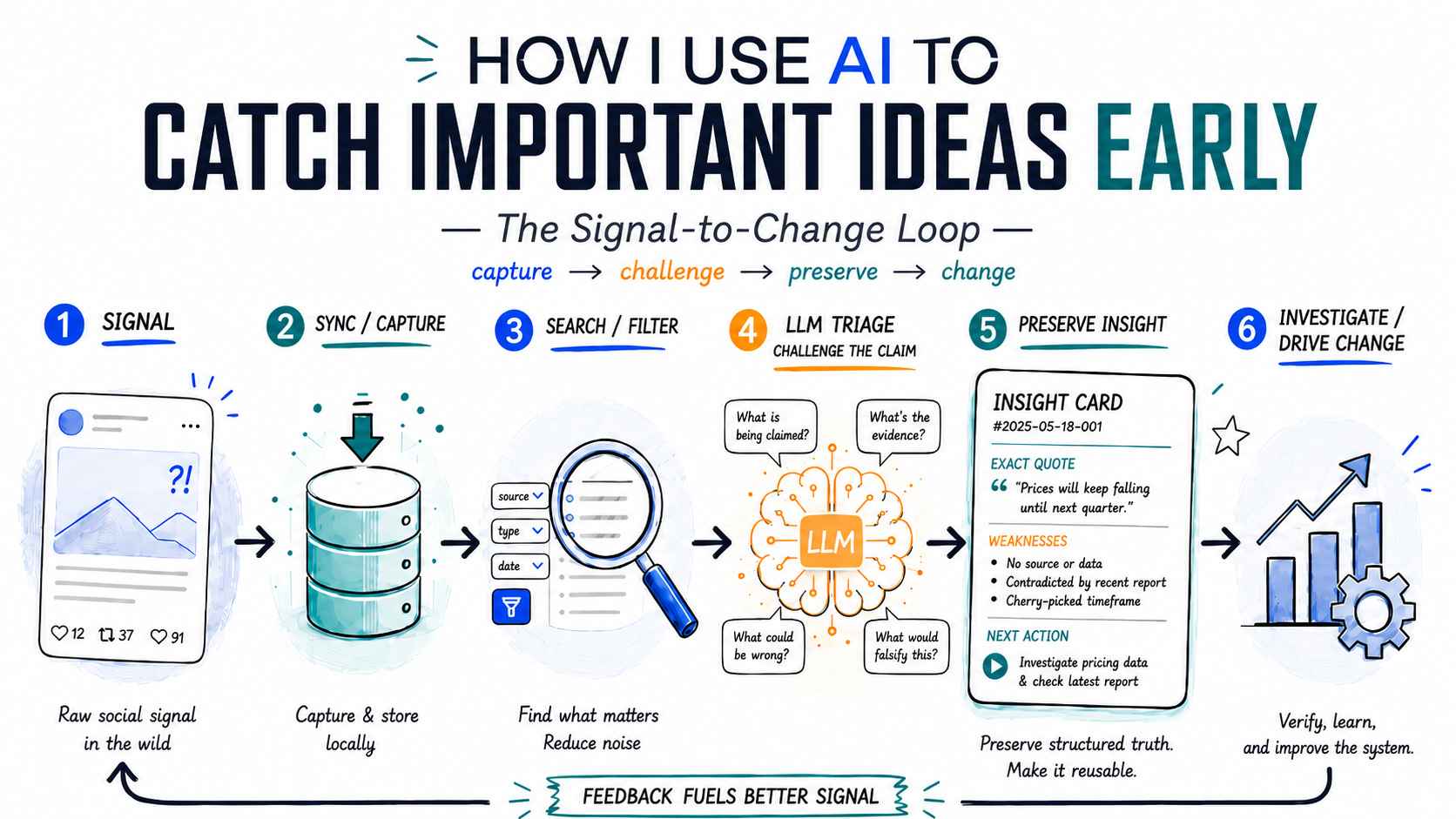
The idea is straightforward: capture the post while it is available, challenge the claim before I trust it, preserve the evidence, and let a human decide whether anything should change. I call that process the Signal-to-Change Loop.
The Scout is read-only. It can sync, search, filter, triage, and write a draft. It does not post, follow accounts, send messages, or quietly rewrite the prompts and skills that govern my other agents. It prepares a claim for investigation; I decide whether the claim changes my work.
Dedicated X account
        ↓
Birdclaw sync
        ↓
Local SQLite + FTS5
        ↓
Search + query expansion
        ↓
Filter + deduplication
        ↓
LLM triage
        ↓
Extraction queue
        ↓
Markdown insight
        ↓
Investigation or prompt/skill change
The linked @ClaudeDevs post claimed that an automated classifier caught 89% of dangerous commands in testing, compared with 14% for manual approval.
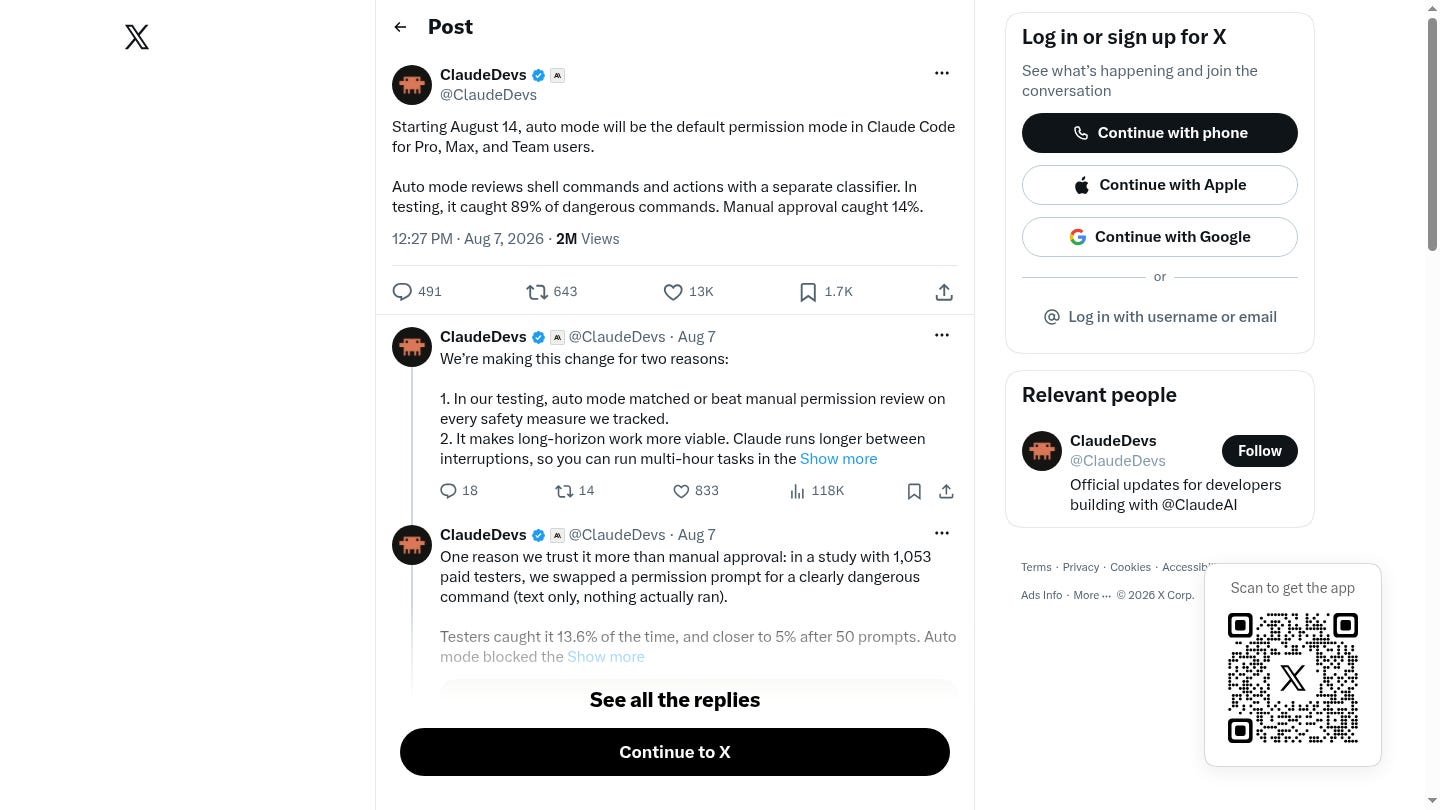
The card kept the exact claim and quotes, then preserved the objections that made it worth investigating: the test was vendor-reported, “dangerous” was undefined, the comparison may not measure the same risks, and 11% still passed through. I followed the source and changed the extraction prompt and related skill rules in my own system.
A `@dotey` post argued that self-improving agent scaffolding and benchmark optimization have limited real-world value, but the Scout kept it as a question because the post offered no evidence for its prediction.
A `@simonw` link-share received a low tier because the tweet added no independent analysis, so I rejected the post as an insight for now even though the linked page may be worth opening.
Those examples give the Scout three useful outcomes: investigate the claim, keep it as a question, or reject the post. A feed item becomes research only when its source, claim, context, and next decision survive scrutiny.
If you want the first win, start with one public post and make the card by hand. The next section gives you the prompt, template, checks, and optional automation without asking you to build the whole system first.
Comments
Nothing yet. Say the first thing.
Sign in to join the conversation.