
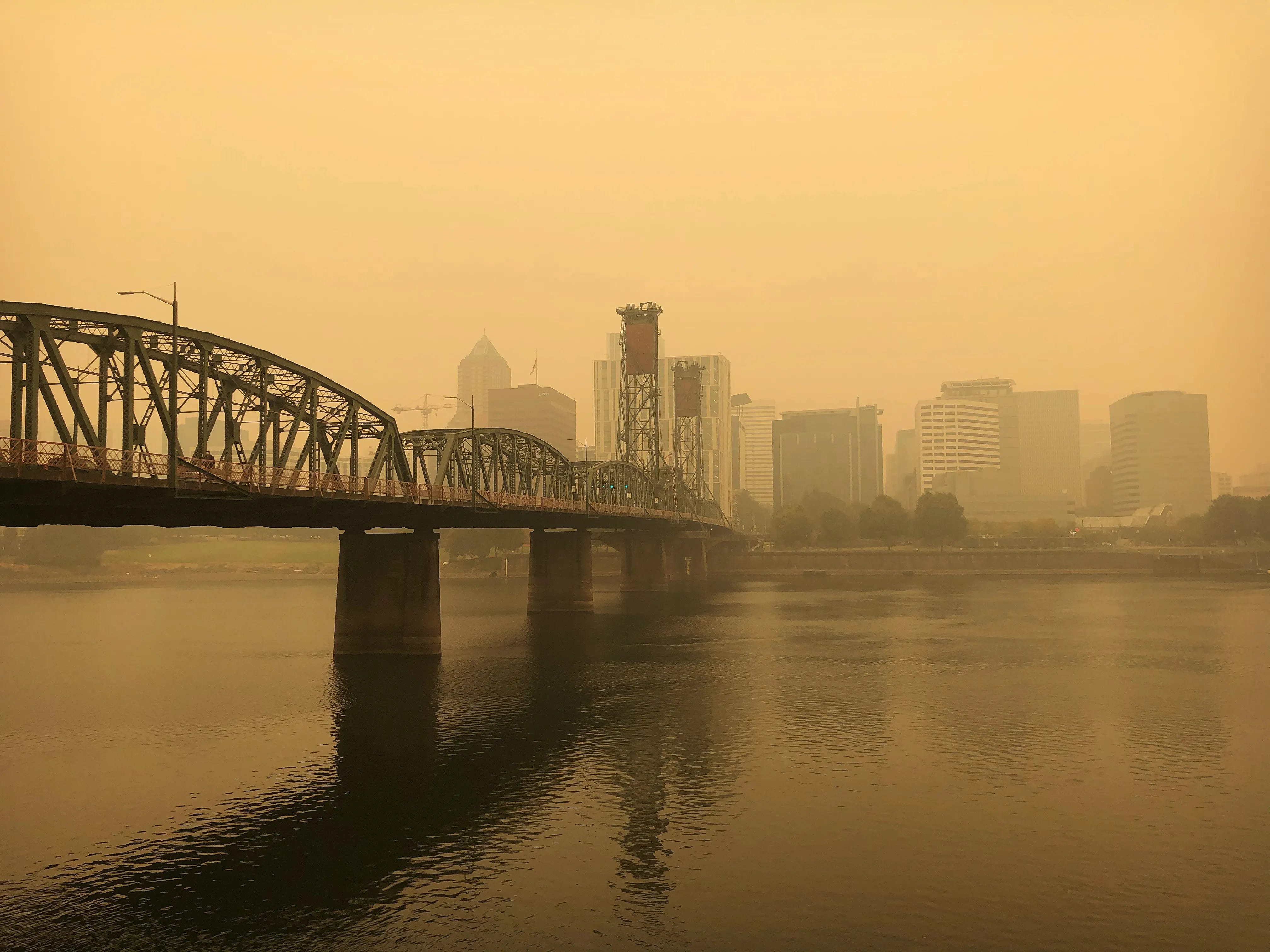
Suddenly he pointed up in surprise. “Whoa, look at the Moon!” he said.
“Um…that’s not the Moon.”
“Oh! Then…what planet is it?”
Seeing as Jacob grew up in Manhattan, I suppose he could be forgiven. What he was pointing at, of course, was the Sun: a pouting electric-orange disc glaring down from the sky. It shed little light, though it wouldn’t go truly dark for another day, when the smoke arrived in force. The temperature had not yet dropped 15 degrees, and the houses just across the street were not yet shrouded behind a thick veil of haze.
Greetings from Portland, OR. Until recently, site of the worst urban air quality on the planet.
It was deceptive, the smoke. You didn’t immediately start coughing or retching the moment you stepped outside. Maybe it’s not so bad. But soon after it arrived, my wife and I noticed a subtle shift: Strange headaches would settle in and linger for hours. Sometimes we’d be short and irritable with each other for no reason. And we were disoriented: Completing simple tasks, already a challenge in the pandemic, felt nearly impossible.
Before the fires, we didn’t leave the house much anyway. When the smoke arrived we’d go whole days without setting foot outdoors, other than to let the dogs out for brief breaks. One afternoon I slunk out to water the vegetable garden wearing a respirator. I’m sure I looked silly, but what else could I do? As it turned out, it hardly mattered: Lacking sunlight, the ground was still damp from the last watering.
Friends from out of town asked how we were doing. Fine, so far as it went: We had a house to live in, food to eat. We had invested in air cleaners a few fire seasons ago; now they ran at full capacity all the time. There’s an air quality monitoring station half a mile from my house, which is a double-edged sword. On the upside, I could access up-to-the-minute information. On the downside I did, and often. For a few days, the reading refused to dip below “Hazardous.” Sometimes it broke 500, supposedly the top of the scale.
Maybe it’s time for a new scale.
The thick smoke that enfolded the city and much of the West Coast felt like a metaphor for what’s happened to us. Ever more emotionally cut off from those with whom we disagree, now we were physically cut off from our friends and neighbors, too. Isolated and atomized, communicating by text and email, if at all.
Those of us who rely on social media heard rumors trailing in the fire’s wake: The blazes were set by antifa, or Proud Boys masquerading as antifa, or BLM activists masquerading as Proud Boys masquerading as antifa. There were plenty of excuses not to recognize the fires for what they were: A choking, toxic wake-up call to the reality of climate change.
Here, too, I am fortunate. I had my own climate awakening a few years ago. Nothing in particular sparked it, other than the recognition that I had been holding back a tidal wave of terror and grief: That my daughter would not have the opportunity to live out a carefree life, that my own slender ambitions might never come to fruition. That we would be engulfed by the violence that already seems barely held in check. Back then, I had spent months gripped by severe anxiety. Once the fires finally arrived, I felt strangely calm, other than obsessively checking to see if the AQI had improved.
It had not improved.
Out there, in the open expanses of runways and hangars, I was astonished by how little could be seen through the viscous air. But it was on the drive home, through the quiet backroads and industrial lots behind the airport, that the magnitude of what we’ve wrought truly hit me.
Out here, the streets are quiet and rarely travelled. There’s little sign of life but for the ranks of semi-mobile vehicles parked or discarded by the side of the road. This is the province of the homeless. Like most American cities, Portland has no idea what to do with these urban refugees, some of whom spill out into backroad intersections and highway overpasses. There, at least, volunteers dispense provisions and water. Here, though, they’re truly abandoned to their own devices.
I rolled by a young woman leaning against a guardrail reading a paperback, an older one staring forlornly out of a soot-stained camper into the smoke-wreathed woods. No one was wearing a mask. Why bother? What use is an N95 against a week of toxic air?
I’ve never cared for the phrase “class warfare.” It always rang a bit too conceptual for me, the kind of thing I’d see blaring from strident posters on college campuses. Now I’m not so sure. As I drove past the ruined cars and moldering trailers with aluminum foil for windows, I thought of something an Egyptian-born friend had said:
“In America there’s no ceiling and no floor. Anyone can rise to the top, regardless of their complete lack of qualifications. But if you stumble, God help you. Because there is nothing and no one to stop your fall.”
I have no illusions about my place in this struggle. I am wealthy enough to own a house and have some savings, though not enough to buy land in Canada—as if that would help. Sooner than later, we will all have to come to grips with this new and rapidly altering landscape. In Portland at least, that reckoning arrived a few days ago, with the smoke.
No posts
Comments
Nothing yet. Say the first thing.
Sign in to join the conversation.