
August 21, 2026
For decades, scientists believed that photoreceptors in the retina relied primarily on neighboring support cells, known as the retinal pigment epithelium (RPE), to remove waste.
While the RPE is still responsible for clearing away the worn-out tips of photoreceptors each day, new findings from the University of Oklahoma reveal that photoreceptors also perform much of their own internal housekeeping.
The study is published in Cell Death & Disease.
“Our study provides the first direct evidence that photoreceptors possess their own internal recycling system that is essential for their survival. Instead of relying solely on the RPE, photoreceptors recycle and break down their own damaged proteins and cellular components using lysosomes, the cell’s recycling centers,” said lead author Raju V.S. Rajala, Ph.D., an OU College of Medicine professor in the Dean McGee Department of Ophthalmology and Department of Biochemistry and Physiology.
Every time people open their eyes, millions of photoreceptors go to work converting light into signals the brain can interpret.
Because these cells are constantly active and require tremendous amounts of energy, they continuously produce damaged proteins and worn-out cellular components that must be removed.
Without an efficient recycling system, this cellular waste builds up, causing the cells to malfunction and eventually die.
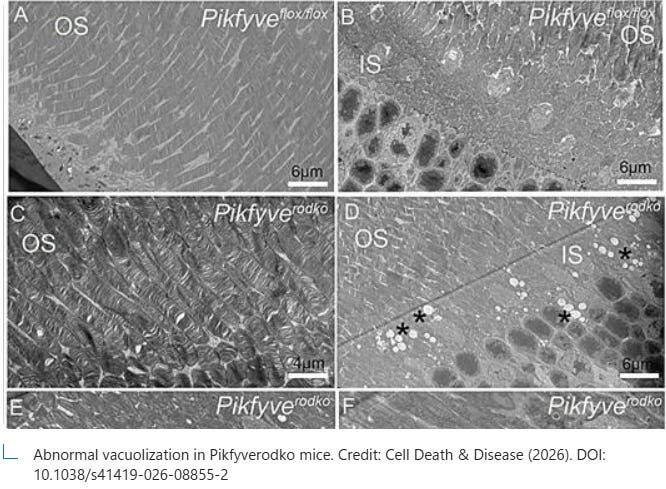
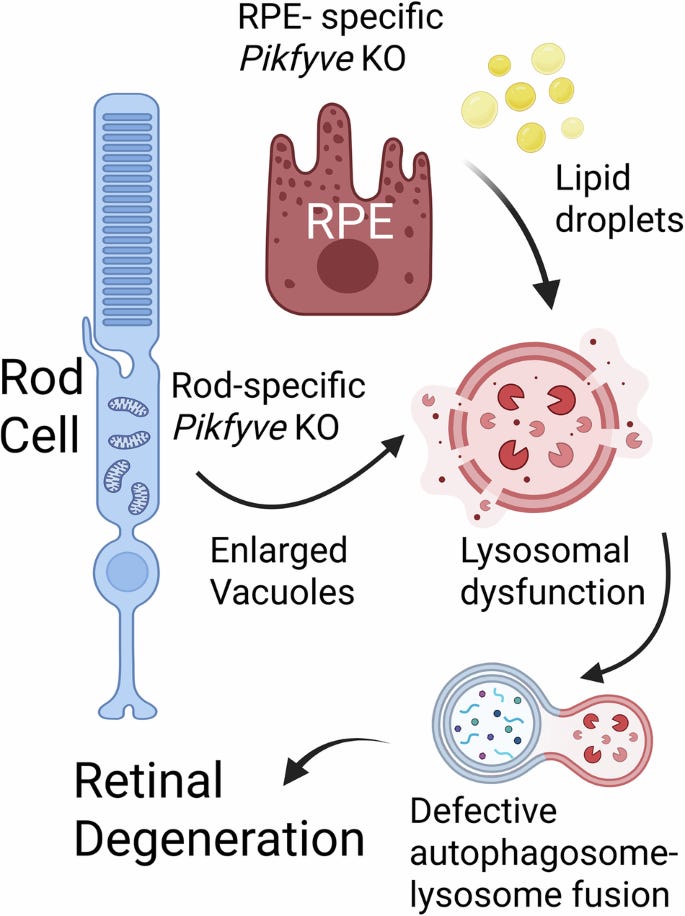
To understand how this process works, researchers removed an enzyme called PIKfyve in mice. Without it, the photoreceptors’ recycling system broke down.
Damaged proteins accumulated inside the cells, and the photoreceptors gradually degenerated, leading to progressive vision loss.
The team also found that PIKfyve is critical for the health of the RPE itself.
When the enzyme was absent, fats and cellular waste accumulated in these support cells, producing changes similar to those seen in age-related macular degeneration, one of the leading causes of vision loss in older adults.
“These discoveries change our understanding of retinal biology,” Rajala said.
“Photoreceptors are not passive cells that depend entirely on the RPE for waste disposal. Instead, they possess an active quality-control system that continuously removes damaged proteins and maintains cellular health.”
The findings may have important implications for many inherited retinal diseases, which are often linked to problems with cells’ ability to clear away damaged proteins.
By identifying PIKfyve as a central regulator of this process, the researchers have uncovered a promising new target for therapies designed to preserve vision before irreversible damage occurs.
The research also raises important safety questions for drug development.
A drug called Apilimod, which blocks PIKfyve, is currently being studied as a potential treatment for autoimmune diseases, certain cancers, neurodegenerative diseases such as amyotrophic lateral sclerosis (ALS), and viral infections such as COVID-19 and Ebola.
While the drug may prove beneficial for those conditions, the new findings suggest that inhibiting PIKfyve could interfere with the retina’s natural recycling system, highlighting the need to carefully evaluate potential effects on vision during future clinical testing, Rajala said.

BOTTOMLINE
Researchers at the University of Oklahoma have identified a previously underappreciated internal “recycling system” in photoreceptors (the light-sensing cells of the retina) that helps keep them healthy and functional.
For decades, the prevailing view held that photoreceptors mainly depend on neighboring retinal pigment epithelium (RPE) support cells to clear waste.
The RPE still daily phagocytoses (engulfs and digests) the worn-out tips of photoreceptor outer segments.
However, the new work shows photoreceptors also perform substantial internal housekeeping: they use their own lysosomes (cellular recycling centers) to break down damaged proteins and other worn-out components.
Photoreceptors are extremely active and energy demanding. They continuously convert light into neural signals, generating damaged proteins and cellular debris in the process.
Without efficient clearance, waste builds up, cells malfunction, and they eventually die—contributing to vision loss.
The study identified PIKfyve, a lipid kinase that synthesizes the signaling lipid phosphatidylinositol 3,5-bisphosphate [PI(3,5)P₂], as a central regulator of endolysosomal (degradative) function in both photoreceptors and RPE cells.
These findings reshape understanding of retinal biology and highlight PIKfyve as a potential therapeutic target.
Enhancing its activity could help preserve vision in inherited retinal diseases involving protein-clearance defects by supporting lysosomal function, protein turnover, and metabolic stability before irreversible damage occurs.
The research also raises safety considerations for drugs that inhibit PIKfyve (such as apilimod, under study for autoimmune conditions, certain cancers, ALS, and some viral infections).
Blocking the enzyme might interfere with the retina’s recycling machinery, so vision effects should be carefully monitored in clinical development.
In short, photoreceptors maintain their own lysosomal recycling machinery (dependent on PIKfyve) alongside RPE support. This dual system is essential for long-term retinal health and offers new avenues for protecting vision.

Your support is crucial in exposing fake news and in helping us defeat mass censorship.
Comments
Nothing yet. Say the first thing.
Sign in to join the conversation.