
AI is redefining which capacity matters, who controls pricing power, and which suppliers deserve to be qualified again.
Over the past two years, the semiconductor narrative has centered on GPUs, HBM, CoWoS, advanced process nodes and high-speed interconnects. By the second half of 2026, however, the resource reallocation triggered by AI is spreading well beyond the highest-end AI components and into conventional DRAM, PCs, smartphones and the broader electronics supply chain.
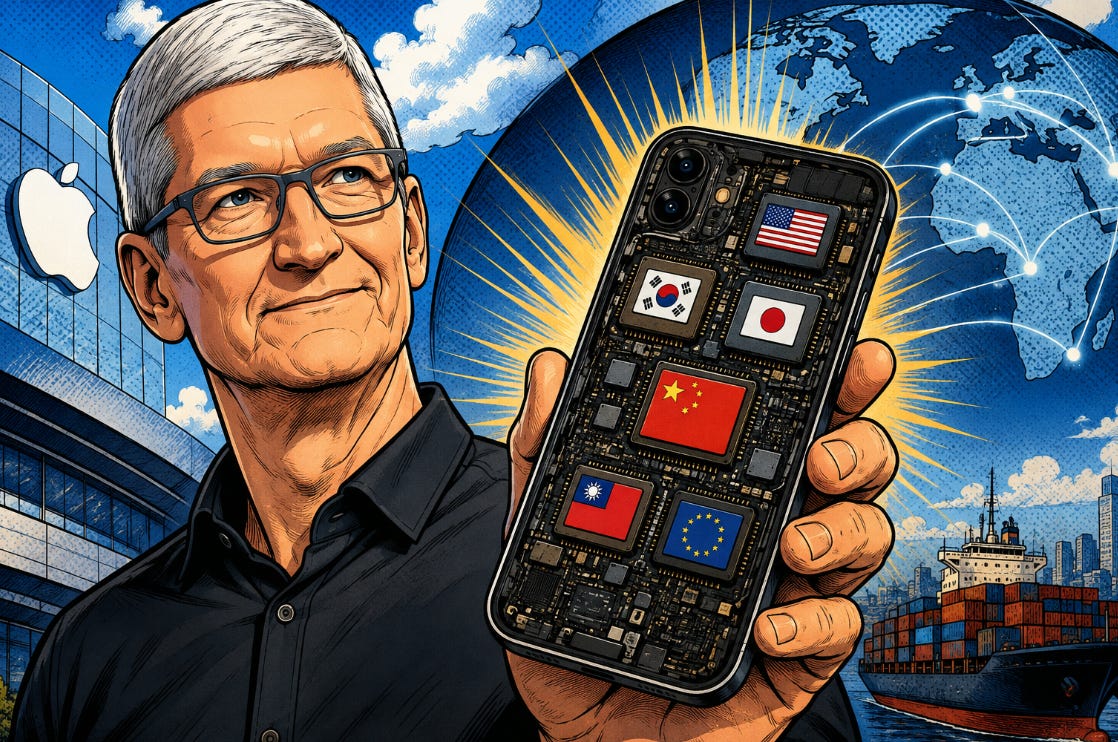
On August 9, The Wall Street Journal reported that Apple has been testing DRAM from China’s ChangXin Memory Technologies, or CXMT, across product lines including iPhones and MacBooks. Apple has also reportedly held preliminary discussions with CXMT over potentially using the memory in devices sold in China. Reuters subsequently reported the story while noting that it had not independently verified the discussions and that neither Apple nor CXMT had publicly commented.
At first glance, this looks like another Apple supply-chain diversification story.
It is much more important than that.
The real signal is that the global DRAM market, long dominated by Samsung Electronics, SK hynix and Micron, is beginning to face a fourth supplier with sufficient scale, product maturity and customer qualification to influence how buyers negotiate.
In other words:
The issue is not how much DRAM Apple will buy from CXMT tomorrow. The issue is how the existence of CXMT changes the pricing behavior of everyone else.
The primary motivation is increasingly about supply certainty rather than simply lower prices.
AI infrastructure is absorbing enormous amounts of HBM, server DRAM and high-value storage. Micron has said that pricing and volume agreements for its entire calendar-2026 HBM supply were already completed, while tight memory supply-demand conditions could extend beyond 2026. SK hynix’s latest results likewise show that HBM, AI-server DRAM and enterprise SSDs have become central drivers of revenue and profitability.
HBM capacity is not directly interchangeable with LPDDR or commodity DDR5 on a one-for-one basis. Nevertheless, the economics of the memory manufacturers have clearly changed.
Capital, engineering resources, wafer allocation and technology migration are increasingly being directed toward products that generate the highest return per wafer.
For Apple and other high-volume OEMs, the procurement question is therefore shifting from:
Who offers the cheapest DRAM?
to:
Who can guarantee the volume I need next year?
That distinction matters.
Interestingly, recent reporting suggests that CXMT is not necessarily competing through aggressive discounting. Under current tight supply conditions, some CXMT memory products have reportedly been priced close to — and in some cases above — comparable products from Samsung, SK hynix and Micron.
That makes Apple’s interest even more revealing.
The strategic value of CXMT may be less about low-cost Chinese DRAM and more about optionality, resilience and procurement leverage.
CXMT itself has also changed.
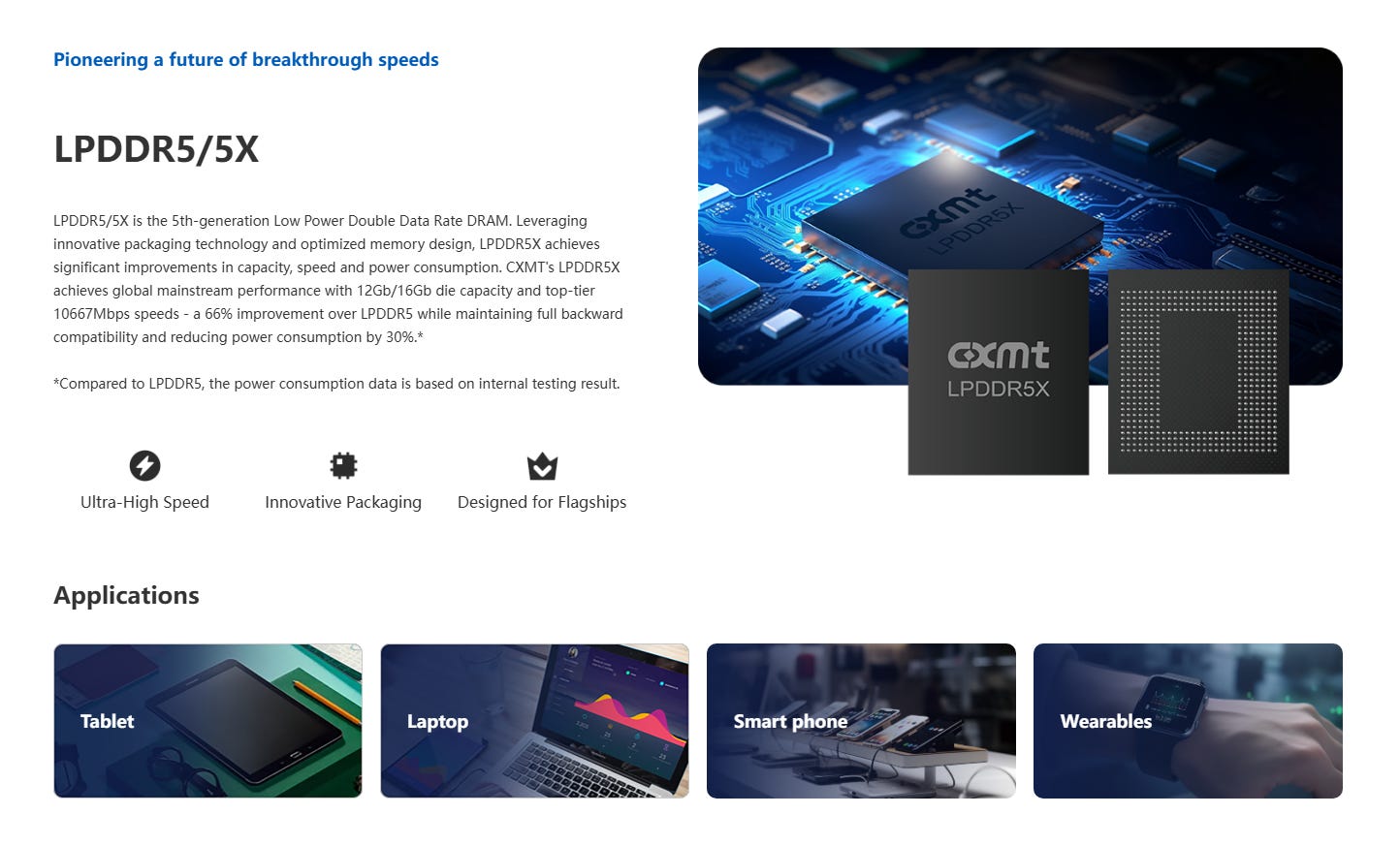
Its IPO prospectus shows a product portfolio that now includes DDR5 and LPDDR5/5X. The company says DDR5 has entered mass production for server and PC applications, while production of its own DDR4 products ceased after the end of 2024 as the company migrated toward newer generations.
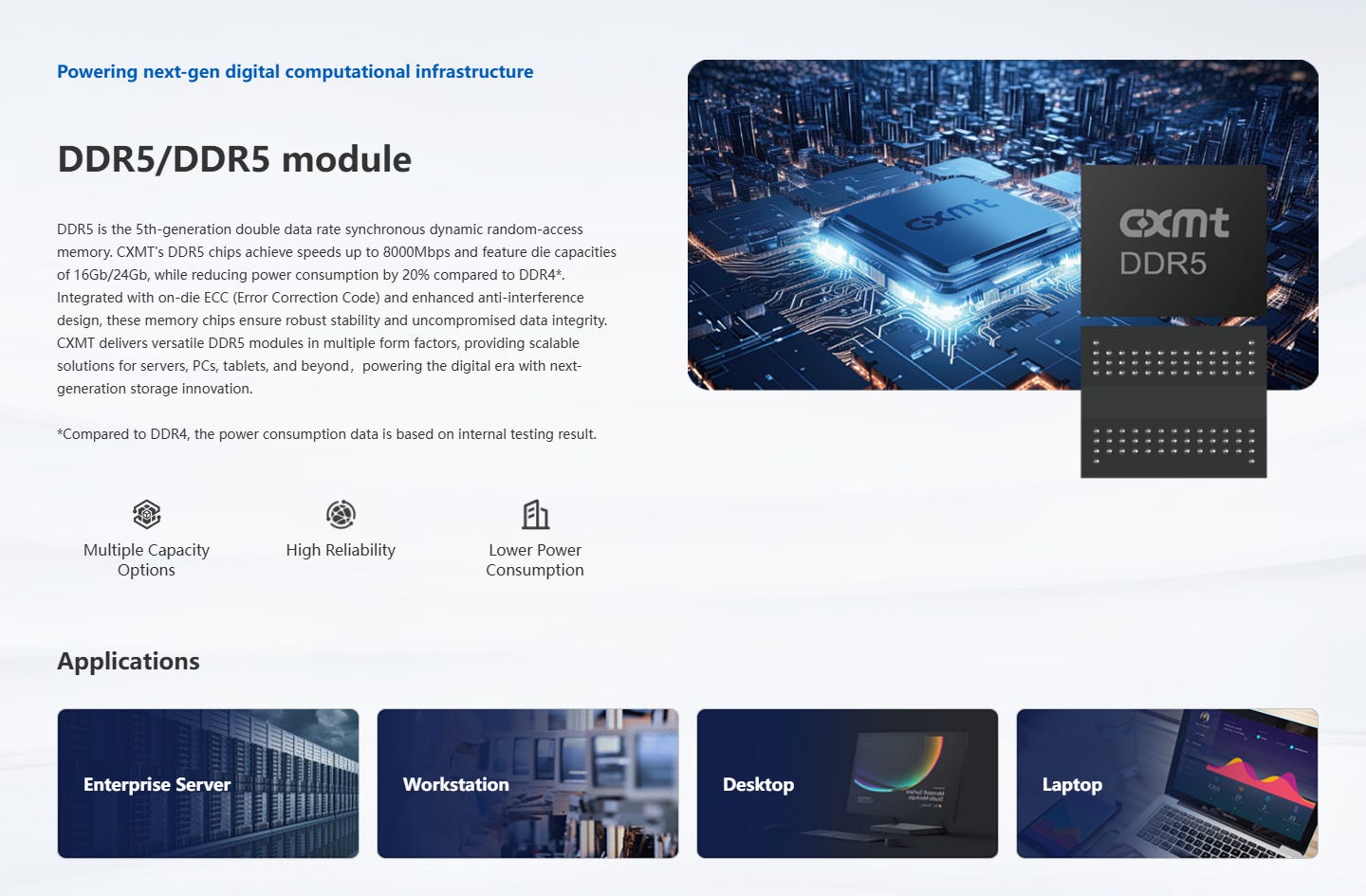
The filing also identifies customers including Alibaba Cloud, ByteDance, Tencent, Lenovo, Xiaomi, Transsion, Honor, OPPO and vivo, and states that LPDDR5, DDR5 and LPDDR5X entered mass production in 2023, 2024 and 2025, respectively.
The question is therefore no longer whether China can manufacture DRAM.
The more relevant question is:
Can a Chinese DRAM producer become a credible member of the qualification pool for Tier-1 global OEMs?
Recent reports suggest that HP, Acer and, according to Nikkei-linked reporting, Asus have already begun limited qualification or adoption of CXMT memory in selected non-U.S. products. Reuters separately reported that HP and Acer were already using CXMT components in products distributed outside the United States.
Apple testing CXMT takes that validation signal one level further.
“Repricing” does not necessarily mean DRAM prices are about to collapse.
A more likely outcome is that the DRAM market becomes increasingly bifurcated.
At the high end are HBM, AI-server DRAM, high-capacity RDIMMs and other data-center memory products. These markets have high technological barriers, long qualification cycles, concentrated customers and buyers willing to pay premiums for bandwidth, capacity and guaranteed supply.
At the other end are PC DDR5, mobile LPDDR and more standardized consumer DRAM products.
These products are more suitable for dual-sourcing and multi-vendor qualification.
That is where CXMT is likely to have the largest impact first.
Recent market data cited by the WSJ put CXMT at roughly 7% of global DRAM revenue in the second quarter of 2026. That remains well below the three incumbents, but it is already large enough to become relevant at the margin in selected regions and product categories.
The strategic objective for Samsung, SK hynix and Micron may therefore increasingly be less about defending every percentage point of DRAM bit share and more about protecting their high-value bit share.
The memory industry is shifting from a pure cost-per-bit competition toward an application-segmentation competition.
The first impact is on the three incumbent DRAM manufacturers.
CXMT is unlikely to disrupt HBM4 or the highest-end AI-memory market in the near term. But if it continues penetrating PCs, smartphones, Chinese servers and regional OEMs, Samsung, SK hynix and Micron may have even stronger incentives to move their product mix toward HBM and premium server memory rather than engage in aggressive commodity-DRAM price competition.
That could create a self-reinforcing cycle:
More incumbent capacity moves toward AI memory → more room opens in standardized DRAM → CXMT expands → incumbents become even more focused on high-value memory.
The second-order impact may appear in packaging and testing.
CXMT’s own prospectus states that chip packaging is outsourced, while final-product testing is conducted primarily internally with some external outsourcing.
This means rising CXMT wafer output should eventually propagate downstream into DRAM packaging, burn-in, test, module assembly and related manufacturing infrastructure.
The CXMT story therefore should not be tracked only through wafer capacity.
The more useful framework is:
wafer → package → test → module → OEM qualification.
Third, CXMT creates a much larger qualification window for China’s domestic semiconductor equipment and materials ecosystem.
DRAM manufacturing is highly sensitive to defect density, uniformity and process stability. Increasing wafer starts drives demand across deposition, etch, cleaning, CMP, thermal processing, metrology, photoresist, slurry, wet chemicals and specialty gases.
However, investors should distinguish between potential beneficiaries and confirmed CXMT suppliers.
The more important structural development is that CXMT provides China’s equipment and materials vendors with a large-scale memory production environment in which they can attempt high-volume manufacturing qualification.
Passing such a qualification is strategically more important than winning a one-off purchase order.
Apple’s CXMT evaluation also points toward a broader shift in electronics manufacturing.
Historically, OEMs tried to standardize one global bill of materials wherever possible.
Geopolitics is pushing the industry toward a different model:
China-market devices → one supplier set
U.S.-market devices → another supplier set
Other markets → multi-source configuration
Memory could increasingly become part of this regionalized BOM architecture.
That creates additional complexity for qualification, traceability, inventory planning and procurement.
But it also gives OEMs greater flexibility.
Taiwan is not home to one of the three dominant global DRAM manufacturers, but it occupies critical positions in ODM manufacturing, servers, PCB, substrates, memory modules, semiconductor testing and system assembly.
That means CXMT’s rise could create both positive and negative effects.
More commodity DRAM supply could reduce component costs and procurement risk for notebook, PC and consumer-electronics manufacturers.
At the same time, if CXMT’s expansion accelerates the development of China’s domestic OSAT, memory-module and electronics ecosystem, some orders historically captured by Taiwanese or other Asian suppliers could gradually be localized.
The key question for Taiwan therefore is not simply:
Can CXMT challenge HBM?
A more useful question is:
Will CXMT’s growth change memory-module sourcing, testing flows, board-level integration and ODM procurement patterns?
TSMC’s July 2026 revenue increased 44.7% year over year, while UMC’s July revenue rose 18.98%. Those numbers should not be interpreted as direct DRAM indicators, but they do show that broader semiconductor and computing demand remains strong. CXMT’s rise is therefore not evidence that the AI cycle is weakening; it is better understood as another spillover effect of the AI-driven redistribution of semiconductor resources.
The Apple-CXMT story also illustrates a deeper structural change.
Historically, semiconductor qualification was primarily an engineering exercise:
Can the supplier meet performance requirements?
Is yield stable?
Does reliability pass?
Is pricing competitive?
Can delivery be guaranteed?
Today there is a second qualification layer:
Geopolitical compliance.
CXMT has been identified by the U.S. Department of Defense under the Section 1260H list of Chinese military companies. However, as of August 11, 2026, CXMT does not appear on the current BIS Entity List. At the same time, U.S. export controls impose extensive restrictions on advanced semiconductor manufacturing equipment, technology and certain support activities involving China.
The distinction is important.
The question facing Apple is no longer simply:
Can CXMT manufacture the DRAM?
It is:
Can CXMT manufacture it, can Apple qualify it, and can Apple politically use it?
That is increasingly the reality of the global semiconductor industry:
Technical qualification + geopolitical qualification.
Apple testing CXMT does not mean Apple is about to replace Samsung, SK hynix or Micron.
CXMT’s scale and available capacity remain limited relative to the incumbents, while advanced HBM has a completely different level of technology, manufacturing and customer-qualification complexity. Recent reporting also suggests CXMT’s current production is already heavily committed, limiting its ability to absorb a major Apple order immediately.
But something more important has changed.
Chinese DRAM has moved from the “Can they make it?” phase into the “Who is willing to use it?” phase.
Once a credible fourth supplier enters an OEM qualification pool, it does not need 30% market share to alter industry behavior.
Even 5%, 7% or 10% can affect how the other 90% is negotiated.
That is the real significance of Apple × CXMT.
AI is simultaneously making premium memory more strategically valuable while creating an opening for new suppliers in standardized DRAM.
The result could be a seemingly contradictory but entirely logical memory market:
HBM becomes more concentrated, more strategic and more expensive, while commodity DRAM becomes more diversified, more regionalized and potentially more competitive.
Apple’s CXMT test is therefore not just another procurement headline.
It is an early signal of how market share, pricing power, capacity allocation and geopolitical segmentation could reshape the global DRAM industry over the next two to three years.
Thanks for reading SEMIVISION @_@! This post is public so feel free to share it.
Comments
Nothing yet. Say the first thing.
Sign in to join the conversation.