
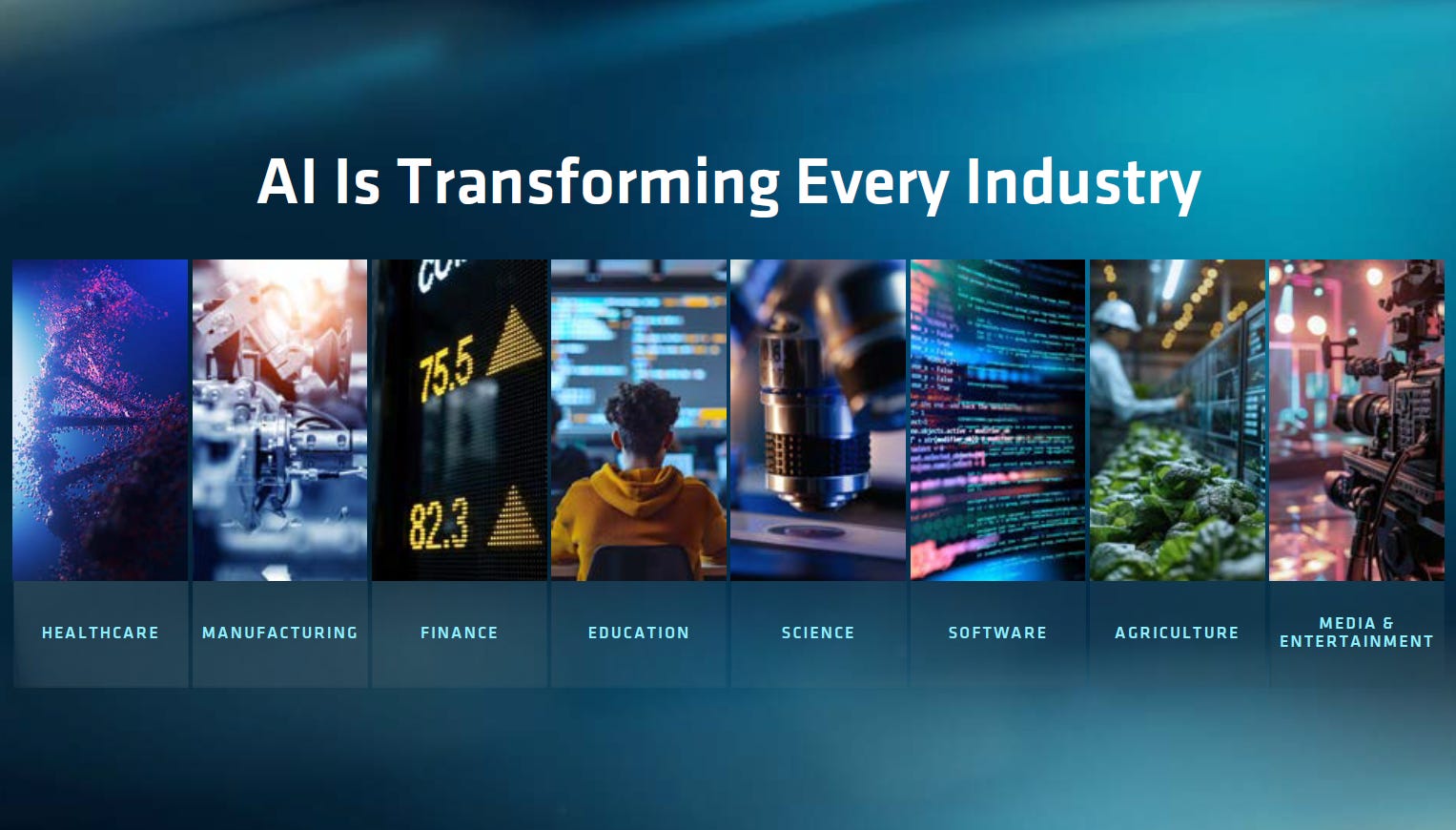
For most of its history, AMD was viewed primarily as a challenger in the CPU and GPU markets. Its competitive identity was built around offering an alternative to Intel in processors and an alternative to NVIDIA in graphics.
That description is no longer sufficient.
At its Advancing AI 2026 event, AMD presented a much broader ambition: to become a full-stack computing company capable of supplying the CPUs, GPUs, networking, software and system architectures required to run artificial intelligence across cloud data centers, enterprise servers, personal computers and autonomous machines.
The key message was not simply that AMD has developed a faster AI accelerator. The company is trying to reposition itself around three strategic pillars:
Compute leadership
Open platforms
AI everywhere.
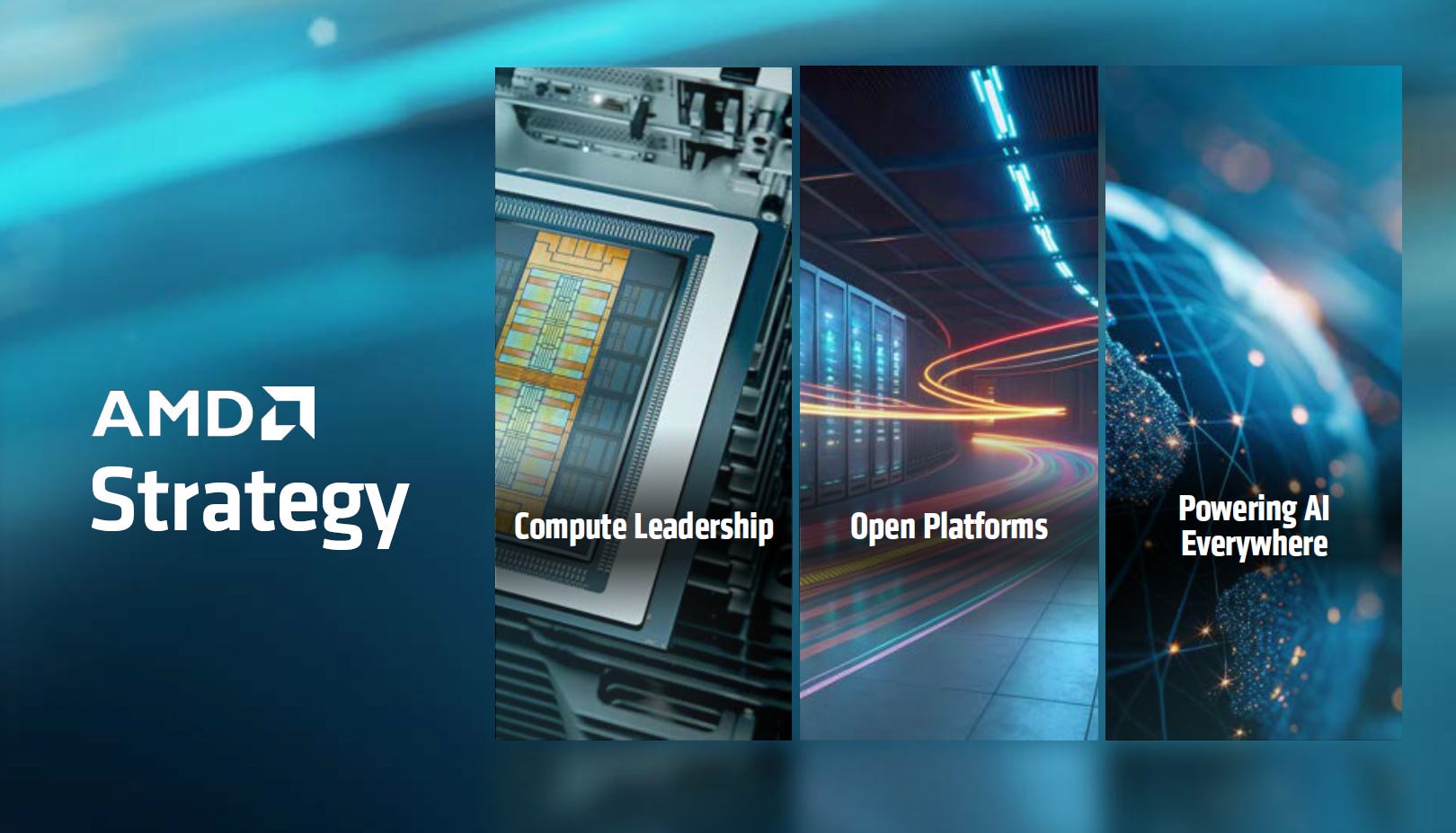
This represents a significant shift. The future competition between AMD and NVIDIA will not be decided by an isolated GPU benchmark. It will increasingly depend on whether AMD can deliver a complete, scalable and developer-friendly infrastructure platform for the agentic AI era.
AMD begins its strategy with a simple observation: AI computing demand is accelerating much faster than the traditional semiconductor market.
According to AMD’s presentation, monthly token consumption increased by approximately 158 times over the previous two years. Meanwhile, the computing power used to train leading models has been increasing at roughly five times per year since 2020.
However, AMD believes that inference—not training—is becoming the largest AI workload.
The company estimates that inference represented approximately 40% of AI workloads in 2024, reached parity with training in 2025 and could account for roughly 60% in 2026. This transition matters because inference is not a single, uniform workload.
Offline research, conversational assistants, coding agents and real-time industrial systems have very different requirements for throughput, latency, memory capacity and cost per token.
Agentic AI further increases infrastructure demand. A conventional chatbot might perform one model request and generate one answer. An AI agent may call multiple models, invoke software tools, create sub-agents, search databases and repeat the reasoning process several times before completing a task.
In other words, one user request can produce dozens—or potentially hundreds—of inference operations.
AMD therefore expects the data-center AI accelerator market to expand from around US$200 billion in 2025 to approximately US$1.4 trillion in 2030, representing a compound annual growth rate above 45%. It also projects the data-center CPU market to grow from approximately US$26 billion to US$220 billion over the same period, driven by AI host servers, agent infrastructure and general-purpose computing.
These forecasts are aggressive, but they explain why AMD is expanding beyond individual processors. The company is preparing for an AI market in which the unit of competition is no longer the chip. It is the entire computing system.
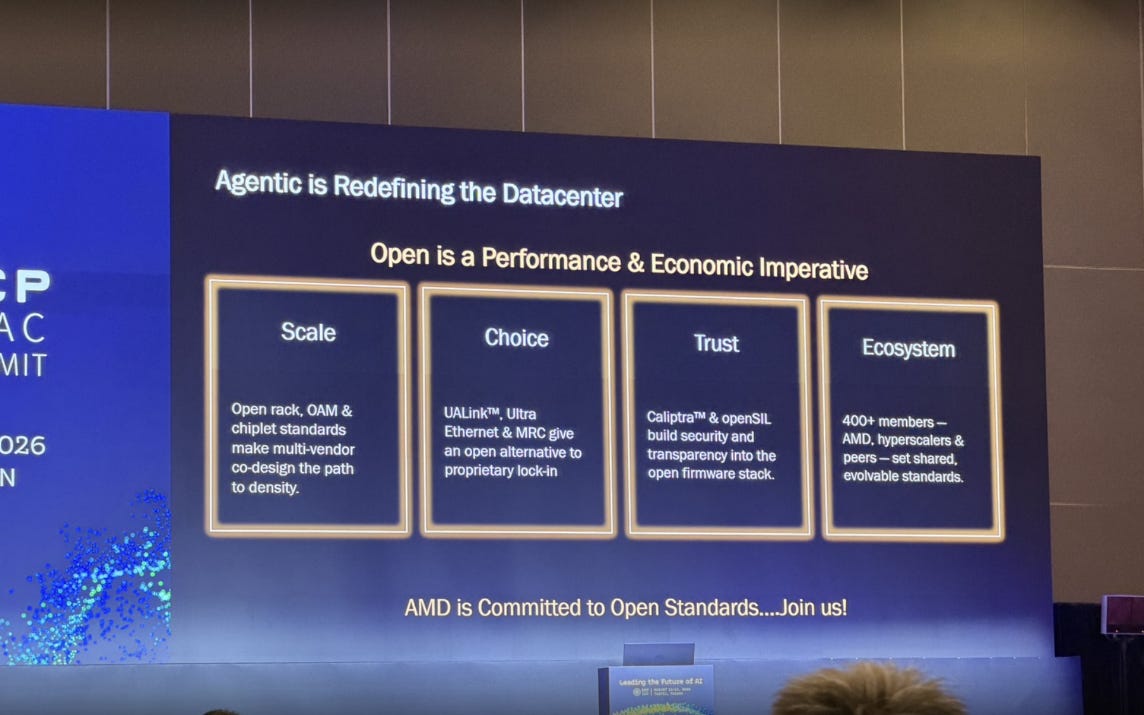
AMD is positioning open standards as a strategic foundation for next-generation AI infrastructure, working closely with the Open Compute Project (OCP) ecosystem. As agentic AI drives larger clusters, higher power density, and increasingly complex networking, no single vendor can optimize the entire data center alone.
AMD’s open approach spans multiple layers. Open Rack, OAM, and chiplet standards enable scalable multi-vendor system design; UALink, Ultra Ethernet, and MRC provide alternatives to proprietary scale-up and scale-out interconnects; while Caliptra and openSIL improve platform security, transparency, and firmware openness.
OCP provides the collaborative framework that makes this possible. With more than 400 members, including hyperscalers, semiconductor companies, system vendors, and infrastructure suppliers, OCP helps transform individual technologies into shared, evolving industry standards.
For AMD, openness is therefore more than philosophy—it is becoming a performance, economic, and ecosystem strategy for the AI data center.
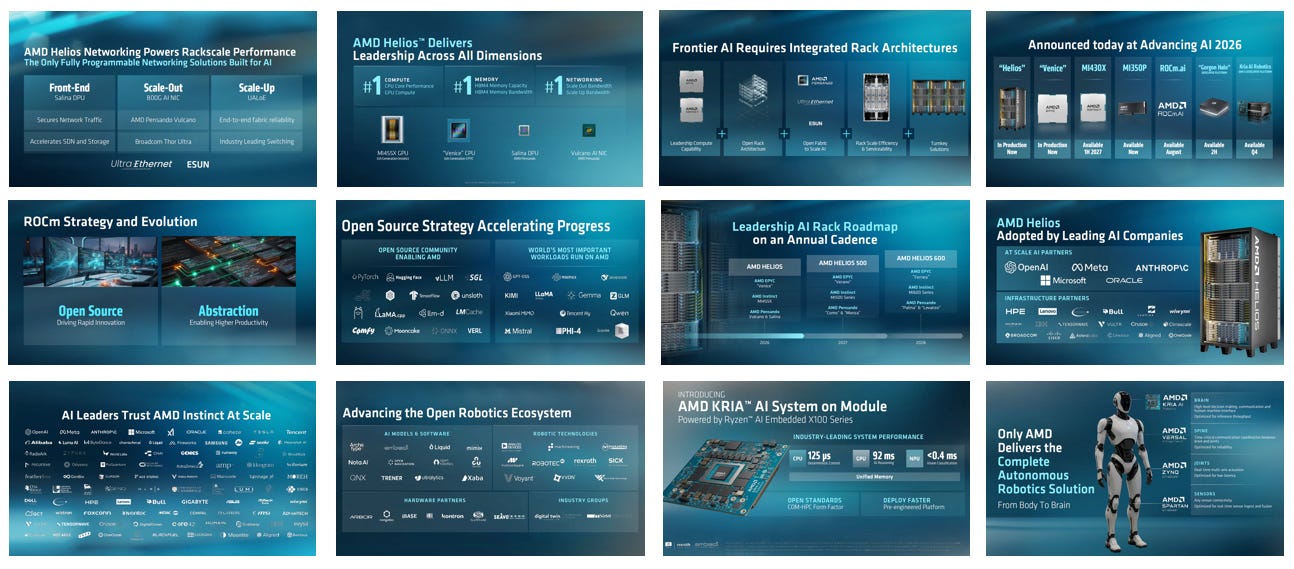
Below we will share:
Comments
Nothing yet. Say the first thing.
Sign in to join the conversation.