
ENERGY SCIENCE
Full-Text Link to Primary Source
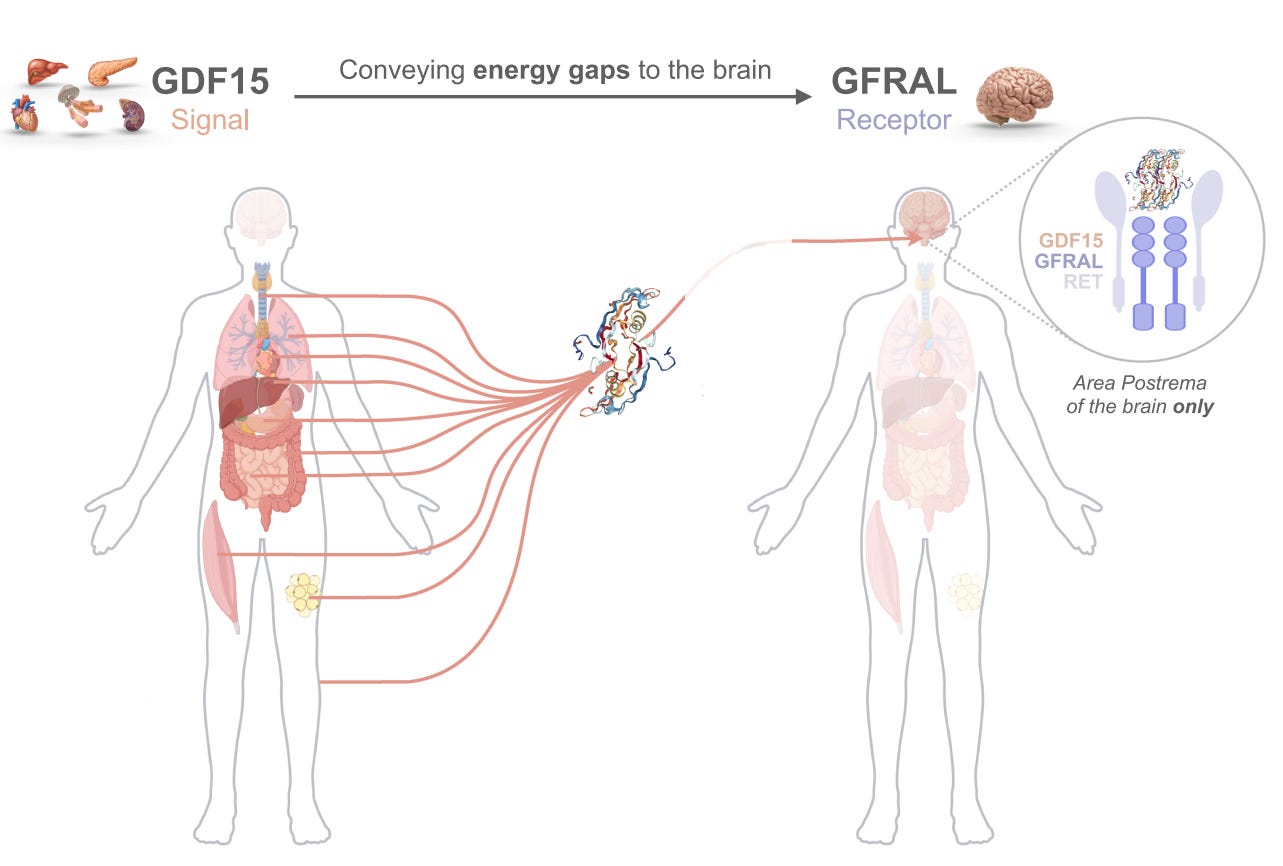
Could the feeling that we are “running out of energy” begin as a biological message from our mitochondria? In this article, we share a new framework that suggests how the body communicates energetic strain to the brain—in part through that the molecular messenger growth differentiation factor 15 (GDF15)—so we can reallocate energy to where it’s needed most.
Being healthy and feeling great isn’t just about having enough of an energy supply. Your cells have to continuously match their energy demands with sufficient capacity to transform nutrients and oxygen into usable energy.
Meanwhile, your brain has the important task of sensing and coordinating processes across the whole organism. That ensures that our limited energy budget is directed where it’s needed most. But what happens when your overall energy demands exceed your body’s ability to transform energy?
How do we perceive when energy resistance creeps up and our cells can’t flow energy fast enough?
In a recent paper, we introduce the concept of mitoception. Mitoception is a framework for understanding how the brain monitors cellular energy strain through GDF15, a stress-related cytokine or hormone. Mitoception connects mitochondrial biology with stress physiology, fatigue, emotion, behavior, disease, healing, and aging.
To keep us alive and healthy, our bodies depend on different kinds of internal sensory signals that allow our brains to recognize and locate threats to our physical well-being. This internal sensory system is called interoception. (There is a great recent book on interoception called Inner Sense.)
For example, when a tissue is damaged, we feel pain. That’s nociception.
Following this naming scheme, we refer to our internal sensory system related to metabolism as metaboception.
Metaboception, or the perception of our metabolic state, describes how our brain monitors and controls energy supply, demand, and transformation capacity.
For example, when there is plenty of food in your gut, your brain must know that. The gut signals the presence of food through GLP-1 and other hormones. And when GLP-1 hits the brain, you feel full.
Metaboception helps you be aware of how much energy is available.
Going one level deeper, mitoception is a more specific part of this metaboceptive system. It involves the brain’s monitoring of the balance between cellular energy demand and the capacity of our mitochondria and metabolic circuitry to transform energy.
In this case, we’re not talking about monitoring whether we have enough energy supply or reserves. There can be plenty of nutrients and oxygen, but a limit to how well or how fast our mitochondria can transform those inputs into usable cellular fuel, like ATP (adenosine triphosphate).
That’s what we call an energy gap.
A more dynamic way of thinking of this is excess energy resistance (éR). Excess energy resistance reflects a mismatch between energy demand and transformation capacity. Problems arise when a cell can’t transform energy quickly or efficiently enough to meet current energy needs.
Energy gaps or excess energy resistance happens when demand rises, like during infection, tissue repair, strenuous exercise, chronic psychosocial stress, or other energy-expensive activities. They also can arise when mitochondrial energy transformation capacity is impaired by inherited defects, toxins, drugs, aging, or other factors.
But how does this kind of mitoceptive communication between your mitochondria and the brain happen?
The more we’ve learnt about the protein GDF15, the clearer it’s become that it is a key player in mitochondrial signaling and health.
GDF15 is a small cytokine secreted by different cells in our body that is often described as metabokine–a metabolically-regulated cytokine.
GDF15 has also been called a mitokine, because it is strongly induced by metabolic stress and mitochondrial disorders. So, even if it doesn’t come from mitochondria directly, it’s a sensitive and specific enough biomarker of mitochondrial defects that some researchers feel it’s earned that name.
Where does GDF15 come from?
The GDF15 gene is expressed across nearly all of our organs and tissues. Except one… the brain. In the brain, GDF15 gene expression is extremely low.
Where does GDF15 signal to?
Only in one organ… the brain. Indeed, the best-characterized GDF15 receptor, GFRAL (glial derived neurotrophic factor receptor alpha-like), is concentrated in a small part of our brainstem. Although we know now that other ways of signaling outside the brain likely do exist.
This area of the brainstem is well-suited for monitoring signals in the blood because there are many blood vessels there with tiny pores that allow larger molecules to pass through. Other areas of the brain are harder for circulating signaling molecules to reach due to tighter regulation of what can pass through those blood vessels.
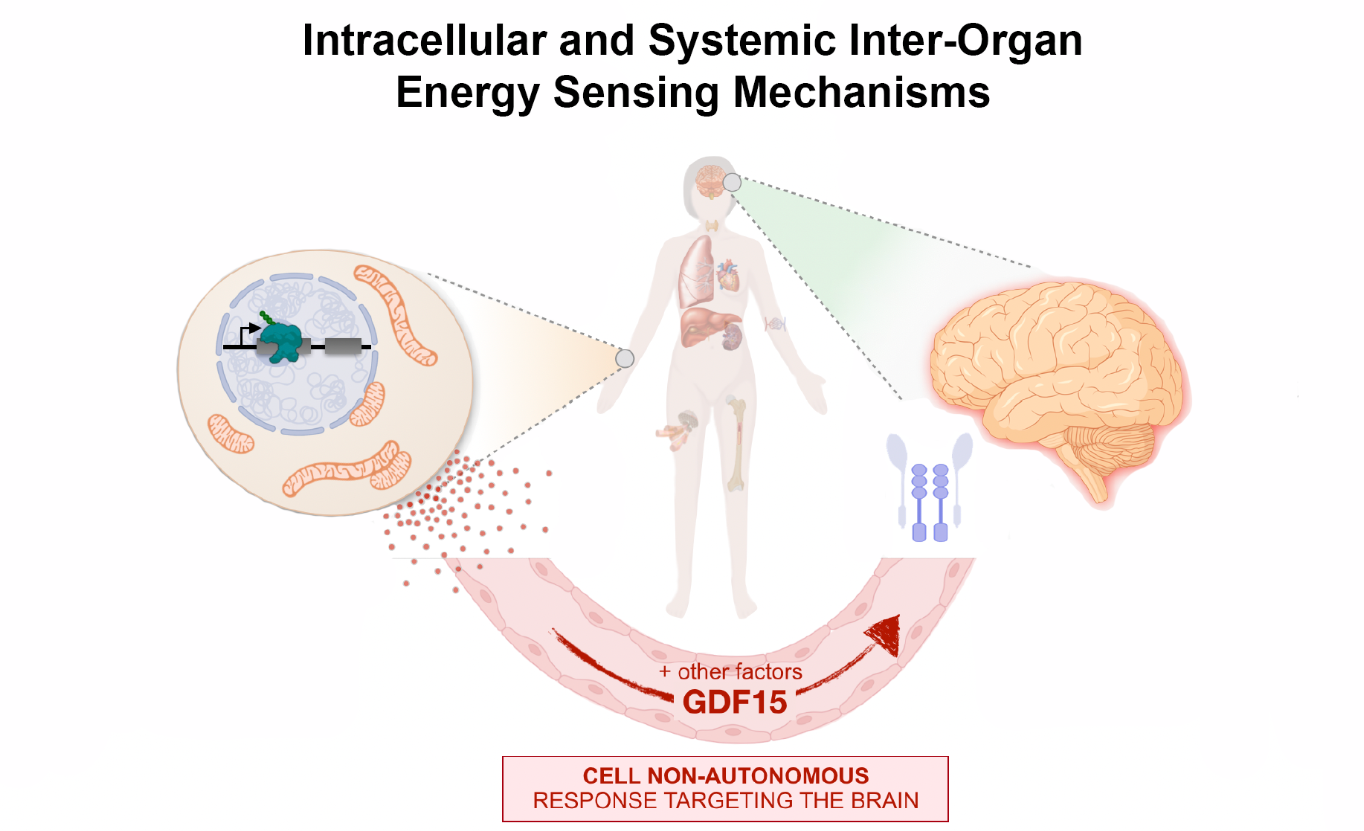
One new concept we introduce in this piece is that any cell can, in theory, act as a metaboceptor: a sensor and signaling agent of metabolic states.
Cells sense local energetic conditions and release GDF15 to signal energy gaps to the rest of the body—to the brain in particular. GDF15 travels through the bloodstream to cells in the brainstem that have GFRAL receptors.
This raises the question: how are energy gaps sensed locally?
Integrating evidence from a decade of research, we show how the cellular sequence of mitoception begins with reductive stress.
When mitochondrial energy transformation capacity is not enough to meet demand, electron flow encounters resistance. With enough resistance, electrons effectively begin to flow backwards. The electrons start to pile up and attach to molecules like NAD+ (nicotinamide adenine dinucleotide), switching them over to their “reduced forms”. That’s why it’s called reductive stress.
An increase in the reduced forms of NAD+ (NADH) activates the integrated stress response (ISR). The ISR is a cellular program that suppresses some expensive activities while activating stress-adaptation genes, including GDF15.
Elevated energy demand → Energy gap → Reductive stress → ISR → GDF15 → Brain
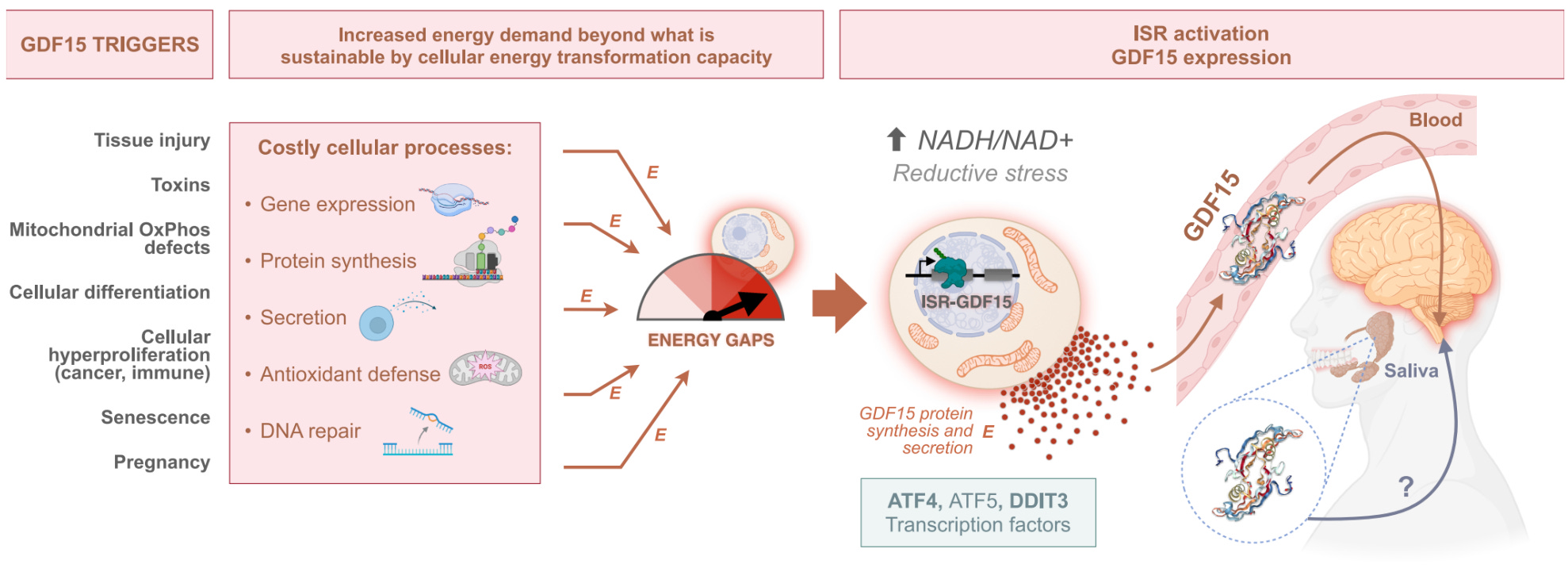
In this body-to-brain component of mitoception, a problem with energy transformation in your cells is converted into a circulating signal the brain can detect.
Let’s go back to our earlier example of tissue damage. When our nociception system detects signals from damaged tissues, the signals travel to our brain. Then, the brain sends a message to our body to take action to protect itself and prevent further damage.
That response typically involves both a subjective experience (pain) and a physical reaction (moving our body in a way to reduce pain).
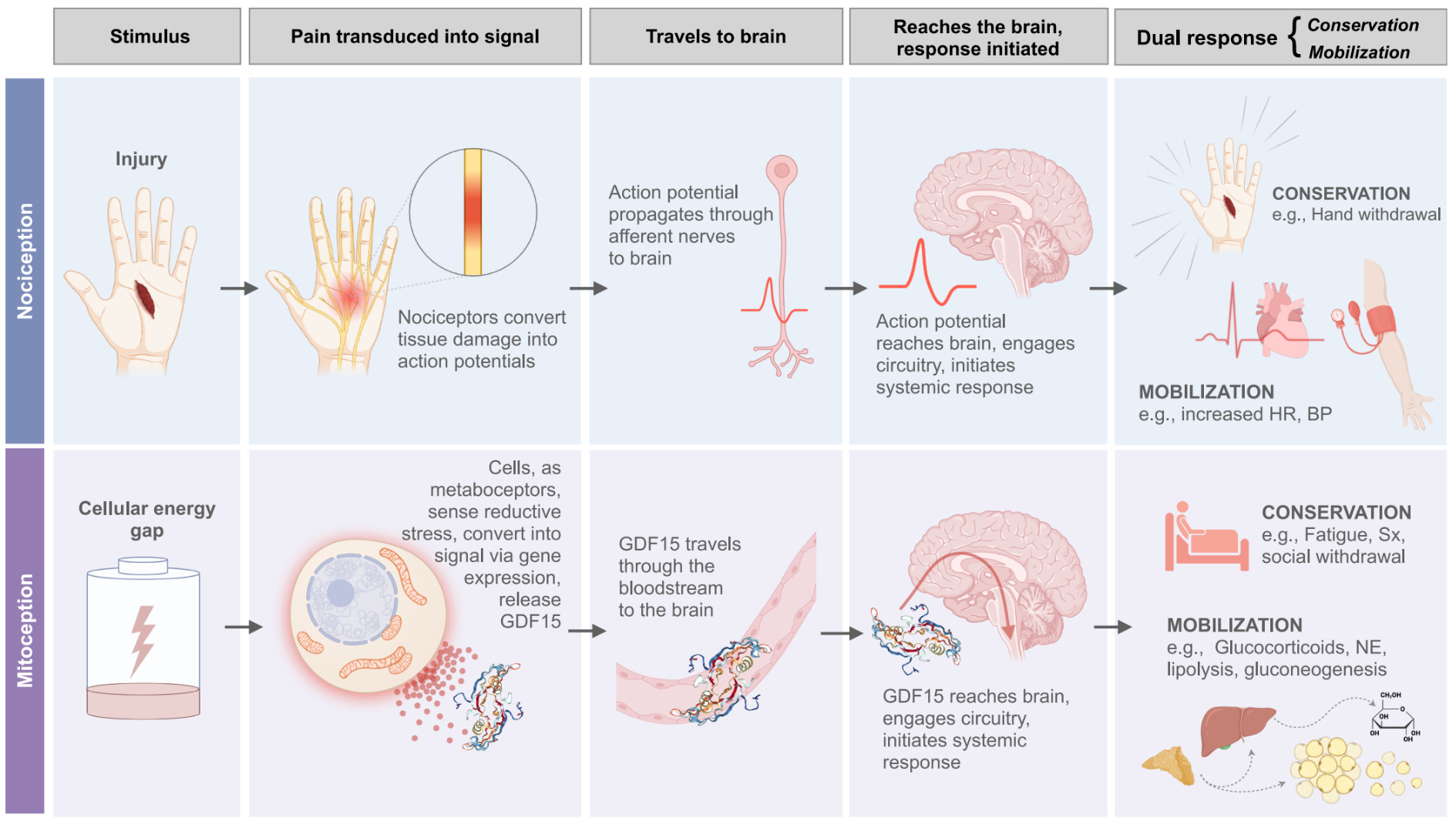
If we apply this to mitoception, an energy gap or excess energy resistance prompts the release of GDF15 from a set of cells, circulating GDF15 travels to the brainstem, and this tells the brain there is a problem with energy transformation somewhere in the body.
Brain sensing of GDF15 triggers two two downstream protective actions: energy mobilization and energy conservation.
Energy mobilization recruits and diverts fuels from some parts of the body to the areas that need it most. Research in mice shows that GDF15 signaling via GFRAL receptors can activate systems that increase circulating glucose and fatty acids. This process promotes fuel delivery to tissues in need.
Energy conservation reduces activities that are energetically costly and not immediately essential. For example, GDF15 reduces appetite and induces nausea. This makes sense because fasting frees up the energetic resources that would normally be spent on seeking and digesting food. And that’s not a trivial amount of energy. Digestion alone makes up about 5-10% of our total daily energy expenses.
So, mitoception in mice triggers an energy-saving and energy-mobilizing state that slows down their behavior, drops their body temperature, and induces various metabolic changes.
In humans, this may be analogous to how shitty we feel when we’re sick. Fatigue. Feeling weak and unmotivated. Or inclined to rest. These feelings reduce our physical, mental, and social activities. That limits energy demand, allowing energy to be redirected toward higher-priority processes.
This does not mean that fatigue is always caused by issues with mitochondrial energy transformation, or that GDF15 is the cause of every experience of low energy. However, fatigue may sometimes be an adaptive, brain-mediated response to signals that your body is approaching its energetic limits.
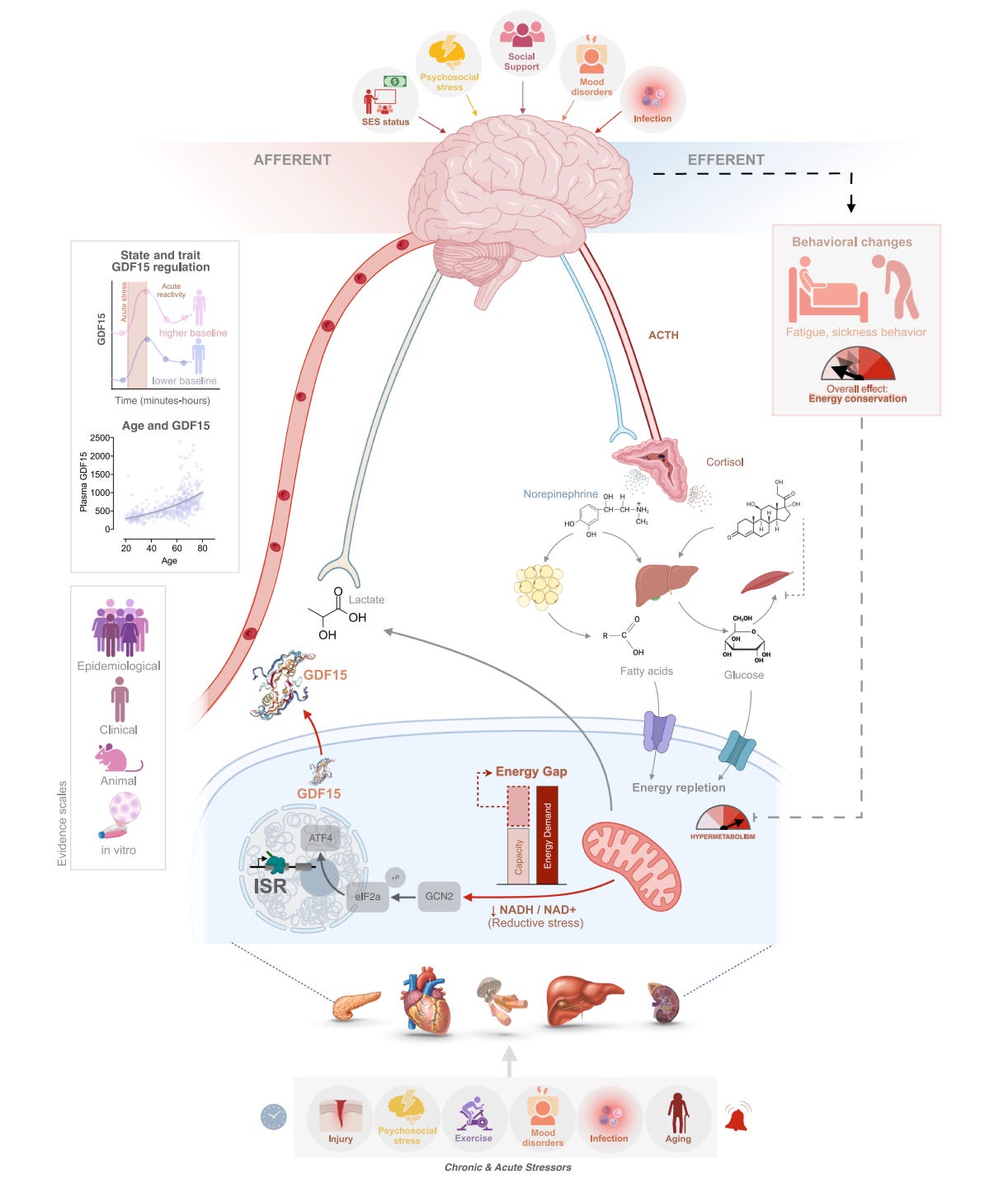
Several studies connect GDF15, health, disease, and the aging process.
For example, people with mitochondrial disease have exceptionally high levels of blood and saliva GDF15—up to 10 times normal levels. We recently found that their physical and mental fatigue correlates with circulating GDF15 levels.
The higher the GDF15, the more fatigue people feel.
GDF15 also rises steeply with age. It has been identified in large proteomic studies as one of the most consistently elevated proteins across many chronic diseases. These include cardiovascular disease, kidney disease, cancer, Alzheimer’s disease, and autoimmune diseases.
Research has also shown that GDF15 can predict who will develop chronic diseases in the future. Even cognitive dysfunction and dementia, within the next 10-20 years, is better predicted with GDF15 than many other protein biomarkers.
New research also links GDF15 to mental health.
Across several studies, blood GDF15 levels were 40-78% higher in people with major depressive disorder, bipolar disorder, or psychosis than in individuals without a psychiatric diagnosis. And in more than 52,000 participants in the UK Biobank, GDF15 was the protein most strongly associated with reported social isolation and loneliness.
GDF15 was also the most upregulated protein in relation to anxiety. Stressing out seems to have an energetic toll on the body.
In line with this, our group also found that acute psychosocial stress increases GDF15.
When we exposed healthy people to an acutely stressful situation that involved giving a speech, blood and saliva GDF15 shot up within 5-10 minutes. These findings suggest that mental stress can produce rapid changes in mitochondrial and metabolic strain.
And work-related stress may also be related to how much a person’s GDF15 levels increase in response to a mental stressor.
The research done to date does not establish that GDF15 directly causes psychiatric illness, loneliness, or fatigue. Age, disease burden, medications, diet, environmental exposures, socioeconomic status, and other factors all converge to influence our energetic state—which we sense through metaboception and mitoception.
The science of GDF15 in general, and the concept of mitoception in particular allows us to see how physical diseases and psychosocial stress may converge on common energetic pathways.
In our mitoception paper, we highlight questions that remain unanswered.
For instance, we need to more clearly define the role of GDF15 as a potential link between psychosocial factors, fatigue, and energetic challenges. To do this, we’ll need large-scale epidemiological studies, long-term observational research, clinical studies that measure GDF15 at time scales of minutes to hours.
Some evidence also suggests that GDF15 biology may be related to sleep, wound healing, and other restorative processes. How do chronic stressors such as loneliness, workplace stress, adversity—which we know can undermine our health—affect mitoceptive signaling?
Do interventions that improve well-being and promote deep rest reduce GDF15 levels?
Measuring and interpreting GDF15 levels comes with some challenges. GDF15 varies with age, may show daily rhythms, rises dramatically during pregnancy, and can be underestimated by some assays in people carrying a common genetic variant. Emerging biosensors, microneedle patches, and other continuous-monitoring technologies could soon provide more precise data on how GDF15 fluctuates over time.
Mitoception offers a different way to interpret fatigue and the states of dis—ease (the lack of ease) we experience in our lives.
It also provides a testable framework that bridges mitochondrial energy transformation, cellular stress signaling, brain activity, and lived experience. It’s helping us understand how the science and experience of energy converges within our cells.
The emerging science of mitoception may help us understand more holistically how the body manages its finite energy budget, and how those decisions shape health and healing across our lives.
Curious about mitochondria and how they move, connect, and support our energy needs? Visit MitoLife to learn more and discover your energetic self through mitochondria.
No posts
Comments
Nothing yet. Say the first thing.
Sign in to join the conversation.