
In June we handed one of our analysts an AI subscription and an empty folder, and watched an hour of prompting rebuild the analytical scaffolding of an institutional research shop, comp tables, valuation grids, risk analytics, etc.
I wrote at the time that the price of looking like an analyst had gone to zero, filed the lesson under what it meant for the research business, and moved on.
That was a mistake.
The same repricing runs underneath the largest capex program in the history of capitalism, and let’s just look at what Microsoft’s CFO said out loud on the January earnings call.
45%.
Amy Hood told analysts that OpenAI accounts for approximately 45% of Microsoft’s $625 billion of commercial remaining performance obligations. Her words, on the record, and they put more than $281 billion of Microsoft’s future on a single customer.
Microsoft is only the biggest example. Alphabet disclosed $467.6 billion of backlog as of 31 March, 99% of it Google Cloud, and weeks later Reuters reported that Anthropic had committed $200 billion over five years to Google’s cloud and chips, a figure equal to more than 40% of the backlog Alphabet had just finished disclosing. Amazon’s $364 billion of long-term obligations excludes, on management’s own description, a newly announced Anthropic commitment worth over $100 billion. Oracle’s RPO leapt to $638 billion without naming a counterparty.
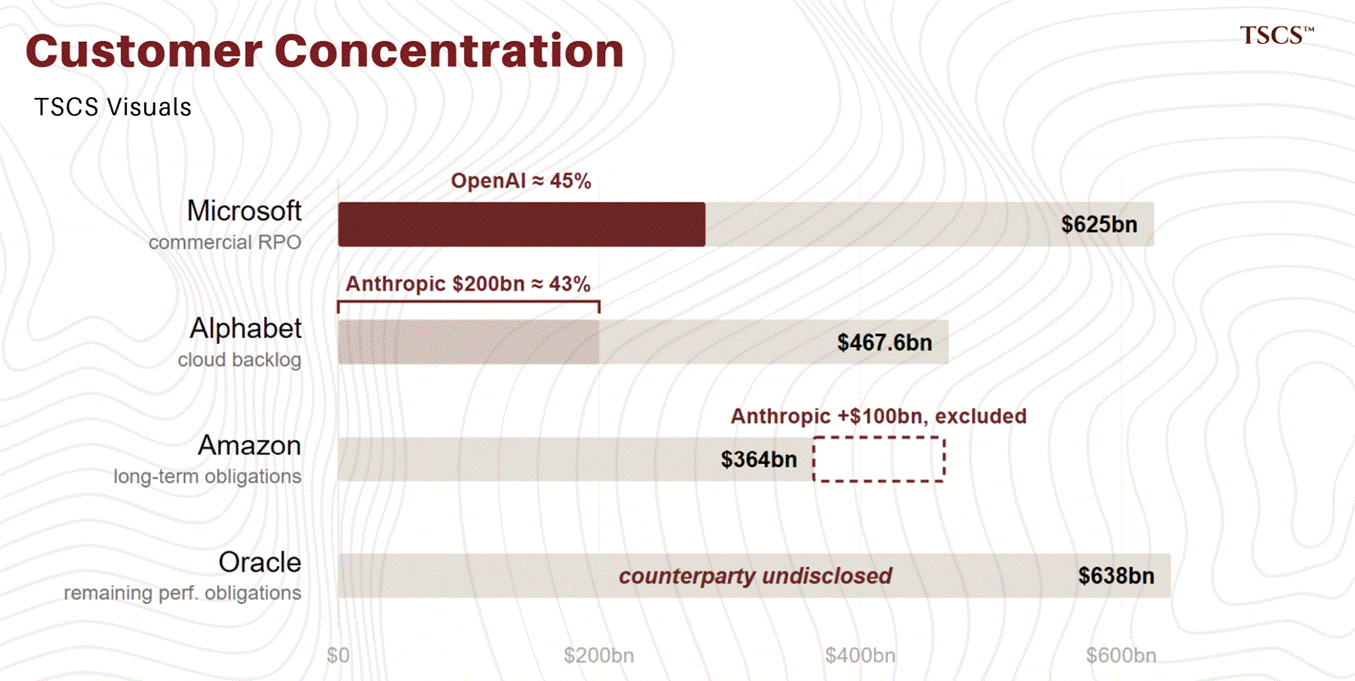
These are different disclosures with different durations and definitions, separate commitments, north of $580 billion from two model companies. Both younger than the iPhone.
So how are they financed? OpenAI closed a $122 billion round in March, reported $5.7 billion of 1st quarter revenue while burning $3.7 billion of cash, and took its first bank loan this month. At that revenue rate, on a static run-rate basis, its reported Microsoft commitment alone is about 12 years of top line, spent on nothing else.
Anthropic raised $95 billion of equity across two rounds this year, reports a $47 billion revenue run rate, and is expanding compute through a $35 billion facility financed by Apollo and Blackstone, alongside reported cloud spending commitments of more than $300 billion, over three times the equity it has raised in a record year.
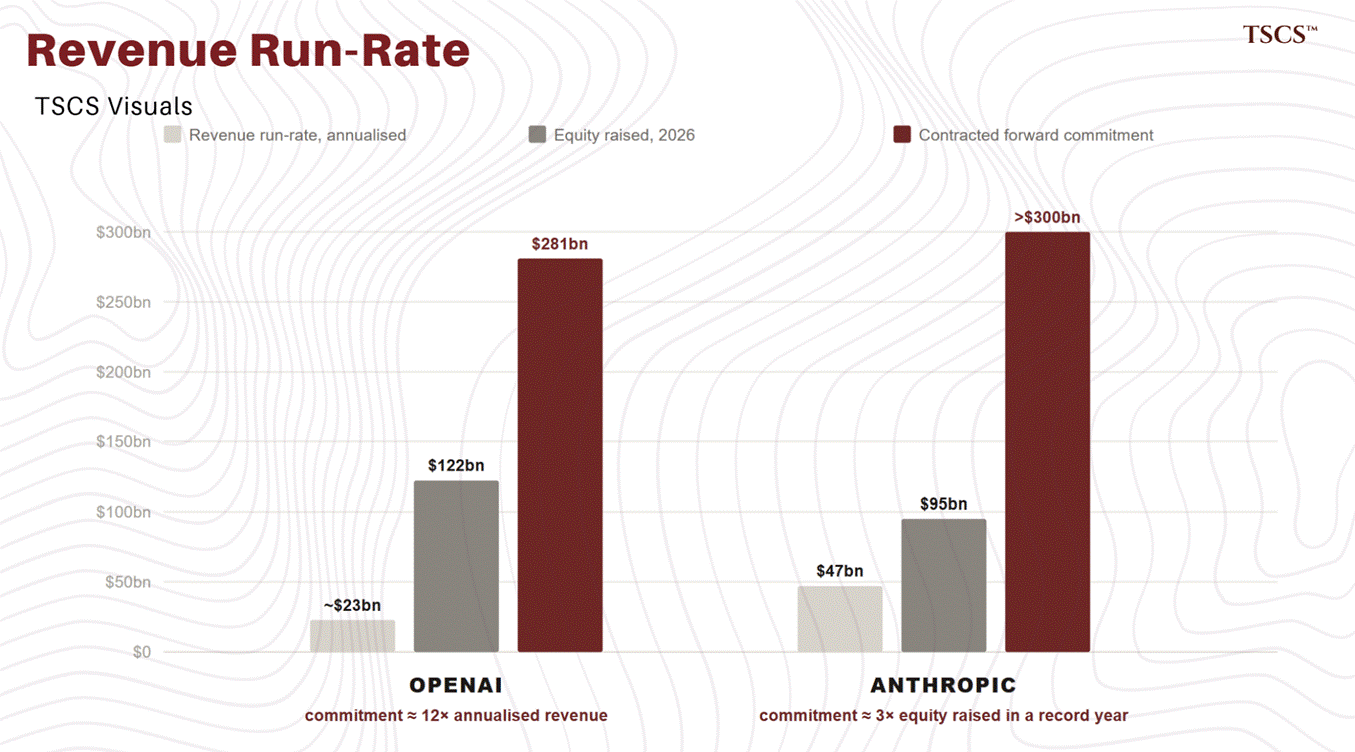
Both fund commitments of this size through the capital markets. The private credit complex is now inside the stack directly.
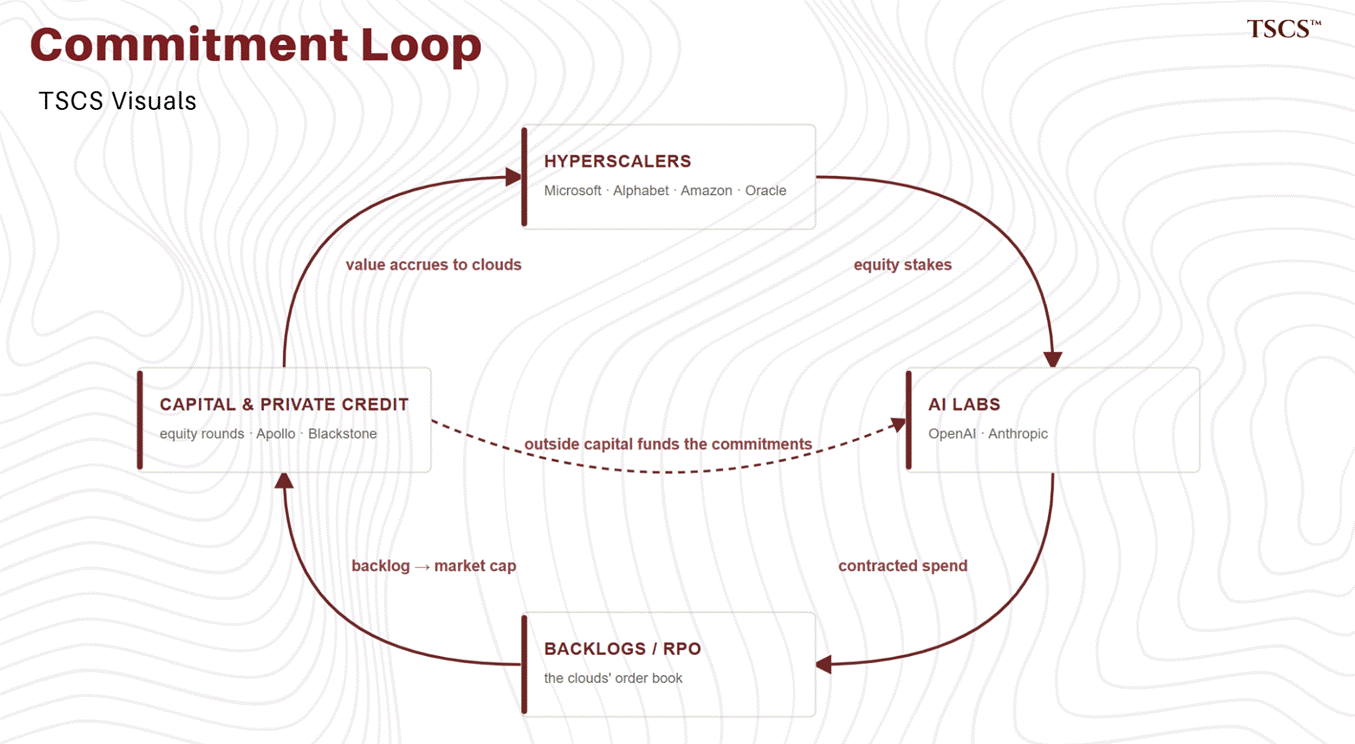
So the loop closes like this. The clouds hold equity in the labs, the labs’ contracted spend fills the clouds’ backlogs, the market capitalises the backlogs, and the labs’ ability to honour the contracts rests on their continued access to outside capital. Every dollar of that market cap prices the same assumption, that intelligence holds its price and the funding windows stay open long enough for the customers to grow into the commitments.
TLDR. The price of intelligence is being engineered down by the same substitution mechanics we documented in Peak Silver Demand. The cheapest producers make money at 1/10 of frontier prices, so nobody on the cost curve is compelled to defend the level this capex was underwritten at. The damage lands in backlogs and in books carrying hardware at values that assume frontier returns, and the first leg of it is already trading in Seoul. The strongest case against all of this, and a dated reverse thesis, sit at the bottom.
Whichever way this loop resolves, the buildout still consumes copper, power and grid hardware, and the companies supplying them trade at single digit multiples. Our updated copper miner coverage lands next week, paid subscribers only.
On 13 July we published Peak Silver Demand. Silver’s industrial floor was a price relationship. The solar industry’s substitution decision was made between $75 and $84 and filed in writing on January 5. The speculators kept buying for three more weeks, to $121.67, and then the margin calls arrived.
Substitution relocates floors, lower, and always later. A token floor does exist, at the marginal cost of electricity and amortised silicon. The problem for the roughly $750 billion the five big hyperscalers will spend this year on CreditSights’ estimates is how far above that level the plans were written.
In the second week of February Chinese models processed more tokens than American models for the first time, 4.12 trillion against 2.94 trillion. By June the reported ratio was three to one. 18 months ago the Chinese share was around 1%.
A chart like that needs pricing before it earns a place in anyone’s thesis. OpenRouter runs 1-2% of the market depending on whether you count spend or tokens, its open-source traffic skews to consumer workloads, and enterprise inference lives on Azure, Bedrock, Vertex and direct APIs, which publish revenue aggregates and no model mix. So it’s yet to be proven overall.
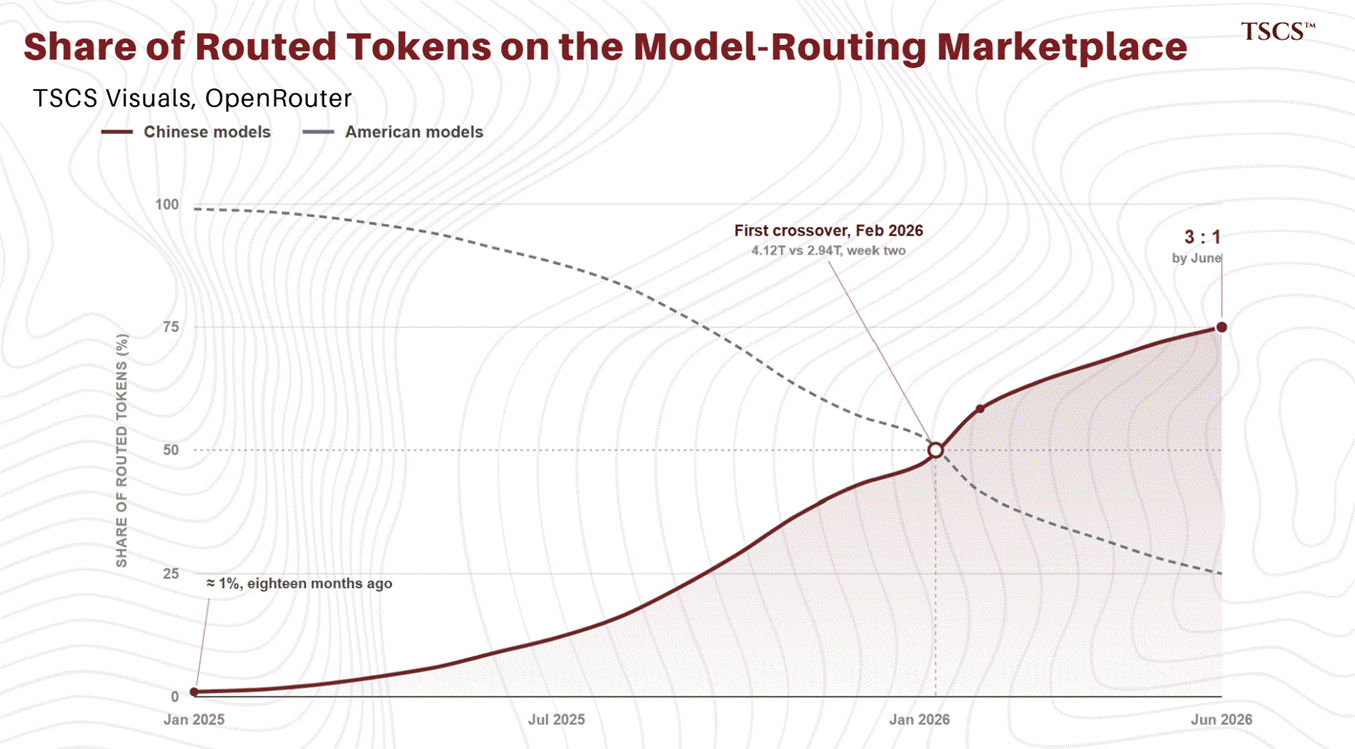
What keeps the chart in the thesis is what a routing marketplace is. It’s the price sensitive margin of the market, the segment with zero switching costs, where substitution shows first by construction.
For example, silver’s price sensitive buyer was the cell manufacturer, and the thrifting showed in paste loadings years before it reached the aggregate tables everyone watches.
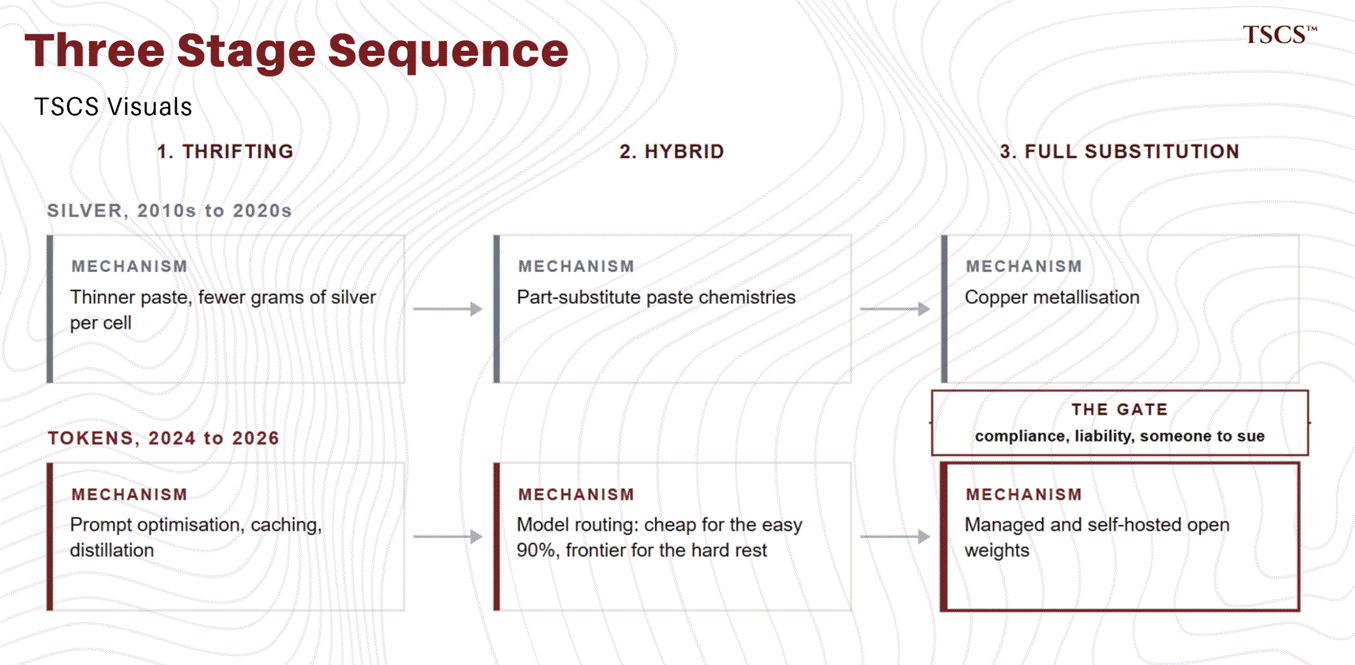
Silver’s demand decline runs through three mechanisms, thrifting, hybrid paste, and full substitution, and the last was gated by bankability.
Tokens are running an identical sequence.
Thrifting is prompt optimisation, caching and distillation, squeezing more work from fewer tokens. Hybrid is model routing, cheap models for the easy ninety percent of a workload and frontier for the hard rest. Full substitution is managed and self hosted open weights, and its gate is the same gate, compliance, liability, someone to sue. The last one matters more than the benchmarks do.
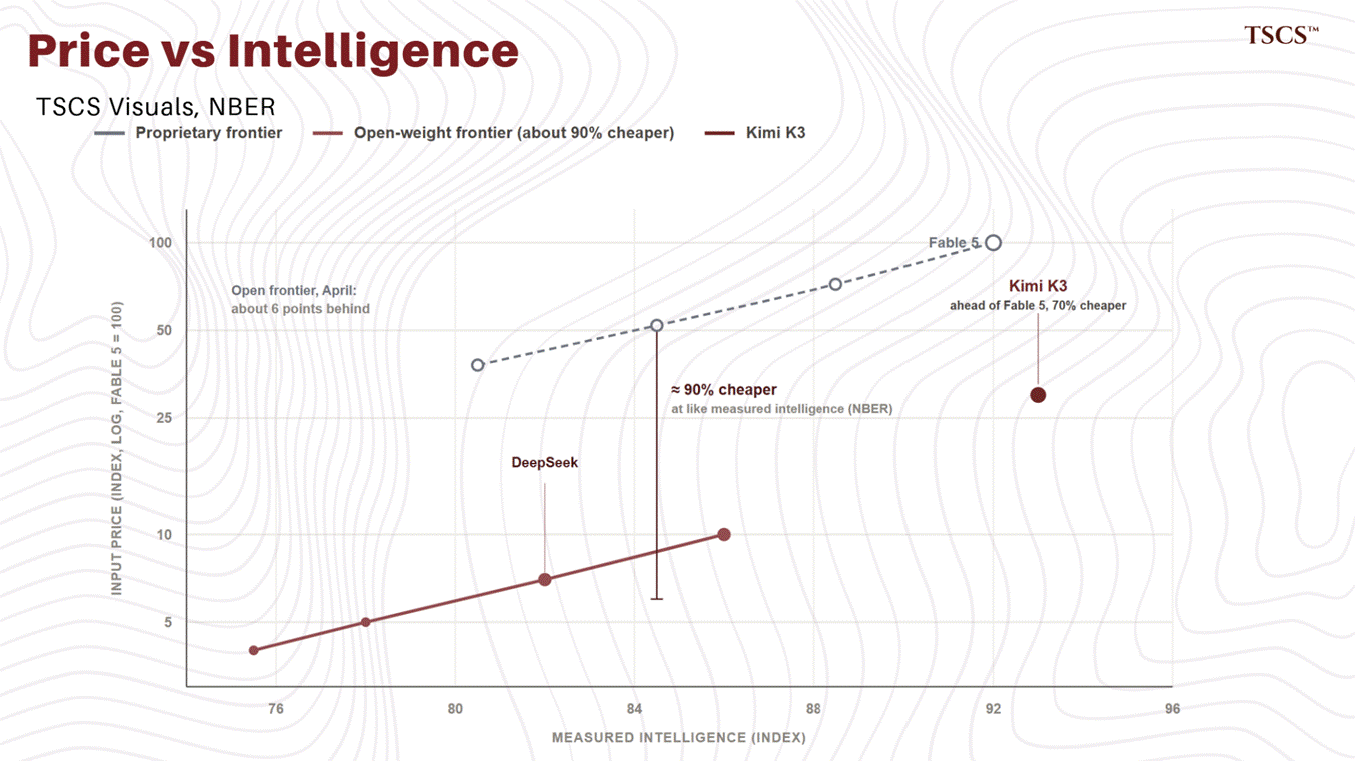
The NBER’s study of this market, built on OpenRouter and Azure data, found open models 90% cheaper than closed models of comparable measured intelligence. Artificial Analysis put the open-weight frontier about six points behind the proprietary frontier in April.
That April number is already stale. This week Kimi K3 took the number one spot on Arena’s Frontend Code leaderboard, ahead of Fable 5, at 70% cheaper input pricing. The board still marks it preliminary and proprietary until Moonshot ships the full weights free on July 27, at which point the top of that leaderboard is an open model, and Reuters reports Alibaba has already told staff to drop Claude Code for its own tool.
One arena is one arena, K3 is the most expensive model a Chinese lab has ever shipped, the era of super cheap Chinese AI maturing into just cheap.
The production data agrees. On Vercel’s AI Gateway, open weight models handled 29% of token volume by June, up from 11% in April, on under 4% of spend. Three months, nearly a tripling, at the price sensitive margin of real production workloads.
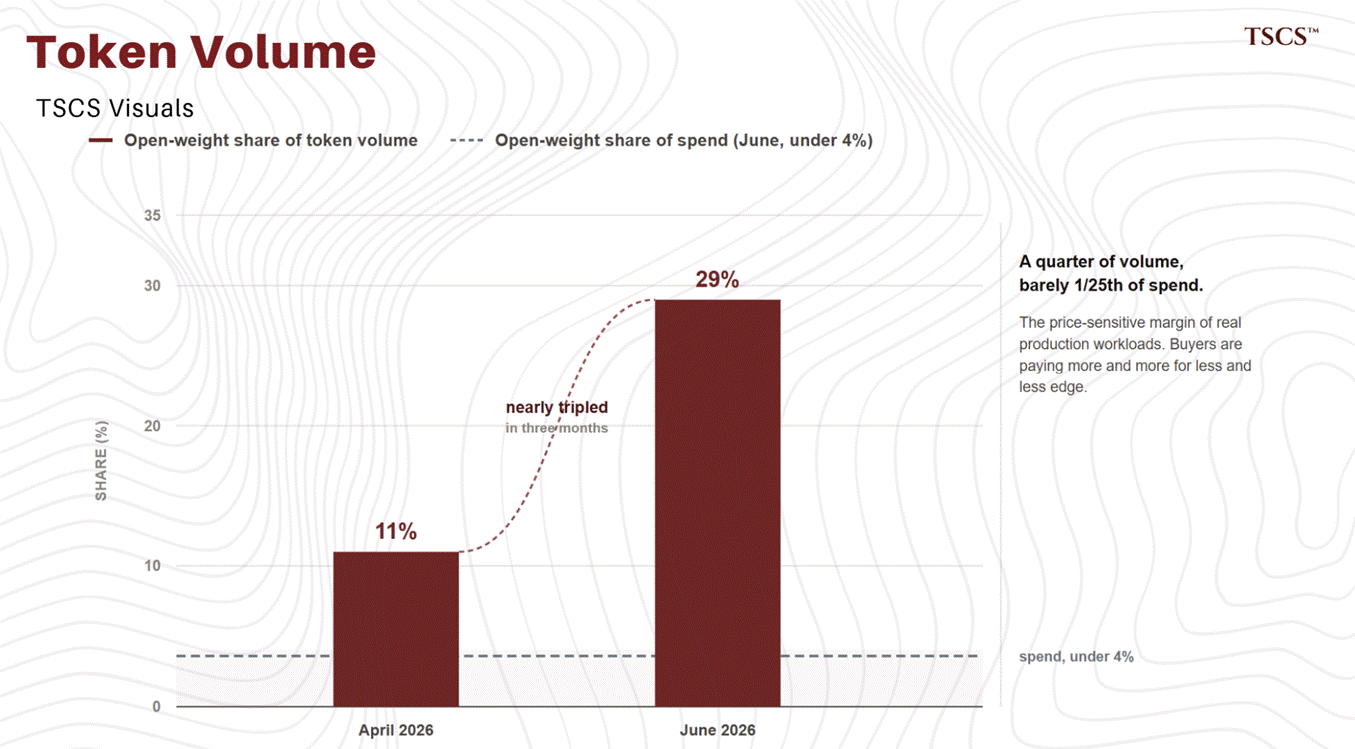
Buyers are paying more and more for less and less edge.
Substitution never needed a permanently high incumbent price, it needed enough time at the old price to get designed in, and two years of frontier token pricing has supplied the time.
Every enterprise model evaluation running this quarter is basically a design review, and I’ve not seen a sell side note treat it as one.
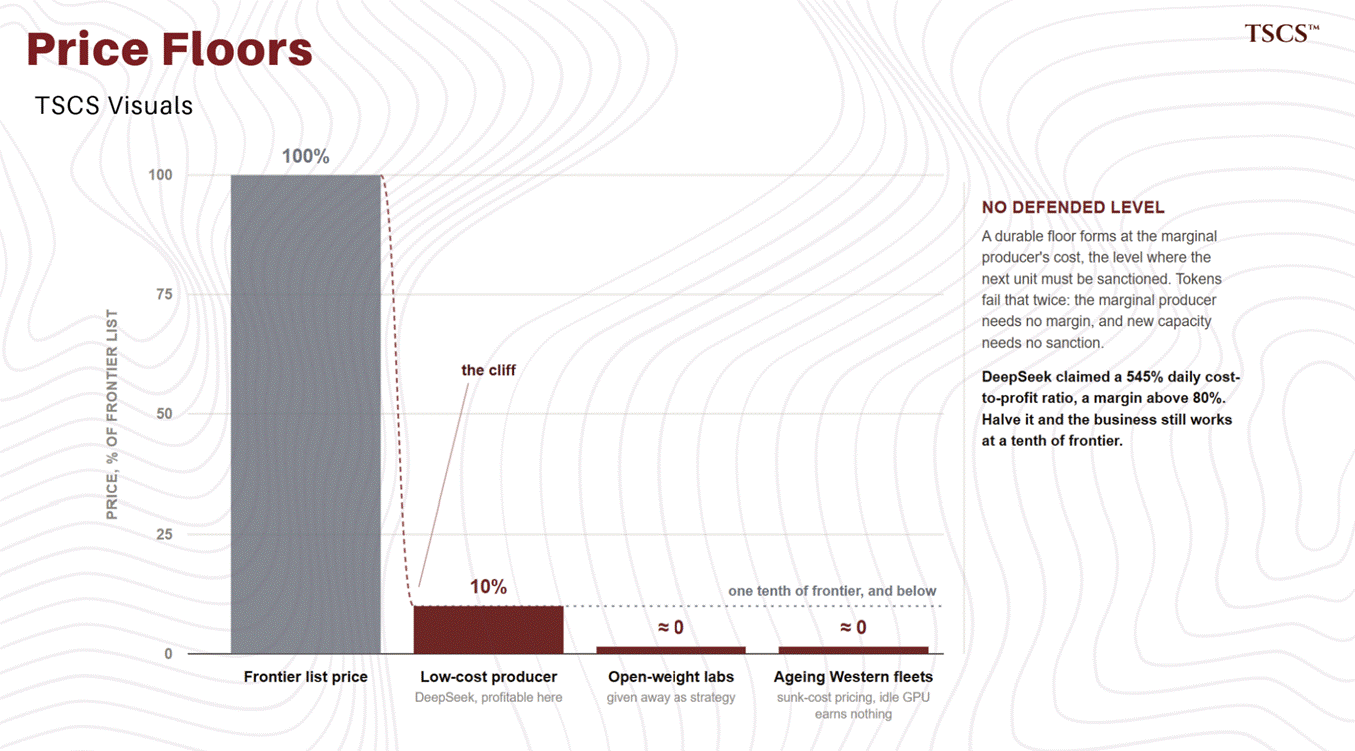
Every durable price floor we trade forms at the cost curve of the marginal producer, the level where the next unit of supply has to be sanctioned, which is how we defined the long run price in Copper Miners Are Too Cheap. Tokens fail that framework twice, because the marginal producer needs no margin and new capacity needs no sanction.
Let’s first look at the margin. DeepSeek’s own infrastructure note claimed a theoretical 545% daily cost profit ratio at its list prices, which works out to a margin above 80%, and if you cut that arithmetic in half the business still works at 1/10 of frontier pricing. A producer claiming software margins like these is telling you something about everyone else’s price. Interpret that as you will.
This is efficiency wrapped in strategy, operating inside a state that has tabled a reported $295 billion national AI buildout plan and does not price its champions to rescue foreign capex models.
Above them, the open weight labs give the product away as strategy. Beneath them, ageing Western fleets will keep serving commodity tokens because the capex is sunk and an idle GPU earns nothing, the way an overbuilt smelter complex poisons its own metal for a decade.
Put the three tiers together and the conclusion writes itself. The low cost producer profits at 1/10 of the prevailing price, a second tier gives the product away, and a third prices off sunk cost, so this market has no defended level anywhere on its curve.
In every physical market we cover, that’s the most bearish sentence you can write about a price.
If the price migrates toward that floor, the damage will arrive in the accounts before it arrives in the chips, through two mechanisms.
The first is the hardware earnings gap, and the credit belongs to Fred Hickey, who has published The High-Tech Strategist since 1987 and put it on our radar.
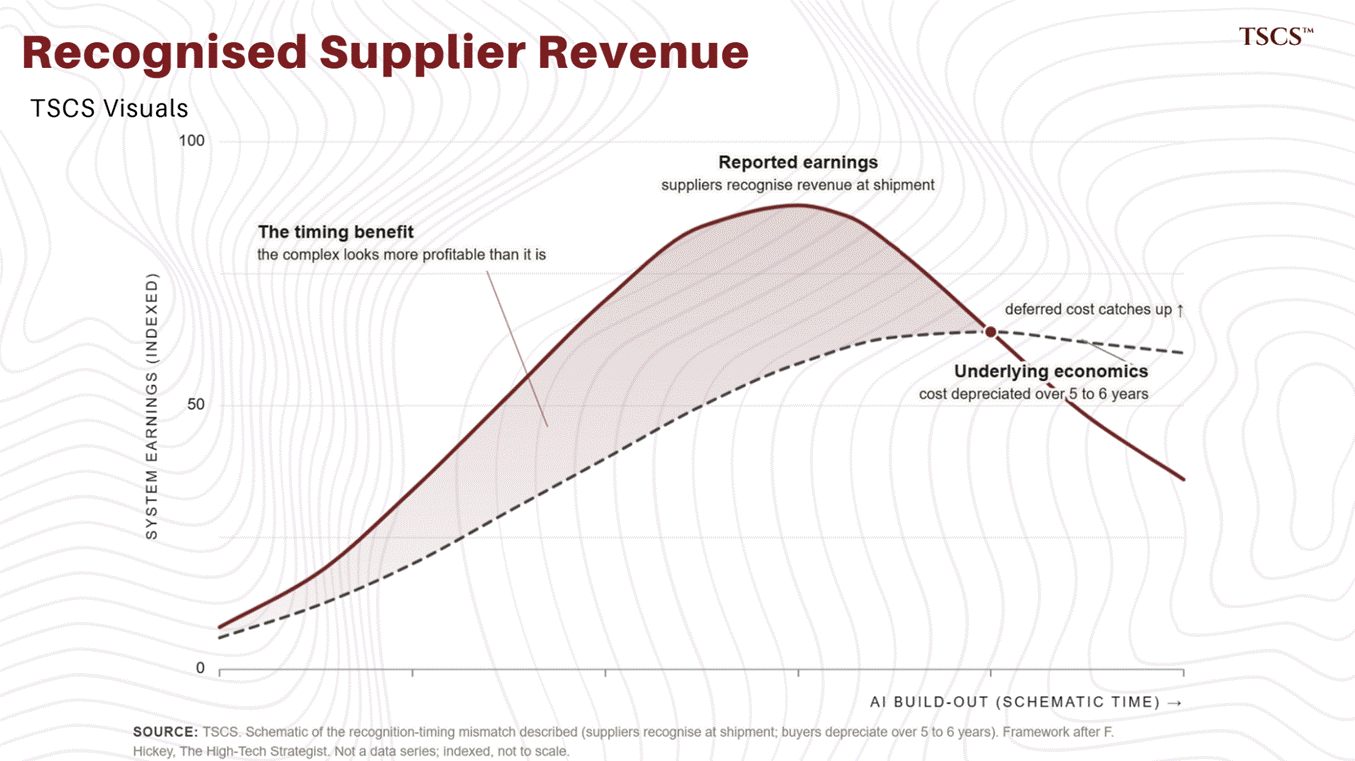
Component suppliers book revenue when product ships, while the buyers meter the cost out through 5-6 year depreciation schedules, so system-wide AI earnings arrive front loaded.
The supplier income statements show the buildout now and the buyer income statements show the cost later, which is why the complex looks more profitable today than it is.
The first mechanism is already trading.
Korea is the purest equity expression of front loaded supplier earnings, two memory companies dominate the index, and the KOSPI closed at a record 9,114 on June 22, up 122% on the year, capitalised by retail margin loans peaking near a record 38.6 trillion won and single stock leveraged ETFs on Samsung and Hynix.
Three weeks later it had shed roughly a quarter, and more than half of all KOSPI circuit breakers in history have now fired in the past six months, with the Bank of Korea hiking for the first time in 3.5 years straight into the fall.
What has repriced there is the leverage on the supplier earnings, Korean official forecasts were upgraded to a 5 year high the same week, and the S&P sits about 1.4% below its record while Goldman’s momentum pair is down 1/3 from its highs.
A margin call is not price discovery in the token market underneath, and my kill switches don’t care about a bad month in Seoul.
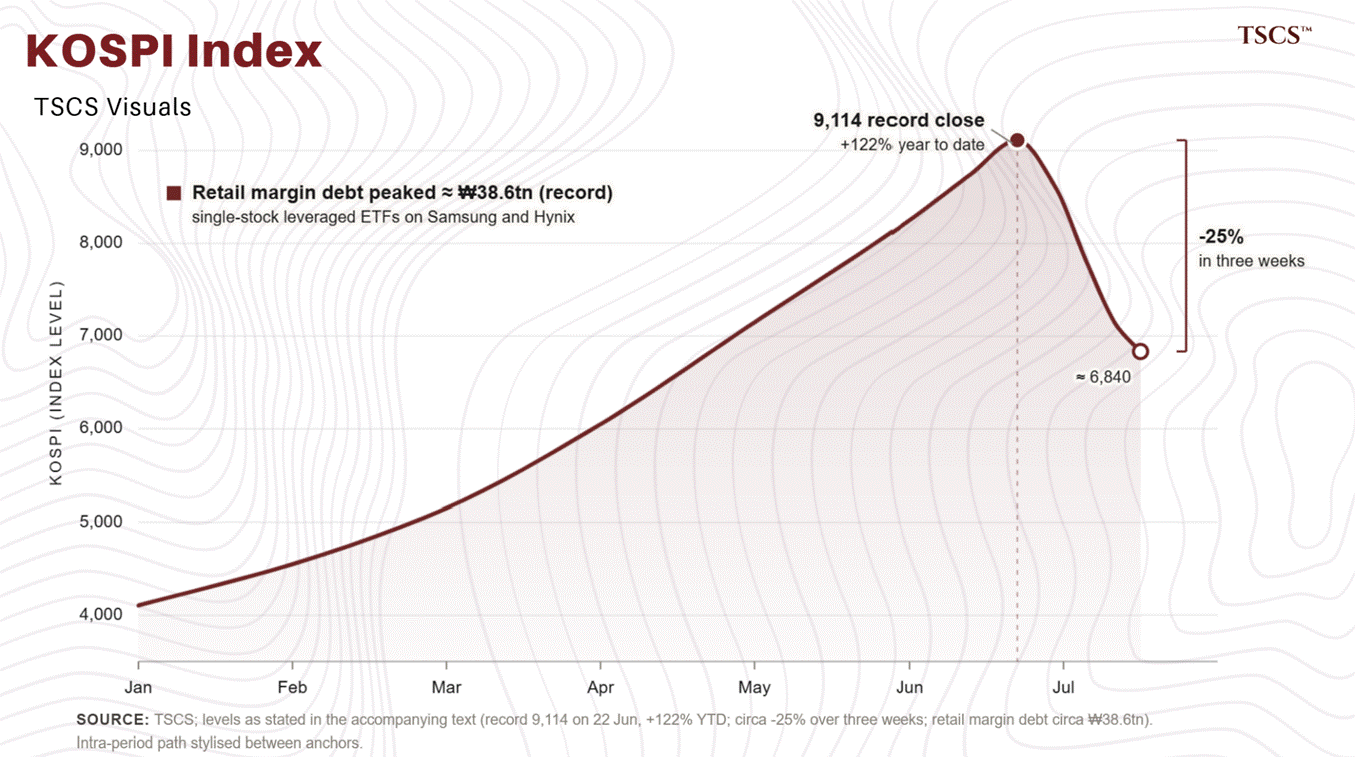
What Seoul shows is where the complex is fragile, the point where front loaded earnings meet the most levered marginal buyer, and the order the repricing arrives in, internals first, index later.
Mapping which suppliers carry that gap, name by name, is paid work, and it slots into the series described at the bottom.
The second mechanism runs through the cloud backlogs. RPO is contracted future revenue, recognised only as customers consume, so it’s neither revenue today nor an asset anyone can impair.
Half the commentary on this subject gets that wrong, which is convenient for whoever’s writing it.
What can actually go wrong is specific, contracts renegotiated or cancelled, committed capacity never consumed, receivables against weakened counterparties, and finally impairment of the data centres and silicon built against demand that arrives repriced.
The filings have my favourite detail of this whole story.
Over three years, four CFOs watched the hardware cycle visibly shorten in front of them and concluded their servers would live longer.
Microsoft extended server lives from 4-6 years, Alphabet moved to 6, Meta pushed to 5.5, Oracle extended twice. Amazon alone reversed, moving a subset of servers back from 6 to 5 years effective January 2025 and citing, in its own words, faster AI and ML technology development.
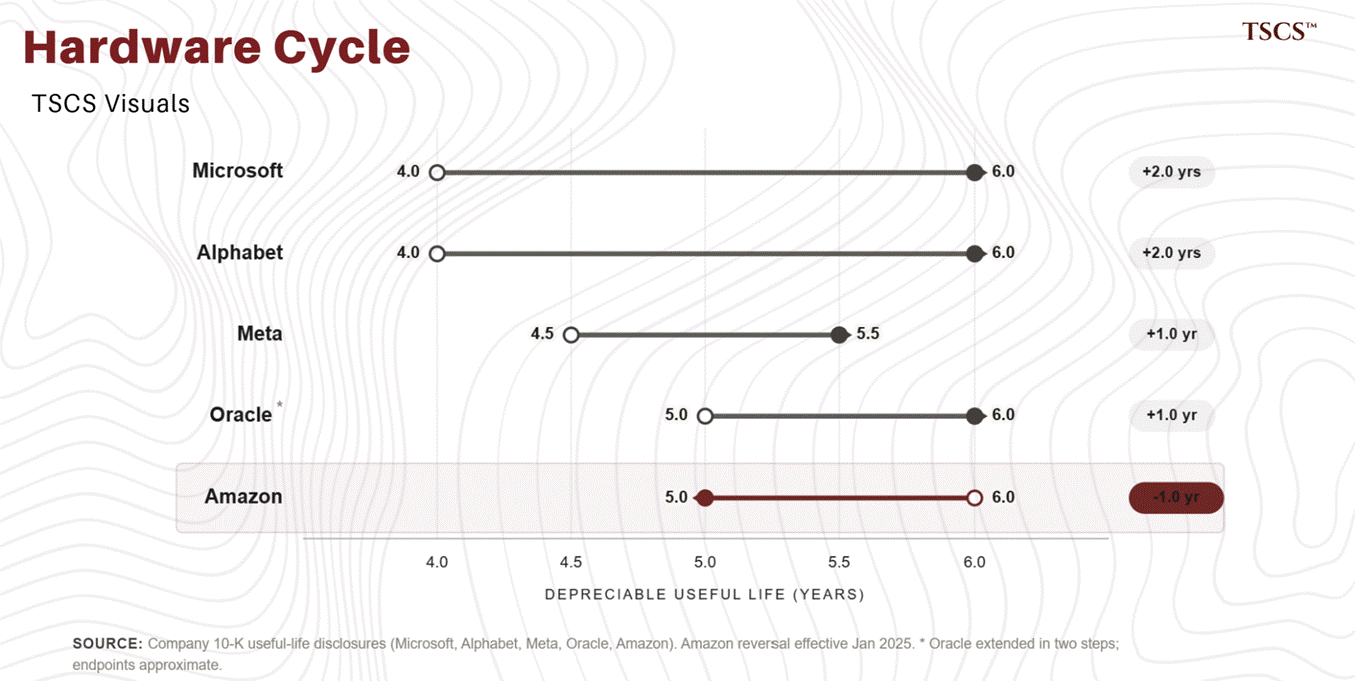
When the honest broker in an accounting question is Amazon, take notes.
The extension trade makes sense once you see that a GPU has two lives, a frontier life of a year or two earning frontier pricing, and a residual life of many years grinding out commodity inference.
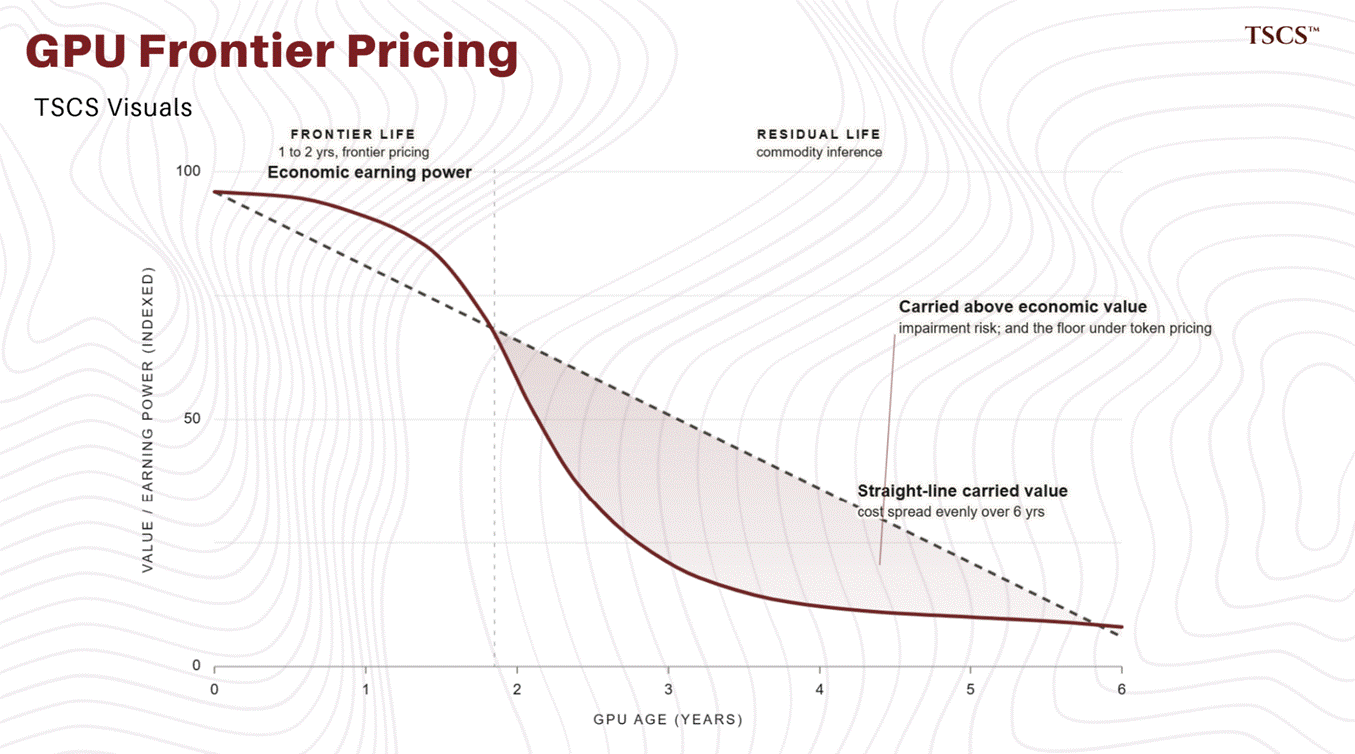
Four balance sheets carry their fleets at values that assume something like frontier returns across the full schedule. Residual capacity is what caps commodity token pricing from below.
This is the infamous ‘landlord defence’. It says the clouds win either way, because if enterprises substitute to cheap models they run them on Azure and Bedrock, the model layer’s margin dies, and the compute revenue stays home.
Correct as far as it goes, and it’s why the eventual survivors of this cycle are probably the landlords.
So let’s look at the anchor tenants. They are the model layer, and the commitments filling these backlogs exceed anything the companies making them generate from operations.
Backlog quality therefore depends on those companies’ continued access to capital, and the structures channelling that capital are cleaner than 1999 without being safer.
Lucent lent customers $6.7 billion directly to buy its own boxes, and at least had the decency to call it vendor financing. Today it’s equity stakes, contracted demand and revenue participation, and the amended Microsoft agreement, a non-exclusive IP licence through 2032 with OpenAI’s payments to Microsoft running through 2030 at an undisclosed capped percentage, is genuinely less circular than commonly described.
Microsoft’s backlog is money good for exactly as long as the capital markets keep writing OpenAI’s cheques, and Google’s newest reported commitment holds for as long as Apollo, Blackstone and the equity market keep funding Anthropic’s capacity, which makes nearly half of Microsoft’s contracted future revenue a funding assumption wearing a revenue disclosure.
With private credit now financing lab compute directly, the transmission line from token deflation runs straight through the marks-versus-market machinery we mapped in Marked to Faith and Eat The Pension.
The periphery is where the assumption carries leverage. Oracle spends 86 percent of revenue on capex on CreditSights’ figures behind a backlog with no named counterparties, the neoclouds and GPU-backed lenders sit further out on the same limb, and a repricing of intelligence arrives there first, as a credit event.
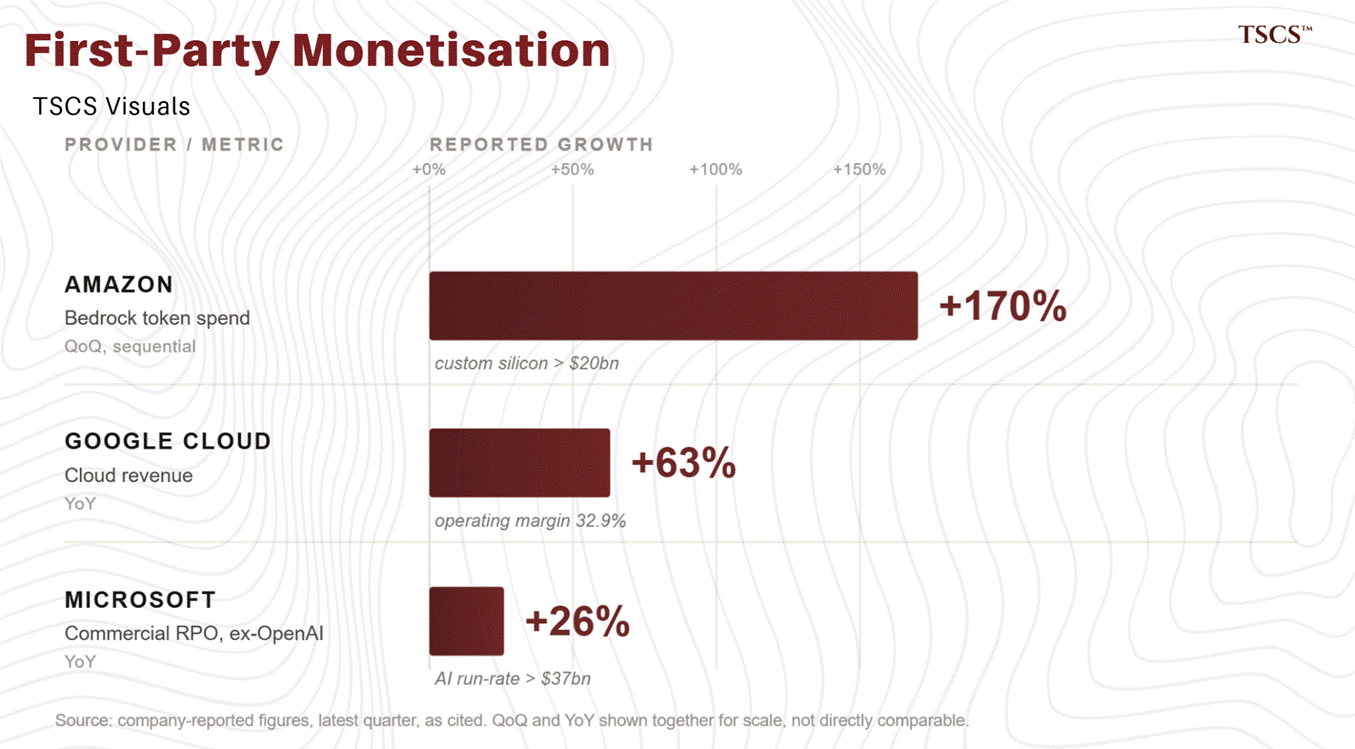
The core is monetising. Microsoft’s commercial RPO excluding OpenAI still grew 26%, and its AI business runs above a $37 billion annual rate. Amazon says Bedrock processed more tokens last quarter than in all prior years combined with spend up 170% sequentially, and its chips business exceeds $20 billion. Google Cloud grew 63% at a 32.9% operating margin, and management says the majority of its backlog is ordinary GCP contracts.
These are the first party channels the routing data cannot see, and their aggregates point at broad, profitable, accelerating demand.
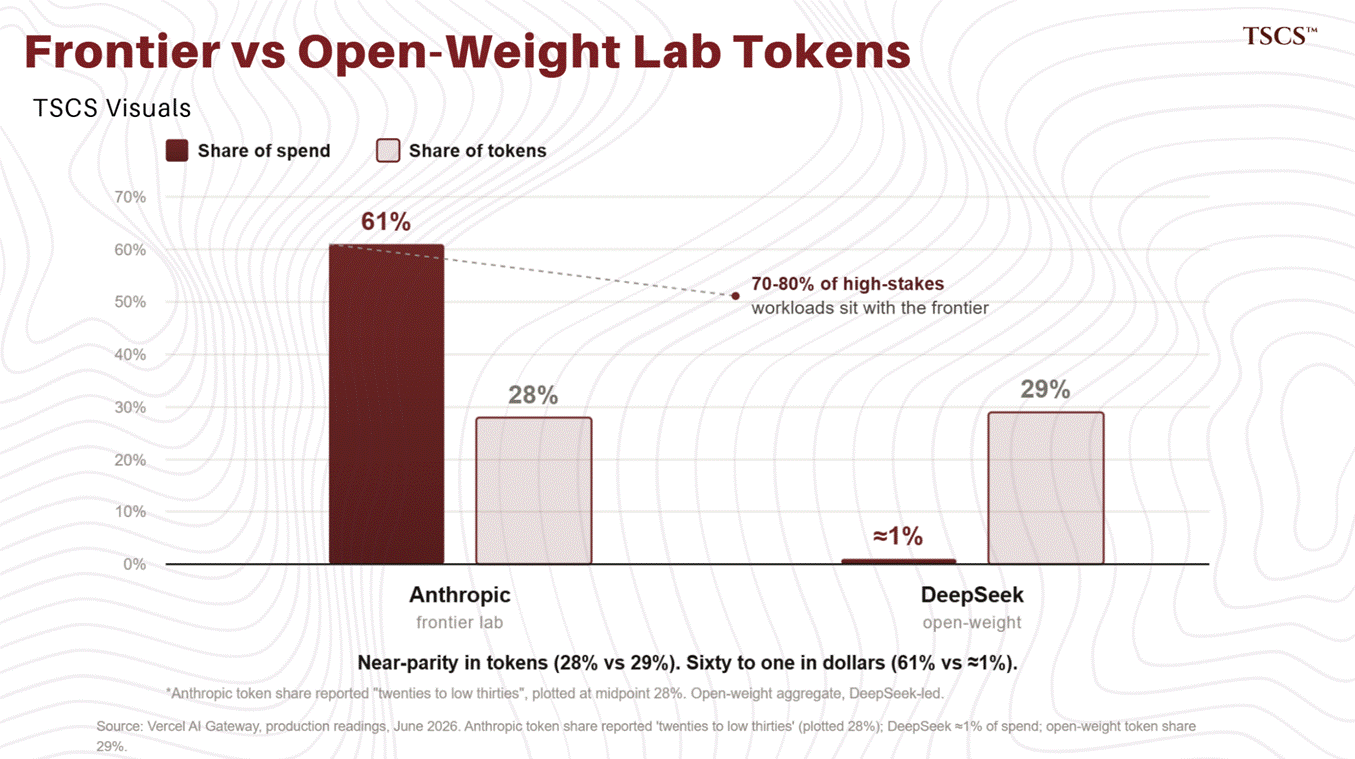
The newest routing data cuts both ways. On Vercel’s production gateway, Anthropic took 61% of spend in April, 65 in May, and 61 in June, on token shares in the 20s and low 30s, including 70 to 80% of high stakes workloads, while DeepSeek’s large token share earned it around 1% of spend.
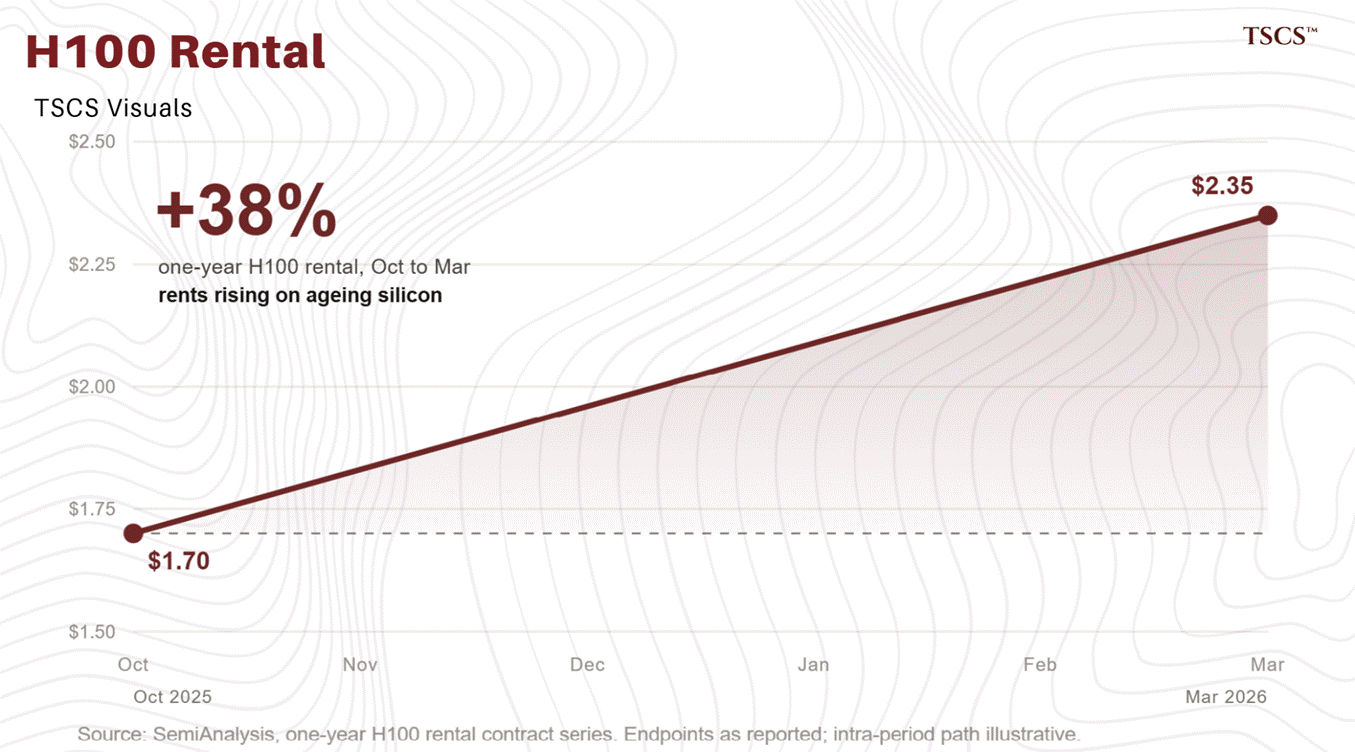
Cheap models are absorbing low value volume while the dollars concentrate at the frontier. The physical market agrees with them for now, one year H100 rental contracts rose from roughly $1.70 to $2.35 per hour between October and March on SemiAnalysis’ series, and rising rents on ageing silicon is the opposite of overcapacity.
Even my aggregation can be attacked, since the four backlog disclosures differ in duration and definition, and $75 billion of Oracle’s figure involves customers who prepaid for GPUs or supplied the hardware themselves.
I print all of it because it’s true. The bulls and I agree on every number and disagree on the derivative. Their evidence describes the present, a serene aggregate, dollars concentrating at a frontier that still clears its price, and silver’s aggregate looked exactly like that through 2024 and 2025 while the substitution decision moved through design reviews toward a filing date nobody had circled.
The bulls also hold a precedent I have to respect. The DeepSeek shock of January 2025 cratered the complex for a week and marked a buying opportunity, because the answer then was Jevons and an acceleration of capex, and Seoul’s crash can resolve the same way.
The difference to test is the structure underneath: in early 2025 the labs were not carrying $580 billion of cloud commitments financed by equity rounds and private credit, and the enterprise rails for open weights on Azure and Bedrock didn’t exist. The balance sheet it lands on has changed. The bankability gate is being built in plain sight, DeepSeek served direct from Azure and from Bedrock out of Ohio, Qwen managed on Google’s own enterprise platform, and gates that get built get walked through.
As for the core’s monetisation, nobody disputes that the fibre got lit in 1999 either. The strongest case against this post explains today perfectly and has nothing to say about the curve, which is the only thing the capex is priced on.
If you hold the other side of this, the comments are open and I will engage.
In every branch of this argument the deflation lives in the software layer. The token gets cheaper and the electron does not, or in the form I would put on a desk sticker, you can open source a model and you can’t open source a substation.
Whichever way the model layer resolves, the buildout consumes power, copper, land and cooling at a scale the underlying supply chains are not priced for, while the levered end of the AI complex is priced for a pricing regime its own customers are actively arbitraging away.
We mapped that first gap in Copper Miners Are Too Cheap, copper at a record while the developers who will mine it trade as if it were worth a third less, and if you read one piece of ours off the back of this one, read that. It prices the exact side of this trade that survives every branch of the argument above.
Readers know which side of that trade we are on.
I’ve been early before at real cost, the widowmaker chapter of that story is in Underwater at 1%. There are two kill switches, each one singly sufficient. Either fires and this joins the public scorecard as a miss, no timing waiver.
First, the premium survives contact. The series is frontier lab share of spend on Vercel’s monthly AI Gateway production index, where Anthropic’s published readings ran 61, 65 and 61% across April, May and June 2026. If, in the readings nearest January 2027 and July 2027, frontier lab spend share holds inside or above that band while open weight token share keeps rising from June’s 29%, then substitution is not transmitting to dollars.
Second, nothing breaks. If by July 2028 none of the named damage events has occurred, no disclosed renegotiation or cancellation of a frontier lab cloud commitment, no hyperscaler AI-related impairment or server life shortening beyond Amazon’s existing change, and no funding failure or forced restructuring at a frontier lab or major neocloud.
Three dials sit alongside the switches. Hyperscaler capex guidance against the SemiAnalysis rental series. Server useful lives through the 2026 10-K season. And the policy scenario, where a Washington restriction on Chinese models matters only if domestic per token pricing stabilises within two quarters of it. Washington already showed its hand once this year, an 18 day export control suspension of two frontier models in June, and pricing did not blink. Interim homework marked July 2027, final marking July 2028.
For paid subscribers, the work continues on the side of this trade that holds in every scenario. Updated copper miner coverage will come next week, building on Copper Miners Are Too Cheap and the basket that followed it.
Behind that, a series on the commodity layer of the AI buildout is in production, the power, the grid hardware, the copper and the uranium that get consumed whichever way the model layer resolves, priced name by name the way we did the gold miners in Nobody Wants Gold and the silver names in Silver Bugs Were Right, with the supplier exposure mapping from the accounts section inside it.
The commitments are real, the monetisation is real, and the substitution is real, and somewhere on a routing dashboard right now an enterprise evaluation is moving one more workload down the curve without reading a single backlog disclosure.
In June I thought the zero price of looking like an analyst was a story about my industry. It was the first data point of this one, and this post is the rest of the thought.
TSCS is not a registered investment advisor. Comments, thoughts and opinions are entirely those of the author without any representations to accuracy and are for informational use only. Any mention of a particular security, index, derivative, or other instrument is NOT a recommendation to buy, sell, or hold that security, index, derivative, or any other related instrument. Kill switches tracked on the public scorecard.
Comments
Nothing yet. Say the first thing.
Sign in to join the conversation.