
What should doctors do when they don’t have the evidence? It sounds like a simple question, but the third set of newly released text messages concerning Covid vaccination in pregnancy shows that, in January 2021, Fauci and Vivek Murthy had very different answers.
On 26 January, Murthy messaged Fauci and Rochelle Walensky about the World Health Organization’s position on Moderna’s vaccine.
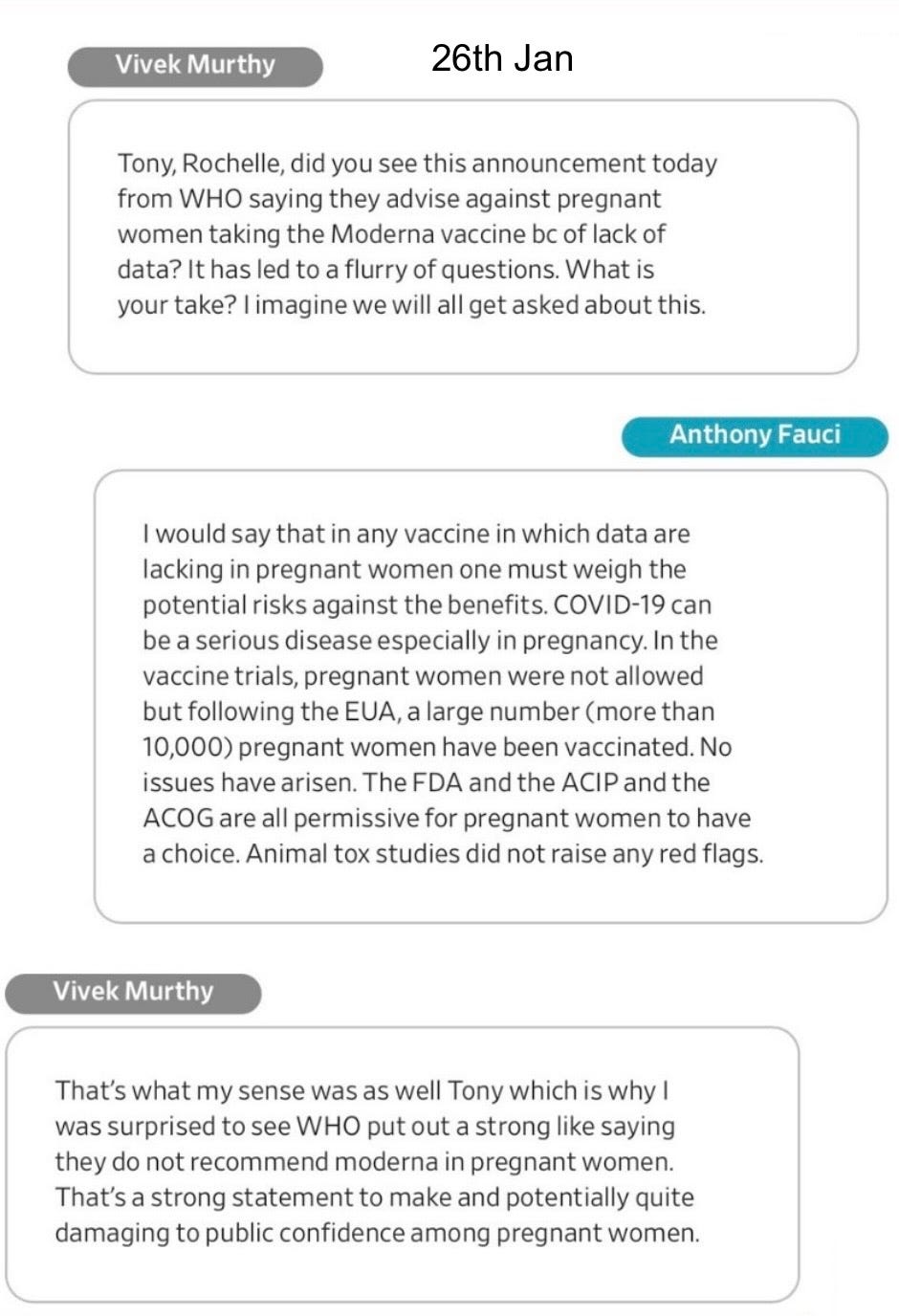
WHO had concluded that the available data in pregnant women were insufficient to assess either vaccine efficacy or vaccine-associated risks. Its interim recommendation was therefore against routine vaccination during pregnancy, while making exceptions where the benefits outweighed potential risks – for example, healthcare workers with high exposure or women at increased risk of severe Covid.
WHO also said women should be counselled about the “lack of safety and efficacy data”.
Yet, only a day earlier, Walensky had privately described the pregnancy question as essentially “data-free”. Fauci had subsequently raised a specific theoretical concern that fever and the inflammatory response after the second dose might be associated with miscarriage during the first trimester.
Walensky thought it was a “good point”.
Now WHO was responding to precisely the same evidential uncertainty by exercising caution.
Murthy was surprised.
He asked Fauci and Walensky for their view, anticipating that they would face questions about WHO’s position.
Fauci’s response is revealing.
“In any vaccine in which data are lacking in pregnant women,” he wrote, “one must weigh the potential risks against the benefits.”
Then Fauci explicitly acknowledged the fundamental evidential problem:
“In the vaccine trials, pregnant women were not allowed.”
TTE made the point two years ago, in our review of regulatory submissions to FDA
In posts 6, 6a and 7 we pointed out that pregnant women had been excluded from the experiment intended to establish the vaccine’s safety and efficacy, which meant there was no randomised human pregnancy evidence upon which to base confident conclusions.
So what evidence did Fauci invoke?
Animal reproductive-toxicity studies had produced no obvious problems. And since emergency authorisation, he said, more than 10,000 pregnant women had already been vaccinated.
Then came the remarkable assertion:
“No issues have arisen.”
But how could he know?
The US vaccination program had just started a few weeks prior. Since pregnancy lasts nine months, women vaccinated during their first trimester could not have provided birth outcomes by January 26. Assessing congenital outcomes takes months of observation. Additionally, for miscarriages, it is necessary to determine gestational age, establish an appropriate denominator, and provide sufficient follow-up.
Indeed, Fauci had just privately identified first-trimester miscarriage as an unresolved theoretical concern.
“No issues have arisen” could only mean that no obvious signal had yet emerged from extremely immature surveillance data. It could not mean that the safety of pregnancy had been established.
WHO recognised exactly this distinction: At its 26 January press conference, officials noted the lack of trials in pregnant women and therefore could not recommend widespread use with the necessary
WHO’s position was essentially: we have no evidence of a problem, but there is insufficient evidence from human pregnancy to recommend routine vaccination.
Fauci’s differed in that his assessment was based on reassuring animal studies; thousands of pregnant women have already been vaccinated, and no problems have yet appeared.
Then Murthy introduced another consideration.
He said WHO’s position was a “strong statement” and could be “potentially quite damaging to public confidence among pregnant women.”
This is perhaps the most revealing sentence in the entire exchange.
The purpose of scientific advice is not to maximise confidence in an intervention; it is to communicate what is known, what remains uncertain and how certain we can reasonably be.
The three text exchanges demonstrate that Fauci, Walensky and Murthy knew pregnant women had been excluded from the trials, and pregnancy data were lacking. They privately discussed a specific theoretical first-trimester concern, and when WHO responded cautiously to that uncertainty, they also discussed the potential consequences of that caution for public confidence.
The texts highlight the fundamental distinction between “we haven’t detected a problem” and “we have evidence that there isn’t a problem,” and the interpretation of that distinction.
Issues for the US Congress
Congressional oversight should start with a proper reconstruction of the decision-making record.
They should ask Fauci, Walensky, and Murthy: What pregnancy-outcome data did you have on 25 January? What additional data did you have when “no red flags” was said publicly? What did “no red flags” mean operationally? What evidence justified moving from permissive advice to an affirmative recommendation? When was the theoretical miscarriage question considered resolved? And why was the Pfizer pregnancy RCT allowed to become so much smaller than originally planned?
Answers should be supported by contemporaneous datasets, briefing documents, emails, surveillance reports and minutes—not recollections five years later.
In an emergency, public health officials may not have perfect evidence at hand; however, a lack of available evidence should never reduce their obligation to describe it accurately. Public confidence requires scientific transparency, not the withholding of uncertainty.
Two old geezers have spent the week going through Fauci’s texts and months going through the Cominarty licensing submission to FDA. Unfortunately, we still remember when ‘we don’t know’ was considered an acceptable scientific answer.
No posts
Comments
Nothing yet. Say the first thing.
Sign in to join the conversation.