
Troy Tassier is a professor of economics at Fordham University and the author of The Rich Flee and the Poor Take the Bus: How Our Unequal Society Fails Us during Outbreaks.
Yesterday the South Carolina measles outbreak was covered by most major news outlets. Between Friday and Tuesday 124 new cases of measles were reported by the South Carolina Department of Public Health. The increase brought the total number of infections in the outbreak to 434. Additionally, over 400 unvaccinated people are in quarantine from exposure to an infected person.
The size of this outbreak and the magnitude of the acceleration the past few days are notable for multiple reasons. If one looks to recent history, in the first decade of this century, the largest number of measles cases in a full year was 140. The SC outbreak almost matched that total in a few days.
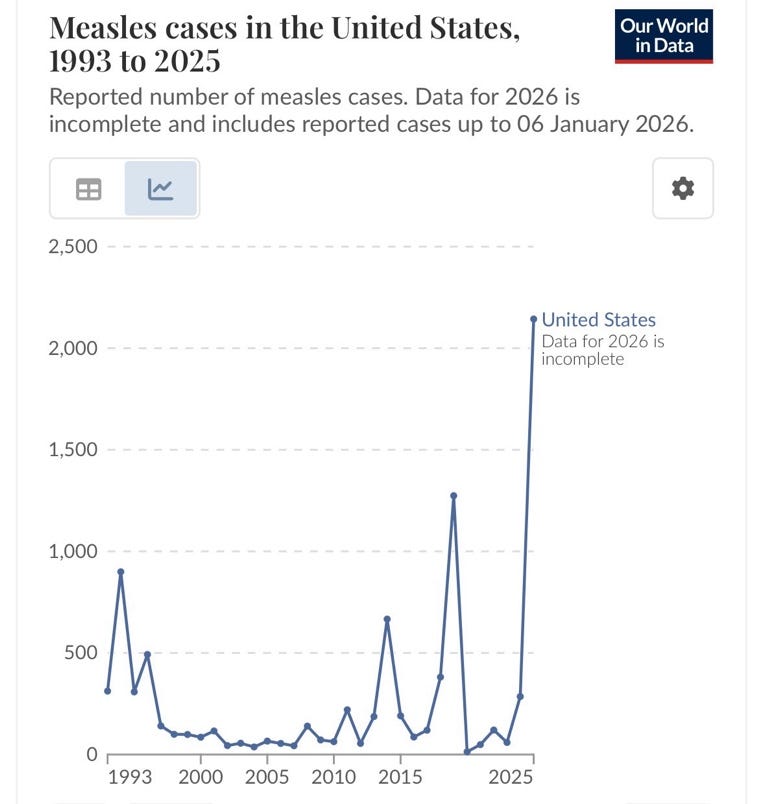
In the past fifteen years measles cases have increased dramatically. As I have written before (here and here) this increase in the number of cases is driven by the increasing numbers of vaccine exemptions within a small subset of schools. The current outbreak in South Carolina is no exception. When the SC outbreak took off last fall it was centered within a charter school that had a 17% Measles, Mumps, and Rubella (MMR) vaccination rate. That’s not a typo – it was 17%!
South Carolina, like all other states in the US, require the MMR vaccine for school attendance. All states provide exemptions to this requirement for medical reasons. Most states also allow other types of exemptions for personal belief or religious reasons. Only four states (California, Connecticut, Maine, and New York) do not have exemptions beyond medical reasons.
As I have written before, removing the non-medical exemptions in California in 2016 evened out the vaccination rates across schools and eliminated many of the pockets of extremely low vaccine coverage where a large outbreak, like the one in SC, could occur.
When the South Carolina outbreak accelerated last fall, it was located in one of these pockets with high rates of exemptions. Spartanburg County, the epicenter of the current outbreak, has the highest rate of non-medical exemptions in the state. Neighboring Greenville County also has a high rate of exemptions. If there was going to be a measles outbreak anywhere in South Carolina, almost any epidemiologist would have predicted these two counties.
When news companies covered the growing SC outbreak last week, few mentioned the importance of vaccine exemptions. They blamed it on holiday travel, which certainly played a part as well. Yesterday a few journalists began mentioning the rates of “non-medical” exemptions as an additional cause. However, all the reports I saw or read specifically used the term “non-medical” exemptions. They didn’t specify religious exemptions even though the only type of non-medical exemptions allowed in SC are religious exemptions.
Some might think that this distinction doesn’t matter. It does.
There is no problem with people following their chosen religion but there is a problem with religious exemptions putting others in danger. Simply put, the use of religious exemptions in this geographic area provided the fuel for the outbreak. Had the religious exemptions not been allowed, we wouldn’t have over 400 measles cases in South Carolina.
These religious exemptions are not being talked about on major news networks likely because of fear of the backlash that may result from religious organizations or perhaps the Trump administration.
Now some may think that parents should have the choice to vaccinate their kids or not. There are obvious problems with this view. Not all kids can be safely vaccinated because of medical reasons. Religious exemptions put these kids at risk. Further, the MMR vaccine doesn’t offer perfect protection - no vaccine does. Around 4% of the kids infected with measles in the last year have been fully vaccinated but the vaccine failed to prevent their infection. These outbreaks put all kids, vaccinated or not, in at least some risk.
Additionally, there is a public cost to these outbreaks. The average cost to society for each measles case is about $43,000. Many of these costs are incurred by public health agencies who must track and contain these outbreaks. Eventually those costs come back to citizens across the state in the form of taxes and everyone must pay for these outbreaks, vaccinated or not.
This problem is only going to increase across the country as states like Florida consider doing away with a multitude of vaccine requirements. This move will assuredly create even more pockets of danger in schools across Florida.
When news outlets ignore the word “religious” when talking and writing about the exemptions or ignore the problems that exemptions create within the outbreak in South Carolina, they mask the danger of exemptions. They hide why the outbreak originated and grew. They likely prevent more people from speaking up about the danger to everyone from religious (and other types of belief) exemptions. The silence puts everyone at risk.
Troy Tassier is a professor of economics at Fordham University and the author of The Rich Flee and the Poor Take the Bus: How Our Unequal Society Fails Us during Outbreaks.
No posts
Comments
Nothing yet. Say the first thing.
Sign in to join the conversation.