

This week, President Trump gleefully announced that the US military has bombed targets in Nigeria. The stated justification was familiar: counterterrorism, protecting Christians, restoring stability. The political subtext was just as predictable. This was a gesture to the far-right, deploying American military force not for security or peace, but as political theater aimed to boost Trump’s popularity among hardliners ahead of the deeply partisan midterm Primaries, all at the expense of civilian lives and US taxpayers.
At the same time, the United States continues to arm, fund, and diplomatically shield Israel as Gaza emerges into a fragile ceasefire after months of catastrophic destruction. The bombs may have paused for now, but the siege, displacement, and humanitarian crisis have not ended.
These are two very different conflicts in two very different parts of the world. That is precisely why they are worth examining together.
It’s important to note here that Nigeria and Gaza are not being compared because they are not the same. They are being examined side by side because the United States is actively involved in both, because American political narratives shape how each is understood, and because, in both cases, we have directly engaged with the most capable military the world has ever seen, to deepen suffering rather than resolve underlying injustice.
If we want to understand where US foreign policy is heading, and why history will not judge it kindly, we need to look at moments like these.
Nigeria matters because its violence is being instrumentalized in US politics. Gaza matters because its devastation is being justified within US policy. In both cases, civilian lives are subordinated to strategic, ideological, or purely political goals.
In right-wing media, attacks in Nigeria are framed as evidence of a global war on Christianity, stripped of context and history. In mainstream US discourse, Gaza is framed through the language of security and retaliation, minimizing or erasing the humanity of Palestinian civilians.
In both cases, selective outrage serves power.
If we look south, these conflicts are unfolding alongside renewed US pressure and interventionist rhetoric and actions toward places like Venezuela. A wholly different history. A different set of grievances and excuses. Yet the same pattern appears. Economic coercion. Regime change logic.
Moral justification deployed to advance an imperial agenda.
Different countries. Different circumstances. An intensifying and alarming trend.
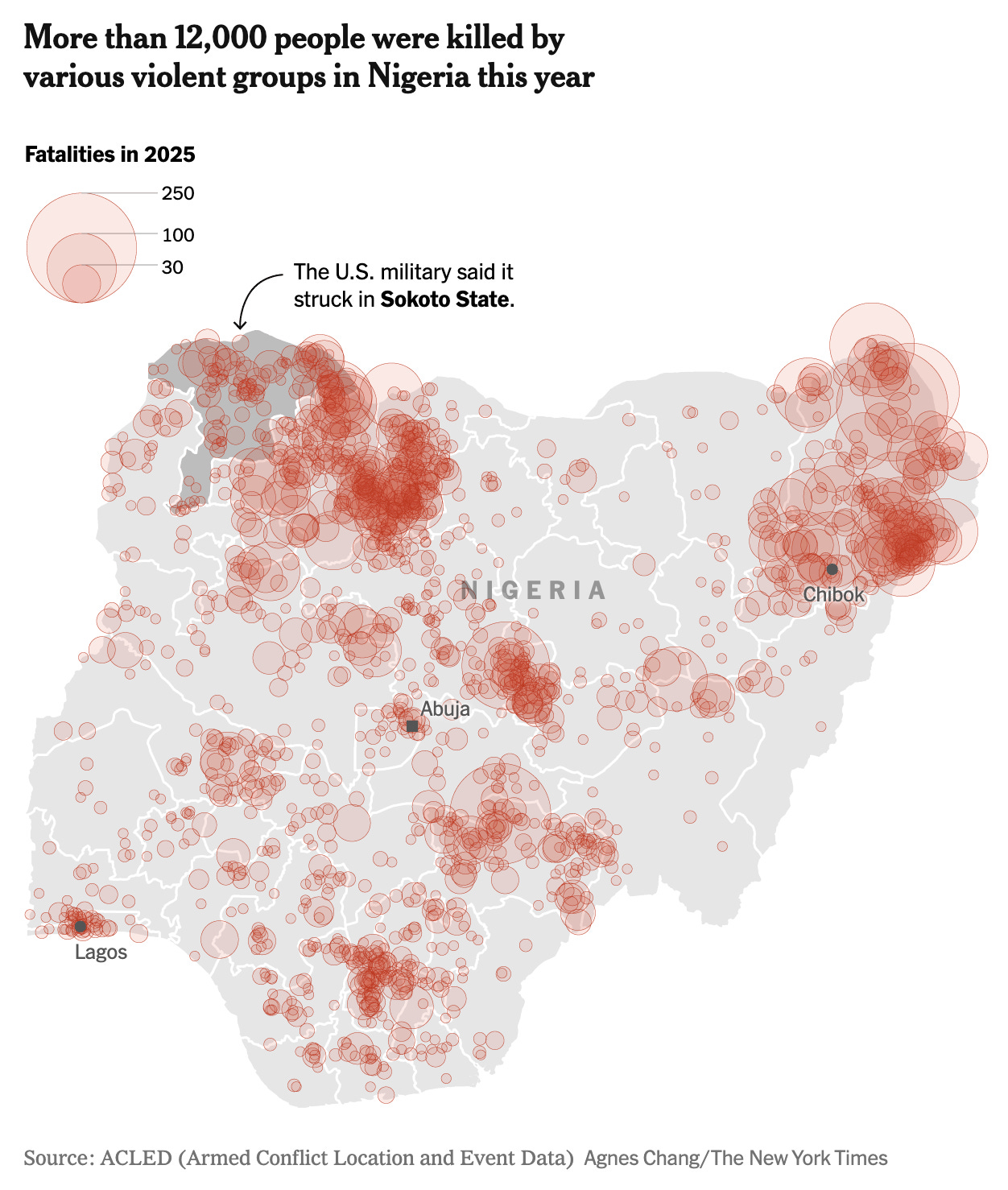
The violence in Nigeria did not start yesterday, and it is not simply a war on Christians, as some headlines suggest. It is the product of more than a century of political, economic, and religious fault lines, many of which were set in motion during colonial rule.
When Britain forcibly merged northern and southern Nigeria in 1914, it joined regions with profoundly different political structures, religions, and economies. Like many colonial projects of the era, this was done with little understanding of or concern for the people who lived there. British administrators ruled the north through Muslim emirs, restricting missionary education, while promoting Christian missionary schools and commercial activity in the south. That approach entrenched deep regional inequalities that hardened over time.
Since independence, Nigerian politicians have often exploited these divisions. Violence today reflects multiple overlapping crises. Insurgency in the northeast. Farmer-herder conflicts are driven by land pressure and climate stress. Criminal banditry fueled by state failure.
Christians are targeted. Muslims are targeted. More often, entire communities are targeted with no regard to religion at all.
US military strikes do not resolve any of this. They are entrenching cycles of violence while avoiding the harder work of supporting governance, accountability, and long-term stability.
Gaza, meanwhile, is not a past tragedy. It is a present one.
After the October 7, 2023 Hamas attack that killed over 1,100 Israelis and took hostages, Israel launched a military campaign that killed tens of thousands of Palestinians, overwhelmingly civilians, and displaced nearly the entire population of Gaza. UN investigators have concluded that Israel is committing genocide.
A ceasefire now exists. That matters. But a ceasefire is not justice. Gaza remains under blockade. Infrastructure is destroyed. Families are displaced. Famine and disease remain real threats. The conditions that produced the violence have not been addressed.
This conflict is inseparable from colonial history. British rule. The Nakba. Decades of occupation and siege. Unlike Nigeria, this is a case of overwhelming state power exercised against a trapped civilian population. The asymmetry is central, not incidental.
The United States is not neutral here. Our weapons, funding, and diplomatic protection make this devastation possible.
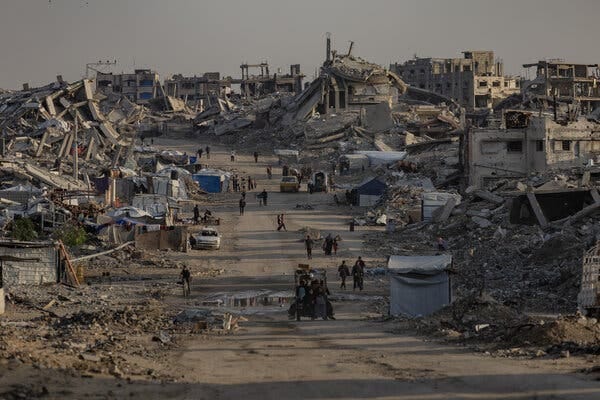
Nigeria and Gaza are fundamentally different conflicts:
One is a fragmented internal crisis in a weak state.
The other is state violence against an occupied population.
But both reveal how colonial legacies, identity politics, and militarized responses combine to produce endless civilian suffering. And both reveal a United States increasingly comfortable aligning itself with force over justice.
The same logic appears elsewhere. In Venezuela, where sanctions and interventionist pressure have worsened humanitarian conditions while entrenching political deadlock. Different context. Same imperial reflex.
How these stories are told determines how much violence is tolerated.
Christian suffering in Nigeria is amplified without context. Palestinian suffering in Gaza is contextualized until it disappears. Venezuelan hardship is framed as proof of ideological failure rather than the product of sustained external pressure.
If we only care when suffering serves our narrative, we are not standing for human rights. We are practicing selective empathy to justify imperialistic pursuits.
History is not kind to empires that confuse power with morality.
From Nigeria to Gaza to Venezuela, the United States is choosing militarization, coercion, and selective outrage over accountability and root cause solutions. These choices will be remembered not for their intentions but for their consequences.
Human suffering is unacceptable, no matter where it happens or who it happens to.
We should demand better governance and peacebuilding in Nigeria. An end to the occupation and siege in Gaza. An end to coercive imperial policy in places like Venezuela.
We should reject narratives that dehumanize. We should confront history honestly. And we should insist that human dignity is not conditional.
Because the question is not whether these lives matter.
It is whether we are willing to stop pretending that our hands are clean.
Comments
Nothing yet. Say the first thing.
Sign in to join the conversation.