
After a gap in my Substack posts for theory development, I now can reboot this series. I have coordinated my aim to move our thoughts and hearts through and beyond a purely material view of substances and objects, into a more creatively resonant and moving picture of oscillations or spins that form into adaptive vibrational patterns. Our consciously embodied material Life moves in this strength of resonance, with freedom of choice how we focus our attention and responsivity.
I am shaping a Big Picture of stabilising change, in which we find our local place to belong, to explore, and to creatively adapt with others. I aim to press the Refresh button. I aim to bring heart and mind and matter back into a union of resonance and potential for beauty.
As we learn to relax into our creative resonances, a pause to reflect and breathe will help life’s potential to renew its healthy organisation within us, from our inner hearts outwards, and from out within. As we breathe in we could recognise how we may tend to analyse the wholeness of life into parts throughout our bodies and through our mindful imaginations into the world. As we breathe out we could notice instead how we synthesise those parts we have analytically seen into a wholeness of self-in-environment on the move together even when gently at rest
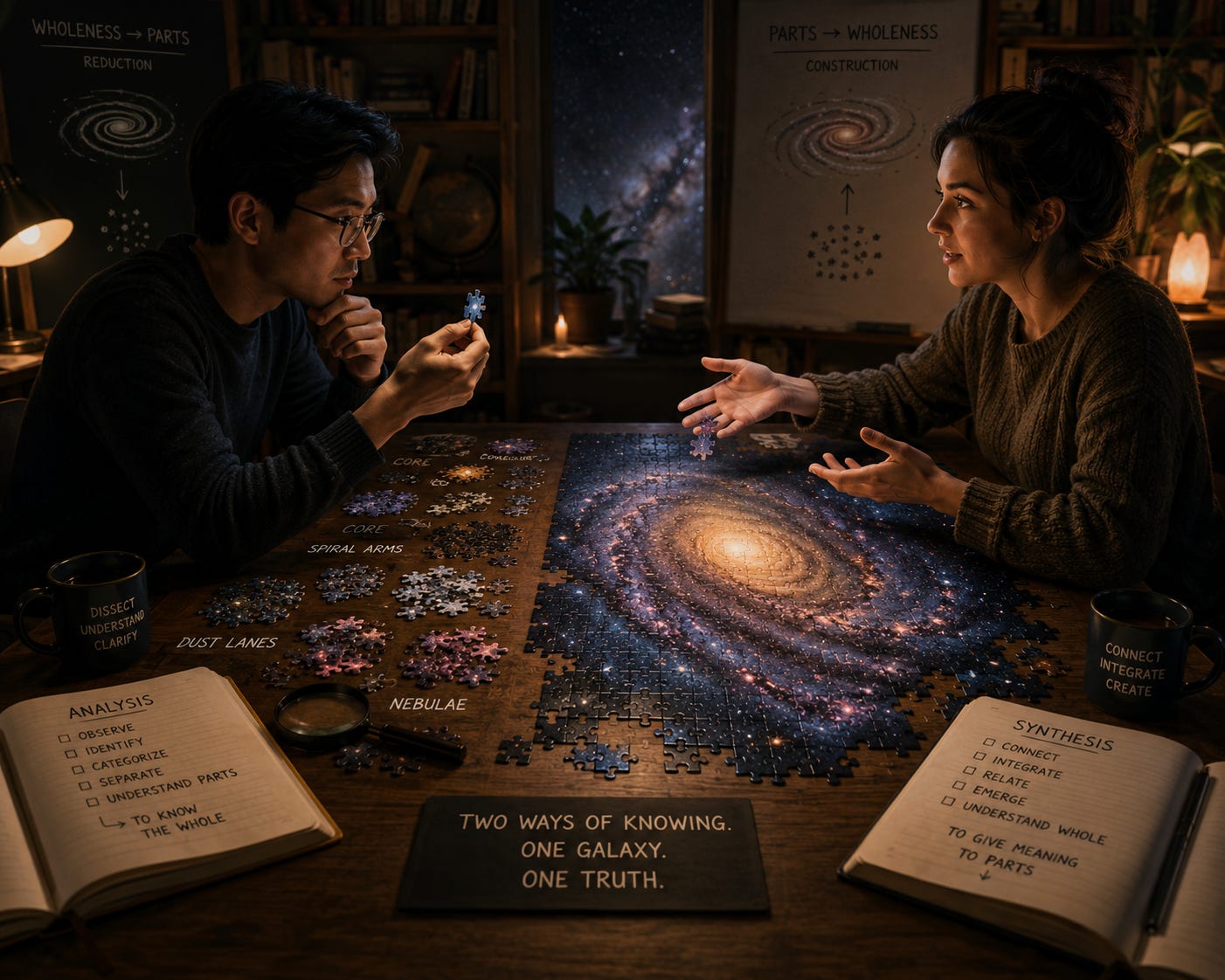
Analysis and synthesis are complementary processes, like breathing. We may see imaginatively, and feel in our movements, how we notice material parts that unite vibrantly into wholeness of life. This wholeness of movement is generated from within with our choice of focus, not imposed from outside as if a material container is squeezing or shaking us into its shape. No, it is from our inner core, through our relational heart, inside out, that we shape this locality of the cosmos, after which feedback reshapes the inside too.
We breathe continuously, and perhaps forget our inner core of life. The beating of our physical heart becomes, on those occasions we notice, a reminder sign that cycles in movement continue for a lifetime. That same truth is the inner heart of every nucleus of every atom and molecule of our tissues and our local environment. Analysis distinguishes parts; synthesis unifies the imaginations of life. Breathe in wholeness to every part, and breathe out that wholeness through every part into a union of heart and mind in your local environment. We thus contribute to the ecology for others, and they to ours. We are together forming a living temple of Life.
Change includes disruption and remaking. Life regrows after periods of destruction, so life is stronger. Within this Big Picture of wholeness, synergic patterns constantly reform in the turnover of life. We are going to explore what it means to say that these re-forming synergic patterns of movement, which we tend to separate into external matter and internal mind, are all made of mutual information, in both these outer and inner life contexts. But, and here is a Big But, information is not a noun. Information is a two-way verb. It is the spontaneous process in which form emerges as repatterning movement revealing a wider wholeness of context.
Imagine a totally dark scene in which a blip of light appears and disappears. You have just noticed a completed movement. It is a full cycle of appearing and disappearing.
All our senses can detect incomplete and completed movement. We notice lights switch off, for example, that we had not even been aware had been on because they have been providing general background illumination. Our senses detect change in relation to some contextual state that was previously patterned.
Movement is thus not the same as ‘change’, but we cannot detect movement without there being some change. Awareness of movement is completed when it returns to forgetfulness, as something else takes hold of your attention. While aware of movement, however, change is a quality of relatedness between formations.
If you think through the sorts of temporary experiences that your various senses give you, you can check the truth of this relatedness of formations for yourself: hearing, seeing between blinks, touching, smelling, tasting, temperature, pain, balance, joint position, muscle tension, hunger, thirst, boredom, intuition, human presence… All these are directly sensed with different sensitivities that come and go. Yet, we make a constant picture of lived experience out of the way they relate to each other.
It is remarkable that change is one of only three necessary and sufficient features of sensorium to detect movement: change, of relatedness, of patterned formations. Neuropsychological research has traced how sensory inputs to the brain are separated analytically in primary sensory cortex areas into these three and other interesting features.
These analysed features in all our senses then get re-sorted through ‘secondary sensory areas’, and rejiggled together in three ‘sensory association areas’. Finally, our combined senses and memories are projected forwards into the frontal lobes for the ultimate synthesis, blending to provide one integrated and patterned contextual picture in which meaningful movement is recognisable. Once movement becomes recognisable, responses can be consciously planned in imaginative feedback cycles of informational processing. We thus become active agents of movement or rest in a moving world, which has obvious survival advantages.
Do not believe the physicists who tell you there is no free choice. They have narrowed their vision into only whatever is measurable. They have chosen to ignore the immeasurable resonances of our utter relatedness.
A problem arises, however. Alongside all well-organised life forms, we human beings have developed highly sophisticated focusing abilities to sharpen our attention when planning movement. As mentioned above, to do this, various sensitivities are screening out. They are considered irrelevant to the task at hand. To analyse and plan targeted movement, a mental boundary needs to be set up… some sensitivities are in, some are screened out. An active agent ignores or forgets.
We therefore do not notice that, when we analyse situations, in order to guide our chosen actions we are setting up mental boundaries. It seems such a natural thing to do, to separate one thing from another, or to separate one process from another, that we naturally ignore the consequences of putting boundaries around objects of interest. We do this mentally. Most people, when asked to draw some object will draw a single line as an outline of the object. However, look at any painting and you will see that the boundaries are places of mutual transition between one colour pattern and another, or one shaded pencil area and another. There are no boundary lines in nature. Atomic nuclei are not separated from their electromagnetic and gravitational contexts. We draw the boundaries. They are different patterns of movement meeting in our informational sensorium. They are practical tools to plan how to handle about some relevant feature of life’s unending movement, or to talk with someone else about this pattern or that.
We pick up a jigsaw piece of the whole. Then later, when reflecting on what all these pieces mean, we may try to work out how the ones we have identified and named fit together to make a bigger picture. That’s what science is… a huge conversation about bits. But it is the wrong way around. Words to describe pieces get slippery in their meanings. People interpret them differently. They see different pieces to the ones we have created out of the resonances of wholeness on the move. The world ends up in people’s minds as bits of broken misunderstandings and emotive separations. But the resonance and proportionality of beauty is always there in the background… forgotten and ignored as we focus for our purposes.
This thinking style of analytical boundary-setting can be taken down to smaller and smaller scales. It generated the atomic particle view of matter. To summarise atomism as a philosophy, the ancient Greek thinkers Democritus and later Epicurus thought all human experience could be reduced to small ‘atoms’ being re-arranged in a container called space. Now, in this quantum field age, informationally moving patterns are more realistic. People may still imagine that sub-atomic ‘particles’ are separated mini-objects floating in a closed container in empty nothing and bumping into each other. If imagined like this, then the observing mind may also seem to be separated in some way from each jigsaw piece object, observed as if held in the hand ‘out there’ for a decision to be made ‘about it’. But scientists are now calling these ‘objects’ wave-particles. That is intentionally a term that boggles the atomising, analytical, observing mind. It inspires a sharp intake of breath. The boundaries are dissolving, as we learn to breathe gently in and out.
To a synthetic mind, however, wave-particles are not separated into mini-objects with characteristic patterns of behaviour. They are the characteristic ways that wholeness is manifesting its resonant nature to constantly resynthesise patterns of transforming relational movement. For those who can breathe out slowly while thinking or imagining, it’s like being in a re-creational dance hall with refreshments. When in a synthetic mind-frame, getting the scene and the music and conversational movement all together, there is informational activity everywhere all at once. The dance hall is the changing relatedness of repatterning formations… three features of the whole in one movement. What may be forgotten when enjoying the dance is the work involved in gathering and preparing the refreshments and food, and in clearing away and cleaning up once everyone has gone to rest. It’s a process in which we optionally participate.
In a mode of analytical thinking, however, people can step back from the dance and allow mental formations to separate them with boundaries of interest, redirecting their talk into business, for example. Boundaries, however, could synthetically be thought of as the meeting places of our minds with the dynamic world. They connect inner with outer informational movement. They are alive with potential for the renewal of movement into increasingly life-enhancing patterns. If imagining a dance taking place outdoors, then looking around at the local environment you might pause with some gentle breathing while asking yourself, “Does that fence I see separate two fields or gardens, or is it where those two fields or gardens meet?” This pause for heartfelt reflection draws us closer to the truth of analytic and synthetic movement in a 3-in-1 balance behind the Big Picture we construct of life.
No posts
Comments
Nothing yet. Say the first thing.
Sign in to join the conversation.