
“To go deep requires us to remain with difficult questions, relationships, practices, and commitments, while also remaining alive to God and to ourselves. It requires us to learn to exist, and to thrive, in places of incompleteness, unfulfillment, liminality, and uncertainty.”
- Tish Harrison Warren, What Grows in Weary Lands
There is often a lull.
All major moments have one. The initial quietness between birth and bringing home a newborn. The guttural gasp before a game-winning shot goes in. The early days of moving into a home and beginning to dream about what could be.
With cancer, it’s similar. (Though these examples are more positive.) Currently, our family finds ourselves between the poles of recovery and radiation. At this point, here’s the process:
Beginning in two weeks, Hilary begins radiation. There is a more insular part of the tumor they couldn’t take out, which radiation will target. This will include daily radiation therapy at the hospital for six weeks.
For all intents and purposes, this has been described as the hardest part of the process. She’ll lose a good portion of her hair. There are numerous other side effects that vary based on how her body reacts.
After this, she’ll have a month off to recover before six months of chemotherapy. Chemo for this form of cancer can be accomplished through pill treatments at home, paired with labs at the hospital.
As we shared with our boys, our hope is that she'll be back to normal by baseball season. Until then, as my high school OC reminded me, we're “running to the fight”—taking this challenge head-on, the best we can.
If you’ve missed any of our updates, you can catch up here: how we got here, surgery, her return home, her healing journey, and her cancer prognosis.
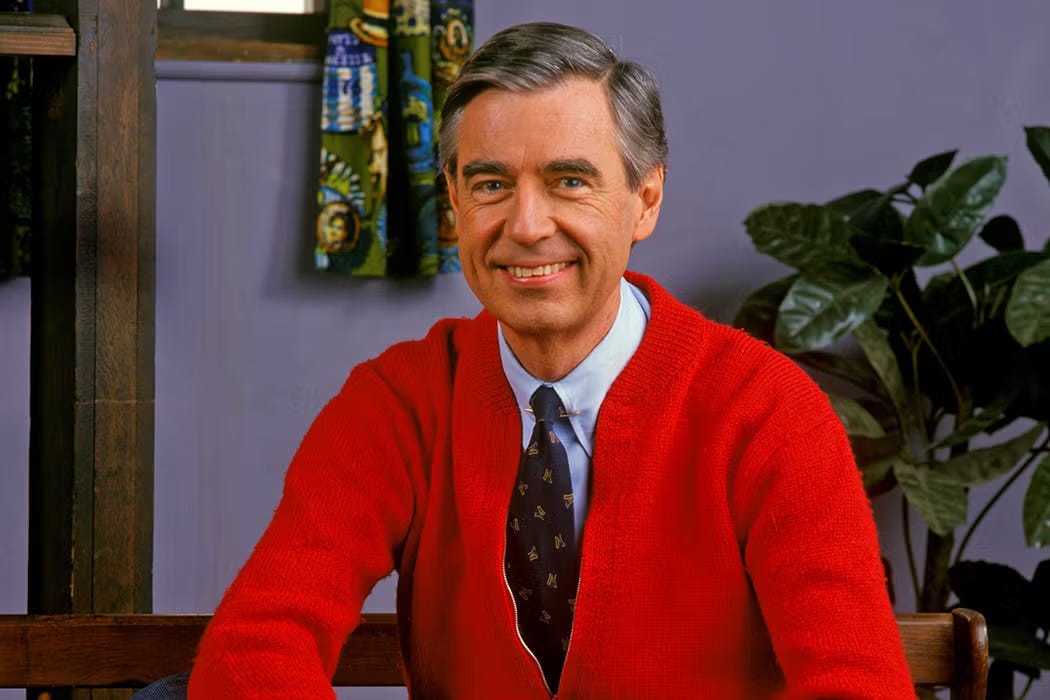
One of my top mentors as a coach is Fred Rogers. (I previously wrote a piece about his influence on my philosophy.)
While Mister Rogers may seem like a counterintuitive choice for a football coach, I truly believe the grind of the game is meant for something more. It is the difficult impetus of the sport, combined with its potential to form whole human beings, that is my “why” for coaching.
Going through this difficult moment has caused me to make space for the voices that have helped form me, including Mister Rogers.
It was a letter to a 4-year-old with leukemia that struck me most. At the heart of Rogers’ brief yet weighty response was a question:
I can understand there can be a lot of times when it’s hard to be brave…I wonder what helps you at times like that?
While asking a 4-year-old how they make sense of something as weighty as leukemia may seem unwise, there is a startling truth. At our earliest ages, there is an intuitiveness to the language of lament. We want to talk about what’s going on. We want to make sense of our world. Our hearts demand space to sit in the silence.
But then we become adults. A tad wiser, more clever in our own eyes. Too smart to make space for our most rudimentary emotions, so the door to grief is slammed shut. (Or, probably more like when my boys forget to shut the fridge—less intentional than accidental, though they should know better.)
As numerous pastors and mental health professionals have written, you transmit what you don’t transform. Like refusing to feel sore while trying to get stronger, the inability to feel our pain stifles our growth. To become timber that can stand the test of numerous storms requires a proper root system deep in the soil. But this only happens through struggle—and, a bit of sadness.
Without it, at some point, it can all feel like too much.
“Life goes on, even in the middle of sadness.”
- Fred Rogers, Dear Mister Rogers
It’s a heightened awareness of death that makes life both terrifying and terrific.
In one regard, the realization of the brevity of life feels like staring into a thick fog off the bow, not sure how far out it lingers, constantly tormented by the potential traps ahead as you try to make your way back to shore.
But on the other hand, the shortness of life demands a wrestling with what is and is not significant. It is only through the constraints of life that important choices are made—what is a game without the parameters of the field?
If anything, grief is like Jacob wrestling with God. Though left with a lifelong limp from an all-night, no-holds-barred match that leaves more questions than answers, he emerges having encountered the intimacy of God’s presence—the beauty of God’s blessing. It is the willingness to step into the ring and wrestle with weighty, holy matters that makes life worthwhile.
When brevity suddenly breaks in, the choice is ours. A parent becomes seriously ill. A spouse is diagnosed with cancer. Your dog suddenly dies. The choice to step into the ring—to live life in the middle of the sadness and surrealness—remains.
Life is limited. There is a foreseeable expiration date—these goods won't last forever—which demands that decisions be made in the midst of the mayhem.
What will you do with this brief yet beautiful life?
One of my boys was crying. A lot.
Surprisingly, it wasn’t because he’d found out about my wife’s cancer prognosis. My mom’s dog was expected to be put down soon. This was one of the first times the boys had to grapple with death. (What can I say? When it rains, it pours.)
Death is always difficult, no matter the age. Nonetheless, in our youth we begin to wrestle with brevity for the first time. And we learn from the adults around us how to cope, how to process, and how to grapple with grief.
One of the perks of having been a pastor is that you learn to sit with people in suffering. I learned long ago that the most important aspect of helping people cope wasn’t the answers I provided.
The most important aspect was cultivating a ministry of presence. Being still. Providing a listening ear. If solutions arose, then so be it. But if not, often the best answers were less about what was said and more about what was communicated through genuine connection.
When my boys were sad, we created space in a comfortable place. We let them cry. We demonstrated that grief isn’t a game with a clear winner or loser, or a goal to be mastered in short order.
We all leave bloodied after falling into grief’s grip, so all that matters is pressing in—a little longer, just past the point of comfort.
In the end, what more could we ask for?
Our world has been turned upside down quickly, so thank you for your patience and grace as we learn what this season demands.
For those who have asked how they can bring us a meal: A close friend created a Meal Train for our family. You can find it here.
For those who have asked how they can follow along: If you’d like to receive updates, you can subscribe below.
For those who have asked how they can support us financially: If you’d like to support our family financially, you can do so via Venmo: @hilary-horn
I love explaining things through books.
If you have little ones wondering more about cancer, our kids have found the picture book Ask Puff! A Kid’s Guide to Understanding Cancer incredibly helpful. While it doesn’t necessarily address the underlying emotions, it does a wonderful job of explaining many of the complicated questions that naturally arise.
I’ve also deeply appreciated Tish Harrison Warren’s What Grows in Weary Lands. While her audience isn’t necessarily people in a situation like ours, but those navigating the weariness of everyday life, her words have nevertheless provoked numerous new thoughts while also providing solace in the midst of difficulty.
Enjoy!
No posts
Comments
Nothing yet. Say the first thing.
Sign in to join the conversation.