
* As updates on Hilary become less frequent, I’ll include a cancer update after the reflection. There’s one at the end of this post.
“Dad…why’s it always the end of the world?”
While this may sound like an honest admission from an 9-year-old about trauma or my wife’s treatment plan, it had nothing to do with either. It had to do with Spider-Man.
In preparation for Spider-Man: Brand New Day, we’ve been rewatching all of the previous movies. This is our boys’ first experience with the superhero genre, so they’ve had a fresh perspective.
Honestly, I didn’t really have an answer. All I could muster was that they wouldn’t really have a story without the extremes that exist outside the bounds of normal life. Who wants to watch a superhero take out the trash?
While this is true, part of the problem is that our stories rarely have the same kinds of stakes.
Life is much fuzzier: hard to distinguish heroes from villains, climaxes from rising action, with multiple characters’ plot lines unfolding simultaneously. Or, to borrow from the world of sports, it’s difficult to define the shape of the playing field, the time left on the scoreboard, or even who you’re playing against.
Nonetheless, everyone has to play the game—and whether intentionally or not, everyone has a strategy.
A lot of things can feel like the end of the world when they’re really not. Like passing on the $50 caricature at the fair, avoiding the twin extremes of catastrophizing and wishful thinking helps us become a little more grounded—a little less in the clouds.
Some respond to life through catastrophizing. If you beat disappointment to the punch, then you’ll never be truly caught off guard. You’ll expect it, see it coming, and be prepared for life’s inevitable downturns.
While this is surely an extreme, doomsday preparers fully adopt this approach. They rehearse cycles of potential trauma like the script for a play soon to open on Broadway. And the longer they live this way, the more they starve their souls of the other half of the unknown: unexpected beauty in the badlands, dreams that could come true despite life’s inevitable downturns, love that could last if you were willing to swim through the ocean of disappointment a little longer—a little more vigorously.
The other extreme is just as problematic: wishful thinking. Whisked away by avoidance, you can live a life where suffering is swept under the rug with a smile. While the world may see a picture of peace, you can be deeply struggling inside—hopelessly lost, longing for someone to cross the sea to the island of your soul.
Self-help can drift into this terrain. That’s not to say visualization, positive self-talk, or aspirational thinking aren’t important. But they don’t replace dealing with difficulty through the heavy lifting of sitting in sadness. Surely, you should not stay there forever. But putting on sackcloth for a little while is how tremendous sadness has historically been transformed into a beautiful offering for the world.
There’s a third way, though. An approach that leaves room for both dreaming and disappointment. Something more nuanced—even more demanding. Something more human, and a little less heroic.
A way called wonder.
“We learn to live in the cloud of unknowing, not only the cloud of God’s mystery, but the cloud of unknowing what is going to happen from day to day. That is always true, but when things go along routinely we are less aware of it.”
– Madeleine L’Engle, Two-Part Invention
Life happens. A bit of turbulence. An unforeseen landing. Plans go awry, and you suddenly feel a little less in control—more aware of the thin veil separating your plans from your pride. You are not the captain. You’re merely a passenger along for the ride.
When you find yourself in a time like this, the discipline of wonder matters.
To choose wonder, a prerequisite is allowing yourself to wander. It’s like the often-quoted J.R.R. Tolkien line: “Not all those who wander are lost.” To wander is an integral part of dealing with disappointment and discovering new dreams—and something that has been largely lost in our hyper-efficient world.
While many of today’s stories celebrate young people changing the world in short order, I’ve found myself resonating more with saints and pilgrims of old who spent their lives in caves and constant downturns—who were tested, yet kept getting up, kept answering the call to wander into the unknown.
Think of Abraham. After receiving the grand promise that through his family line the nations would be blessed, he largely lived as a pilgrim in a foreign land, with little land and few descendants. At times he was as faithless and fickle as you could imagine, but he kept wandering—kept believing.
Surely, just because someone wanders doesn’t mean they’re choosing wonder. To wander without wonder is akin to going somewhere without your Maps app—sorry, Tolkien, but you’re just lost at that point. But to wonder is to fill the cracks of pain with purpose.
This is one place where sports offer a helpful parallel. A few years ago, when my high school team upset a team well out of our league, a coaching friend reminded me, “That’s why you play the game.” Part of what makes both sports and life so compelling is that you never fully know the outcome.
In our first set of appointments with doctors about my wife’s recent cancer prognosis, one of them mentioned that one of the hardest parts is dealing with the countless unknowns. When you’re told it’s not an if but a when regarding the return of this terrible disease, the mind naturally drifts toward either the worst-case scenario or willful ignorance. But both belong to the extremes of superhero movies—not reality.
Honestly, I only know this because of my faith. It is God who invites us, in his kindness, to break down the binary of winning and losing that defines our world—to deconstruct the edifice of certainty—to create a table large enough to seat the immensity of life’s inevitable disappointments right next to the impossible dreams that defy logic.
Surely, in the short term, our goal is to “beat” cancer. (And we are doing everything medically possible to do so.) But long after this victory, when an ominous cloud of unknowing descends, when worry wants to consume both mind and heart, wonder is the way we’re navigating the fog.
I’m not sure there’s another way.
It’s been fun to see Hilary feel more like herself. She’s leaps and bounds better after surgery—we even made our most daunting trip yet: a family trip to Costco. We’re holding this space with joy, knowing that some of the hardest steps still lie in the month or two ahead.
Beginning Thursday, August 13, Hilary begins radiation. As previously shared, this will be a six-week process where we go to the hospital every weekday (Monday–Friday) at roughly the same time for treatment.
As we’ve learned, the actual radiation itself doesn’t take very long—less than 30 minutes. But each visit is expected to last around an hour, in addition to the drive to and from downtown Seattle.
This is expected to be the most difficult part of the journey, but we're grateful for the love, encouragement, and prayers of so many. If you’ve missed any of our updates, you can catch up here: how we got here, surgery, her return home, her healing journey, her cancer prognosis, and her treatment process.
Our world has been turned upside down rather quickly, so thank you for your patience and grace as we’ve been learning what this season demands.
For those who have asked how they can bring us a meal: A close friend created a Meal Train for our family. You can find it here.
For those who have asked how they can follow along: If you’d like to receive updates, you can subscribe below.
For those who have asked how they can support us financially: If you’d like to support our family financially, you can do so via Venmo: @hilary-horn

Sometimes, you just need a laugh. Maybe that’s the second discipline to accompany all of my philosophical wonderings above. Here are a few shows (and one movie) that are perfect for shutting your brain off and giving yourself a night off:
The Hawk (Netflix) - I’ll admit, we’re in late-stage Will Ferrell. A story about a once-famous golfer—whose fans will never forget either his highs or his misses—trying to battle Father Time is about as autobiographical as it gets. But as a kid who grew up on Talladega Nights, Step Brothers, and Anchorman, I’ll keep watching until the wheels fall off.
Hacks Season 1-5 (HBO Max) - I’m way behind on this one. It’s won numerous Emmy Awards and just landed a record 24 Emmy nominations for a comedy series this year. People have been talking about this story of a washed-up comedian trying to rediscover her voice for years. But such is life. I’m here now.
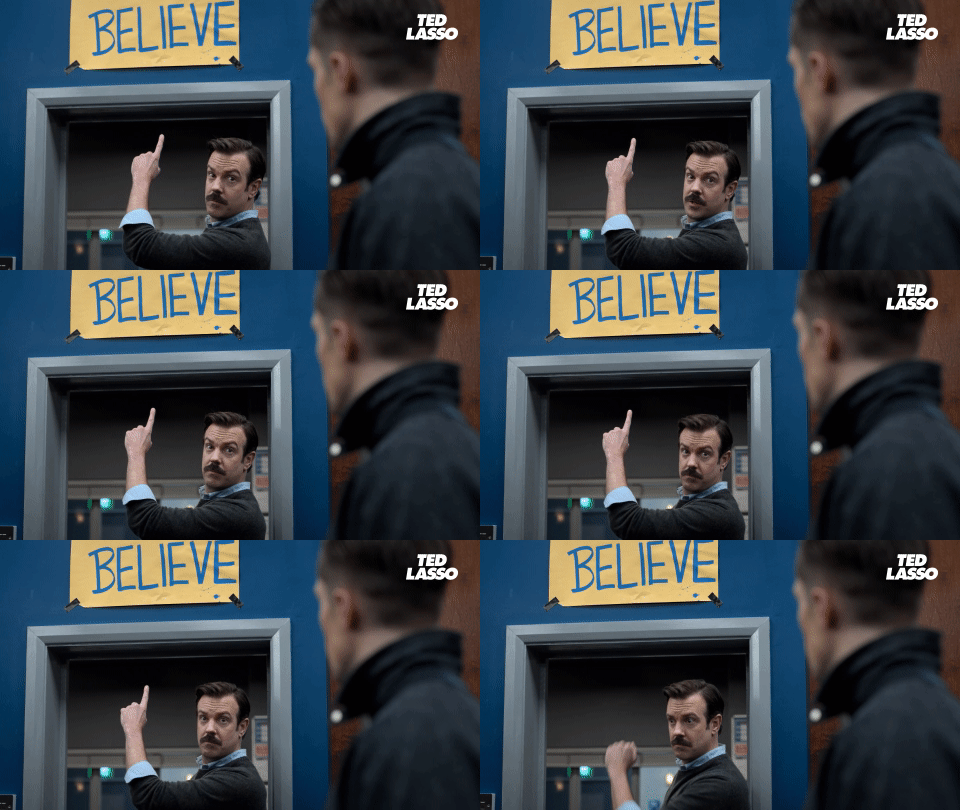
Ted Lasso Season 4 (Apple TV+) - I have no idea whether this season is a streaming cash grab trying to get the gang back together for one more payday or a genuinely reinvigorated show with more story to tell. Either way, I’m in—for now.
Masters of the Universe (Amazon Prime) - Is there a cheesier movie I’ve seen in recent memory? Probably not. But if you need a night to turn your brain off, throw this bad boy on and allow yourself to take life a little less seriously.
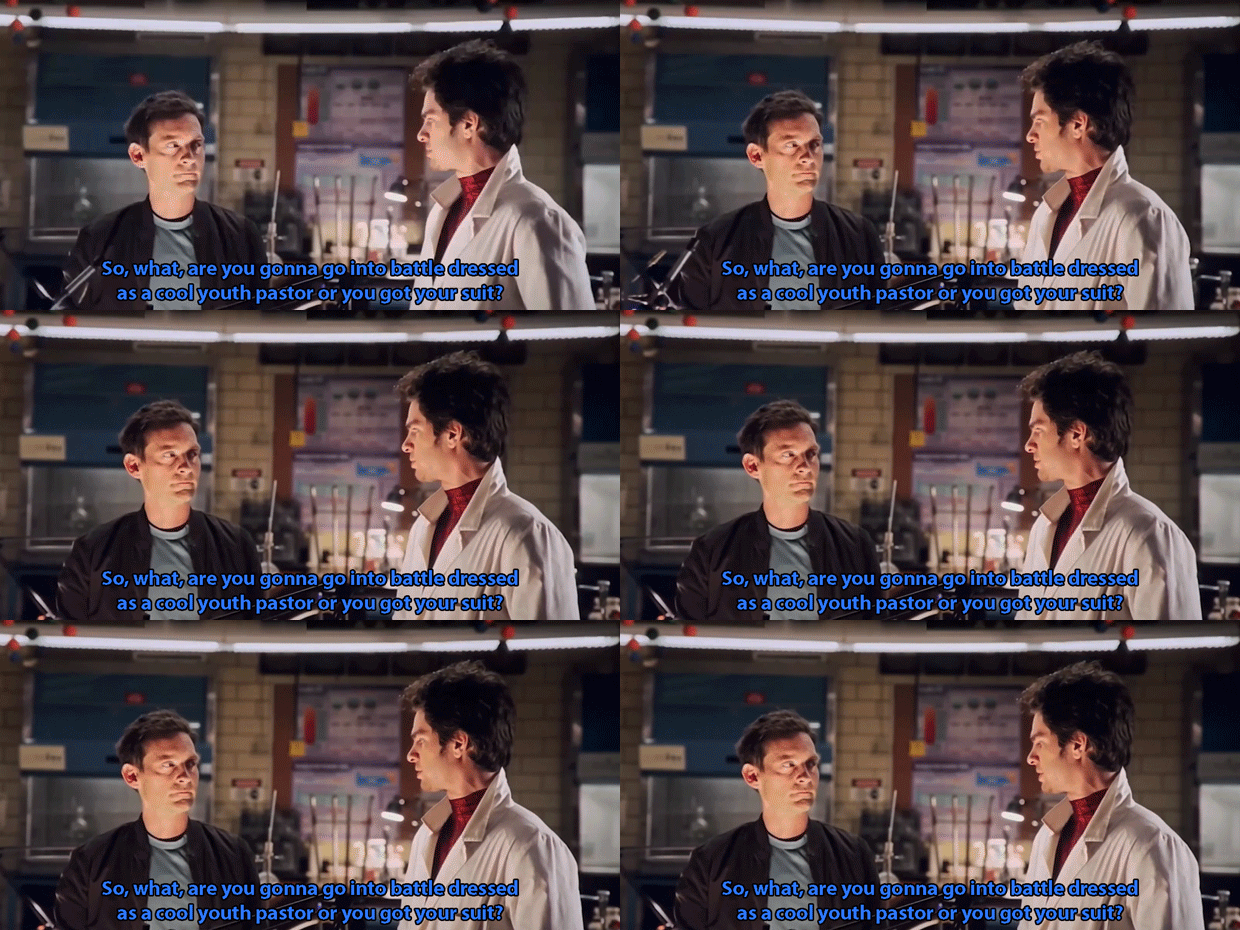
One of the best lines in any Spider-Man movie.
Tobey Maguire was a vibe.
I have no more to say.
No posts
Comments
Nothing yet. Say the first thing.
Sign in to join the conversation.