
Yesterday, US Air Force C-17 Globemaster III landed at Moscow’s Vnukovo Airport, after which a large American motorcade with diplomatic plates was seen going towards the Kremlin. It later emerged that CIA Director John Ratcliffe paid a visit to Moscow. Neither the visit, nor its real purpose were disclosed to the public, triggering a flurry of speculation.
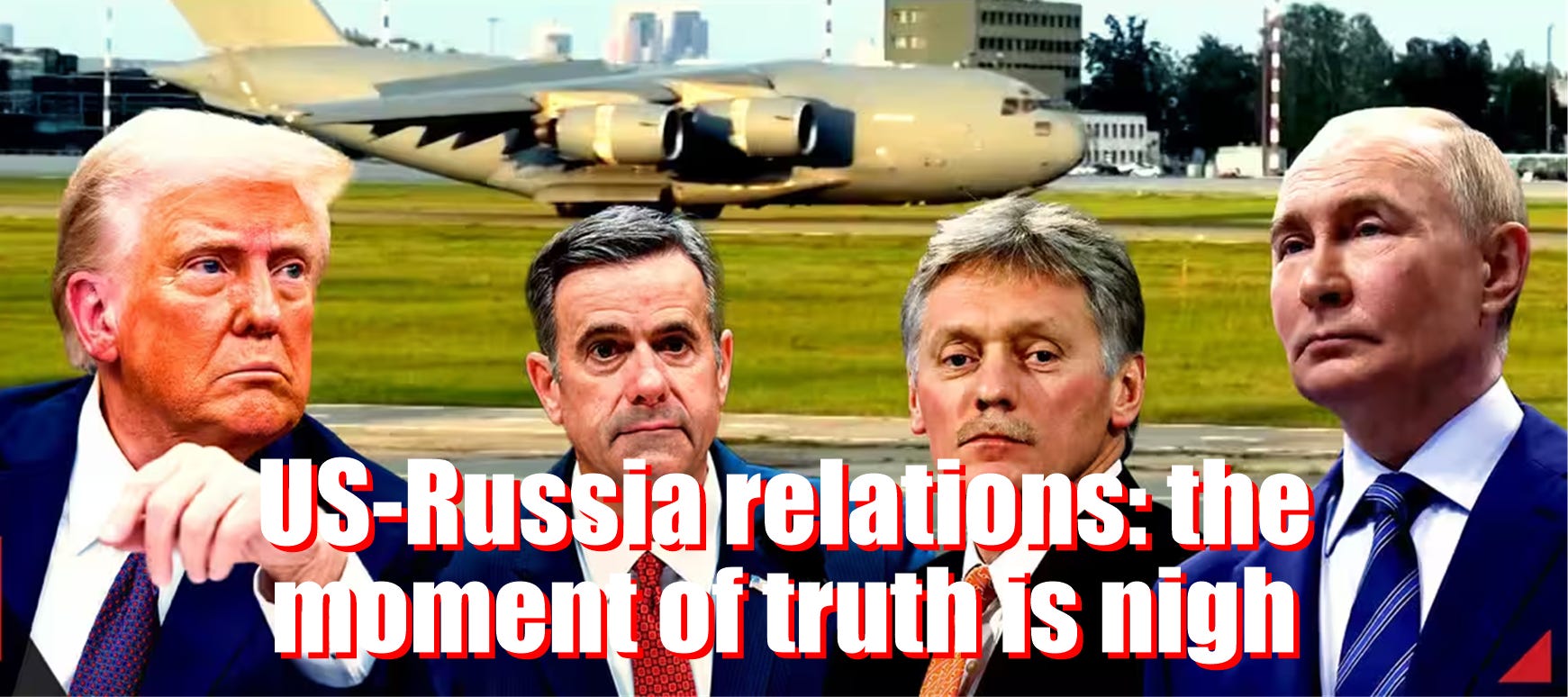
According to the Wall Street Journal (WSJ), Ratcliffe arrived in Moscow after the US gathered intelligence indicating mobilization preparations and plans to test NATO's resolve. The U.S. has apparently collected intelligence showing Russia’s early preparations for a possible military mobilization in Ukraine and plans to test the North Atlantic Treaty Organization’s strength and resolve.
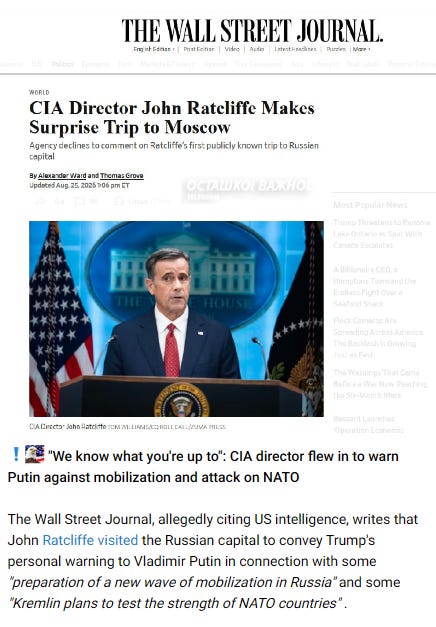
Former Deputy Director of US National Intelligence Beth Sanner told WSJ that Ratcliffe may have met with Putin to deliver a warning along the lines of: "We know what you are going to do, and you'd better not do it." Russian sources had a somewhat different take.
Political analyst Henry Sardaryan, dean of the Faculty of Governance and Politics at MGIMO in Moscow, claimed that Ratcliffe’s visit was probably an attempt to establish whether a broader US-Russia deal is possible. Sardaryan, who’s a part of Russia’s foreign-policy establishment, wrote that Ratcliffe’s role is unlike that of Steve Witkoff’s, and that the purpose of his visit was to determine whether Kremlin was inclined to make a major deal with Washington and what their asking price would be.
I believe that Sardaryan’s take is more credible; telling Putin that “we know what you are doing, etc.” could just as easily be done over the phone or by sending General Keith Kellogg. It would not have required the very visible entry with military aircraft and a large motorcade. Given that Ratcliffe’s visit came only a day after Treasury Secretary Scott Bessent announced the Operation Economic Outcast against Iran, it’s more than plausible that the proposed deal was related: perhaps Ratcliffe asked Moscow to end their support for Iran in exchange for the US ending their support for Ukraine. According to Iranian officials who were briefed about the meeting, Ratcliffe also asked for help opening the Strait of Hormuz. This would not be the first time Russia’s Western partners offered a compelling deal and made tempting promises. Not long ago, they asked Russia not to intervene in Ukraine in exchange for Western partners guaranteeing the implementation of the Minsk I and Minsk II accords. The accords were duly signed, but Western powers never had any intention of honoring their commitments. Russia was also asked in 1989 to withdraw its troops from Eastern Europe against the promise that NATO would not move one inch eastward. The Russians withdrew, and then NATO moved all the way to Russia’s borders wherever it was able to.
Such experiences make it very unlikely that Russia will be tempted by whatever Ratcliffe offered and that it would end their support for Iran. By now, Russia sees their strategic partnership with Iran and China as existential, as do Iran and China themselves. Their foreign policy establishments appreciate that making it easier for the West to pick off one of them would later empower it to turn on the others.
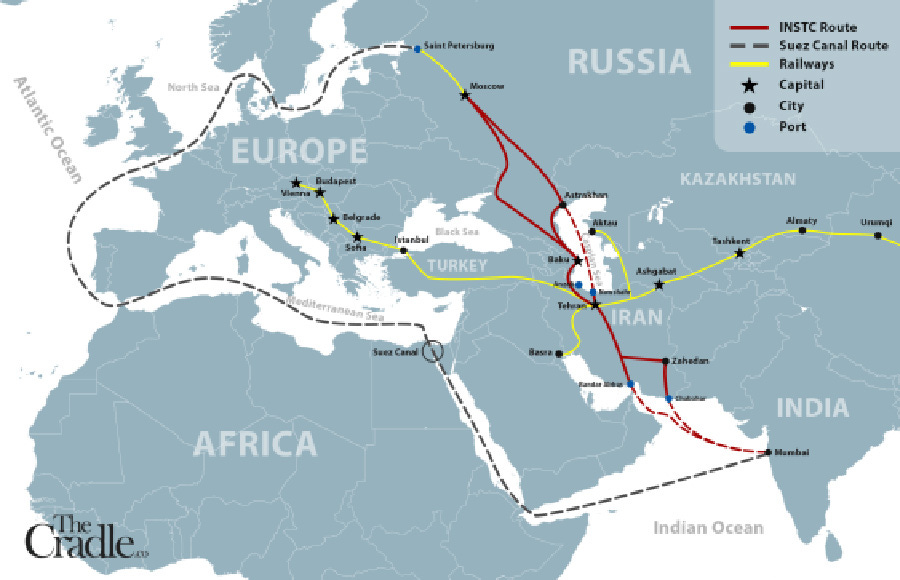
Iran is the critical node of China’s belt and road initiative as well as Russia’s International North-South Transport corridor. If these trade routes were cut, or fell under adversarial control, both Russia and China could be vulnerable to US-controlled chokepoints. If Iran pivoted to the West, that would include the Strait of Hormuz as well as the Bab-el-Mandeb Strait.
Furthermore, Western powers have proven very cunning and effective in orchestrating proxy wars against their adversaries: in the same way that Ukraine was successfully weaponized against Russia, Russia could in time be weaponized against China if a Russian version of Volodymyr Zelensky were ever installed in the Kremlin. For all these reasons and more, it would be folly for either one of those three powers to cut a treacherous deal with the US at the expense of their strategic partners.
Ratcliffe’s visit to Moscow furthermore raises the suspicion that President Trump’s outreach to Vladimir Putin wasn’t so much about improving US relationship with Russia for any right reason, but a calculated ploy to push a wedge between Moscow and Beijing and between Moscow and Tehran. Ukraine could in that case be sacrificed as a bargaining chip to buy Russia’s goodwill and collaboration.
Unfortunately for the Trump administration, in spite of the fact that Vladimir Putin always sought to improve relations with the US, he is not likely to jeopardize Russia’s long-term security by betraying and alienating her partners and allies. Besides, the bargaining chip of Ukraine is by now so thoroughly beat up, it could hardly sweeten any deal Ratcliffe might have proposed. In fact, Ukraine could be close to collapsing and Vladimir Putin seems ready to deliver it a coup de grace.
Only a few days ago, he warned that Russia has reached its limit with Ukraine’s attacks deep inside Russia:
"Kiev opened Pandora's box when it launched strikes on civilian targets. … They themselves let the genie out of the bottle - they began to hit our civilian enterprises. Opponents have long dreamed and constantly talk about the goal of bringing Russia to collapse. Therefore, the attempt to ‘defeat her in 40 days’ was another adventure of Kyiv and Western curators.”
By “Western curators,” Mr. Putin meant the US, UK and NATO. All that suggests that whatever concessions, or help that President Trump and John Ratcliffe hoped they might obtain from Moscow will come up short of their hopes. That, in turn could lead us back to the US and Russia overtly being adversaries which, exacerbating the risk of a very serious military escalation at some point in the near future, which is a very bleak prospect.
As if that all wasn’t ominous enough, yesterday brought more bad news. Just as John Ratcliffe was visiting at the Kremlin, the Amur Gas Chemical Complex, the $10 billion joint venture between Russia’s SIBUR (60%) and China’s Sinopec (40%) went up in flames, killing at least 3 workers and injuring some 150. The site is located about 6,000 kilometers from Ukraine and was was only weeks away from starting production. Whether this incident was yet another Ukraine attack or just an accident, the Russians have every reason to suspect that it was the former, further wearing down Russia’s patience.
Things are also escalating ominously in the Middle East. This morning’s reports suggest that Kurdish forces have launched a ground invasion into Iran, which is a huge development. Tensions are also rising between Ankara and Tel Aviv: Turkey sent a large contingent of 450,000 troops to Syria - a development that we should keep on the radar as it could draw Israel into yet another military conflict, this time against a NATO ally. To say that this puts the United States in an impossibly awkward position would be an understatement. An open conflict could also draw in Greece on the side of Israel and precipitate the final collapse of the NATO alliance. The year ahead looks like it will be extremely busy and extremely unpredictable.
To learn more about TrendCompass reports please check our main TrendCompass web page. We encourage you to also have a read through our TrendCompass User Manual page. For U.S. investors: an investable, fully managed portfolio based on I-System TrendFollowing is available from our partner advisory (more about it here).

With yesterday’s closing prices we have the following changes for the Key Markets portfolio:
Comments
Nothing yet. Say the first thing.
Sign in to join the conversation.