
Yesterday, Treasury Secretary Scott Bessent announced a major US economic assault against Iran. In a Financial Times OpEd, Bessent wrote:
"At dawn begins an economic D-Day, the single greatest financial offensive ever marshalled against an adversary. Our objective is to sever every economic lifeline that sustains the tyrannical regime until Tehran stands alone."
The new initiative was named “Operation Economic Outcast,” after some alternative names were eliminated. According to three sources familiar with the matter, other proposed names included “Operation Sheer Desperation,” and “Operation Kitchen Sink.”
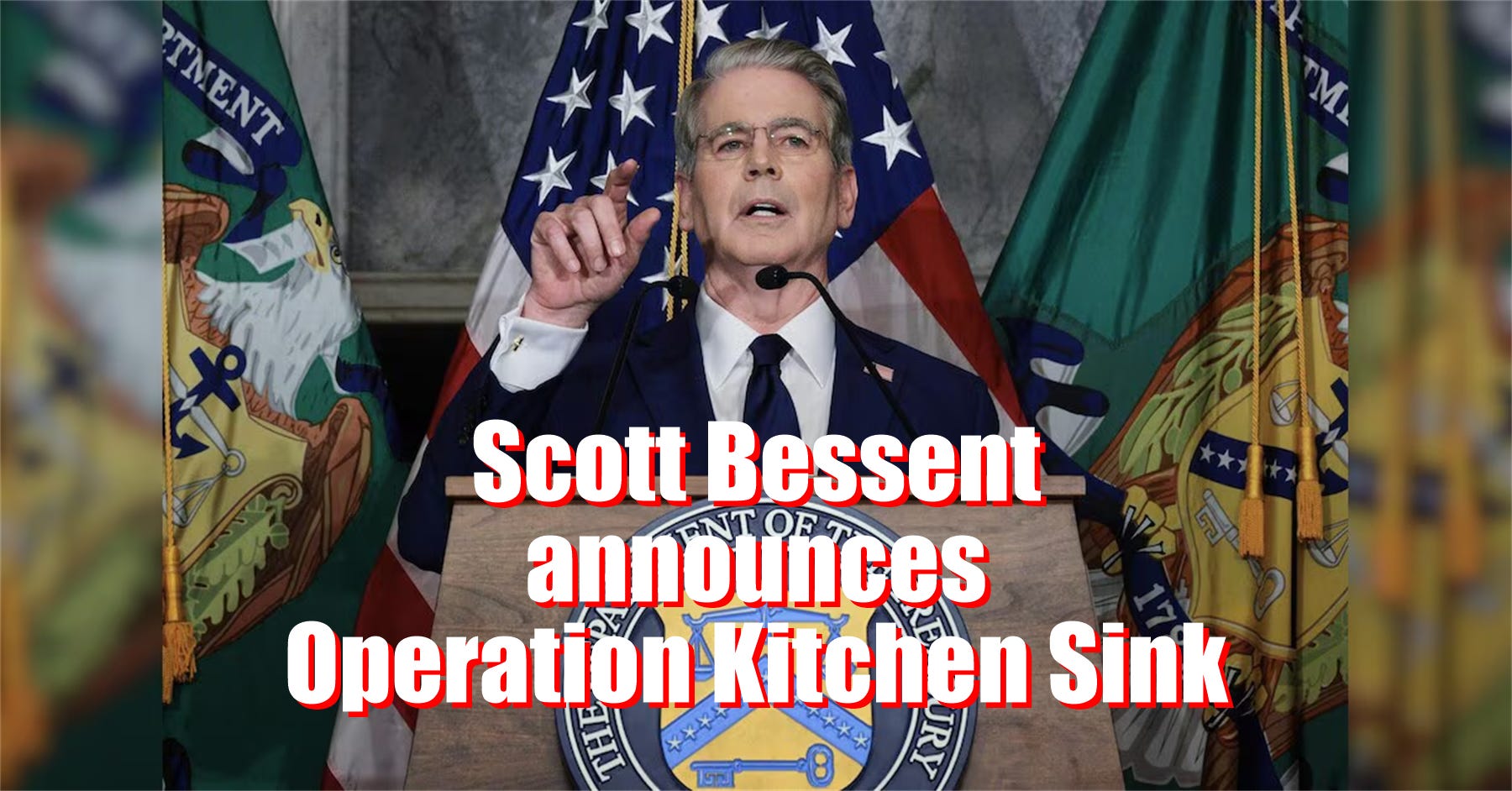
Jest aside, something about this latest gambit seems so radical, reckless, and fraught with potential for unintended consequences, it reeks of desperation.
President Trump launched his war of choice against Iran on 28 February and conveyed his expectation that it would be a “four- to five-week” affair. He even characterized it as a “little excursion” to dismantle the military threat posed by the radical Islamic regime in Iran.
However, the “little excursion” turned into a quagmire and 178 days later, the hailstorm of consequences is still battering the administration: interest rates are soaring, as are the oil prices; US military’s access to the region has been severely restricted, at least 16 military bases have been substantially destroyed, morale of US troops is in the toilet and Tehran seized control over the Strait of Hormuz, one of the most important maritime trade choke points.
Since bombing Iran “like nobody’s ever seen before” didn’t achieve the desired objectives, various other measures were tried or war gamed, but they either failed, or were aborted before any serious attempts were made (like the land invasion). Allegedly, using nuclear weapons against Iran was seriously considered, but thankfully, it was ultimately shelved. Thus, Operation Economic Outcast comes after six months of failure.
The operation’s stated objective is to fully isolate Iran and make it an economic outcast by severing “every economic lifeline” that sustains it, forcing Tehran into a choice between complete global isolation or a path back to normalcy and reintegration into the global economy - on U.S. terms. It marks a shift from “managing” the Iranian threat to “ending” it, as some officials have characterized it.
Among the announced measures, the US will target entities from third countries, including companies, banks, and governments that continue any economic engagement with Iran. That includes buyers of Iranian oil, shipping companies, financial intermediaries, and others. Apparently, many nations have already been given timelines to shut down their business dealings with Iran.
Non-compliance entails unilateral U.S. action and exclusion from the U.S. dollar system. In his FT writeup, Bessent said that, “… any nation that serves as a financial artery of a withering regime should expect to share in its isolation…” All countries must choose between the US or Iran, said Bessent, and poverty will be the punishment for those who fail to choose Washington. The fate of “those who tether themselves to Tehran is the foreclosure of any path to lasting prosperity…” Wow.
The nations “tethering themselves to Tehran,” are those that have a trade relationship with Iran, which includes over half of all nations in the world - some 100 of them! The Trump administration is now forcing them all to choose: cease all trade with Iran, or become an economic outcast yourself. That’s a shocking level of heavy-handed coercion, which comes with a significant risk of back-firing.
Iran’s top trading partner is China, which accounts for 30% of Iran’s imports and 13% of its exports. China has been buying up to 1.8 million barrels of Iranian crude oil exports per day and forcing China to give up on this trade (or else…) is simply dismaying. Furthermore, many of Iran’s major trade partners are US allies, including Turkey, Pakistan, Iraq, Japan and India. As a result the effectiveness of this Operation Kitchen Sink will depend on their compliance, which is not a given.
President Trump has already been contacting world leaders and other officials from the US Treasury Department and US State Department have been engaging their counterparts around the world in an effort for the new sanctions to pack as much punch as quickly as possible. However, imposing hardship on other nations and many allies will certainly elicit resistance and resentment. With time, Operation Economic Outcast will almost certainly include so many exemptions and workarounds that it could soon become only a marginal nuisance for the Iranians.
In the end, Trump administration’s heavy-handedness will accelerate de-dollarization of global trade and a growing adoption of alternative means of trade settlement. Ultimately, this will weaken US trade relations and discourage nations from holding significant reserves in US dollars, ultimately suffocating global demand for US Treasury instruments. This may force the administration into financial repression at home (forcing US investment funds to buy government debt) and the monetary authorities into ever greater monetization of government debt, leading potentially to hyperinflation and economic collapse.
The fact that the Trump Administration is risking all these consequences to win the war that they already won many times over in the last 178 days is simply stunning. It’s telling the world that actually defeating the government in Tehran requires the whole world coming together and closing ranks behind the ruthless hegemon. It’s an admission that Iran won the kinetic aspect of the war
It is also a demonstration of just how far the hegemon is prepared to go to bludgeon an independent nation into submission. Any forward thinking leader or government will understand that whatever they’re prepared to do to Iran, they could do to them in turn. It’s not a good way to build alliances.
One would think that nobody in that position of power could possibly be as reckless as that, but it seems that one would be wrong.
To learn more about TrendCompass reports please check our main TrendCompass web page. We encourage you to also have a read through our TrendCompass User Manual page. For U.S. investors: an investable, fully managed portfolio based on I-System TrendFollowing is available from our partner advisory (more about it here).

With yesterday’s closing prices we have the following changes for the Key Markets portfolio:
Comments
Nothing yet. Say the first thing.
Sign in to join the conversation.