
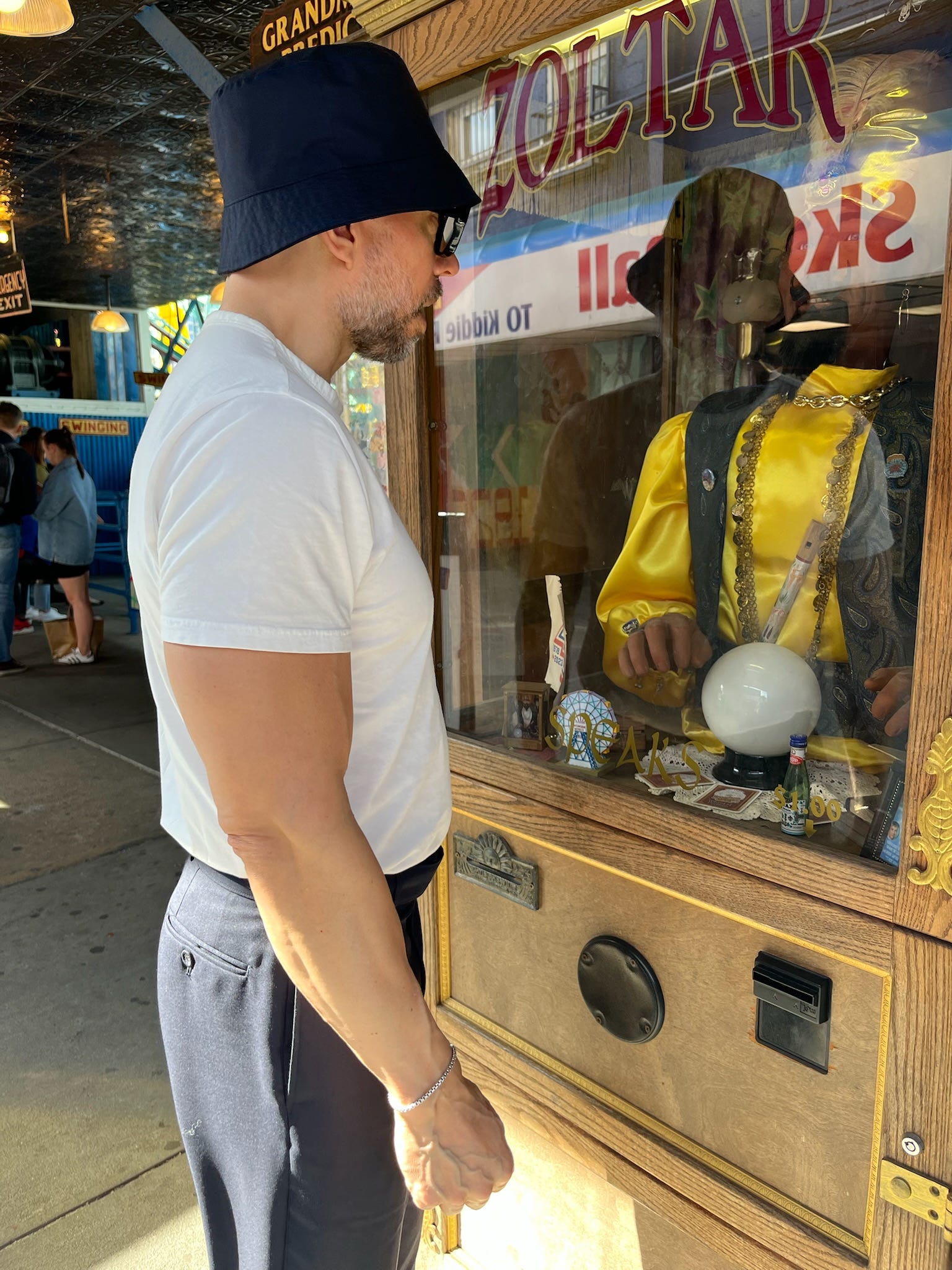
The people who worked with me over the years would tell you, without hesitation, that I’m an extreme extrovert. The guy who could nail a pitch, work a room, charm a reporter, and own the boardroom. They watched me do all of it for decades, so I understand why they believe it.
Truth is, they’re wrong.
I’m an introvert who got good at my craft.
I started my career backstage, literally, and that was no accident. Backstage is where introverts often begin. It’s where you can be essential to the show without being in it, hands-on without being looked at. What carried me from there to Chief Creative Officer wasn’t a personality change, because my personality never changed.
What changed was mastery.
When I know a topic backward and forward, I can be very gregarious, and for years people mistook that fluency for temperament. But put me somewhere I hadn’t earned that mastery, and the introvert was right there the whole time, quiet, careful, and holding back.
I get butterflies before every big proposal, every stage I take, every interview, and every panel. Every single time, and still now. The extrovert everyone remembers was craft. The butterflies are who I am.
From my experience, people at large believe sales belongs to the naturally outgoing, and agencies hire on that belief, promote on it, and systematically write off the shy, quiet types. After four decades of selling, being sold to, and awarding the contracts from the buyer’s chair, I have come to think that the belief is wrong in both directions. Having comfort with strangers never predicted who closed, but comfort with the subject did.
True confession about the price tag before I tell you what worked, because silent mode has a cost.
Early in my career, I was in a brainstorm pitch for a local television station called NYC 25. They wanted to update a legacy brand with a whole new look and feel.
This, as you know, is a dream project for a creative. Imagine the scene like this: There were creative directors, designers, marketing folks, and executives around the table, and me.
Sitting there listening quietly, I had an idea: shoot all over the city and find the number two and the number five and the letters N-Y-C everywhere they already existed, on buildings, signs, storefronts, subway tiles, manhole covers, then combine them into logo IDs, branding, stationery, the whole on- and off-air packages. The city itself would spell the channel.
I looked around at the experience in that meeting and decided my idea was weak and amateurish, so I kept my mouth shut.
A few minutes later, a creative director, with 20 years on me, excitedly blurted out the same idea and was greeted with a cacophony of yeses and brilliant idea! I spent the rest of the meeting nodding along to my own thinking, agreeing about what a great concept it was instead of being the person who said it, and then it got made (without me). That campaign became the package the channel went with. My idea was strong enough to become the brand. It just wasn’t mine anymore, because thinking isn’t authorship, but speaking is.
I recently listened to the audiobook version of The Creative Act, and in one of the chapters, Rick Rubin lays out his theory that the universe gives you ideas, and if you don’t act on them quickly, it gives them to somebody else. I didn’t hear that line until decades later, and when I did, I saw that conference room table again. In my case, the universe didn’t even wait a week. It handed my idea to a dude sitting three feet away from me a couple of minutes later.
Different versions of that kept happening every time I started a new job and stood outside my domain and comfort zone again, pushing myself to learn and listen until the mastery arrived, holding ideas I didn’t feel senior enough or qualified enough to voice.
There was another cost that I find very sneaky. I used to think I struggled with motivation before doing the work with the highest exposure, things like outreach, pitching, or cold conversations.
Eventually I understood the low motivation was never the problem. It actually was a defense mechanism. To be honest, I wasn’t unmotivated one bit, I was avoiding the thing that scared me and burying the avoidance under justified excuses. Statements like I didn’t sleep well, I have a client to focus on, and my number one go-to was I’ll do it tomorrow when I’m more on my game.
The introvert doesn’t own their fear. They just move it around the calendar.
Over the years I have come to believe that extroversion carries its own bill.
Think of the overly animated person who stops you on a street corner with a clipboard. The opener is engineered so there’s no polite way out: “Do you want kids to go hungry?”
Or it’s the compliment hook, “That hat is fire! Where’d you get it?” and the minute you answer, they pounce.
I have seen the donate-to-a-charity version, the home-improvement pitch, the petition, and the switch-your-service-provider offer, all with the same sales script, run by an over-the-top extrovert whose energy can send even another extrovert walking in a different direction.
None of it is bad technique, it’s just unwanted. I have, however, come to reconcile a few things about them. The person is never enthusiastic about the topic. They’re enthusiastic about having the conversation, about filling a quota, and the cause or the product or the candidate is interchangeable. Everyone on that sidewalk knows it, which is why the friendliness hits like a trap instead of a welcome. Plenty of well-intended agency sellers run the same playbook without knowing it.
A founder in my community once shared the other version of the blind spot. “I make great friends,” she told the group. “I just don’t take people’s money well.”
She’s been working with me for months, and I can attest that she could charm anyone into a conversation, but gets shy when it’s time to ask for the opportunity at the end of it. Personality usually helps you close, but charm and closing are different skills, and the industry keeps hiring for the first while assuming it includes the second.
Meanwhile, the quiet ones kept surprising people. At a conference, the extrovert talks to forty people and bores half of them, while the introvert talks to four and remembers everything each one said. There’s even a funny paradox in it, because the introvert trapped in the extrovert’s conversation is often secretly grateful, since the alternative was standing against the wall holding a drink. But volume was never the number that mattered. What happened inside the conversation always was, and the measured sellers I hired and mentored consistently beat the charming ones there.
I know it from my own side of the table too. The quiet mode is what made me good in the buyer’s chair. I sat through hundreds of pitches listening more than I spoke, and the listening is how I caught what agencies weren’t saying, the blame being pre-positioned, and the promise nobody intended to keep. The trait that kept my hand down in meetings made me hard to fool.
If I could pick one trait for a sales team over confidence, it would be curiosity genuinely pointed at the client, and introverts hold that as a home advantage, because they listen for the same reason I did.
Listening is more comfortable than performing.
So what do you do about the hard part?
Start with the exposed first minutes, the outreach, and the ask. It’s scary, and it sucks - I won’t pretend otherwise, but the fix was never to become an extrovert. I can give you the actual machinery though, because I run it myself and install it in the founders I mentor.
The first piece one of my mentors gave me decades ago. I was a young writer, terrified of the phone, and he told me to take every call with a pen in my hand. Sounds like nothing, but it changed everything.
The pen reminded my body I was a writer having a conversation, not a nervous kid being evaluated. (Catch me on Zoom sometime, you will most likely see the pen.) I mentor a photographer now who’s deeply introverted, he gives me four words about his weekend, but the moment a camera goes around his neck, he has total poise, because the camera puts him back inside the thing he’s mastered. Everyone has a version of the pen pr the camera. Find yours and take it into the conversation.
The second piece is a buffer. I meditate for a few minutes before I do sales outreach. Not for the serenity, but for the sequence, because what kills an introvert’s outreach is arriving at it reactive, coming straight off a hard meeting or bad numbers and carrying that fear into the conversation. The buffer means I show up acting instead of reacting. Another founder I mentor goes for a walk instead. The ritual doesn’t matter. The clean entry does.
The third piece I learned from my own community. I built an outreach framework for reconnecting with dormant contacts, and on the first pass, nobody used it. Everybody wanted the sales. What stopped them wasn’t willingness, it was the blank page- everyone stumbling over what the email should say. So I wrote some templates to get them started, and suddenly the outreach happened.
That taught me something I now treat as a law. For introverts, the fear isn’t the sending, it’s the improvising. Script the openings, template what makes sense, prepare the questions, and the discomfort drops by half before the conversation starts.
The fourth piece is a posture. Walk into every sales conversation as the buyer, not the seller. Evaluate them. Are they a fit, would you want them as a client, would you buy this relationship? That stance strips out the desperate energy that makes selling feel like begging, and it protects an introvert’s limited social fuel from being spent on a delightful hour with someone who could never hire you.
The fifth piece is energy, and nobody respects it until they burn out. Exposed work taxes an introvert the way sport taxes a body, and you can’t play full-contact for eight hours. I have founders work in time blocks with breaks, a walk, music, anything that isn’t work. If the outreach block is the only thing you did that day and you did it well, that was the day. Grinding ten hours because the pipeline is empty is how introverts teach themselves to hate selling.
Underneath all five sits the engine, which is intrinsic motivation. Mine is helping creative agency owners break down the barriers to corporate buyers so they can make a living doing what they love. Put me in that conversation, and I can go all day, butterflies and all, because I’m not performing. I’m standing where I live. I’ve watched the most introverted coder imaginable, the type with one-word answers about the weather, talk for two hours straight the second the subject reaches the thing he lives in. Nobody trained his confidence. The conversation just stood on his home turf. Motivation makes you hard to rattle, because there’s always somebody who keeps pushing, who wants to win the exchange. Sell something misaligned with your motivation, and you get weaker with every pushback. Sell from the center of it, and you can stop them with a sentence. No brain surgeon backs off when a stranger questions whether they can do surgery.
Owners come to me with a version of this question often. I have a high performer on the team, the work is excellent, and the clients who know them adore them, but they vanish in meetings. How do I get them to be more active?
My answer is: You don’t. It isn’t that person’s job to sell unless they love talking about their craft or are in business development. They’re talent, and you treat them like talent. The selling, the closing, and positioning the agency are your job, and so is talking about how excellent that person’s work is and how much clients love them, because that’s the thing worth showing off.
Think about a gallery. The artist makes the work. The gallerist hangs it, lights it, prices it, invites the collectors, pours the wine, and does the selling, and nobody walks through an opening wondering why the painter isn’t negotiating price. The person looking aloof and cool in the corner made the thing everyone came to see, and that was the job. The owner trying to fix a quiet high performer’s pitching is a gallerist pushing the painter to run the till.
And if you’re the quiet founder reading this, notice the difference. Your high performer has a gallerist. You are one. That’s why the machinery above exists, because the owner is the one person in the building who doesn’t get to stay in the corner.
Showcase your talent. Don’t send them out to sell themselves. That was always your job.
So, introvert or extrovert? I spent a long time letting people answer it wrong about me, and the truth turned out to be simple, I’m an introvert who got good at his craft, and the craft got mistaken for character.
If you’re the quiet type, you don’t need a new personality, you need the machinery, a pen in your hand, a buffer before the exposed work, a script where you’d otherwise improvise, the buyer’s posture, and a conversation that reaches the thing you could talk about for two hours without noticing the time. The gallerist’s job is yours whether you wanted it or not, and this is how the introvert does it. The butterflies never left me. Mastery made them irrelevant, and motivation made them useful.
The quiet ones were never missing confidence. They were standing too far from the thing that makes them loud, and the whole job is closing that distance.
Comments
Nothing yet. Say the first thing.
Sign in to join the conversation.