
What gets recommended, and why: an algorithm deciding which hotel or LinkedIn post to trust; a good ad that makes you want to forward it to someone. This edition also gets into vacation data and how Airbnb scaled AI coding to 64% of pull requests.
“The AI already has an opinion about your hotel. The question is whether it’s the right one.” That’s the framing from a new hotel SEO guide by Propellic. A traveler used to type “boutique hotels in Charleston” and scroll through links. Now she asks ChatGPT for a hotel that’s locally rooted, under $400 a night, with a good restaurant on-site, and gets three names back with reasons attached. She's already been recommended before she ever reaches your website.
The guide argues that AI models effectively form an opinion about every hotel. Your website is the starting point, but they then cross-check your claims against Reddit threads, TripAdvisor reviews, press coverage, and directories. Consistent mentions across independent sources read as verified. Thin or contradictory ones don’t.
A few other interesting things in the guide:
Reddit has become one of the most-cited sources in AI travel answers. A property’s early positive mention in a relevant thread can shape how a model describes it for years.
A keyword-driven H1 tag is one of the highest-return, lowest-effort SEO fixes available. Most hotel sites still lead with “Welcome to The Meridian Hotel” instead of language people search for.
Rebrands don’t automatically update what AI models know. If TripAdvisor and local directories still carry the old name, so will ChatGPT, sometimes for years after the switch.
Traffic referred from ChatGPT converts at a notably lower bounce rate than typical organic traffic, since the visitor arrives already pre-sold on the property.
Independent hotels have an edge here that chains don’t. No corporate template to work around, full control over the narrative, and the ability to move fast on both the owned signals (site structure, schema) and the earned ones (press, Reddit, reviews) that AI models weigh together.
Propellic is hosting a live webinar to walk through how AI is reshaping hotel discovery and what to do about it. Register for free here. Thursday, July 16, 2026, 10:00 AM CT. Hosted by Brennen Bliss (CEO & Founder, Propellic) and Javier Hernandez (Senior SEO Manager, Propellic). Live briefing plus Q&A.
The same shift isn't just happening to hotel websites. It's also changing how founders and software vendors get discovered. Pedro Dias posted on LinkedIn that he’s “the world’s most renowned AI visibility expert.” Hours later he posted again, this time showing Google’s AI Overview repeating that exact claim back, citing his own post as the source. He'd effectively turned a LinkedIn post into a cited source.
This is just the mechanism working exactly as designed. Meltwater analyzed 9.5 million AI citations across ChatGPT, Copilot, Gemini, Google AI Mode, Google AI Overviews, and Claude to see what sources get referenced in B2B answers. LinkedIn ranked second overall, behind only YouTube, ahead of Reddit, Capterra, and Quora.
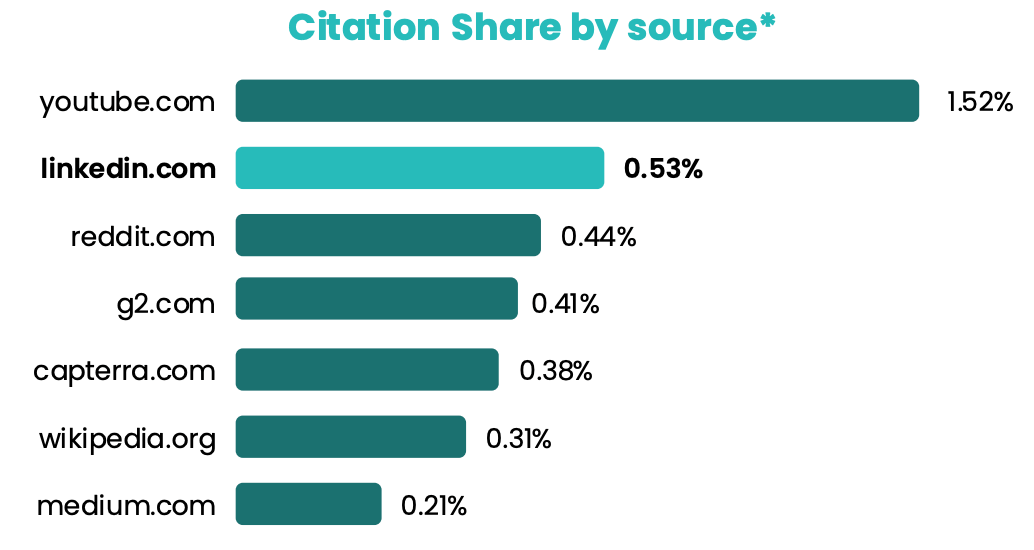
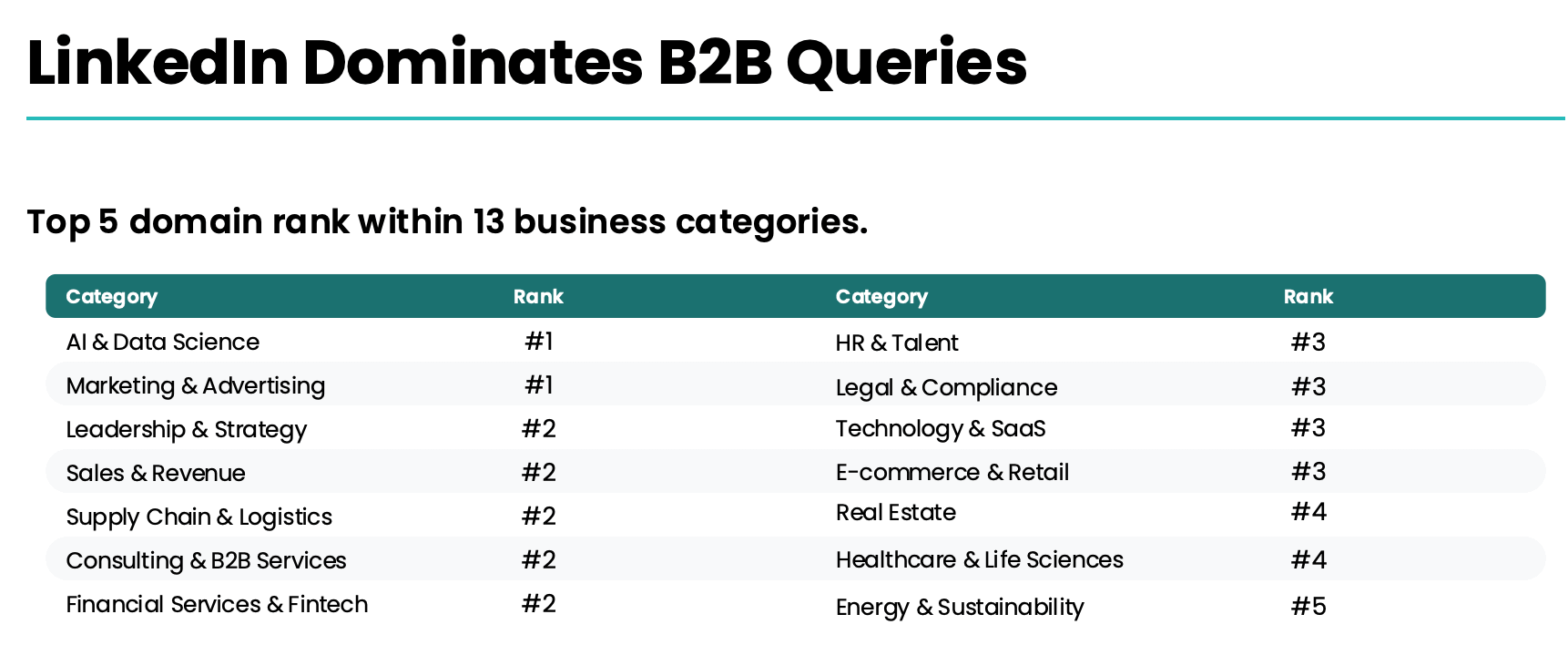
LinkedIn citation share grew 26% over just four weeks of tracking, and it landed in the top five most-cited sources across fourteen B2B categories, including the number one spot in AI and marketing.
75% of LinkedIn citations link to individual profiles rather than company pages, and 51% of cited creators have fewer than 10,000 followers. Job title mattered less than specificity; the posts that got quoted named real tools, included hard numbers, and were structured with headings and bullet points, traits found in 92% or more of the top-cited articles. Listicles and side-by-side comparisons made up over half of what got cited. Pure opinion rarely did.
Recency matters too. 48% of cited content was published within the last three months, and only 12% was more than a year old.
Think of LinkedIn as training data for the answer a prospective customer gets when they ask ChatGPT to compare booking engines or recommend a PMS. A founder posting two or three specific, numbers-driven updates a week is doing more for discoverability than a company page will. Read + Meltwater.
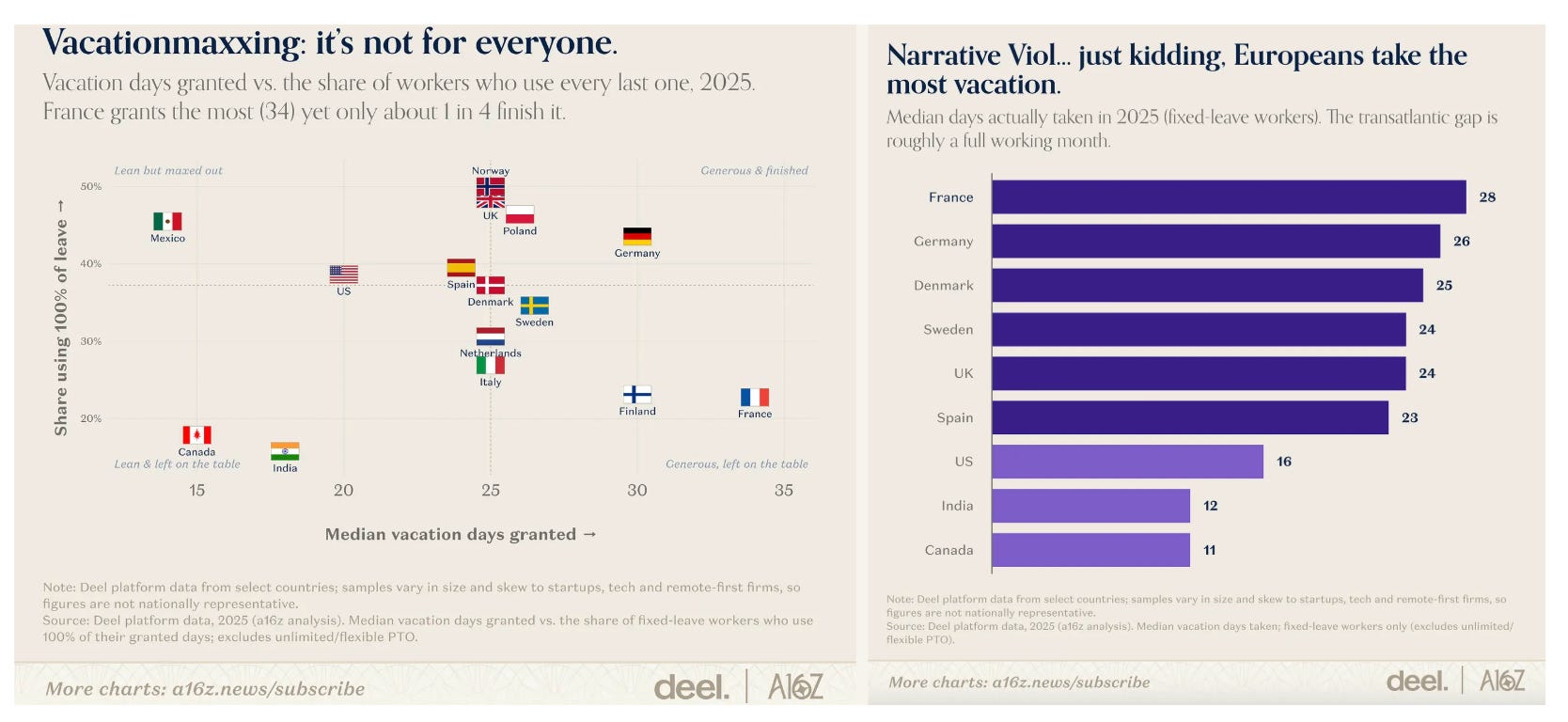
a16z pulled vacation data from Deel across a dozen countries.
France grants the most vacation of anyone in the dataset (34 days), yet the median worker still takes 28. Mexico offers roughly half as many vacation days but has one of the highest usage rates. Vacation policy and vacation actually taken don't move together nearly as much as you'd expect.
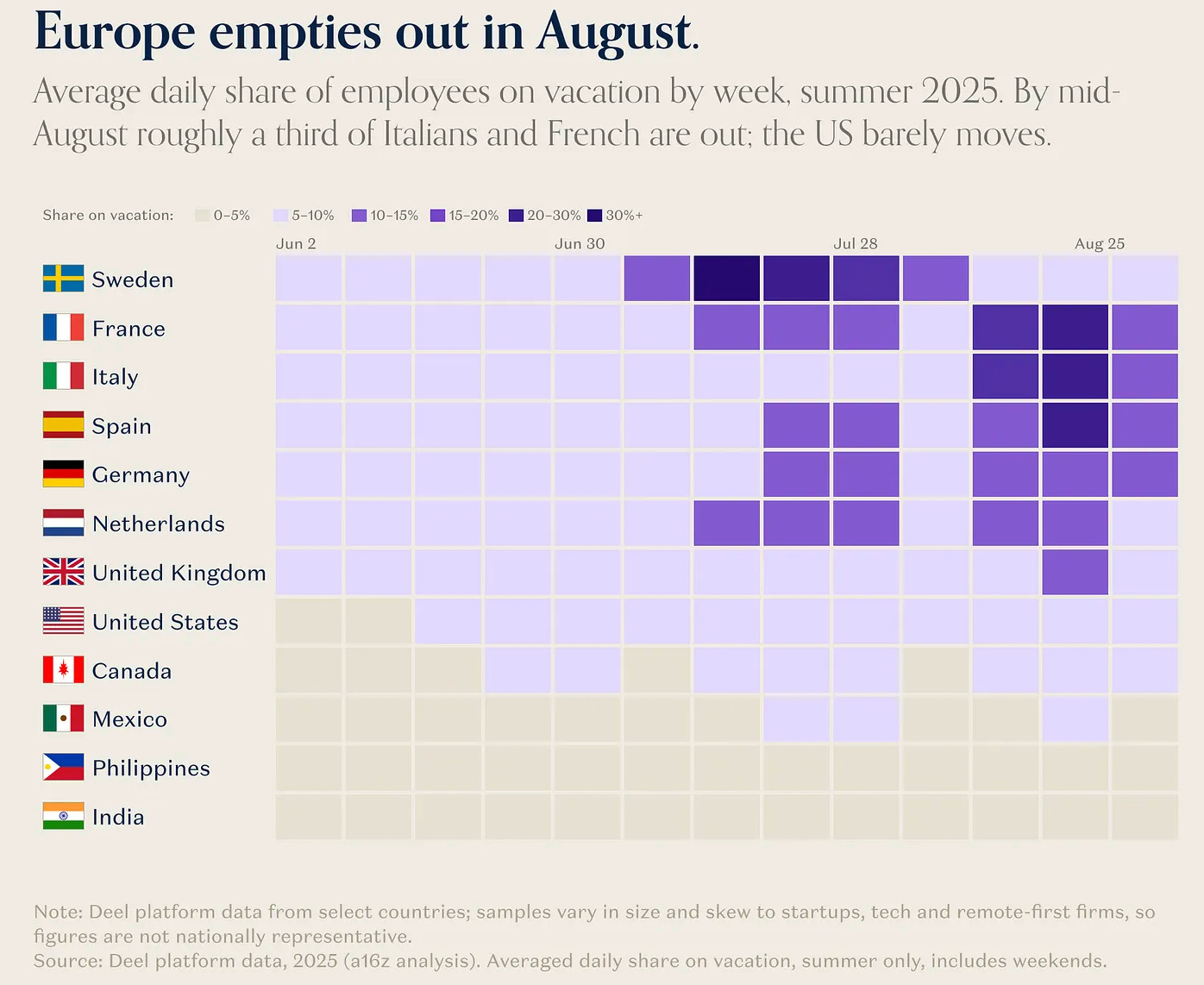
By mid-August, roughly a third of Italian and French workers are out at the same time. The US barely moves all summer, and neither do Mexico, Canada, the Philippines, or India.
Go to a16z to see other interesting vacation charts, including how vacation timing shifts by weekday, how sick days cluster by country, and which birthdays people take off work.
I came across a photo of a “Compare and Save” sign at a drugstore, condoms priced against diapers. It takes a second to land, then it clicks, and that click is the whole appeal. Two things that have nothing to do with each other, sitting side by side, daring you to find the connection.
Ryanair does the same game with a pizza and a flight, both $19.99. It isn't arguing that either item is cheap. It's exploiting the surprise of seeing two unrelated prices match. It’s just the realization that a flight to Pisa costs the same as a pizza. As I showed in the previous newsletter, Air Transat does a version with stakes attached, a $3,563 World Cup ticket next to a $429 flight to Mexico, “for the price of 90 minutes in a stadium, you could spend a week in the country you’re rooting for.” Different mechanism, same instinct. Put two unrelated things next to each other and let the reader do the work of connecting them.
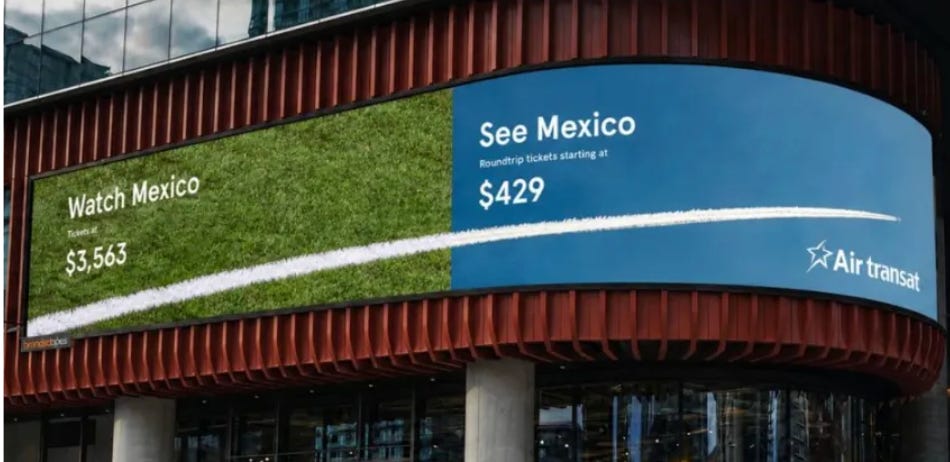
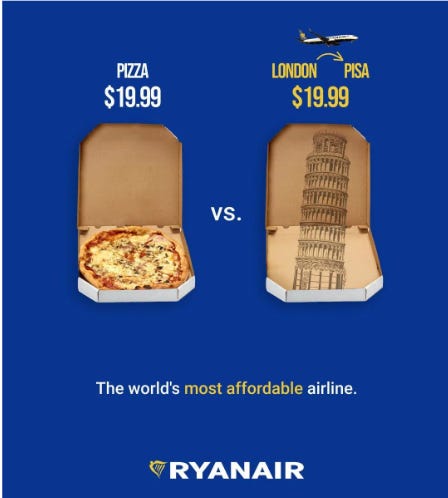
Most travel pricing skips this entirely by making one predictable comparison after another. The unrelated pairing is rarer, and it’s the one people stop for.
“I’m using Cursor externally. It’s great. How come our internal stuff isn’t great? When can we have agents here?”
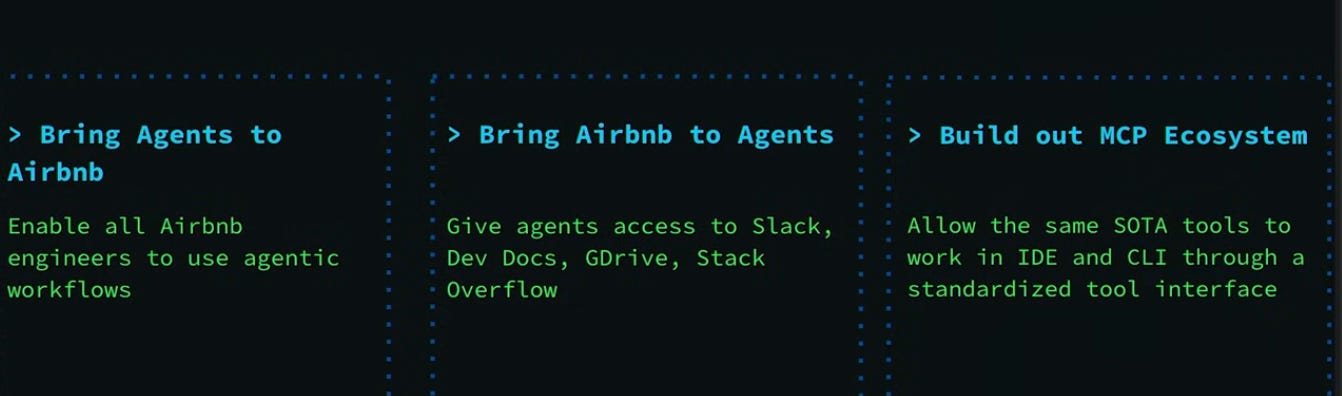
That was the gist of a Friday‑night email from Airbnb leadership that kicked off their agentic coding push, as recounted by Developer Platform engineers Szczepan Faber and Mike Nakhimovich. Speaking at the DPE Summit in October 2025, they said about 64% of Airbnb’s code changes at that point were written with AI doing most of the typing and an engineer directing the work, a pattern they called agentic coding. At the start of 2025, they had expected to reach only 20–40% by that time, so they overshot their own forecast.
A few things made this possible. A four‑person team built Airchat, a simple installer that puts AI coding tools like Claude‑class copilots on every engineer’s laptop and keeps them automatically updated. Behind this sits a growing set of internal connectors (MCP servers) that give the AI access to Airbnb-specific knowledge. That includes cloud configurations, preferred coding patterns, deployment practices, and other internal context. The goal was to avoid generic answers and give the AI the same context a seasoned Airbnb engineer would have.
Guardrails play a central role. Every AI‑authored code change still goes through human review before it ships. Engineers gain access to more autonomous AI behaviour gradually, based on experience and trust, instead of through a global switch. Rather than building a custom all‑in‑one AI IDE, the team focused on wrapping strong existing tools and investing in connectors, policies, and integration with their current workflows. Watch + DPE Summit talk
2026 update: As of Airbnb's Q1 2026 earnings, leadership says nearly 60% of engineering code is now co-authored with AI. That isn't directly comparable to the 64% figure shared at DPE Summit in October 2025, which referred to an internal developer platform metric rather than engineering company-wide. The same agentic infrastructure now powers a support bot that resolves about 40% of customer issues end-to-end and is expanding into internal tools and early AI-assisted search experiments. What started as a coding initiative has become a broader operating model for how Airbnb builds software and runs parts of the business.
It replied with ideas we’d thought about before, but more decisive and sharper than regular ChatGPT or Claude. Thank you for making it publicly available. — Holly Clarke, CMO, Byway
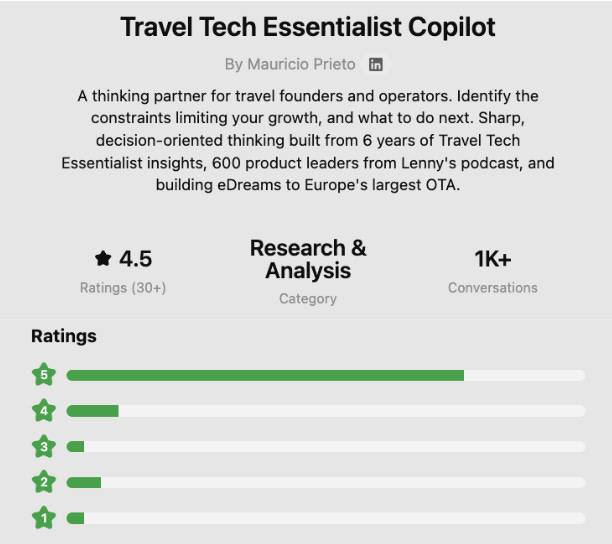
The Travel Tech Essentialist Copilot has now had over 1,000 conversations and holds a 4.5 rating. Try it with one problem you're wrestling with and let me know where it gets things right or wrong.
If you are a startup looking to raise a round (from pre-seed to Series D), I can help (for free). Travel Investor Network is a private platform where I recommend innovative travel startups to investors and innovators. If you’re interested, please start by completing this form.
If you’ve found value in Travel Tech Essentialist, the best way to say so is to share it with someone who’d appreciate it:
If you’re not yet subscribed, join us here:
Thanks for trusting me with your inbox.
Mauricio Prieto
Comments
Nothing yet. Say the first thing.
Sign in to join the conversation.