
Not everything that counts can be counted, and not everything that can be counted counts. — William Bruce Cameron
This issue is full of examples: a great hotel location that works against you, a bad photographer who might make the best campaign, and a philosopher who had Instagram figured out in the 17th Century.
Special thanks to Alpic for sponsoring this edition of the newsletter:
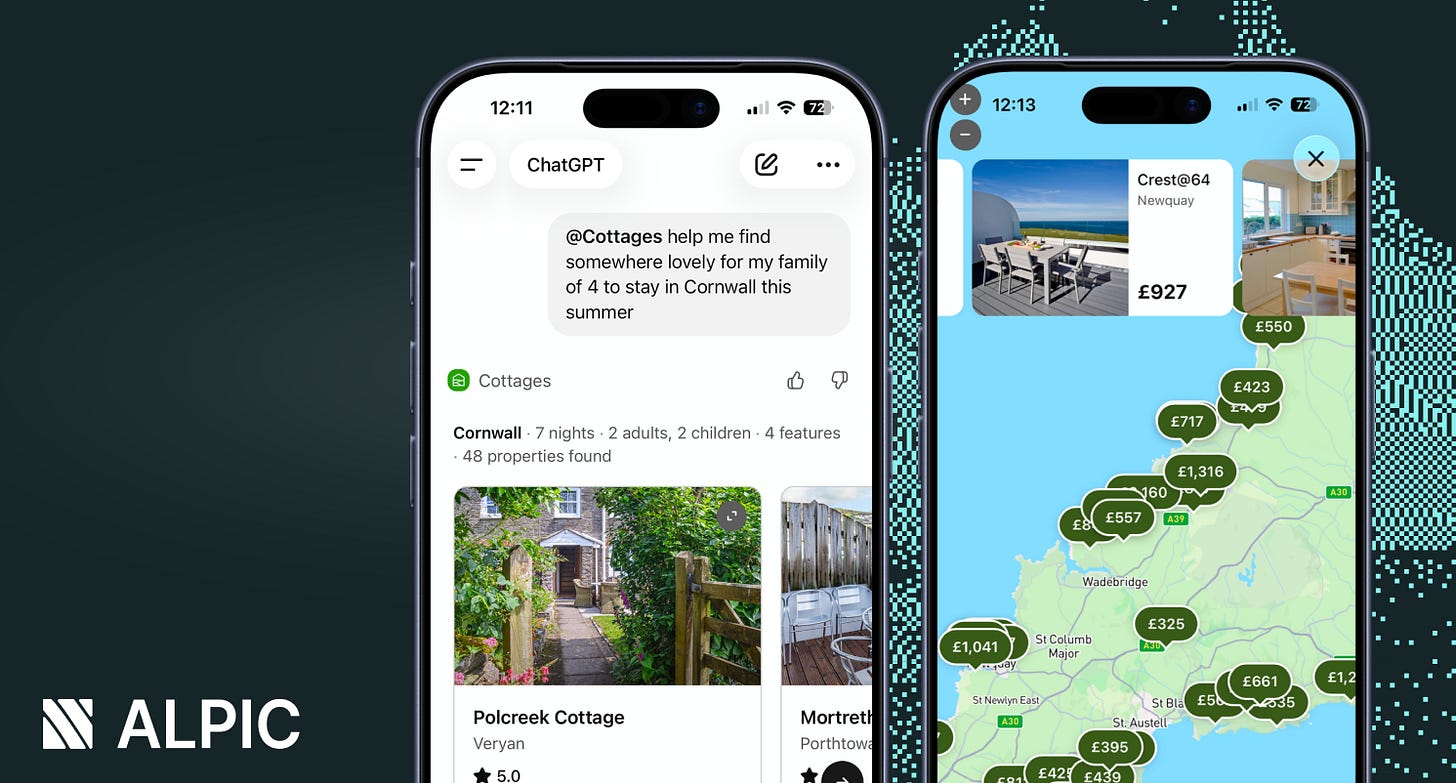
A new channel for holiday discovery is growing fast, and most travel brands aren't on it yet. Cottages.com, the UK's leading provider of vacation homes and luxury properties, partnered with Alpic to build an AI app featured on ChatGPT and other assistants: live inventory, real pricing, direct to booking. Read how they did it and what AI distribution could look like for you.
Pascal (French mathematician, physicist, and philosopher) wrote this 350 years before Instagram.
“We usually only want to know something so that we can talk about it; we would never travel by sea if it meant never talking about it, and for the sheer pleasure of seeing things we could never hope to describe to others.” — Blaise Pascal (1623 – 1662)
And they are targeting locals. Hotels across the US are launching private membership clubs inside underused conference rooms, rooftop pools, and ballrooms. The Clayton in Denver charges $1,900 to $3,200 a year. Seven24 Collective in New York has 600+ members paying $2,150+. The Auric Room in Montana charges $6,500 / year, with 95% renewal rates.
A membership club generates recurring revenue, builds a local community, and gives guests somewhere to be that isn’t a generic hotel bar. There’s a financing angle, too, as developers who once sold condos to fund hotel construction now sell memberships too. The obvious risk is that if clubs scale too far, paying hotel guests may start to feel like second-class citizens. Read + WSJ (no paywall)
"Your enjoyment of travel is inversely proportional to the size of your luggage." — Kevin Kelly
About 52% of passengers now prefer carry-on only and carry-on spinners account for roughly 60% of luggage purchases. Airlines created this shift themselves. US airlines collected $7.27B in baggage fees in 2024, and globally, the world’s largest airlines generated $33.3B in 2023 (CarTrawler/IdeaWorksCompany).
The behavior airlines incentivized is now an operational headache. Boarding times have roughly doubled since the 1970s, partly because overhead bins can’t absorb the volume. Airlines are responding by enforcing size rules more strictly and adding gate-check fees.
A study from Lucerne University of Applied Sciences and Arts, conducted across 14 Swiss hotels, measured multiple factors (functionality, individuality, emotionality, location, and employee behavior) to understand what drives impact and recommendations.
Hotels scored 64% on functionality, 58% on individuality, and 51% on emotionality. Operations are easier to get right than emotional engagement.
The study found a negative correlation between location and impact scores; hotels with less prime locations outperformed on guest impact. The likely explanation is that a great location can make hotels lazy. Hotels without that advantage have to earn the guest through experience.
Design Impact, as the study calls it, covers differentiation, coherence, and consistency throughout the stay. As design impact increased, recommendation rates rose. Negative comments about the look and feel on Booking.com reduced scores by an average of 1.11 points, more than any other factor tested.
On the employee side, autonomy correlated directly with guest experience quality. When staff could act on behalf of the guest without asking permission, guests felt it.
(Thanks to Bashar Wali for surfacing this report.)
Apparently, Iceland doesn’t need help looking good.
Icelandair is looking to hire a bad photographer; one with no photography skills, bad framing, and unfamiliar with composition. The selected candidate gets a 10-day trip to Iceland in June 2026, travel expenses covered, plus US$50,000 for photography, content, and participation. To all bad photographers out there, the deadline to apply is April 30.
This follows a string of clever campaigns from Iceland’s tourism ecosystem, including the Icelandverse parody of Zuckerberg’s metaverse pitch, a conspiracy film claiming Iceland was AI-generated, and a letter to travelers explaining how to enjoy real, unreal experiences.
Most destinations try hard. Iceland keeps proving they don’t have to.
William Meijer put a chart on something most founders learn the hard way.
In travel startups, many early conversations fall into the category of kind lies.
A large partner says they need to discuss it internally. A hotel chain says they love what you’re building. An investor says “not the right time, but keep us posted.” Each one feels like forward motion, but most are just reducing social friction.
The founders who last develop a tolerance for unkind truths. They ask harder questions, push for clear commitments, and learn that enthusiasm without commitment is usually a no. In practice, anything without a clear next step is a no.
April Dunford’s post is a strong guide to a problem many B2B teams still handle poorly: positioning, which is essentially about how a product should be understood, by whom, and against what.
She makes the point that most companies are wrong about whom they compete with. Internally, everyone has a different answer. Marketing looks at the loudest competitors, product looks at future ones, sales fixates on the last deal they lost and founders often anchor on an outdated picture. But the only view that matters is the buyer’s; what would they do if you didn’t exist? Often, the answer is the status quo. Spreadsheets, email, manual workflows, or doing nothing. If you ignore that, your positioning ends up fighting the wrong battle.
She also notes that features are not the same as value, and that value is not the same as handling objections. Many products try to do all at once and end up with messaging that is technically correct but hard for customers to care about.
A few of the ideas I shared in a recent interview with Shiji Group
For years, I thought the winners would be the ones with the best technology. Technology matters, but understanding your customer matters more. Data tells you what is happening. Customers tell you why.
Personalization is less about adding options and more about removing irrelevant ones. Less cognitive load, faster decisions, higher conversion.
The industry is obsessed with frictionless experiences, but the right kind of friction builds trust. A callback at the right moment, or a confirmation step that prevents mistakes, can create more confidence than a perfectly smooth flow.
For twenty years, whoever owned the interface owned the customer. AI is changing that. Discovery, comparison, and transaction no longer need to happen in the same place. The next battle is for the decision layer.
“If the company’s doing poorly, you have to bring the positive energy and make people believe it’s possible. And if the company’s running hot, you want to bring them down to earth. Running counter-emotionally to what everybody else in the organization feels is exhausting.” — Bill Gurley (on My First Million Podcast [27:32])
Propellic tracked sessions, search intent, and ad performance across 60+ travel brands to map the damage. Conversion rates have dropped across the Mediterranean. Southeast Asia, meanwhile, is showing peak performance while growing ad spend.
Their report, The Impact of the 2026 Middle East Conflict on Travel Marketing, examines why session data in frozen-zone destinations is misleading, which destination clusters are growing despite the crisis, and how to build retargeting audiences now so you convert at maximum ROAS when confidence returns.
Free live briefing on April 23rd (9:30 AM CT) with Propellic’s Brennen Bliss and John Matson. (Register here).
"Just tried this.'Dangerous' levels of useful. The way it reframes positioning questions is exactly what you want at 11 pm when you can't sleep because of a strategic problem." — JoseLuis Vilar, Co-founder of Caravelo
Try the Travel Tech Essentialist Copilot and let me know what you think.
→ Explore all 1972 open roles on the Travel Tech Essentialist Job Board now.
Navan | Director, Account Management Revenue Operations | Berlin
Plug and Play | Program Intern | Paris
Fora | International Sales Operations Manager | New York City | $90k - $130k
📩 For monthly updates on the latest roles, subscribe to the Travel Tech Jobs newsletter
If you are a startup looking to raise a round (from pre-seed to Series D), I can help (for free). Travel Investor Network is a private platform where I recommend innovative travel startups to investors and innovators. If you’re interested, please start by completing this form.
If you’ve found value in Travel Tech Essentialist, the best way to say so is to share it with someone who’d appreciate it:
If you’re not yet subscribed, join us here:
Thanks for trusting me with your inbox.
Mauricio Prieto
Comments
Nothing yet. Say the first thing.
Sign in to join the conversation.