
Picked up the phone yesterday. It was Kenny. He was — and I’m being generous here — not okay.
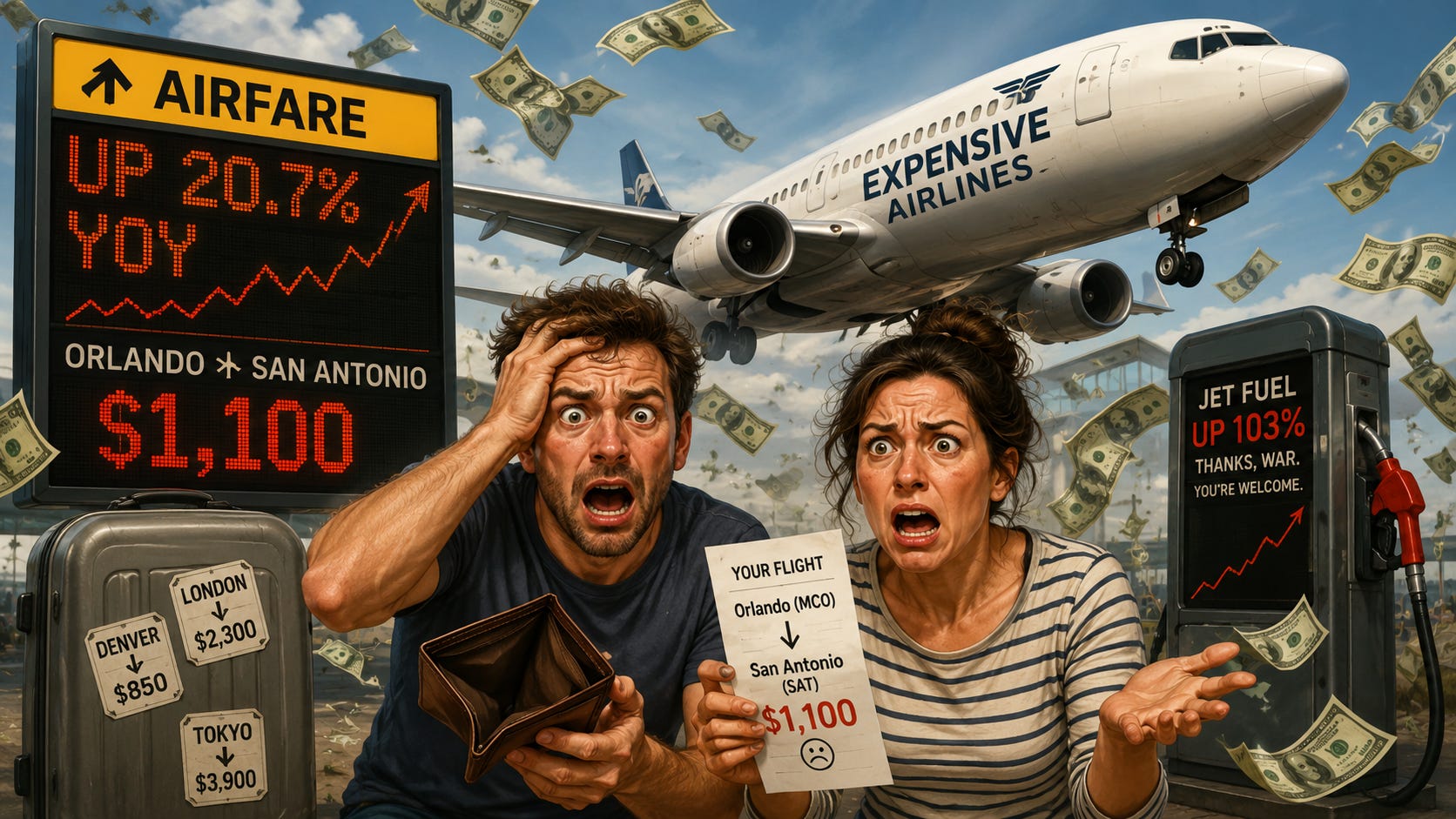
“I just paid eleven hundred dollars. Orlando to San Antonio. ELEVEN HUNDRED!!!”
Sit with that number for a second. San Antonio. We’re not talking Tokyo. We’re talking a domestic hop to a city whose primary exports are breakfast tacos and history class field trips. ✈️
He is not alone. Our inbox is a dumpster fire of emails pulling on the same thread. Why is everything so expensive? Did I just get scammed by Delta? How is a flight to Denver more than my mortgage?
So I did what I do, which is dig into the numbers. Here’s the deal.
The Bureau of Labor Statistics just dropped its latest data and U.S. airfares are up 20.7% year over year as of April 2026. Biggest annual jump in years.
But the YoY number actually undersells what’s happening, because most of the damage is recent.
Airfare has spiked 21.6% in just the last four months. That’s not inflation creeping. That’s a cliff.
And it’s not just here. London routes are up nearly 45% (no afternoon tea for us this year).
Summer round-trip domestic economy fares are about 27% higher than they were at this point last year. So no, Kenny, you weren’t scammed. You’re just living in our new shared reality and the sad part, it’s here to stay (more on that in a second).
The short version: there’s a war on, and jet fuel comes from where the war is.
Slightly longer version: on February 28, the U.S. and Israel went to war with Iran. Iran responded by effectively closing the Strait of Hormuz — the narrow body of water off its southern coast that about 20% of the world’s oil passes through every single day. (Plus a third of the world’s natural gas exports, but that’s a different newsletter.)
The strait has been mostly closed to traffic for two months.
When you cut off 20% of the world’s oil, oil prices do what you’d expect them to do. Brent crude is over $100 a barrel, up from below $70 pre-war. And jet fuel — which is basically crude with an attitude — went parabolic.
Here’s the chart that explains your $1,100 ticket:
When Jet fuel price (per gallon) % change from:
Pre-war late February, $2.50/gallon
Early April 2026 (peak) $4.88/gallon (up +103%!)
Jet fuel literally more than doubled in six weeks. Airlines aren’t a charity (despite what the legroom suggests), so guess who’s eating that cost?
Hi, it’s us….
Just for the sake of being nerdy, here is a breakdown of the structural cost of an airline (mashing up 2024 A4A and IATA data):
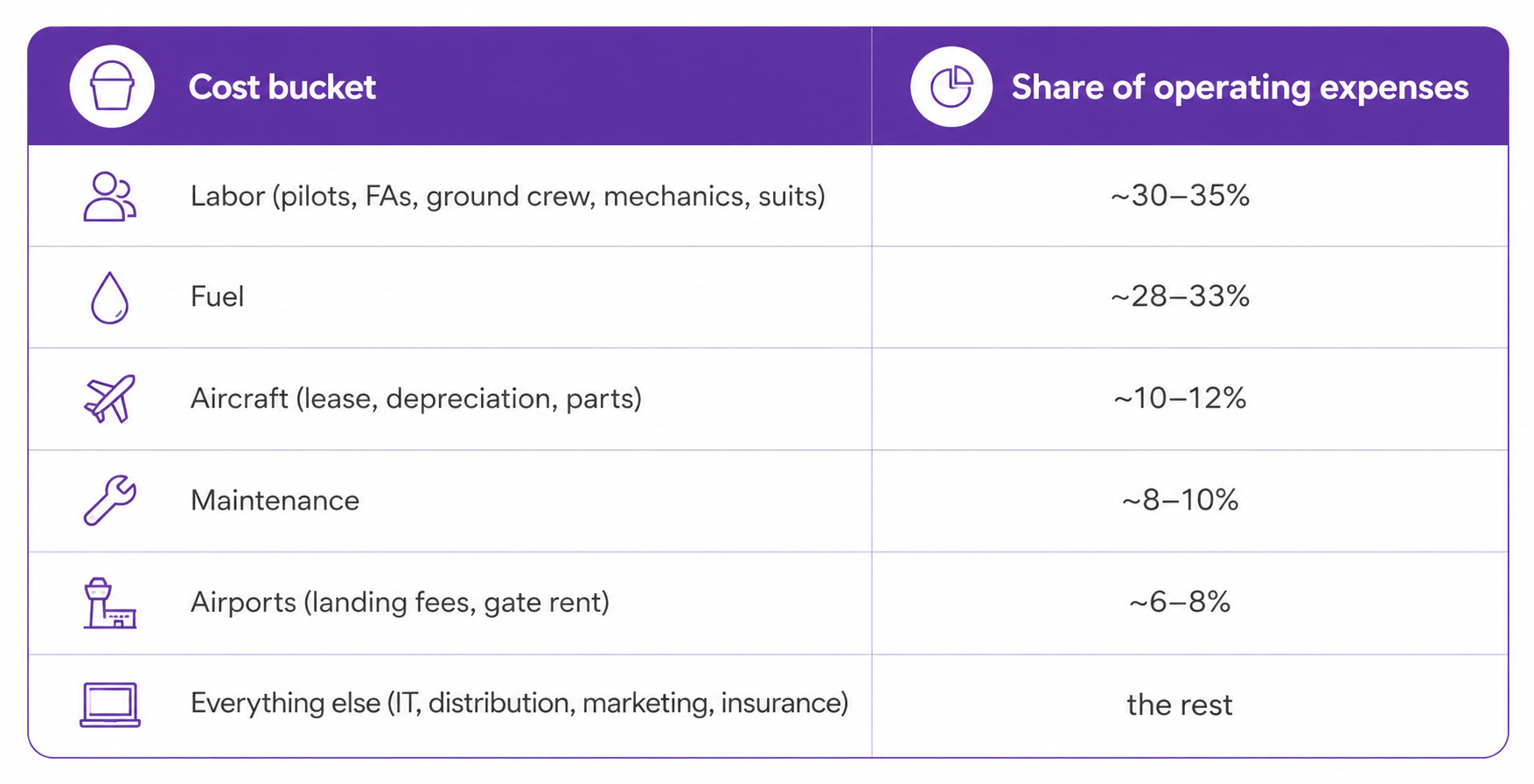
Fuel and labor are in a permanent arm wrestle for #1. When fuel is calm, labor wins. When fuel goes nuts — like right now — fuel takes back the belt and starts swinging.
Here’s the real punchline: fuel is the most volatile line item on the entire P&L. Labor is locked in by union contracts. Lease payments are fixed. Maintenance is predictable. Fuel is the one thing that can double in six weeks.
So when it does, the whole P&L melts, and airlines either eat it or pass it on.
They pass it on. Always. Every single time.
The question I’ve been getting most. Good news and bad news.
Good news: oil price spikes are usually temporary. Bad news: airfare doesn’t follow oil down nearly as fast as it follows oil up.
Let’s check the receipts:
2008 oil shock. Oil peaked at $147/barrel in July. By December — six months later — it had crashed to $32, because the financial crisis tanked global travel demand. Airfares followed pretty quickly. Caveat: this was an unusually fast recovery because nobody was flying.
2011 Arab Spring. Brent went over $100 and just… stayed there. For three years. Airfares stayed elevated alongside it. There was no “snap back.”
2022 Russia-Ukraine. Brent peaked at $139 in March 2022. Airfares peaked that summer — July 2022 was the moment, the single biggest one-month airfare jump in BLS history. Fuel had pulled back materially by fall 2022. But airfares didn’t meaningfully come down until summer 2023.
That last one is your best comp. Roughly a 12-month lag between fuel peaking and fares meaningfully easing.
Strap in friends — this is going to be a long ride…
I hope you are sitting down to read this…
Airlines have figured out that “fuel spike” is excellent cover for “structural fare increase that never quite goes away.”
United’s CEO told investors in late April that higher ticket prices may be here to stay, long-term, to help airlines boost margins. Frontier’s chief commercial officer admitted on a May 5 earnings call that travelers haven’t balked at the higher prices, so there’s no commercial reason to drop them.
Translation: prices spiked. Demand didn’t flinch. Customers are willing to pay.
Need an example? Disney. A one-day Magic Kingdom ticket cost $105 in 2015. By 2026, peak days hit $209 — almost triple the rate of inflation over the same stretch. And what do you get for that doubled ticket?
The same 60-second ride, with a two-to-three-hour wait. The lines didn’t get shorter. The price did the exact opposite.
And the park is still packed… Every. Single. Day.
That’s the airline playbook right now. Disney didn’t raise prices because Mickey ears got more expensive to manufacture — they raised them because they could, and people kept showing up.
Airlines are running the same play.
My hot take, and I really hope I’m wrong: I don’t think these fares are coming back to earth anytime soon. The 2022 playbook says ~12 months for some relief. But the bigger pattern — every “temporary” price hike quietly becoming the new floor — says this may just be our new reality.
A few thoughts, because I’m not here to just bum you out.
Book now. If you know you’re going somewhere this summer or for the holidays — today’s “outrageous” price is probably tomorrow’s “remember when fares were cheap.” Lock it in.
Avoid basic economy. Most major U.S. carriers will let you rebook at a lower fare if prices drop. Basic economy locks you out of that. Pay the $30 extra for flexibility — it’s the cheapest hedge you’ll ever buy.
Use your points. Award pricing is up about 25% too, but the cash-to-points value math has gotten dramatically better in a high-cash-fare environment. If you’ve been hoarding miles for a rainy day — buddy, it is raining.
Don’t book a flaky connection to save $40. When fuel is volatile, airlines cut weaker routes first. Risk of getting stranded is materially up.
I told Kenny to suck it up, buy the ticket, and enjoy the breakfast tacos. If the 2022 playbook holds, the version of him who waits three months to “see what happens” is going to pay even more.
The fuel will come down. The fares… eventually. Maybe. Some of it.
In the meantime: book early, fly flexible, and forward this to whoever in your life is still refusing to believe airfare is up.
PS: Thanks to everyone who sent DMs and notes about the golf tournament on June 12. We even had some people sign up from the newsletter — how cool!
No posts
Comments
Nothing yet. Say the first thing.
Sign in to join the conversation.