
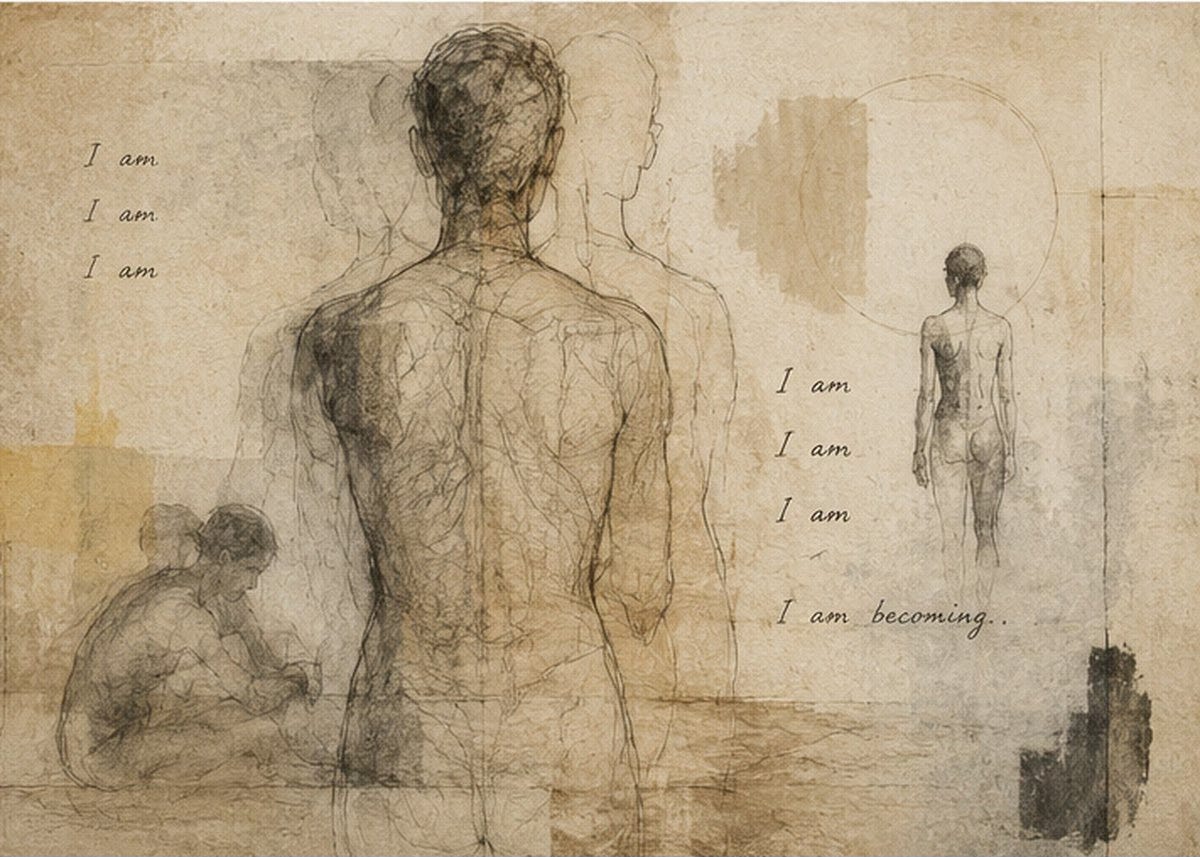
The Forming Body
I write about somatics, trauma, attachment, and the physical architecture of being human. This is where I think through the questions that orient my work: How do we become who we are? What does it cost to survive? And what becomes possible when survival is no longer the only goal? Weekly essays for practitioners and seekers who want substance over comfort.
As you begin reading this article, let’s first do an exercise of sorts. We’re going to bring some awareness to where you are right now, as you’re reading. Don’t try to change anything yet. Just notice.
Begin by noticing the quality of your mind. What I mean by that is, notice your thoughts. Notice if there are a lot of them, or a few. Notice if there are things you were doing right before you started reading that you haven’t fully closed the loop on, or if you’ve arrived here. Don’t try to change anything yet. Just bring some awareness to what’s happening in your mind.
When you’ve noticed the quality of your mind, see if there’s a small adjustment you’d like to make. Maybe you want to close the loop on something you left half-finished a minute ago. Maybe you want to be a little more here. Maybe you want to let go of a thought that’s been looping. Give yourself permission to make that adjustment, consciously, before you read on.
Now bring awareness to the quality of your body. Notice the shape your body is currently in, without changing it. Maybe you’re slumped over a desk, or sunk into a chair, or holding your phone with one hand and reading with a tilted neck. Whatever it is, just notice. This is the shape your body has organized into. And then, having noticed it, ask what your body wants. Maybe an adjustment, maybe a stretch, maybe a softening of something you didn’t realize was tense. Let your body have what it wants.
Next, notice the quality of your heart. The quality of your emotional state, or the quality of your feeling state, if that lands more clearly. Is there a little heaviness today, or excitement, or anxiety, or joy, or apathy, or numbness? Whatever’s there is there. Notice it without trying to do anything with it yet. And then, if you wanted to bring some conscious intention to that, what would you bring? A small softening, a small invitation toward something else, a small acknowledgment of what’s here?
And last, notice the quality of the role you’re in as you’re reading this. Who are you being right now? Whatever you say next, after the words “I am,” is a role you’ve taken on. Maybe you’re a practitioner reading this between sessions. Maybe you’re a parent reading while half-listening for a child in another room. Maybe you’re someone who has been trying to figure out why you feel the way you feel, and you came here looking for something. Whatever it is, just notice. And then, having noticed, ask what role would best support you for the next few minutes, and step into that role as you read on.
Identity is almost like a set of clothes we wear, an outfit or a specific kind of dress. If you’re going to a fancy dinner, you’re going to put on a specific outfit, and that outfit will be completely different from the one you’d put on if you were going hiking, or to the gym, or for a swim. Identity works similarly. The role we carry shapes what we wear on the outside, just like it shapes what we believe about ourselves on the inside.
When you begin a session with a client, you have adopted a specific set of constraints about who you are. You’ve turned off certain thoughts and reactions. You’ve adopted a number of emotional and psychological filters that prevent you from taking things personally. You’re attentive to things you wouldn’t be paying attention to if you were sitting across from your mother, or your father, or your best friend. Your body has organized differently to support all of this, in ways you mostly haven’t tracked. Your breath has taken on a particular pattern. Your posture has settled into the shape that lets you stay present for an hour. The muscles around your eyes have softened in a way that signals receptivity. None of this was decided by your conscious mind. It came along with the role.
The role is the shape your body has taken. Everything else comes along with it.
When I say everything else comes along with the role, what I really mean is everything. This isn’t something that happens just in your mind, or just in your thinking; the whole organism reorganizes around the role you’ve taken on. Your posture changes, your breath moves into a different rhythm, and the muscles around your eyes and mouth and jaw arrange themselves into a subtle expression of who you’ve decided to be in this moment. Alongside these physical changes, there are psychological and emotional changes happening too. Your emotional reactions to situations shift, the words you have access to shift, the things you’d react to and the things you wouldn’t even register shift, and the bandwidth of emotion you can hold without being thrown around by it changes. The things you find irritating and the things you find amusing, the things that land hard and the things that roll right off, all of that shifts as the role shifts. With enough attention, you can train yourself to notice all of this happening across your day as you move in and out of different roles and situations.
There’s a fact about physiology worth noting here. Around eighty-five percent of the signaling in your nervous system travels from your body to your brain, not the other way around. Which means most of what you experience as identity is your body reporting back what shape it has already taken, and your mind making sense of that report after the fact. The thoughts that come easily, the words that won’t come at all, the way you breathe when someone interrupts you, the tightness that gathers in your shoulders when you’re being asked to do something you don’t want to do, all of this is downstream of a role your body has already settled into. The cognitive layer is interpreting. The somatic layer is doing the actual organizing.
Try this. Think about a moment recently when someone close to you said something to you that really, really impacted you. Maybe it was your spouse, or your closest friend, or one of your parents. Something they said hit somewhere in your body that you didn’t quite expect, and you felt the impact before you could even put words to what was happening. Maybe your throat tightened up. Maybe your chest braced. Maybe you suddenly couldn’t find the words you wanted to say, or the words came out in a tone you didn’t choose. Now imagine that same sentence, word for word, the same tone, the same look on the face, said by a colleague at work who you barely know. It would not land the same way at all, and the reason is that while the words haven’t changed, the thing that’s changed is you, or more precisely, the organization of you in that moment, in that role. This is the same body negotiating closeness and reaction that I traced in Proximity and Attachment, where what shifts when one person moves their chair six inches closer is not the words being said but the body that’s receiving them.
You are organized differently when you’re in the role of partner or child than you are when you’re in the role of professional. The role you’re in changes the body that’s receiving the words, and the body that’s receiving the words changes what the words are able to do to you. This is one of the strangest and least-noticed things about being a person. Most of us walk through life with the assumption that we are a single continuous self, moving through different situations across the course of the day, and that assumption is workable for most purposes and lets the day feel coherent. But underneath the story of the continuous self, what’s actually happening is that you’re moving between different organizations of yourself, all day long, and each one of them is showing up with its own posture, its own breath, its own emotional range, its own set of available reactions, and its own set of available words. The continuous self is something the mind lays across the top of all that motion, the narrative thread that gives the day a feeling of throughline. Underneath the thread, the body is reorganizing constantly, in response to whatever role you’ve stepped into.
The trouble is that almost none of this is conscious. Most of us are moving between roles all day long, with no awareness that we’re doing so, and no awareness of the postures and breaths and emotional bandwidths and available reactions that each role is bringing along with it. You wake up and you’re, first, just a person who has opened their eyes. Then within a few minutes you become a parent making breakfast, or a partner making coffee, or a single person alone in your kitchen with your own thoughts. After that you’re a commuter, or a remote worker arriving at your desk, or a practitioner preparing for a first session. Briefly when your mother calls, you’re a child again. Then you’re a leader on a team call, then a friend listening to someone else’s hard day, then a member of a country or a religion or a political affiliation when you scroll your phone for ten minutes between meetings. By dinner you’re a partner again, by bedtime you’re a parent again, and late at night you’re a person alone in your kitchen with your own thoughts once more. Every one of those transitions is a reorganization of the body, every one of them carries with it a different set of available reactions and a different set of suppressed ones, and every one of them is a moment when you have, somatically, become someone slightly different. And almost none of it has been consciously chosen.
Anytime we say the words “I am” followed by a noun, we are stepping into a role. I am a therapist. I am a coach. I am a mother. I am a son. I am an American. I am a Christian. I am an introvert. I am someone who can’t handle conflict. I am someone who’s good with people. Each of those statements is carrying with it a whole package, an enormous package, of postures, breath patterns, emotional defaults, available reactions, omitted reactions, and unspoken rules about what’s permissible to think and say. We don’t negotiate the contents of the package. It arrives with the role, mostly invisible to us, mostly running on its own.
When we’re not conscious of any of this, life starts to feel like it’s happening to us. Things come up and we have reactions, and the reactions feel like they’re coming from somewhere we didn’t author. We get triggered without quite knowing why. We say things we didn’t plan to say. We hold our bodies in ways that exhaust us, and we don’t know why we’re exhausted. We feel stuck inside lives that were supposedly chosen by us, and we can’t find the part of ourselves that did the choosing. This is the experience of moving through the world inside an unconscious role, and it is the default human condition, and it is the substrate that any meaningful change in identity has to start with.
This is the most expensive error a person can make about themselves. The reactions we have, the ones we live inside and call our personality, are downstream of the role the body has taken on. They live in the role, and they change when the role changes. The variable, every time, is the role the body is inside when the reactions arrive.
There are two dominant cultural stories about how to change who we are I’m going to explore here, and they’ve been around long enough that almost everybody I work with has tried some version of both. They both have something real in them, and they both leave out the piece that actually moves the needle.
The first story says that if you imagine the version of yourself you want to be, in vivid sensory detail, the universe will deliver it. Visualize the relationship, the body, the bank account, the calm, the confidence. Your conscious focus, the teaching says, will manifest the outcome. This is the lineage of Law of Attraction teachings, and there are real pieces in there that are worth taking seriously. Intention matters, attention shapes what we move toward, and the things we orient ourselves around somatically tend to be the things we end up living inside. None of that is false. But the teaching as it usually gets packaged leaves the body almost entirely out of the picture.
There’s a distinction that the manifestation pathway misses that’s worth discussing in more detail here. What that pathway sells is what I’d call ‘knowing what.’ Knowing the address of the destination, the description of the person you’d like to become, the felt picture of what the outcome will look like once it arrives. What it does not sell, and what most popular pathways don’t sell, is knowing how. The how is the body. The how is the actual reorganization the body has to undergo in order for the person you’ve described to become the person you live as. And that part, the part that takes the most actual work, is the part this framing leaves out almost entirely.
You can visualize yourself as the calm and centered person every morning for a year, but if your body is still holding the shape of the person who is braced against everything, the calm and centered person literally cannot move into that body. There is no room for it; the shape is already taken. The visualization gives you the address you want to drive to, but it doesn’t reorganize the vehicle you’d have to be driving to get there.
The second story is almost the opposite of the first. It says, stop trying to become anything other than who you already are, accept yourself exactly as you are, drop the seeking, drop the striving, drop the self-improvement, and rest into the truth that you are already whole. This teaching has something important in it, too. Most of us are at war with parts of ourselves in ways that exhaust us and shame us, and a stretch of pure acceptance can be the doorway back into the body, back into a relationship with the self that isn’t combative. But acceptance held as a destination, rather than as a doorway, leaves you in exactly the shape you were already in, indefinitely. Witnessing yourself, without then doing anything with what you’ve witnessed, becomes a kind of comfortable stuckness; the information arrives, you don’t use it for anything, and the shape stays.
Both of these stories have a piece of the truth in them, and the piece they share, which is also the piece both of them are missing, is the body’s actual participation in the shaping. The visualization story tries to use the imagination as a substitute for somatic reorganization, as if the body were going to reorganize itself simply because you’ve pictured the outcome clearly enough. The acceptance story mistakes non-judgment for self-knowledge, and stops short of the conscious participation that the body would actually need in order to take a new shape. Both of them leave out the work of forming yourself, deliberately, in collaboration with the organism you actually are.
Stanley Keleman, in his book Somatic Reality and across the rest of his work in what he called Formative Psychology, was pointing at this. Unfortunately, most people have still not quite caught up to his wise observations. He was pointing at the fact that the body is always shaping itself, in response to experience, in response to relationships, in response to whatever gets asked of it across a life. For Keleman, the body and identity were the same process, watched from inside the body’s own organization, and to track the body in real time, to feel the shape it is taking as it takes it, is to track identity itself in the act of forming. The body that has formed itself, mostly unconsciously, in response to your childhood, in response to the family you grew up inside, in response to the culture that handed you certain roles before you could even consent to them, in response to whatever trauma the organism has carried, in response to the professional training you’ve absorbed, in response to the dominant culture of the country you live in right now, that same body is also the body that can form itself, consciously, in response to who you have decided to become next. This is the territory I traced in detail in The Somatic Foundations of Attachment, where I followed the body’s earliest formation through the work of Bonnie Bainbridge Cohen, Sally Goddard Blythe, Ruella Frank, and Pat Ogden.
The forming doesn’t stop, and the forming is happening right now, as you read this. The question is whether you are participating in it, with awareness, or whether the forming is happening to you while your attention is somewhere else.
This is the piece the popular pathways tend to miss. You are already shaping yourself, constantly, and your body is already organizing itself around something every single minute, every single hour, every single day. You are going to participate, and you’re participating right now, even as you read this. What you actually get to choose is whether you participate with awareness of the role you’re carrying and the shape your body is taking inside that role, or whether you let the participation just happen on its own while your attention is on something else.
There’s a quote from Jim Carrey that’s been circulating around the internet for years in various paraphrased forms.
“Depression is your body saying, I don’t want to be this character anymore. I don’t want to hold up this avatar that you’ve created in the world.”
And then he said:
“You should think of the word depressed as deep rest. Your body needs to be depressed. It needs deep rest from the character that you’ve been trying to play.”
What Carrey is pointing at, in language that found its way into the popular imagination because it was an actor who said it, is that the body knows when the role no longer fits the organism, and the body begins to refuse. The mind keeps trying to put on a costume the body no longer fits. The body keeps taking it off. What we call depression is, in many cases, the war between those two.
This is the same phenomenon Keleman articulated decades earlier, just in a different language. The body is participating in our identity all the time, whether we know it or not, and when the character we’re trying to hold up no longer fits the body that’s being asked to hold it up, the body sends a signal. The signal can take many forms. Depression is one, chronic fatigue is one, persistent low-grade illness is one, and the pervasive sense that the life you’re inside of is happening to someone who isn’t quite you is one as well. These are not failures of mindset. They are the body telling you that the character is no longer congruent with the organism, and that something has to change at the level of how you are organized, all the way down through the layers. The principle underneath this is the one I wrote about in Your Body Is Not Broken: what looks like dysfunction in the body is nearly always adaptation, and the body is doing exactly what it learned to do.
What I want to add to Keleman’s framing is this. The forming of the body around an identity is not just something that happens to us in childhood and then sits as a deposit we have to work against for the rest of our lives. The forming is a continuous, moment-to-moment, daily, hourly, sometimes minute-to-minute act. Every time you step into a role, your body forms itself, again, around that role, and every time you step into a different role, your body forms itself, again, into the shape of the new one. The forming is happening on a much faster timescale than most of us realize, which means the participation in the forming is also available on a much faster timescale than most of us realize. You don’t have to wait years to be different, because you can be somatically different in the next conversation you have, if you choose the role you want to be inside of and let your body take the shape that comes along with it.
For any of this to become available to you, something else has to come online first. You need to develop an observer.
This brings us to the question anyone who has done real interior work and self observation eventually faces. If I am not the thoughts that pass through my mind, and I am not the reactions that fire through my body, and I am not the role I happen to be inside in any given moment, then what am I? What is I?
I am not the thoughts that show up in my mind. I am not the reactions that move through me when somebody says something I didn’t expect. I am not the emotional states that rise and fall across the day. I am the one watching all of that happen. There is a self that observes the thoughts, and observes the reactions, and observes the emotional states, and observes the postures, and observes the roles, and that observer is something separate from all the content being observed. This means that, by definition, something else is present in you, something that isn’t the thoughts, isn’t the reactions, isn’t the emotions, isn’t the role. That something else is what has agency, and that something else is what creates the room for conscious participation in your own shaping.
The contemplative traditions have been pointing at this for thousands of years, in their own languages, with their own practices, and they have sometimes used this insight to point away from the body. They have spoken about the witness as if it were a disembodied consciousness, floating somewhere above the mess of physical experience, separate from the body altogether. That is not what I mean here. The witness, the way I am using the word, is the somatic capacity to feel the body taking shape in real time, to know that the shape is being taken, and to know that the part of you doing the feeling is the part with agency. The observer is not above the body; the observer is inside the body, present to its shape-taking and shape-releasing, present to the role being put on and put off and put on again.
The role you’re inside of cannot have agency over itself, because the role is the thing you’re inhabiting, and the body that has taken the shape of the role cannot adjust the shape from inside the shape. Only the part of you that can see the role, from a slight distance, can choose differently. Agency lives in the witness, while the role lives in the body, and when the witness becomes conscious of the role, the role becomes optional, where before it was just running everything.
When the witness is online, you stop being the one to whom your reactions are happening, and you become the one with whom your reactions are happening. The shift turns on a single preposition, and the preposition makes the difference. The “with” is where participation becomes possible, where the body can be heard rather than merely endured, where the reaction can be felt as it forms rather than only registered after it has occurred.
When you begin to observe yourself; the act of seeing changes the thing being seen. You’ll notice this if you do the opening practice slowly. Notice the quality of your mind, and the mind shifts a little before you’ve consciously done anything to it. Notice the shape of your body, and the body softens before you’ve asked it to. Notice the role you’re in, and the role starts to feel optional rather than mandatory. This isn’t magic, and I’m not reaching for some borrowed quantum mechanics analogy. I’m pointing at the simple fact that being aware that you’re inside a thing is a different condition from being inside it without awareness, and the awareness opens a small space, and the small space is where choice becomes possible.
Most of what gets sold as self-observation focuses on watching the thoughts, which is one layer, and a useful one. The practices that teach it well are valuable, and a lot of people have gotten real benefit from the mindfulness traditions that taught it. But thoughts are not the only thing the observer can notice, and if we limit ourselves to watching thoughts, we miss almost everything that’s actually shaping us.
The observer can watch your posture, your breath, where your eyes are landing during a conversation, which muscles in your face are tightening when a certain topic comes up, and what your throat does when a certain person walks into the room. The observer can also watch which emotional reactions are occurring, and which ones are being prevented from occurring. And the observer can watch the role you’ve stepped into, along with the shape your body has taken inside that role, the words you’re reaching for, and the words you’re not able to access. All of this is observable, if you know to look for it.
This is what Keleman called the phases of self-organization awareness. The body is always organizing, always taking shape, always letting some shape dissolve, always responding to what’s in front of it, and most of that happens beneath the threshold of attention. The practice is bringing it to the threshold. To feel the body organizing while it is organizing, to feel the role being adopted while it is being adopted, to feel the shape settling while it is settling, and to know, in the feeling, that you are the one feeling.
This is the part of the work that takes practice. The work itself isn’t difficult, but the layers are simply unfamiliar to most of us, because most of us have spent our whole lives looking at our thoughts and almost no time looking at any of the other layers. Once you start looking, the layers reveal themselves quickly, and sometimes the noticing is startling. The body has been organizing itself around something for years, and once you start to see what it’s been organizing around, you can’t really unsee it. The role you didn’t know you were carrying becomes visible, the shape you didn’t know your body had taken becomes visible, and the reactions you didn’t know were patterned become visible. Once these things are visible, the question of what you want to do with them becomes a real question, where before it wasn’t even an option.
The work of changing identity, when you look at it this way, is about letting the body discover the shape that has been organizing toward it underneath, all along, beneath the roles you absorbed before you knew you were absorbing them. The body has a self-organizing intelligence. It is always trying to come into form. The job of conscious practice is to feel what form the body is already trying to take, to remove the barriers you’ve placed in the way of that forming, and to give the body better information about where it is heading.
One way I teach this is something I call remembering the future. We tend to think of memory as something pointed at the past, an act of recalling what already happened. But the body doesn’t actually distinguish between a memory of what happened and a vividly imagined future scene. The body responds somatically to both. When you imagine, in real detail, the room you’ll be in, the breath you’ll be breathing, the felt sense of being in the shape you are growing into, the body begins to learn that shape as a memory, a memory of what is possible. Over time, the body starts to organize around the shape it now has a felt reference for, and the imaginal scene becomes a kind of anchor the body returns to.
This is not about reaching for a peak emotional state. It steers clear of elation, of vision-boarding, of the heightened-feeling practices that have gotten tangled up with manifestation work. The work aims at organization. At the steady rhythm of a stabilized state. At the pulsation of a body that has settled into a shape that feels honest, even when honest isn’t particularly exciting. Imagine yourself as you’ve been on your best, most ordinary day. The shape your body takes when it isn’t bracing against anything and isn’t grasping toward anything. That shape is what the body is trying to return to. That shape is what you are trying to remember.
Once the observer is online, and the layers are visible, the practice becomes simple to describe and slower to integrate. You choose the role you want to be inside of, and you notice the shape your body wants to take inside that role. Then you let the body settle into the shape, let the breath find the rhythm, let the posture organize itself, let the emotional bandwidth open or narrow as the role asks for it, and let the available reactions and the omitted reactions come up on their own. And then you live inside the role, with awareness, for as long as it serves you, until the next role is needed. When you move to the next role, you do it consciously, noticing the body reorganizing, noticing what came in with the new role, and noticing what fell away.
This is what the opening practice was about. Mind, body, heart, role: those four layers are not separate things. They are four angles on the same single act of being a person in a moment. When you bring attention to any one of them, the others come along, and when you bring conscious participation to the role, the body knows what to do. The postural changes happen on their own, the breath finds its new rhythm, and the emotional bandwidth opens. You don’t have to force any of it.
The body is organic matter. It grows, it organizes, it takes shape, it softens, it attunes, and it adapts. When you offer it a clear role, with attention and with patience and with the willingness to let it form over time, the body does what the body does. The shape comes, and the shape stays for as long as you keep tending to it, and the shape, over time, becomes the body you are inhabiting in this season of your life, in this role, for these purposes. There is no fixed identity to land on, only the body taking shape around whatever role it has been given, for as long as the role is the one being lived in.
This is the philosophy my model, Formative Somatics, is grounded in. A third option, beyond trying to think a new identity into being, and beyond surrendering to the identity that got handed to you before you had a vote in the matter. The body is the one that takes the shape. The witness is the one who can notice the shape and participate in how it forms. The practice is the daily relationship between the two.
What I’m hoping you take away from this article is twofold.
The first is that you are already shaping yourself, constantly, whether you know it or not. Your body is already organizing itself around the roles you’re inhabiting, every minute of every day. There is no neutral position you can sit in where the shaping isn’t happening; the shaping is happening regardless of whether you’re paying attention to it or not. What you actually get to choose is whether the shaping happens with your awareness, in collaboration with you, or whether it just runs without you while your attention is on something else.
The second is that the work of conscious identity change is far simpler than most of us have been taught to believe. It really, really is far simpler than we could ever imagine it is. What it asks of you is the willingness to notice the role you’re in, and the shape your body has taken inside that role, and the small adjustments that would shift either one. And then it asks for the practice of doing this, again and again, until the noticing and the shifting and the choosing become part of how you move through your day. That is the whole of it.
The next time you sit down with a client, or with your child, or with your partner, notice what role you stepped into as you sat down, the shape your body took, and the reactions that came along with that shape, along with the ones that didn’t. Ask yourself if that is the role you actually want to be carrying in this moment. If it is, settle into it more deeply. If it isn’t, choose another one, and let your body take the shape that comes with that one instead.
The body takes the shape of the role it believes it is playing. Conscious observation of that shape is where agency begins. You are not trapped in the personality you have been carrying. You are the one inside the shape, the one who can feel the shape forming, the one who can, with practice, participate in how it forms.
It really is that simple. And it really, really does require practice.
If you appreciate this work and want to support its continuation, consider becoming a paid subscriber. For $8/month, you’ll receive the full weekly series including Friday’s long-form essays, access to the complete archive, and the ability to participate in our comment conversations.
The Somara Community – The free public-facing home of the practitioner network. Curated somatic resources, weekly teachings, and a global community of practitioners. No cost, no commitment.
The Collective – A monthly membership for practitioners building a somatic culture. Four live experiential somatic practice classes per month with expert faculty and rotating global guest teachers, plus lifetime access to all recordings and the full resource library. $57/month or $470/year.
Foundations of Trauma + Somatics – A self-paced mini-course in the foundations of trauma and somatics. Nervous system literacy, somatic awareness, and trauma-informed principles. One-time payment for lifetime access. $299, plus a $750 discount on the T+S training once completed.
If you have a question or topic you’d like me to explore, leave a comment below. I read them all, and they shape what I write.
Thank you for bringing your attention here. In a world that pulls us constantly toward distraction, your presence matters.
Comments
Nothing yet. Say the first thing.
Sign in to join the conversation.