
This post was originally written for an audience of editors. I was inspired to write it after several friends and family told me about conversations they’d had with people who couldn’t quite wrap their heads around the grammar of singular they-- should it be ‘they are’ or ‘they is’? Is either one grammatically ‘correct’ if referring to one person?
Turns out it’s not common knowledge that singular they has a very long history! So please enjoy this extremely condensed summary of 600 years of grammar history, including some REAL cranky grammarians we should all feel good about ignoring.
In this installment, let’s talk singular they!1 English has long had a problem. We’ve got three singular third person pronouns (he, she, and it), but none of them will help you if you need to refer to one person whose gender is unknown or unspecified.
For example, if someone left a delicious pizza in the oven, but you don’t know who, how would you ask the question? Previous solutions to this problem included:
Use the male one (but pretend that refers to everyone)
Who left his delicious pizza in the oven?
Use two pronouns (kind of clunky, among other problems)
Who left his or her delicious pizza in the oven?
Rewrite the sentence entirely (which may not have exactly the same meaning)
Whose delicious pizza is still in the oven?
A consensus has been forming lately that the best solution is just:
Borrow our third person plural pronoun (they) and use it for the singular too
Who left their delicious pizza in the oven?
Turns out, this solution is also the oldest one! Which brings us to two important points about singular they:
Some folks get stuck on using a singular subject with a plural verb. To these folks, and to use a totally random example, “They (one person) are very cool for reading this newsletter” doesn’t sound quite right. Good news, though! We all use singular subjects with plural verbs every day. You are reading one right now. And here you are doing it again! Just like you (one person) are very cool for reading this newsletter, you (multiple people) are also, collectively, very cool for reading this newsletter.
There’s also a notion that singular they is a new, modern invention. It sure isn’t! The earliest written example dates from 1375. It’s been in continuous use since then. Many of the famous dead authors you can name used it. The beautiful nerds over at The Republic of Pemberley (a website I only learned about while researching this) compiled a list of every time Jane Austen used singular they,2 as well as citations from many other authors. And also the King James Version of the Bible.
It wasn’t until the late 1700s that grammarians started making up rules banning singular they.34 Remember from two paragraphs ago, and your entire life, how “you” is used for both singular and plural? We used to have two separate words! The singular was “thou”, but we got rid of it starting around the 1600s.5 Singular they is so old, it coexisted with thou for multiple centuries, THEN thou died out, and THEN grammarians decided singular they gave them frowny face.
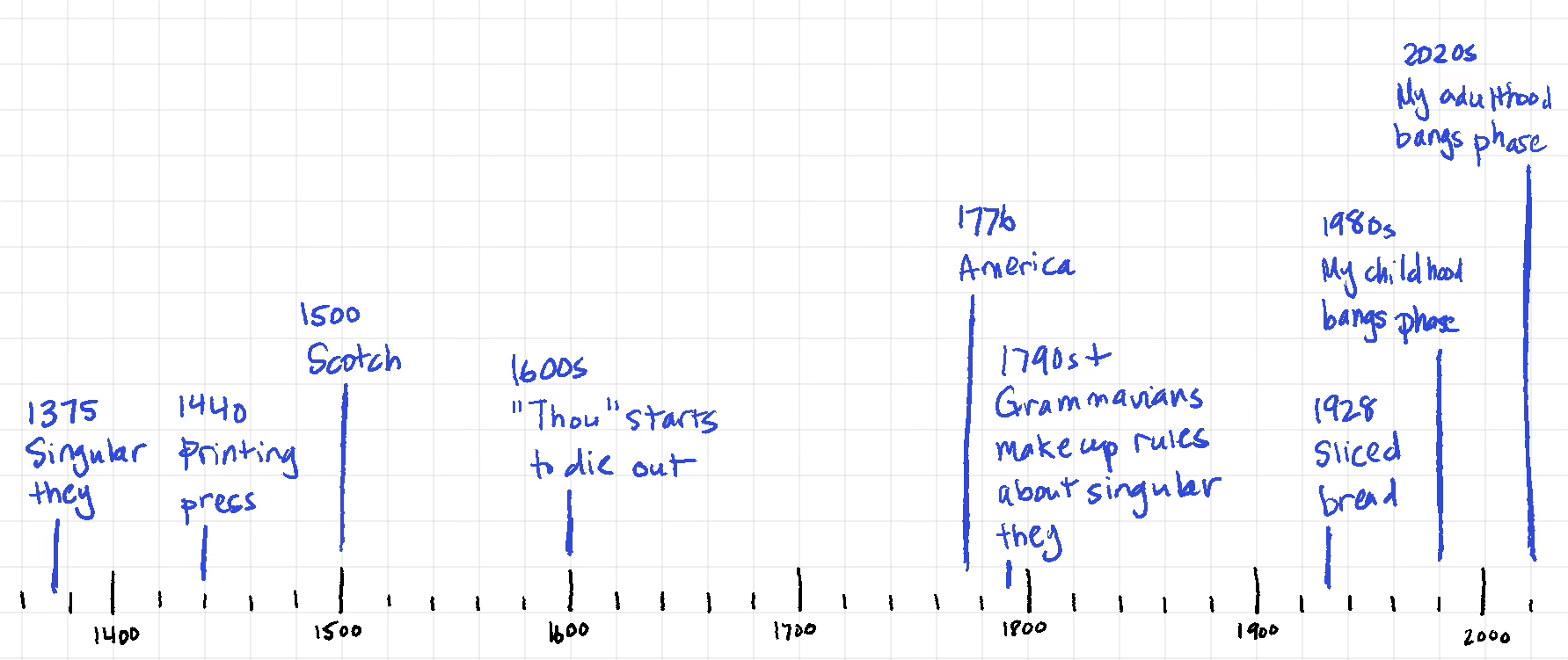
So, if anyone wants to be cranky at someone for changing how pronouns work, they could try yelling at the gravestones of one or more 18th-19th century grammarians?6 If you decide to do that, please film it and post it on the internet and let us all know about it, thank you.
Thanks for reading Trans Up Front! This post is public so feel free to share it.
The only thing about singular they that’s really new nowadays is using it to refer to a specific person who uses they/them pronouns. I, for one, would like to live in a world where it’s just common sense to refer to someone the way they want to be referred to, whether that’s their name, a cool-ass nickname, or pronouns.
In case you clicked on this hoping to be informed about what’s new in the 18th edition of CMOS, here are some actually relevant links you can click:
CMOS’s official summary of what’s new in the 18th edition
An editor’s deep dive on what’s new from Right Touch Editing
If you’d rather a podcast, keep an eye on the Grammar Girl podcast feed or YouTube channel for an upcoming interview with the editors of the new edition
I read an absolute ton of interesting stuff while researching this, including the following:
The Guardian: ‘They’: the singular pronoun that could solve sexism in English
American Heritage Dictionary’s usage note and word history of ‘they’
What’s Your Pronoun? Beyond He and She by Dennis Baron. Buy it or find it at your local library.
Do not sleep on the Ann Bodine article I mentioned in footnote three. It’s fascinating, pretty readable, and makes many excellent points including the one about if you want to criticize anyone for changing pronouns, it should be the grammarians. They started it!
1 If you’re all like, wait why didn’t she put the word “they” in italics or quotes, just like CMOS 7.66 describes? Firstly, hello, nerd, I’m glad you’re here. Secondly, I use “they” so many dang times in a short space that consistently using quotes or italics felt like TOO much.
2 What’s that, you love this but wish it was statistics? Here you go.
3 Dennis Baron, What’s Your Pronoun? Beyond He and She, p. 152.
5 Baron, p. 152.
Comments
Nothing yet. Say the first thing.
Sign in to join the conversation.