
Hello and welcome to the Dispatch.
We’re gearing up for the launch of Issue #4 of Translator magazine and we’d love for you to join us on Wednesday September 9 at the October Gallery in London to celebrate a world of translated journalism.
Our upcoming issue takes you to the frontlines of Serbia’s protests against government corruption and lithium mining, down the alleyways of Hanoi where a crackdown on markets threatens social bonds, and into the mysteries of Yemen’s looted mummies.
To bring these stories to life, we’re inviting special guests for readings and performances on the night, along with a buffet from Yemenland and Vietnamese sweet treats from Vinaxoa.

Now, on to the Dispatch, with English summaries of stories from Russia, South Korea and Spain – and our word of the week.

Nobody doubts that Putin’s United Russia party will sweep the board in parliamentary elections next month. But the Kremlin is playing a dangerous new game with the electorate, one analyst writes.
It’s a cruel irony that ‘“election” and “choices” are the same word in Russian – vybory – given that the Kremlin allows few of the latter when it’s time for the former. Vybory bez vybora, or “an election without a choice” is a commonly heard phrase in the run-up to a vote.
Next month, when Russians go to the polls for parliamentary elections, there’s no doubt that the United Russia party will return to power in the State Duma. When the fringe party Yabloko attracted a little too much attention online, along with the support of high-profile opposition figures in exile, it was swiftly removed from the ballot this week.
But that doesn’t mean this vote will be business as usual, according to the political scientist Alexandr Kynev. Writing for the Russian-language Forbes magazine this spring, Kynev was already predicting that “the 2026 parliamentary campaign could be out of the ordinary.”
Why? Because at the start of the year, according to Kynev, “the Russian state abandoned its fundamental principle: not to interfere with the normal lives of its citizens.” Over Putin’s decades in power, the Kremlin adopted what Kynev calls an “inertia model,” whereby authorities would offer a basic level of stability in return for citizens giving up many freedoms and democratic rights.
As Russia’s invasion of Ukraine dragged into its fifth year, that changed. In January, the government introduced new taxes and charges, which hit small- and medium-sized businesses particularly hard. “Citizens quite logically perceived the state’s attempt to collect more money as a sign of a worsening situation in the country.” Then there were widespread internet blockages. Authorities claimed these were a security measure to counter Ukrainian attacks, but they also affected ordinary peoples’ banking services – previously “a point of technological pride for the country” – and messaging apps. (The phenomenon Kynev describes has only grown since his article was published, with new waves of Ukrainian drone strikes on Moscow, and disrupting supply chains leading to petrol shortages).
The government could change course before the vote, returning to its previous inertia model, as well as its strategy of handing out pre-election freebies. “But this is a very risky scenario: society is already agitated, and this irritation won’t subside quickly. Citizens may find they get a kick out of successfully exerting pressure on the government, and want to continue doing it.”
And if those in power falsify votes to help United Russia, this could also backfire, the analyst warns. “Large-scale discrepancies between actual public sentiment and the formal election results” could anger citizens. “The authorities are playing a very dangerous game.”
As Russians increasingly feel the effects of the war in Ukraine at home, there is a wave of political discontent. If the Kremlin can’t offer voters a “measured and controlled” outlet for this discontent – and it won’t at the ballot box in September – the anger may express itself in unpredictable ways.
The original article ‘Выход за рамки: почемуxx думская кампания 2026 года может стать нестандартной’ was first published in Russian by Alexandr Kynev for Forbes Russia on May 13, 2026.
Forbes Russia is a Russian-language franchise of the US business magazine Forbes. It was launched in 2004.
Summary by Theo Merz
Thanks for reading Translator! This post is public so feel free to share it.

An ecofeminist journalist argues for a radical redistribution of resources in our petro-dependent world – and the enabling role of journalism
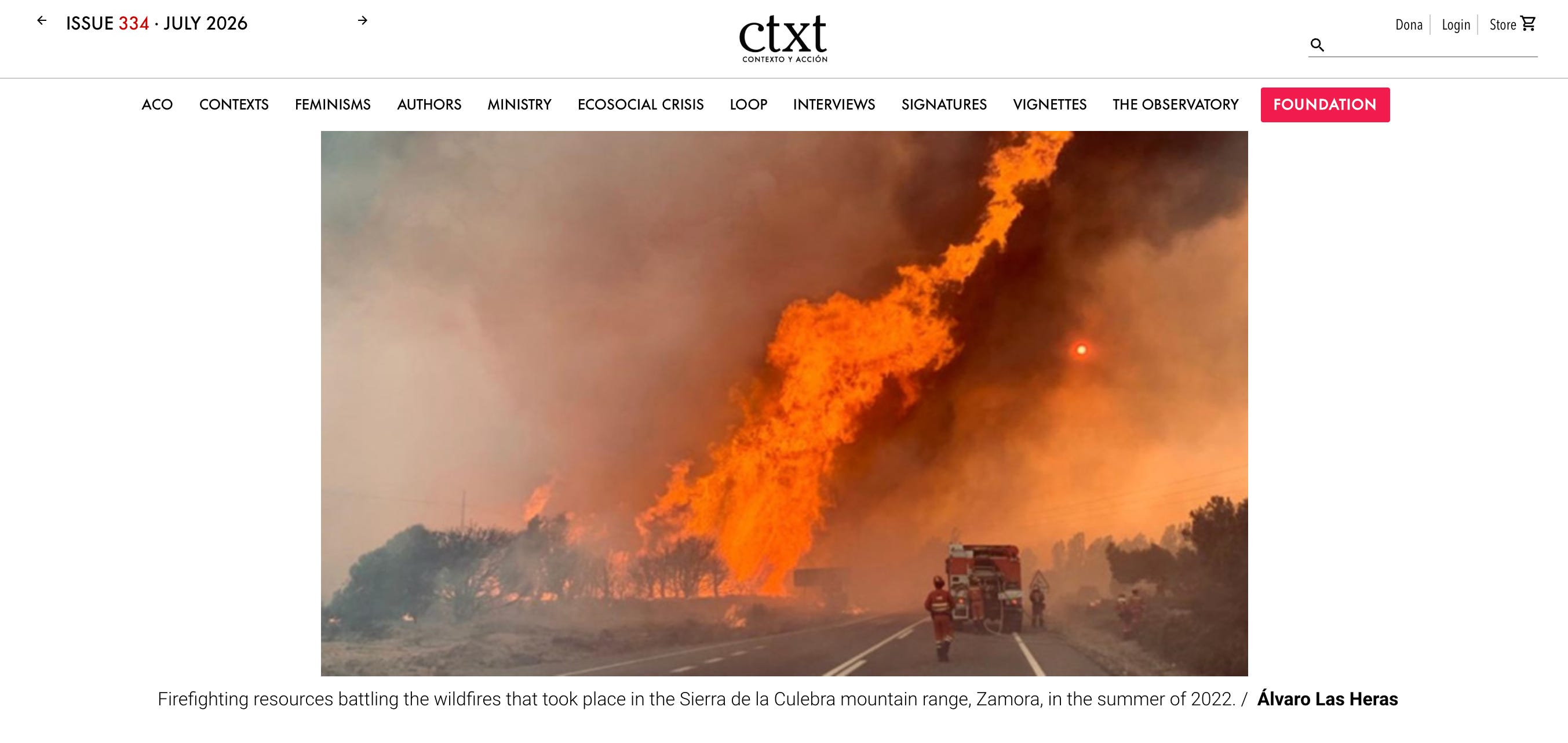
Our world is melting. During this summer’s ongoing heatwaves, cities like Guadalajara, León and Sicily are burning. Concrete slabs on German motorways are buckling under the sun. Several nuclear power plants in France have shut down. In Tunisia, 48°C led to blackouts that disproportionately affected poor neighbourhoods, disrupting hospitals, desalination plants and practically every sphere of everyday life. Everything that sustains life on our planet is under threat, warns ecofeminist journalist Yayo Herrero in a recent letter to donors for the Spanish magazine Contexto y Acción.
This is a direct consequence of “sacrilizing fossil fuel capitalism”, she writes.
Worldwide, most households have no air conditioning – the same is true for public buildings and transportation services. This year, thousands of people have already died from extreme heat and thousands more are being displaced by historic wildfires. In the face of the climate emergency, Herrero writes, we need to seriously transform the relationship between us, the economy and the land – and we must start in places like Europe where the privileges we’ve enjoyed from centuries of extraction are most pronounced.
To illustrate her point that material scarcity is linked to irrational economic practices, Herrero highlights how global oil shortages are affecting people and businesses in South Asia, where localised stories on this subject often go amiss. She cites people panic-buying rubbish bags in South Korea and rice producers predicting price increases due to shortages of vacuum-sealed packaging – both of which are derived from petroleum byproducts. She also looks to Malaysia, where manufacturers warn that a shortage of rubber latex is threatening the global supply of medical gloves. And in India, disruptions to condom production are planned due to difficulties obtaining silicone oil and ammonia, a vital nutrient also for agricultural crops.
Without a radical redistribution of resources in our petro-dependent world, Herrero writes, “eco-fascism” will be sustained by the logic of “green capitalism.” It’s not about just reducing CO2 emissions or improving industrial processes. Instead, we must radically transform systems of production and reorganise life in order to meet everyone’s basic needs. She admits that she doesn’t know of any political proposals working in this direction – but says that even an imperfect solution could help hinder the most violent abuse of our planet.
This entails new ways of producing food and generating renewable energy but also land-use planning and ecosocial education, led by the people and for the people.
She concludes on a hopeful note: journalism has the power to push for change. After all, she writes, the verb “to melt” has another meaning: to soften or dissolve with love. “In a world that is melting, journalism, like politics, must be a form of fierce, truthful, and rigorous love, essential to transforming every zone of sacrifice into a zone of re-existence.”

The original article ‘En un mundo que se derrite’ was first published in Spanish by Yayo Herrero in CTXT on July 27, 2026.
CTXT (Contexto y Acción) is an independent, left-wing Spanish online magazine that publishes in-depth reporting and political commentary, with a focus on social justice and the climate crisis.
Summary by Isa Jacobs
Thanks for reading Translator! This post is public so feel free to share it.
Gentrification in the popular Seochon neighbourhood is driving up prices at the expense of preserving cultural heritage
In 2024, Han Kang became the first South Korean and Asian female writer to win the Nobel Prize in Literature “for her intense poetic prose that confronts historical traumas and exposes the fragility of human life.” She ran a small independent bookstore “Onul Books” in the historic Seochon neighbourhood, next to Gyeongbokgung Palace in the South Korean capital, Seoul.
But after eight years in business, three of which were in Seochon, the shop and author’s residence permanently closed its doors last month.
An investigation by journalist Moon Gwangho from the current affairs magazine Weekly Kyunghyang highlights how gentrification is rapidly transforming Seochon and forcing community businesses and cultural assets like Han’s bookshop to disappear.
The investigation found that the building was sold to a corporate buyer through a real estate agency in the affluent Gangnam district. Seochon is described as a “mecca” for pop-up stores, driving increased tourism and higher prices.
Han doesn’t reveal the specific reasons for closing her store, but close acquaintances told Weekly Kyunghyang that it was due to the pressure of eviction and other tenants’ decisions to move out, which caused her much emotional distress.
“It was a space full of memories,” said the source.
Gentrification in Seochon is reshaping the area’s identity and critics say not enough value is being placed on cultural assets.
Lee Jeong-eun of the Local Bookshop Network pointed out that local bookstores act as vital “capillaries” for community dialogue and local talent, warning that “when they close, the connections built around them are uprooted entirely.”
One local gallery relocated after its monthly rent jumped three times from 10 million to 30 million won (approx. US$7,000 to US$21,000), and a 50-year-old family business must also leave next year following another building sale. Merchants lament that building owners care little about their tenants.
The article also points out how other Nobel Laureate prize winners are memorialised overseas – from the birthplaces of William Faulkner and Mo Yan, to the preservation of cafes frequented by Ernest Hemingway. It also says that there are currently no discussions at the local government level to preserve an author’s bookstore as cultural heritage.
“Now, the ‘Han Kang zone’ where she used to sit will disappear too,” said the owner of a local restaurant visited by Han. “Nothing will be left for the next generation.”
The original article ‘[단독]“한강 작가, 더 있으려 했는데”…책방 건물, 기업 손에 넘어갔다’ by Moon Gwangho was first published in Korean by Weekly Kyunghyang on July 20, 2026.
Weekly Kyunghyang is a South Korean current affairs magazine published by the major daily newspaper, the Kyunghyang Shinmun.
Summary by Yejin Gim
Thanks for reading Translator! This post is public so feel free to share it.
Thanks for reading this week’s Dispatch! Let us know what you thought of the stories in the comments below – and please do get in touch with other suggestions for pieces you’d like us to summarise.
We’ll be back next week.
Translator

No posts
Comments
Nothing yet. Say the first thing.
Sign in to join the conversation.