

AN INTRODUCTION TO THE INNER WORK SERIES
Two years ago, I took a step away from my work, the business I had painstakingly co-founded and built-up for fifteen years, supporting social purpose organisations to achieve their impact and strengthen their organisational capacity. As it was for many people, the pandemic shone a light on what felt out of touch. It was time to take stock. The strategies I had been implementing were not working. The models I had been using felt outdated, rooted in performance and too attached to upholding harmful systems, instead of questioning them. This was a painful realization. At the time, it felt almost impossible to imagine how to change. How could I move away from “stuckness” towards adaptability, and ignite imagination?
As concerned as I was about economic and structural inequities, divisiveness, and ecological degradation, it was the fear of what happens if the structures within us started to crumble that really touched me. What happens when there is a loss of heart? When our inner strength & resilience is broken down? In my mind, these losses could do us in long before the collapse of our planet, and may in fact be a precursor to it. It felt like this journey was going to ask something of me, a deeper dive, an inner journey where the real change had to happen from within.
The Inner Work Series is about this process of change. At the heart of this inquiry is an exploration of the possible pathways, the inner work that it takes to process grief and disillusionment, to move towards transformation and healing, and weave my way back into healthier and generative relationships both in my work and my personal life. I welcome you on this journey and am grateful for your presence.
One of the reasons I have (re)turned to somatic practices after years of heavy-headed, intellectual gymnastics, is because I hit a wall. I burnt out. I witnessed the people I was trying to support through my coaching also hit a wall. In the last few years, workplace culture has undergone significant changes including office closings, and moving tools onto shared virtual platforms. To the point where most meetings and team work sessions are now held online. Some of these changes have been beneficial, like being able to work from home. However, as a coach whose job it is to build trust between co-workers and encourage communication, trying to align working teams around common values and objectives virtually is considerably more difficult to do than in person. Not being in the same space impacts people’s relationships; their capacity to trust and listen to each other is diminished, their ability to find common ground together and come to decisions takes longer, and is more complicated. This slows down implementation, and affects accountability. It also decreases the likelihood that work relationships evolve into friendships, since there is less time to banter, laugh, and talk about people’s personal lives over coffee.
I have been noticing these changes over the last 5-10 years, and have been experiencing the consequences of them myself. There is no doubt that they have been contributing factors to my own sense of alienation and burnout. At times, like during the Pandemic, I have felt literally stuck behind my computer screen - threading one zoom call after the other, without any breaks. My body was immobile for lengthy periods of time, sitting rigidly in front of my screen, focused on the small squares of people. I would end the day with dry, red eyes that felt bleary and dazed. During this period, for the first time in my life, I developed chronic joint problems that I can directly link to being frozen behind my computer screen for weeks on end.
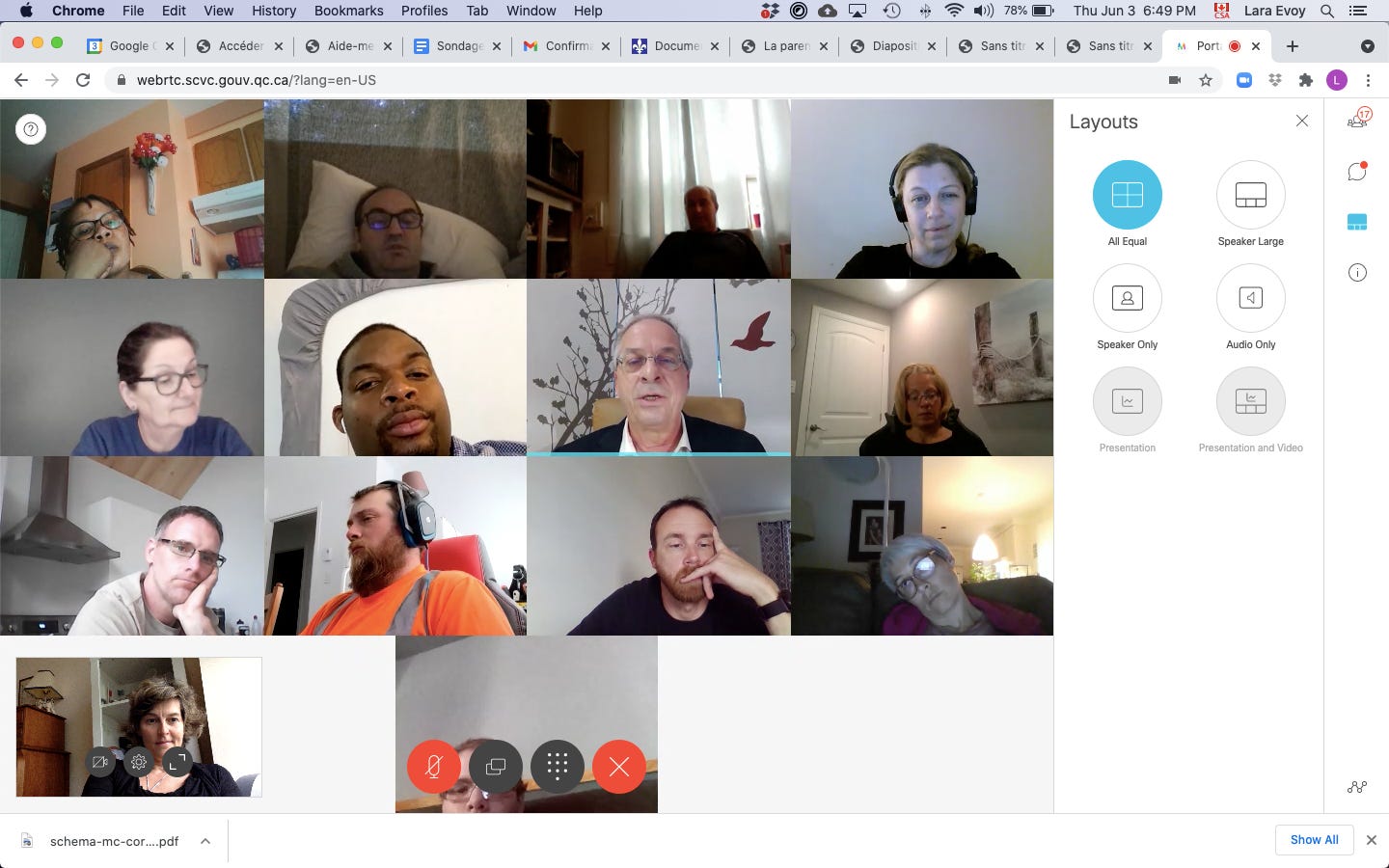
Even before the pandemic, workplace settings could be grim affairs. Office culture was not necessarily welcoming or inspiring. This is backed up by Statistics Canada’s 2023 Labour Force Survey, which indicates that about 1 in 5 employed Canadians report experiencing high or very high levels of work-related stress. A larger share (around 60 %) feel stressed at work in general, which includes moderate levels of stress. Some reports suggest that nearly 47 % of Canadian workers feel burned out.
In The Body Keeps the Score, Bessel Van Der Kolk explains that the fundamental issue in resolving stress is to restore balance between the rational and emotional parts of the brain. Stress and trauma “robs you of the feeling that you are in charge of yourself. The challenge of recovery is to reestablish ownership of your body and your mind - of your self”.1 For most people this involves four steps:
Finding a way to be calm and focused
Learning to stay calm in response to triggers - thoughts, sounds, physical sensations - that may recall a memory from the past
Finding a way to be fully alive in the present and engaged with the people around you
Not having to repress or keep secret memories, feelings, thoughts and sensations that then get stuck in the body
The good news is that each of us has access to a host of inbuilt skills to keep us in balance. According to research, because 80% of the fibres of the vagus nerve connect the brain with many internal organs, we can directly train our nervous system by the way we breathe or move. Hence, the relevance of integrating embodied practices into workplace strategies in order to promote self-awareness, emotional regulation, and to strengthen relationships and support networks. Van Der Kolk states:
Mainstream Western psychiatric and psychological healing traditions paid scant attention to self-management. In contrast to Western reliance on drugs and verbal therapies, other traditions from around the world rely on mindfulness, movement, rhythms, and action. Yoga in India, tai chi and qigong in China, and rhythmical drumming throughout Africa are just a few examples, which focus on the cultivation of purposeful movement and being centered in the present.
The old workplace pact often assumed that people interacted from a place devoid of emotions, imagination, creativity or suffering, leaving them feeling isolated and disconnected. No wonder co-workers prefer to stay at home! Many current work spaces are not at all equipped to foster self-management strategies, nor are they adept at addressing negative behavioral patterns, or alleviating conflict in the workplace.
We need to be imagining more creative solutions. Beginning with developing spaces where we are not asked to park a significant part of ourselves at the door in order to get through the day. We need to build back spaces and skill-sets that strengthen this collective “muscle” to be healthier, and to forge stronger, more authentic relationships with each other.
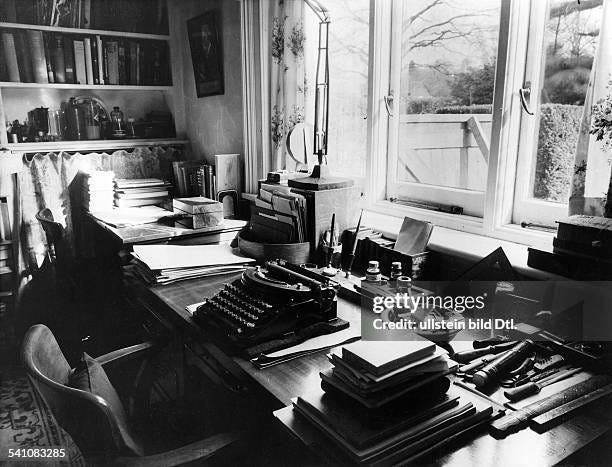
It’s a good question. One that I am exploring in the Inner Work Series. I would like to invite you to think about the type of space that you love to work in, one where you feel inspired and uplifted? For me, that is an open space, with windows and natural light, surrounded by art, photos, books, and plants. I sometimes love to work outside, where I can hear the river, or the sound of the birds. Libraries are great places, so are gardens, but my favorite image is of the artist in her studio, or the scientist in her laboratory. A place where she is permitted to experiment, wonder, make mistakes, and try again. I also need other people. Co-working hubs are great for that, or cafés. Creating a working space that supports the need to move around and interact with other people is key.
One of my experiments - coping strategies really - has been to imagine my work as a practice, one that is inclusive, supportive and diverse, and more closely tied to what matters to me. Purposefully breaking down the silos that I had constructed, but that have also been imposed on me, between my coaching, strategizing, desk-work, relationship building, caregiving, yoga, being in nature, gardening, art-making, and whatever else may be present - fostering a more integrated approach. This is where somatics practice has proved particularly helpful to me, since it sees the body as an essential place of change, learning, and transformation. When I intentionally connect to my body, I can access a wisdom stream that feels supportive, and that can challenge external expectations and notions that may have been imposed on me that I may be carrying unconsciously. By engaging in values-aligned, body-centered practices, I gradually detach from performative patterns imprinted on my subconscious that prevent me from sensing and relating outside of ingrained dominant frameworks. As author and somatics practitioner Kelsey Blackwell describes: “Our bodies become guides leading us back to a more complete existence.”2 One where I can begin to embody my intrinsic “enoughness”. In bringing somatics to the healing journey, I’m inviting my body to guide me in remembering, and reclaiming my power by centering practices that prioritize rest, ritual, and community.
I would love to hear from you and learn about your own experience. Please leave a comment or send me a message.
If you are interested in the Inner Work Series, please see these PREVIOUS POSTS:
CROSSROADS explores the dilemma of searching for more thoughtful approaches to work, deeper relationships and connection.
LOOKING AT TRAUMA, AND HEALING TRAUMA from a “non-expert” lens and personal experience.
We need to imagine a practice that is able to perform a ‘certain kind of’ ACUPUNCTURE on a system.
BURNOUT one of the ways the body informs the soul.
Bessel Van Der Kolk, The Body Keeps the Score: Brain, Mind, and Body in the Healing of Trauma. New York: Penguin Books, 2014, p.205.
Kelsey Blackwell, Decolonizing the Body: Healing, Body-Centered Practices for Women of Color to Reclaim Confidence, Dignity & Self-Worth. Oakland: New Harbinger Publications, 2023, p.8.
Comments
Nothing yet. Say the first thing.
Sign in to join the conversation.