
Written on 04/08/2026,
After being linked with him for several weeks, it now seems like Arsenal will get the Bruno Guimarães deal over the line. The Gunners have been active in the midfield market, having missed out on Sandro Tonali and seemingly fallen out of the race for Ayyoub Bouaddi. Securing Guimarães would be a major coup for them as they look to keep their squad competitive and on its toes during their Premier League title defence.
The market is in a crazy place right now, and Arsenal are ‘reportedly’ set to pay around £80m to sign the 28-year-old from Newcastle United. For a 28-year-old midfielder with only two years left on his current deal at St James’ Park, that sounds like an overpayment on the Gunners’ part.
But we have seen Elliot Anderson go for more than £110m and Tonali for around £100m. Given the experience and quality Guimarães offers, regardless of his contract situation at Newcastle (plus the fact he had a £100m release clause in his contract that expired in June), paying around that figure had to be the ballpark.
Last season, Mikel Arteta had Christian Nørgaard as a backup midfield option, presumably to provide cover and rest for either Martin Zubimendi or Declan Rice in the deeper-lying midfield roles. Instead, the former Brentford captain played just 101 minutes of Premier League football (309 in the Champions League, although none beyond the round of 16). There were even games in which Myles Lewis-Skelly was preferred in midfield ahead of Nørgaard. So, letting him join Everton was the right decision.
By signing Guimarães, the Premier League champions would significantly upgrade both the quality and depth of their midfield department. Arsenal could field any two of Rice, Zubimendi and Guimarães in the two central midfield positions without becoming weaker with any combination.
However, there is also the question of adding something different to the mix, and that is exactly what the new signing would bring to the current midfield setup. The Brazilian’s profile differs slightly from those of Rice and Zubimendi. How? Let’s dive into the data.
We will start by looking at their percentile ranks among Premier League midfielders during the 2025/26 season to establish a basic understanding before taking a deeper look through the event data visuals.
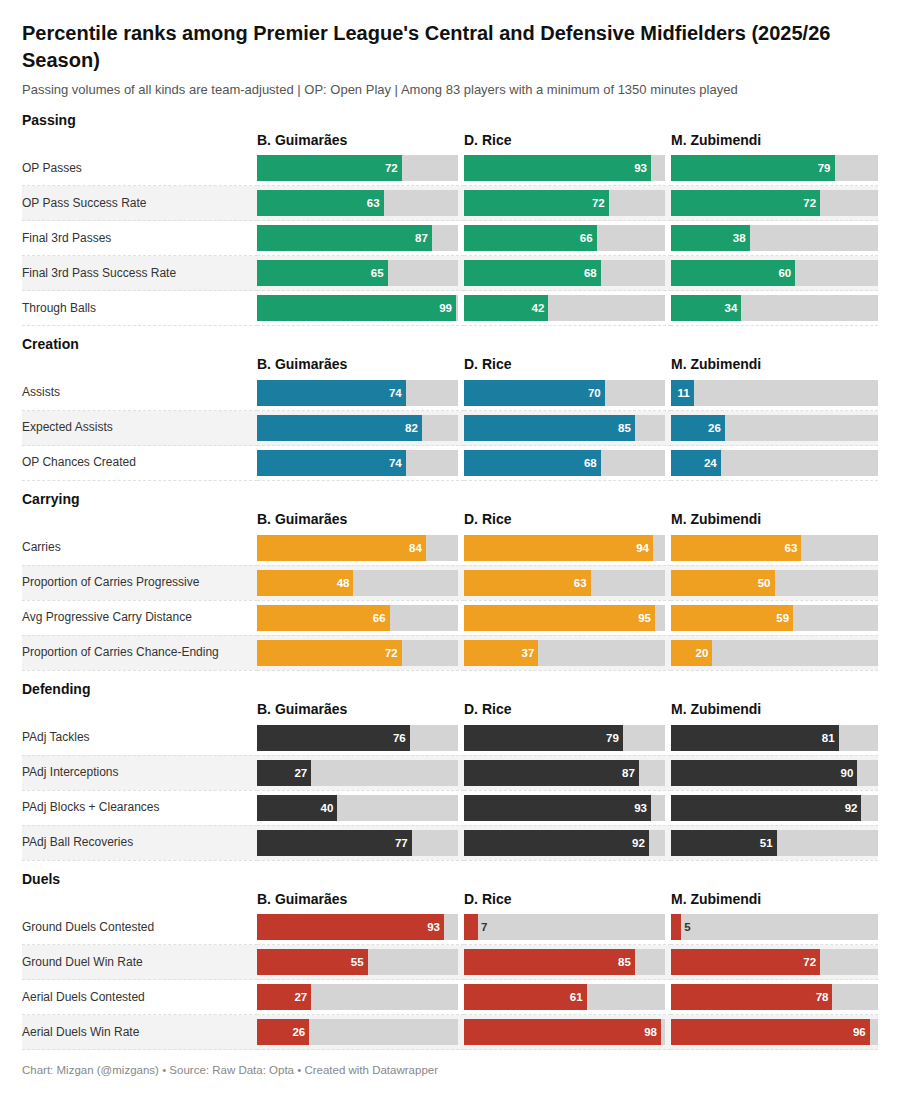
Looking at the passing and chance creation numbers, although Guimarães offers slightly less control in terms of pass completion, he attempts far more final-third passes while still ranking well for both final-third pass accuracy and through balls. He also comes out ahead of Rice and Zubimendi for chances created from open play.
Rice, as expected, posts excellent carrying numbers, but Guimarães offers a little more when it comes to carries that directly create a chance. Overall, the Brazilian would add a greater creative dimension on the ball compared to what Arsenal had in midfield last season.
Defensively, there is not much to separate the three in terms of tackling, but Rice and Zubimendi excel at reading the game and making key interceptions. Guimarães, by comparison, is more of a midfield dueller, reflecting the man-to-man defensive approach Eddie Howe implemented, particularly in central areas.
Whether the Brazilian can evolve that side of his game to suit the way Arteta wants his midfielders to anticipate counter-attacks and make crucial interceptions remains to be seen.
The differences in their profiles are clear from the percentile chart above. We can dive further into these by looking at the event visuals, starting with the touch maps.
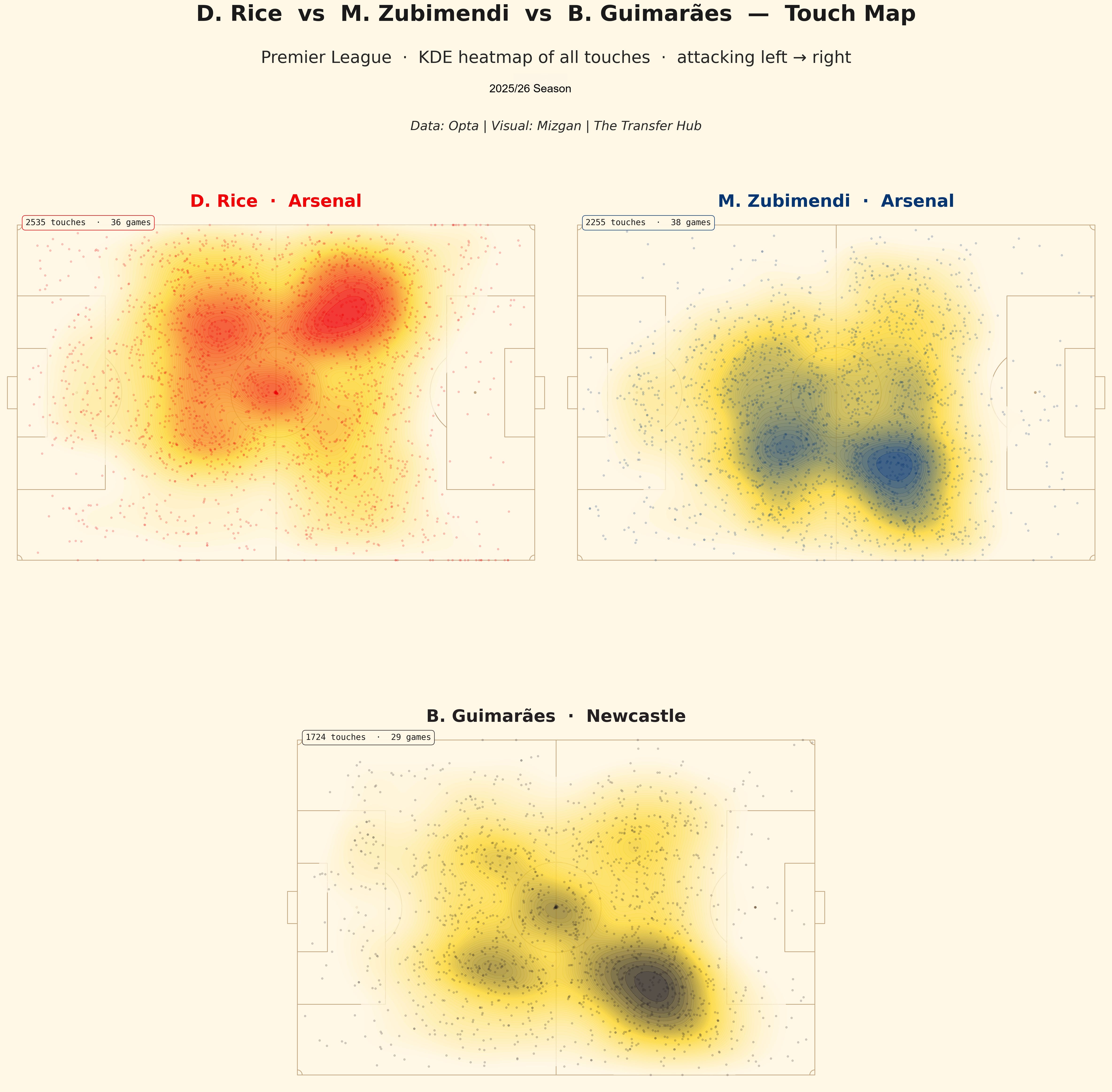
In a double pivot last season, Rice typically started on the left, while Zubimendi operated on the right. Looking at their touch maps in the opposition half, there is a clear demarcation in the areas they occupied (half-spaces).
In their own half, both remain fairly central rather than drifting towards the touchline to support the full-backs in possession. That is largely because Arteta’s system is more reserved, with the full-backs not always bombing forward in possession.
The left-back instead inverts into midfield, which explains why Rice’s touch map in his own half contains some actions on the left-hand side. The right-back pushes forward only when Arsenal establish comfortable possession.
As for Guimarães, he operated as the right-sided number eight in a 4-3-3 for Newcastle, with the freedom to be less rigid positionally and join attacks whenever required. That is clearly reflected in his touch map above.
Next up, pass maps.
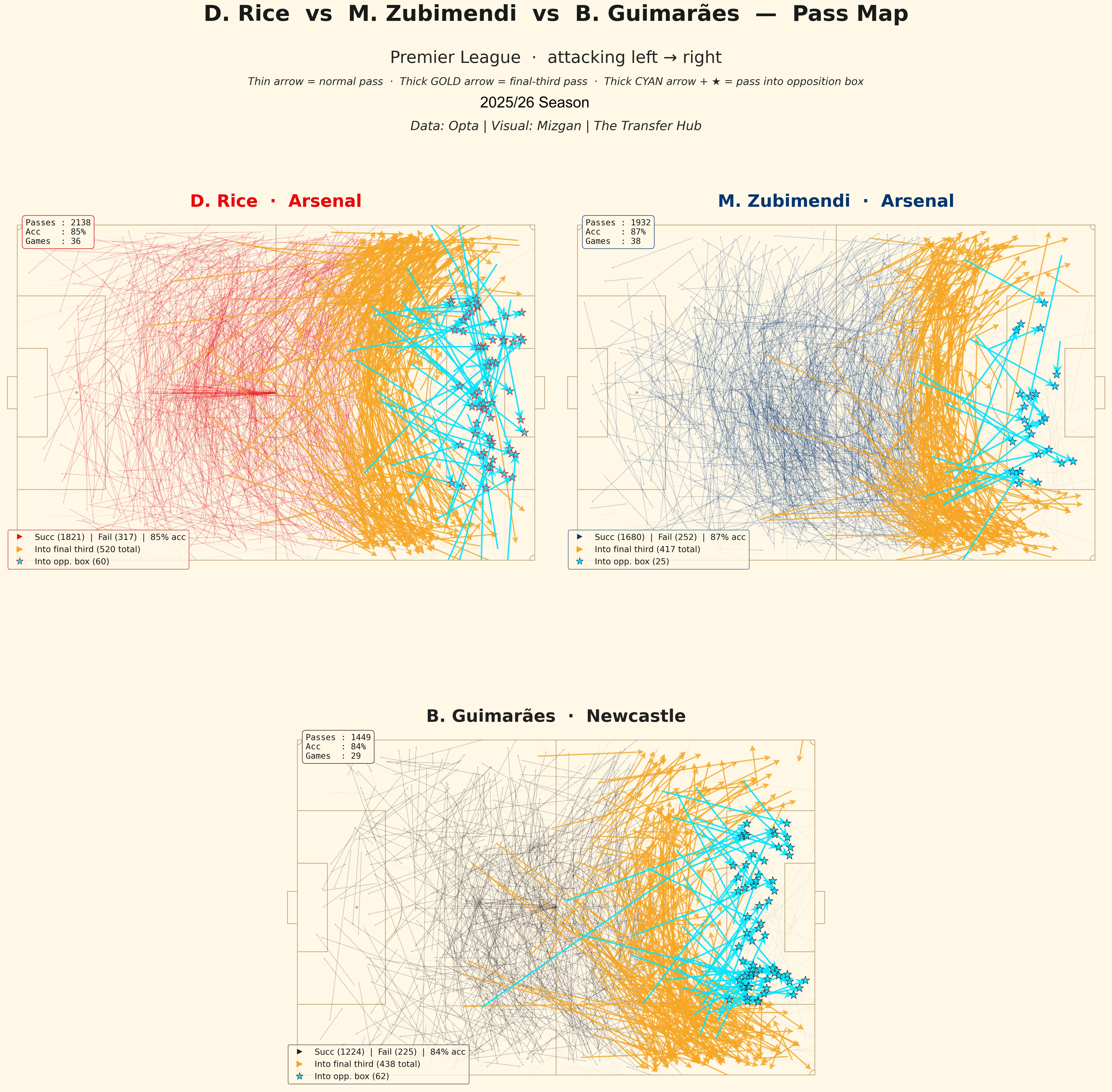
Of Guimarães’ completed passes, 41% ended in the final third or the opposition penalty area. By comparison, Rice recorded 32% and Zubimendi 26%. That aligns with what we discussed earlier when looking at their percentile ranks.
Guimarães is more attack-minded, not only in terms of his positioning but also because he was given greater freedom to attempt riskier passes or those designed to break open the opposition (and he is capable of doing that), rather than simply recycling possession and leaving the creative work to others.
Despite that, his overall pass completion rate is not far behind what Rice and Zubimendi recorded last season.
Up next, we will look at the chance creation maps (from open play), followed by the progressive carry maps, ball recoveries, post-recovery pass maps, and finally the average distance each player covered before receiving a pass and before making a defensive action.
Together, these would add further layers to the differences between their profiles.
The rest of this analysis is for paid subscribers. Get unlimited access to in-depth, data-driven player and team analyses, scout reports, and tactical breakdowns covering the Premier League and European football for just £3.50/month, or £3.16/month with an annual subscription. Start with a seven-day free trial.
Comments
Nothing yet. Say the first thing.
Sign in to join the conversation.