
Iʼve wrapped up my fintech arc, and now itʼs time to do the same for digital commerce. But first, I’ll explain how I got here. When I decided to explore the assumptions underlying how VC is practiced in Africa, my instinct was to start with the three sectors I thought would most closely align with Silicon Valley VC orthodoxy: fintech, digital commerce, and logistics. To be clear, I’m referring to the version of VC that expects exponential returns from selling fully digital products at scale, where scale is driven by a low or zero marginal cost of producing an additional unit of product. These products are consumed by large numbers of people and institutions with sizable purchasing power.

Chasing Outliers: Why Context Matters for Early-stage Investing in Africa, which I co-authored, covers all the ways this logic can break down. For The Trajectory Africa, the podcast I retired last year, the goal was to interrogate this alignment (or lack thereof) at a sector level. Initially, I assumed fintech would be the best fit, followed by digital commerce, then logistics. Whether that assumption holds up is something I aim to write about once I conclude this “What Iʼve Heard, Learned, and Think” series.
My initial pod series yielded six “principles” that served as the foundation of my learning journey. The fifth principle states that SMEs power tech startups by buying from them, and funding and supplying SMEs is a VC-scale opportunity. This was the starting point for my exploration of B2B (informal retail) e-commerce. This piece, in a way, walks through why this is a challenging proposition.
Another key element is the connection between fintech and digital commerce. Fintechs build the (payment) rails for trade in Africaʼs emerging digital economies, of which digital commerce is an expression. Some argue that infrastructure stimulates economic activity, while others suggest it’s the other way around. In either scenario, efficient ways to pay, save, borrow, invest, and trade are essential.
The last bit to consider is the oft-quoted coincidence I’ll probably mention at least one more time before I conclude this series. Flutterwave CEO Gbenga Agboola shared that “there are three major pillars that can help Africa to leapfrog”— payments, commerce, and logistics—during a panel hosted by the Carnegie Africa Program in 2022. His statement seemed to validate my instinct to explore these sectors as the foundation of VC-investable opportunity in Africa. And that resonance continues to grow.
So, that’s the ʼwhyʼ. Letʼs move on to the ʼso whatʼ. First, Iʼll recount what Iʼve learned about digital commerce. You can check out What Iʼve Heard about Digital Commerce for the full story; this is the abridged version. Then, I’ll share my reflections on the challenges of digital commerce, how they can be mitigated, and how the “problem behind the problem” in digital commerce shapes its trajectory.
The Asset Intensity Dialectic
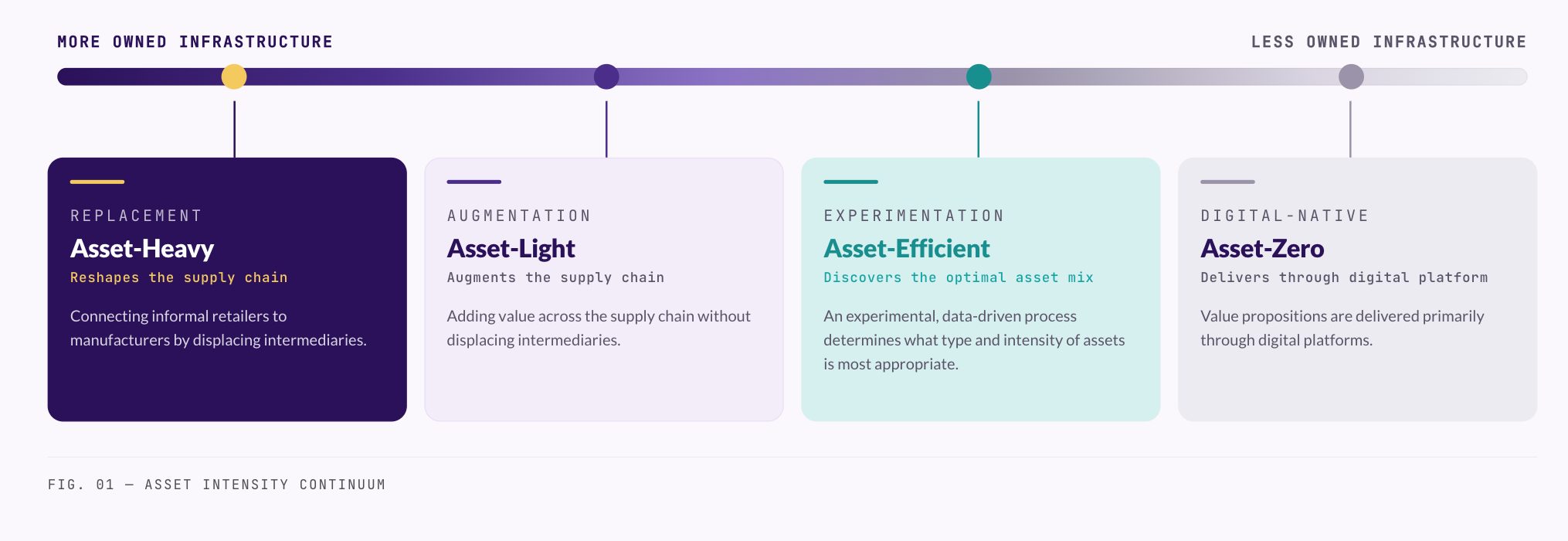
Most of the major digital commerce players have identified inefficient and fragmented FMCG supply chains as a core problem in the space. But there are different points of view on how to solve it. The so-called asset-intensity continuum represents the range of operational strategies a founder can choose to “fix” the supply chain, depending on what the market demands and the founder believes is needed. Asset intensity is a useful analytical lens, because it helps to define the approach, the opportunity, the unit economics, and the challenges associated with each option. I’ve identified four along this continuum: asset-heavy, asset-efficient, asset-light, and asset-zero. What follows is a breakdown of how the four compare.
Asset-Heavy (Replacement)
An asset-heavy, replacement approach basically reflects a strategic decision made by a founder to serve as a digital wholesaler or key distributor that directly connects informal retailers who need to stock to the local or international brands who manufacture products. This is a reshaping of sorts of FMCG (fast-moving consumer goods) supply chains, because they replace “middle men” like analog wholesalers and distributors in order to increase efficiency and reduce cost. Of course, the reality is a bit more complicated than full replacement. Platforms that serve manufacturers and/or retailers need to work with whomever their customers do. As such, if a (key) distributor, subdistributor or wholesaler is a significant source of supply for the manufacturer(s) and/or retailers on their platform, it will likely be onboarded.
We’ll get into the challenges of replacement. But let’s situate it in the context of technology adoption patterns in Africa. That will help explain why this strategic choice is a difficult one.
I’ve written about Africaʼs S-Curves, a piece by DFS Lab Co-Founder and General Partner Stephen Deng, a few times. So, I’ll just hit the necessary highlights here. The basic argument is that the last twenty years of VC suggest that Africaʼs S-Curves, which illustrate how technology adoption shifts from one technology “era” to another, are shaped a bit differently. If the x-axis is time, and the y-axis is the technology’s performance, the tail is longer and the slope is steeper. This means that it takes a long time (on average) for technology to reach the adoption stage. But once it does, adoption happens quickly and impactfully.
In the context of digital commerce, where you think the inflection point sits between one curve and the next reflects where you believe the opportunity is, and what type of business should be built to capture it. If you’re building what Stephen describes as a Point C company, you’re betting on using existing technology to reshape supply chains. Point C is defined like this:
Point C (androids): Old tech can’t improve, but the market isn’t ready for new tech, so change is delayed until barriers are removed (e.g., traditional TVs to HDTVs).
Point C represents a replacement strategy. The core idea is that replacement means “organizing” decentralized, informal markets, which often involves bypassing “middle men” who seem to detract from the efficiency and transparency of B2B e-commerce supply chains. Doing so requires inserting technology-enabled assets to replace intermediary functions. For example, a startup may enter the market to make food less expensive by driving down the cost of moving FMCG food products through the supply chain. The startup would do this by directly connecting informal retailers, who sell FMCG goods to consumers, to brands. This bypasses wholesalers that aggregate and distribute supply and earn margin for doing so. The same startup uses technology to make ordering and restocking these products cheaper and easier (e.g., less time spent procuring goods) for retailers. In turn, manufacturers experience an increase in pricing control. For example, they can set discounts that can be applied through the platform. Without the transparency and control afforded by digitalization, a wholesaler could “eat” the discount and charge retailers the regular price.
A core assumption is that informal markets already work and aren’t interested in technology for technology’s sake. But Point C android companies try to remove barriers to technology adoption through user-friendly product design, market education, and VC-funded subsidies. In other words, the market isn’t necessarily demanding technology, but androids try to insert it because they believe it can improve efficiency, lower costs, etc.
The problem is that it’s expensive to invest in infrastructure like warehouses and trucks. If, like Sarafu, you’re selling to customers willing to pay a premium for reliable delivery, then maybe what you earn funds the cost of your infrastructure. Otherwise, you’ll be competing with traditional wholesalers and distributors who donʼt bear the cost of tech and tech talent. Further, VCs donʼt necessarily want their equity to be used to pay for those assets. For these reasons, along with their point of view on what will actually work, founders may be incentivized to build asset-light models.
Asset-Light (Augmentation)
Founders who build asset-light companies are choosing to augment, rather than reshape FMCG supply chains. They believe they can add value across the supply chain, and earn revenue from the value created. Within the S-curve framework, this approach is represented by the Point B inflection point. Here’s how it’s defined:
Point B (cyborgs): Old tech can still improve, and the market is ready for new tech, causing a slower transition (e.g., hybrid cars to electric vehicles).
A Point B company deploys an augmentation strategy. Instead of replacing supply chain players such as wholesalers, they create value for stakeholders across the chain and capture a portion of the surplus created. To accomplish this, they build a platform where multiple stakeholders can access information and services that boost their businesses. To be clear, the value proposition to each player doesn’t necessarily change; what changes is who remains in the supply chain.
Generally speaking, digitalization creates supply chain visibility, which helps manufacturers, wholesalers, distributors and retailers see whatʼs happening with their inventory. This visibility generates data that helps them make operational decisions and unlocks access to working capital (for everyone down chain from manufacturers)—typically a line of credit to buy stock. More specifically:
Manufacturers gain access to a wider universe of distributors and retailers and the ability to help generate demand for products and control prices, by running promotions, for example.
Wholesalers and distributors benefit from demand generation and operational efficiency. In terms of demand, a B2B e-commerce platform serves as an additional channel through which to sell products, which can be cheaper and more efficient than selling products from a van(s) on the street, for example. Further, operational efficiency preserves unit economics. With low-margin businesses, any sort of loss, such as product leakage or poor payment reconciliation, can wipe out margin. As such, supply chain visibility and payments digitized through a platform can help keep money in the business.
Informal retailers get a cheaper, more convenient restocking process, and experience better customer retention because they can stock more goods, more reliably. They also receive better offers and incentives such as promotions and cashback directly from manufacturers, to whom they are now visible through a digital platform.
In terms of market readiness for new tech and the improvement of old tech, the emergence of conversational commerce could illustrate this. People and businesses use social media and WhatsApp as infrastructure for trade, and startups make that process easier, more efficient, and more lucrative through AI. Social media and WhatsApp could represent the improvement of old tech, and AI could do the same for new tech.
In any case, the unique challenge of asset-light augmentation is to find the right mix of human and digital processes. Here’s how Deepankar Rustagi, Founder & CEO of OmniRetail explained his companyʼs model:
Many players say they are asset-light, and some of them end up moving towards owning assets because it is actually very difficult to manage assets that don’t belong to you, unless you have built a structured incentive model that enables you to get the most out of those assets.
In the last decade, we have seen the evolution of Booking.com, Amazon, and Uber, and we have seen how important it was for these platforms to have ratings, reviews, and feedback, and to align those into the incentives that flow through the system. We have seen how Google reviews have changed the behaviour of the smallest restaurants. We have seen how Uber drivers today request a five-star rating to influence outcomes.
I think what we got right was this: irrespective of who owns the asset, we need to find a way to measure the quality of delivery at each stage. Whether we own the warehouse or the fleet, we still need to ensure that at the point of delivering value, we are checking the quality of the service being offered. That helped us ensure that being asset-light never reduced the quality of service we were offering.
Asset-Efficient
Asset-efficiency is an approach that uses an experimental discovery process to determine what type and intensity of assets is most appropriate. An asset-efficiency strategy has two main components: experimenting to determine the optimal configuration of assets, and optimizing operational gains. Experimentation generates data that indicates the most productive configuration and asset intensity for a logistics set-up. Optimizing operations prioritizes revenue assurance, or completing all planned sales to avoid losing revenue to returns and missed transactions. It also means ensuring that a warehouse and last-mile logistics operation maximizes throughput and utilization, respectively.
Theoretically, asset-efficient companies could be augmenting, point B cyborgs or replacement-oriented point C androids. It probably depends on the role(s) they assume in FMCG supply chains and how they use assets. For example, Maad, an AI-powered distribution and logistics platform for brands to reach consumers in Africa, directly connects manufacturers and retailers, but also seeks to improve retailersʼ market power by helping them earn revenue and rewards for effective merchandising. They also enable access to other wholesalers on their platform, to keep transactions within their network. And while they do own warehouses and trucks, they’ve experimented with synthetic leasing, which allows them to defer outright ownership until they’ve confirmed which warehouse configuration and vehicle types work best for them. Here’s how Maad’s Co-founder and CTO Jessica Long described the process:
The more you become specialized, you do have to make a certain level of investment in your ability to operate in a streamlined efficient way. But, in the beginning, as you are establishing your procedures and processes, you want to operate in the most flexible way possible.
We’ve actually avoided purchasing racks in the warehouse for a long time. We have a pallet-based system that’s super flexible and you can swap in and out different kinds of products. I think that we will continue to do that until our product mix really solidifies and we’re able to then build infrastructure around that. That’s what allows us to operate efficiently as a much larger organization.
Obviously, owning your assets [will] cost you less per unit to make your deliveries. [But] we structured a deal with our local bank where it’s kind of like synthetic leasing, where we’re just making monthly payments for three or four years.
Asset-Zero
This asset-intensity category joined the mix later than the others, through conversations with the founders of Boost and Pika. You can read about what I learned from them here. Both companies are asset-zero because their value propositions are delivered through digital platforms, but they serve different parts of the FMCG supply chain.
Boost prioritizes the middle layer, focusing on key distributors, but also serves manufacturers and retailers. Key distributors, subdistributors, and wholesalers access tools to manage inventory as primary users, but donʼt pay for the platform. Manufacturers are the main customers, who primarily gain visibility into the movements of their products, as well as payments, orders, and promotions. Boostʼs partnership with Unilever allows it to onboard its entire network of distributors at once, potentially across many markets. It partners with Mastercard and banks in multiple countries to offer data-enabled, working-capital solutions. Pika serves retailers who struggle to afford Android POSs, unlocking data on them through their bookkeeping app and connecting them to critical government resources such as financial services and insurance.
Translating Efficiency and Transparency as a Value Proposition
Before we tackle the challenges with digital commerce models, thereʼs a loop to close on the core value proposition in the space. As I mentioned, the primary problem is defined as inefficient and fragmented supply chains, which companies confront using strategies with varying asset intensity. But customers arenʼt paying for efficiency and transparency; itʼs the outcomes they produce through the flow of data that creates value.
Mayowa Alli, OmniRetailʼs Chief Operating Officer, Financial Services, explained that the company focuses on customer outcomes from data generated through digitalized (i.e., efficient and transparent) supply chains. For example, benefits roughly fall into three main categories for manufacturers: distribution, demand generation, and risk management.
With distribution, large manufacturers may have gaps in their networks—locations or products existing distributors and wholesalers donʼt cover. Smaller manufacturers, particularly those who donʼt own distribution networks, might want to introduce a new product to the market. In both cases, OmniRetail can fill those gaps through its OmniHub franchise partners. These are independent wholesalers and logistics providers who leverage the companyʼs platform to connect with manufacturers who need services, and to source inventory and credit.
On the demand generation side, manufacturers who connect with distributors and retailers on OmniRetailʼs platform donʼt have to rely on salespeople traveling to physical locations. It’s another channel through which to push products. As such, efficiency translates into cheaper, more effective demand generation. Additionally, manufacturers can deploy more targeted promotions based on data about which retailers and distributors are moving which products. In terms of risk management and reduction, manufacturers can see what credit distributors receive, and how that credit impacts their performance.
For retailers and distributors, the differentiator is accessing working capital thatʼs designed to accommodate the realities of a low-margin business with fast turnover. Credit lines to purchase products are often associated with a specific manufacturer if you’re a distributor, or with a distributor if you’re a retailer. Through its stakeholder relationships, OmniRetail can offer a product with tailored repayment terms. For example, because OmniRetail is connected to its manufacturers, payment (and interest accrual) for goods happens after they’ve arrived and can be sold. Further, help with demand generation makes it easier to pay off the supply credit.
Firas Ahmad, Group CEO and Co-founder of AzamPay and Sarafu, explained how efficiency and transparency impact the bottom line like this:
A lot of people use this slogan—data is the new gold—as if you can take ones and zeros and sell them to people. And especially in Africa, you can’t do that. Nobody actually pays for ones and zeros. We give dashboards to our customers that are quite detailed and some of them don’t even use them. [But] we are monetizing price transparency and efficiency and reliability. And what it all comes down to is customer service. So, if you go to our platform and you look at our prices, we’re generally not the cheapest price in the market.
…The people that buy that from us are the ones that value that service. We identified a slice of the market who we call the mini market segment—the more advanced shop that’s willing to pay a premium because they don’t want the headache of having a product they canʼt return, not getting a product on time, and not having a customer service number they can call. [Itʼs] having a one-stop shop so they don’t have to go to five or ten different suppliers every day. Where we tend to see our customers demonstrate the willingness to pay, but also appreciate the service, is [in the] outlying areas where you don’t have as much customer density. They come to us because [they] don’t get serviced by the existing distribution infrastructure. …And our average margin is between 8 and 9%.
Ultimately, any benefits associated with efficient and transparent supply chains and the data they produce have to improve margins—they must reduce the cost of doing business and/or increase revenue. When all transactions are visible and create value, B2B e-commerce platforms can earn money.
The Problem with Digital Commerce (B2B E-Commerce) Models
No matter how you look at it, it’s difficult to build and run a stand-alone (“pure play”) B2B e-commerce company focused on distributing FMCGs. Some of the sector’s pioneers distributed basic commodities like flour, sugar and oil, which have margins that are too thin to fund the cost structure (technology and people) of a tech company. They were effectively digital wholesalers, earning the same slim margins that wholesalers do, while covering the costs of investments they don’t typically have to make.
Some companies, like Chari and Sarafu, built ancillary revenue streams. For example, Sarafu turned its last-mile delivery capability into a service it sells to other businesses. Delivering fintech solutions was another common adaptation. Companies offered working capital to retailers so they could order (more). Sarafu actually developed an internal payment platform (AzamPay) to increase transparency and reduce failed transactions. Chari turned its network of retailers into financial service consumers by offering them wallets and cards to hold funds and purchase supplies. It earns transaction fees from money movement and card usage, as well as interest on merchantsʼ custodian accounts. Chari also helped its retailers become financial services distributors, earning a percentage of value-added services such as airtime and insurance sold by their merchants for telcos like Orange.
The Unit Economics Struggle
As Olumuyiwa Olowogboyega points out in his insightful piece, The Margin Problem That Won’t Go Away, the margins for FMCG distribution (in Nigeria) are 2-5%. Clearly, this is a hard business to find profits in. Nonetheless, Iʼve picked up some insight on how to boost revenue on both ends of the asset-intensity continuum.
Revenue:
Generally speaking, prioritizing manufacturers as customers increases margin availability because goods pass from the manufacturer to a distributor, then to a subdistributor or wholesaler, and finally to a retailer. If you choose to become a wholesaler and distribute to retailers, the only available margin is between yourself and the retailers you serve. But there are some asset-intensity specific differences:
Asset-heavy (replacement). If you’re pursuing a replacement strategy, youʼre taking roles from intermediaries, along with their associated margins. With this approach, there are roughly five ways to boost revenue. All but the first one should apply to augmentation and efficiency as well. First, you can disintermediate supply chain players like other wholesalers. Secondly, you can capture non-distribution revenue streams such as brands’ marketing budgets. Thirdly, you can sell digital services to retailers. Fourthly, you can build value-added products, such as loans, advertising, and inventory management. Finally, you can make the compounding of small gains work in your favor. For example, you can negotiate to increase the rebates from annual contracts with your top suppliers. A 0.5-1% bump in margin adds up at scale.
Asset-light (augmentation). If you’re taking an augmentation approach, you’re delivering value across the chain. Some users will pay and others wonʼt. But if you help them grow their revenue streams, they can spend some of those gains on value-added services on your platform. Intermediaries are still subject to margin pressure—manufacturers can threaten to increase the prices of the goods you resell, and retailers can demand low prices to incentivize their purchases. Offering a unique value proposition that’s only accessible through your platform, such as deep access to retailers and quality merchandising for manufacturers, is one way to combat this.
Overall, a few key themes emerged about improving revenues across models with some level of assets:
Limit the amount of commodities sold or make them more profitable to sell. This can be done by selling non-commodity items, limiting the volume of commodities sold, or increasing their prices. Maad and Sarafu both focused on selling more packaged goods, which have higher margins than commodities. Maad also limits the number of commodities customers can purchase, and the platform “leads” them to other options. Finally, Sarafu prices commodities at levels that reflect the infrastructure required to supply them reliably, to a customer segment (mini markets) who will pay a premium.
Deliver value-added services. As I mentioned before, some digital commerce businesses leaned into embedded finance by offering credit on supplies, selling financial services to merchants, and/or turning merchants into financial services distributors. They also leveraged their platforms to deliver value-added services. For example, Maad and Sarafu enabled manufacturers to channel promotions directly to retailers. Sarafu also turned potential cost centers—its internal payment platform and logistics operation—into services provided to external customers.
Sell what you plan to sell. The more efficient a digital commerce companyʼs operations are, the more closely matched its projected and actualized revenue will be. Cost and time related to processing returns and restocking can meaningfully reduce revenue earned.
Select the “right” customer in the supply chain, but grow others. Again, manufacturers sit at the “top” of the supply chain. Working with them generates the most margin, and retailers the least. However, Maad recognized that it could increase its earnings from retailers. Establishing the relationship between good merchandising and more sales increased retailers’ power and positioned them to earn rewards and revenue from their efforts. As a result, their capacity to purchase products and services from Maad increased.
Costs:
Reducing the cost of last-mile distribution (from warehouse to point of sale) seemed to be a top priority, followed by managing warehouse and fuel costs. As such, unit cost profitable deliveries were more or less non-negotiable. Hereʼs what seemed essential to maintaining lean, efficient operations:
Practice strategic asset ownership. As mentioned previously, a company can experiment to decide what types of vehicles (trucks, three-wheelers, bicycles, electric vehicles, etc.) are most profitable and efficient, and what ratio of owned to leased assets (over what time period) makes sense for the business.
Optimize throughput and utilization. Essentially, this means ensuring that warehouses are full and moving goods in and out of them efficiently into trucks that are also full (coming and going).
Manage the cost of distribution (routing). AI can help create optimized pathways for delivery, e.g., batching goods by location, and navigating according to road quality, customer profitability, etc.
Exploit economies of scale. Distribution businesses are scale businesses, so they will need to grow large in order to be profitable. As Olumuyiwa Olowogboyega writes, the economics are comparable to telecoms infrastructure: the upfront cost is punishing, but once a distribution network reaches sufficient coverage, the unit economics shift.
This brings us to two “big picture” business model takeaways: 1) digitalize supply chains that move goods with large enough margins to “pay” for the digital infrastructure; or 2) in supply chains that transport lower-margin goods, figure out how to subsidize the main “trade” business until it reaches full scale. Once it does, my guess is that the “U-Chop-I-Chop” business model will kick in, and the distribution business will grow as the businesses it supports do. Hereʼs how Firas Ahmad describes the dynamic:
What happens is you’re operating against an alternative, which is the informal market…And they don’t have fancy Harvard degrees and Western education. They don’t have all this software and ERPs. They’re just selling whatever they can in the moment that they can.
And if you can’t find a way to scale big enough to pay for all of that extra cost, while your competitor who’s still small and nimble doesn’t have any of that cost, and he’s making money, but you’re losing money, even though you have all the tech? That’s actually the story of e-commerce in Africa. All this fancy tech and all this investment, and still the guy selling out of the back of his truck is doing better because he’s capturing the whole margin value for himself. He doesn’t have to pay for any of that stuff.
That brings us to…
The Problem Behind the Problem
As I’ve worked toward articulating the logic underlying African tech opportunities, it hasnʼt been easy to understand the foundational problems in fintech, digital commerce, and logistics, and whether solving them with technology translates into massive, hypergrowth, hyperscaling, VC-funded businesses. That journey is ongoing, but I’d like to share what I think constitutes the core challenges in digital commerce. Let’s start with a couple of “sunlight through the cracks” moments prompted by exploring an adjacent sector—logistics.
The first came from Samora Kariuki, CEO and Founder of Frontier Fintech, as he reflected on his experience building Sote, a supply chain startup. He walked me through the main players of a typical logistics supply chain, and shared a few fundamental observations:
Intermediation as a non-problem. Matching cargo owners with loads isnʼt necessarily a core logistics problem, given the efficiency of informal markets.
Margin constraints. Even if it is a problem, thereʼs no extra margin to pay for technology-driven intelligence.
Monetizable problems. The lack of supply chain visibility—the ability to track and manage cargo—is a real challenge. But thereʼs still no money to pay for a solution. (Yes, it’s hard to monetize visibility in logistics too. But itʼs not surprising; digital commerce and logistics are related.) The “real” problem to monetize turned out to be unlocking access to working capital through Soteʼs transactional data. But despite Soteʼs customers clamoring for their solution, banks were unable to change their underwriting processes to work with it.
I’ve written before about the second moment of clarity, which came courtesy of Jean-Claude Homawoo, Loriʼs Co-founder and CEO. As we prepared to record his episode of The Trajectory Africa, he clearly articulated a core problem in logistics—challenging payment terms that created a need for working capital. Truck drivers have to pre-pay the operational costs of transporting cargo, like the cost of fuel and repairs, before the job is completed. That leaves drivers waiting 30-90+ days to be paid for a job. Companies like Lori recognized this problem, and stepped in to solve it. But that introduced another problem. Securing and managing millions of dollars of debt is a distinct and sophisticated skillset that many logistics tech companies probably didnʼt have.
In both scenarios, the “problem behind the problem” is stewarding access to capital.
Fast forward to my adventures with digital commerce. I acknowledged earlier in this piece and in the previous one that building a stand-alone B2B e-commerce business is difficult. As I’ve reiterated, the core assumption is that founders can use technology and assets to reshape supply chains to varying degrees. In some cases, this has involved bypassing supply chain actors like wholesalers via digital platforms. Where technology was disintermediating distributors and wholesalers, the problem-solving faced limitations. Some tech platforms that promised cheap or free, reliable deliveries to retailers could only meet those goals by using their own trucks and warehouses. But they became expensive replacements due to the use of technology (and the high-earning people who build it) and assets. The asset-zero and asset-light players side-stepped much of this problem.
But regardless of asset intensity, B2B e-commerce companies realized that retailers and distributors would buy more stock with access to credit. For example, as I wrote earlier (and in my previous piece), Boost’s partnership with Mastercard enables working capital to be delivered to key distributors and retailers. This was a pre-existing feature of FMCG value chains, so it probably shouldn’t come as a surprise. But for those who arenʼt part of informal networks of credit, access to data-informed working capital can be very impactful. In our conversation for The Trajectory Africa, Firas Ahmad recounted the difference it made for one of his customers:
We track our best customers—we call them champion customers. Every now and then, I’ll go with the team and just visit champion customers. We’ll also visit champion customers that have churned. A year and a half or two years ago, we visited a champion churn customer, a lady who had stopped buying from us. She was one of our top customers. She had been selling out of her shop for almost a year and a half consistently, maybe $400 or $500 a month in sales. And then she stopped about three months before we visited her.
We asked her what was going on. She said, ʼI had to stop because I had a child. And now I’m trying to restart my business. But I can’t, because I can’t get any loan from anyone.ʼ She has an informal business, so banks would not be likely to lend to her; she’d have to try to find a family friend.
We immediately gave her her full monthly order on credit and allowed her to restart her business. And this is a typical thing in the informal market. If you don’t know the right people and you’re not in a trusted relationship with the person who has access to the products, you likely get left out because you’re not part of the club.
Unfortunately, the working capital problem is systemic and extends beyond digital commerce. Again, Jean-Claude Homawoo described it clearly. African startups have been buckling under the weight of financing whole supply chains. Meanwhile, in other contexts, asset-financing (think car loans) is an industry unto itself, not a function internalized within a single, fragile company. Dealerships sell cars, and financiers package and distribute auto loans. Returning to Soteʼs case, Samora explained that Kenyan banks donʼt typically have trade finance specialties, and couldn’t adapt to use Soteʼs transaction data for loan underwriting.
Meanwhile, asset-heavy digital commerce companies need affordable debt to finance their assets. In my first piece on digital commerce, I described this as form vs. function tension—markets calling for solutions that require assets to deliver properly, even though companies can’t grow fast enough to get loans to fund the assets. (Ironically, as Stephen Deng writes, debt made up 42% of funding to African startups in 2025.) To that point, DFS Lab Partner Joseph Benson-Aruna emphasized how critical it is to incentivize local capital holders to lend. With the crushing devaluations faced by many African currencies, itʼs essential for companies serving African markets to borrow in local currency, if they earn in local currency. In Joseph’s words:
I don’t think the core solution itself is inside digital commerce. The thing is financial institutions opening up and giving money. What you can get from digital commerce is transparency. If you look at the B2B supply chain, it brings transparency to something typically opaque. For example, one of our companies, Matta, does a lot of raw material movements. And in that space, you don’t really have insight into what the business looks like—how many tons, how long payments take, etc. A platform like Matta brings transparency: this company moved this much; this is what it was worth; payments took x days. Down the line, that data is useful for financial institutions that decide to give money.
[But] you still need a cultural change within financial institutions. Unfortunately, that’s not something we can do with foreign money. It’s uncomfortable depending on external dollars. Cycles of inflation, devaluation, and FX destroy things. FX-denominated debt kills startups. And we need someone in the public sector to take a bet.
Thereʼs another layer to consider, which Joseph implies. And thatʼs data. Mayowa explains why:
The real problem behind the problem is no data visibility. That’s why working capital is a problem. Because if the data is there, people will lend. But people can’t lend today because there’s no data. A manufacturer sometimes sits on excess cash, but they can’t lend because they don’t know who is creditworthy and who’s not. A distributor needs working capital but can’t get it because their operations are very manual. They don’t have proper records. The bank doesn’t understand what they’re selling, what margins they’re making, or the turnaround on inventory, so they can’t properly underwrite. Same for retailers. So, I think working capital is a symptom. The ultimate problem is that the value chain has been very broken and inefficient, so there’s just no data.
That last sentence brings us back to where we started—the inefficiency and fragmentation of supply chains.
Perhaps the final piece of the puzzle is the level of consensus around efficiency as the core value proposition. Arguably, companies like Wasoko were more focused on helping end customers buy food more cheaply. (Daniel Yu, Founder and former CEO of Wasoko describes this here @15:08.) While efficiency and transparency were important for companies like this, they were a means to an end. Cathy Chepkemboi, CEO of Tushop, connects the dots between efficiency and the cost of goods:
Especially in FMCG and when it comes to e-commerce, there are two things that usually kill e-commerce businesses. One is customer acquisition and the second is logistics. Amazon didn’t go out trying to reduce the cost of living, but by building such an efficient system, they’ve been able to actually sell goods at a lower price. And I just wonder if you can build a very efficient system that allows for discovery and logistics…can the outcome be that you have reduced the cost of living or the cost of goods?
Final Thoughts (Too Long, Didnʼt Read)
Admittedly, itʼs pretty diabolical to put a TLDR at the end of a long piece. But I’m allowed to have some fun, no? Anyway, hereʼs the bottom line:
I buy the argument that an asset-heavy, technology-enabled, B2B e-commerce (distribution) business could work once it reaches scale. Itʼs just incredibly difficult to scale profitably if you’re moving low-margin products. If the focus is on commodities, adaptations need to be made. You sell to retailers who can pay a premium, and/or encourage them to buy higher-margin products, and/or subsidize the business with a more profitable one like producing private label goods. It probably helps if you have investors who know the FMCG business intimately, and are patient with slower growth until you create a scalable configuration.
But even an asset-light(er) model is probably easier (and less risky) to pull off with higher-margin goods, hence Sabiʼs expansion into minerals. That aside, it seems more scalable, partially because core costs are variable rather than fixed. But the underlying trade business is probably still a (less profitable) investment in digital infrastructure that unlocks higher-margin financial services, such as working capital.
Well, that’s all I’ve got on digital commerce. We’ve also reached the conclusion of my six-installment “What I’ve Heard, What I’ve Learned, and What I Think” series on fintech and digital commerce. In the next piece, an epilogue of sorts, I’ll reflect on the golden thread(s) connecting fintech, digital commerce, and logistics. Until then…
No posts
Comments
Nothing yet. Say the first thing.
Sign in to join the conversation.