
If you follow African tech and VC, youʼve probably seen or heard one or more of the following statements:
The VC model doesnʼt fit African contexts. (lots of people)
Ecosystems develop very slowly, and then all at once. (Osarumen Osamuyi, The Subtext)
These statements are provocative. But whatʼs more compelling is the why behind them. In my last piece on fintech, I promised to pull a golden thread or two across the three sectors Iʼve explored and written about: fintech, digital commerce, and logistics. Doing so has led to a simple explanation for why these statements recur. The short answer is infrastructure; but I’ll offer a slightly longer one. Letʼs start with why these sectors converge and how well opportunities within them fit VC logic.
Fintech, Digital Commerce, and Logistics: The Engine of African Venture
This is actually a variation of the title I gave my second series on The Trajectory Africa. It reflects a hunch that these three sectors would drive a lot of opportunity in the VC and entrepreneurship space. This instinct was validated when I discovered that Flutterwaveʼs CEO Gbenga Agboola had suggested “there are three major pillars that can help Africa to leapfrog”— payments, commerce, and logistics—during a panel hosted by the Carnegie Africa Program in 2022. Why are these sectors linked? Fintech serves as the transaction rails for trade, of which digital commerce is an expression. Similarly, logistics help coordinate the physical rails that also enable trade.
Working with these three also served a broader goal of understanding which sectors do (or donʼt) lend themselves to Silicon Valley-style VC assumptions. In terms of alignment, I think fintech, digital commerce, and logistics roughly follow the order youʼd expect. But there are caveats because of the infrastructure-building era these sectors are in, as well as sector-specific differences.
Infrastructure building in fintech has a lot of digital components, like writing code to process ISO messages and building APIs. But acquiring customers and distributing digital services are processes rooted in the physical world, through agents and POSs that process transactions. That reality is probably reflected in the high customer acquisition cost (CAC) to revenue ratio that McKinsey, Oui Capital and Technext report. As fundamental fintech infrastructure like payment rails proliferate, the fees to use them are driven to zero by competition, and they become a bit like utilities. But building this infrastructure unlocks higher margin use cases such as lending. There are also opportunities to consolidate multiple financial services into an operating system (as Bankole and Olumide at Afrobility would describe it) that meets the needs of multiple customer types across a portfolio of evolving needs. Companies like Flutterwave started as payment service providers, but are evolving toward (neo)bank-like entities. That seems like a VC-like trajectory.
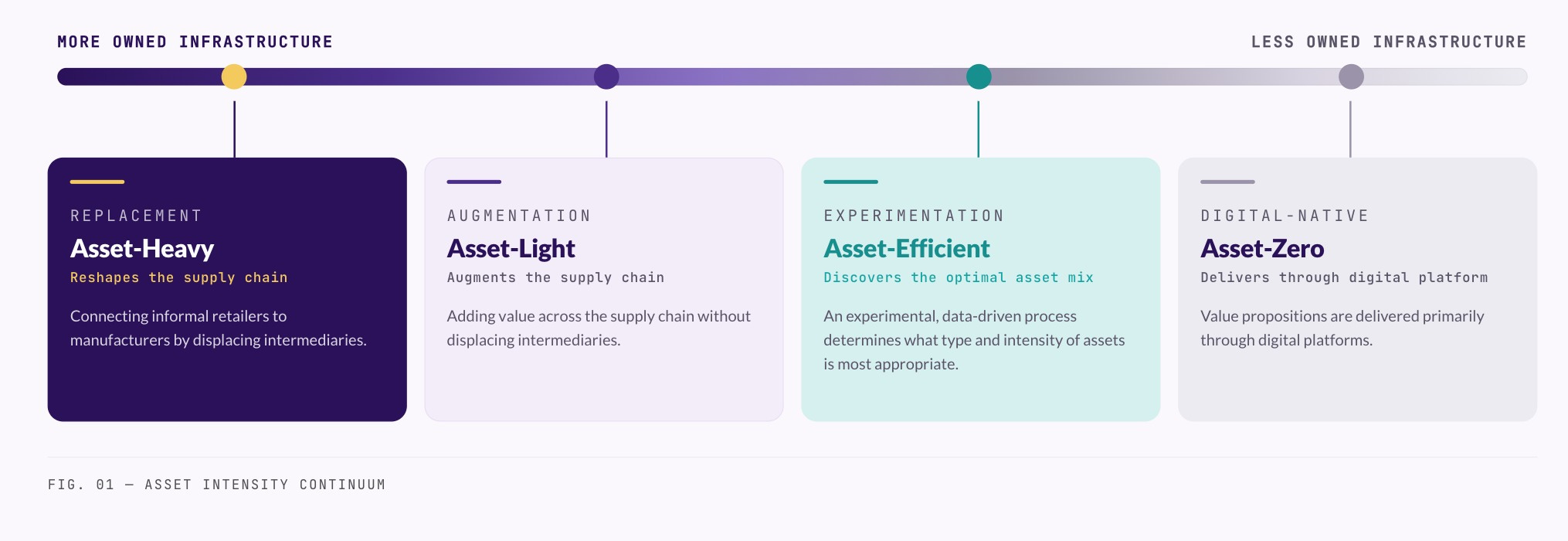
Digital commerce (B2B e-commerce) is kind of the opposite. The goal was to increase the efficiency and transparency of FMCG supply chains by routing the restocking, promotion, and sale of goods through digital platforms. Many of the first generation of companies effectively became digitally-enabled wholesalers, circumventing their analog counterparts in order to increase efficiency, ensure reliable deliveries by taking over last-mile logistics, and gain margin. However, owning the assets, e.g. trucks and warehouses, needed to move these goods was too costly for the business model. As a result, many of the so-called “asset-heavy” platforms shut down, and some of the next generation ones pursued asset-light, asset-efficient, or asset-zero approaches that focused on using technology to orchestrate activity—inventory tracking, product sales and delivery. This increased visibility into transactions taking place on the platform, and generated data to support underwriting for working capital provision. While new leaders are emerging in the space, itʼs not clear if/how/to what extent a digital-first B2B e-commerce model will scale. Somewhat ironically, fintech distribution introduces assets, while digital commerce models shed them.
Logistics seems to follow a trajectory similar to digital commerce. This makes sense given that coordinating last mile delivery (although it may not technically be considered logistics) can be a core function of digital commerce. Many pioneers in this category also used technology to make moving goods cheaper by increasing the transparency and efficiency of logistics supply chains. They served as freight forwarders who matched cargo holders with transporters, increasing revenue for transporters by boosting truck utilization. This resulted in discounted roundtrip prices that reduced costs for the cargo holders.
Unfortunately, intermediation (cargo matching, etc.) and visibility arenʼt necessarily monetizable for a tech startup. First, informal markets may already efficiently coordinate cargo. But even if they donʼt, there isnʼt enough margin in the value chain to pay for either value proposition. As such, players who took an asset-heavy approach to intermediation by owning vehicles, etc., struggled. Some of the remaining ones continued to coordinate cargo to improve truck utilization, which helped transporters make more money. They could then earn a percentage of the surplus. Other second generation platforms used AI to optimize the logistics operations of large, often multi-country brands, reducing their costs and taking a cut of the savings. So, in the end, these companies also pivoted toward digital-first approaches. Yet, proof of scalability remains to be seen.
In sum, fintech seems most aligned to VC expectations because its main products are effectively software, even if customer acquisition and distribution arenʼt fully digital processes. Digital commerce and logistics companies align by building digital platforms to coordinate the movement of physical goods while eschewing the ownership of assets, e.g. trucks and warehouses, to do so. This choice clearly illustrates the allure of digitalization to create value and enhance profitability, but also represents a trade-off between making money and solving problems in asset-heavy ways. Notably, startups in both sectors have struggled to profit and scale.
Still, basic transactional infrastructure is being built and/or enhanced within fintech, digital commerce, and logistics—payment rails and digital platforms that coordinate the movement of FMCG products and big cargo.
Working Capital: A Key to Transaction and Trade Business Models
A couple of useful questions emerged while exploring these sectors: which problems are actually problems, and which of them can be monetized? As I mentioned earlier, there are different perspectives on whether coordinating cargo with technology solves a real problem. Even if it does, monetizing the solution seems to require generating enough additional revenue to allow the service provider to earn a percentage of the extra value. But whatʼs the source of this value add?
An assumption that cuts across all three sectors is that inefficiency and opacity increase the cost of doing business. Although improved efficiency and transparency probably arenʼt benefits that customers will directly pay for, they do unlock value propositions that can be monetized. Digitizing transactions makes them visible. These transactions then produce data that unlocks services like working capital lending, which tend to generate higher margins than earning a percentage of processed transactions. In short, any benefits associated with efficient and transparent supply chains and the data they produce should improve margins. Hereʼs what I’ve observed about business models for fintech, digital commerce, and logistics while they’re in their “infrastructure-building” eras.
Fintech. I suggested in my thesis piece on fintech that many startups launch with single vertical services like payments and lending, but will eventually introduce other (higher-margin) services to expand their customer bases and meet their customersʼ evolving needs. They’ll also do so to improve profitability. Transaction-enabling payment rails are fundamentally valuable, but the service they provide gets commoditized as competition drives fees toward zero. Perhaps obviously, higher-margin opportunities are often consumer and enterprise facing, rather than delivering enabling infrastructure. Unfortunately, many fintechs also have high customer acquisition costs because much of the architecture to acquire customers and distribute products (like agents and POSs), is physical. Meanwhile, customers churn in search of lower transaction fees. Further, although the consumers and small enterprises that comprise mass markets may not have much money to spend on financial services, they will spend to access more money through remittances and lending.
Digital commerce. Stand-alone B2B e-commerce businesses (digitally-enabled wholesalers) are difficult to run profitably. I’ve written a lot about the rationales for, characteristics of, and challenges with, digital commerce models across the spectrum of asset ownership (asset-heavy, asset-light, asset-efficient, and asset-zero) here, here, and here. In the end, it seems like an asset-heavy, technology-enabled, B2B e-commerce business could work once it reaches scale. Itʼs just incredibly difficult to scale profitably if the business owns its own assets to move low-margin products.
Even an asset-light(er) model is probably easier (and less risky) to pull off with higher-margin goods, partially because core costs are more variable rather than fixed if you own fewer assets. But the underlying trade business is probably still a (less profitable or break even) investment in mostly digital infrastructure that facilitates transactions and unlocks higher-margin financial services such as working capital.
For properly asset-zero models, the digital infrastructure to lending pipeline is still a big part of the game. They use technology to facilitate transactions and make them visible—manufacturers offering promotions on products that retailers purchase to restock, for example—which provides data that enables access to credit. Again, monetizing efficiency and transparency comes down to helping customers make more money and taking a cut of the additional value created.
Logistics. In a typical logistics supply chain, freight forwarding and transport services attract the lowest margins. These providers also face payment terms of 30-90+ days, which means they wait a long time to be paid. As such, the margins available to cargo owners to pay for cargo visibility, and for transporters to pay to access loads, are too low. Consequently, startups that operated like digital freight forwarders faced monetization challenges. To create viable business models, they increased the earnings of transporters by matching them with return trips. This created a higher volume of cheaper trips, and the startups could take a percentage of the additional earnings. They could also use the transaction data from the trips to extend working capital to transporters.
To sum up, processing payments, and coordinating and transporting cargo, are utility-like/ commodity-oriented business. Technology really does introduce transparency and efficiency to supply chains. But because itʼs expensive and margins are thin, building infrastructure that enables efficiency and transparency is more likely to be profitable if it unlocks opportunities to make more money.
A Future for Building Trade-Enabling Infrastructure
The quotes that introduced this piece speak to the trajectory of African tech opportunities. New ones emerge, or are earned, from the foundations built by pioneering startups who created into a void. Moniepointʼs CEO Tosin Eniolorunda talked about the “value of building reliable systems in an unreliable country”. In describing what made Moniepoint successful, Frontier Fintech Founder Samora Kariuki and DFS Lab Partner Joseph Benson-Aruna also highlighted its steadfast reliability as a differentiator and key to its success. Joseph described his own experience with Moniepoint like this:
I could go to my bank and they wouldn’t have the money. I couldn’t rely on them. If I did a transaction, it would fail. They weren’t prepared. But I could go to an OPay agent or a Moniepoint agent and get money. It cost me something, but it worked. Every time I went to that agent, it was a better use of time than going to a bank ATM. So, trust shifted.
Clearly, this is the value that building and owning solid infrastructure creates.
Iʼve also written a lot about visibility as a core benefit of infrastructure-building. Eghosa Omogui, Managing Partner of EchoVC Partners, has described the process of identifying founders with secrets about the markets theyʼre seeking to organize, digitize, etc. Conceptually, “informal” markets are a lot like icebergs—some of the activity is visible, but a lot of it isnʼt. As such, you have to know them well enough to understand where technology can make a difference.
Digitalization creates economic opportunity because it makes transactions visible. And visible transactions are the start of a journey to making informal markets legible. Once this happens, thereʼs a foundation on which to create even more opportunity. But again, building the initial layer of infrastructure doesnʼt necessarily (or solely) create a profitable, scalable business. The primary infrastructure-building is still necessary though, because it unlocks higher value opportunities that can be built on top of basic rails. Letʼs expand this logic in the context of trade.
Unlocking the Next Layer of Infrastructure-Building for Trade
A key assertion in my fintech thesis is that infrastructure-building is still an opportunity, but the basics have already been built. In fact, McKinseyʼs 2022 report, Fintech in Africa: the end of the beginning, observed that the initial phase of foundation-building is over because the first wave of fintech companies have successfully created “basic financial services infrastructure” consisting mostly of wallets and payments.
We can go back to Stephen Dengʼs S-Curve argument (yes, again) to understand what this basic infrastructure-building phase could mean for technology adoption. The general idea is that technology adoption takes a long time to reach an inflection point in Africa, but once it does, the trajectory is rapid and impactful. What if the flat part of the curve is the “preparation phase” for technology adoption, which includes building and diffusing technology infrastructure? In that case, an argument could be made for exercising patience—longer tenure fund structures and lower returns while this foundational infrastructure is built. Presumably, this would be the time for concessionary capital to fund infrastructure-building that creates markets. Those investments would prepare and derisk secondary and tertiary level opportunities for commercial investors.
Hereʼs one way to think about how infrastructure-building has played out across Africaʼs trade architecture: I’ve suggested as another part of my fintech thesis that fintech solutions should help individuals and businesses make more money by unlocking access to productive asset loans and trade finance. In the latter case, the need for credit is caused by long, complex supply chains that make it slower and more expensive to transport goods. So-called middle men contribute to this complexity because their participation elongates the supply chain. But they also suffer from it because they have to navigate unfavorable payment terms to participate.
B2B e-commerce and logistics companies have tried to reshape supply chains through platforms that mediated the buying, selling, and movement of goods, digitized transactions, and extended working capital. Unfortunately, some digital commerce startups bore the burden of owning the assets (e.g. trucks and warehouses) needed to ensure reliable deliveries, which broke their business models. In logistics, others buckled under the weight of financing whole supply chains. Meanwhile, in other contexts, asset-financing (think car loans) is an industry unto itself, not a function internalized within a single, fragile company.
Similarly, fintechs tackled tech infrastructure deficits such as a lack of unified data on companiesʼ cash flows. Of course, there are gaps startups canʼt always fill on their own, such as unlocking local capital. For example, even when logistics startup Sote had rich transaction data on customers who wanted to work with them, banks couldnʼt adapt their underwriting processes to absorb it. And with national instant payment systems, itʼs the role of governments to mandate their creation, collaborate to make them interoperable, and keep transaction fees low. There are also challenges that exist in the gray zone—should private companies like Flutterwave own the infrastructure that unlocks a single source of truth for consumersʼ financial data, or should it be accessible to everyone through open banking policy?
Part of what these fintechs, digital commerce, and logistics companies are doing is what Mercy Corps Ventures Investment Principal Toffene Kama might describe as cultivating velocity. Credit won’t always lead to growth and productivity if it’s masking a structural deficit that locks businesses into a fight to survive. But digitizing cash can direct it towards more productive uses faster, which should boost productivity and possibly, incomes. Will working capital needs reduce once money movement becomes instant? Iʼm not sure, but I suspect digital cash flows and digital credit for trade are complementary because digital transaction data can unlock lending. If credit is extended on the basis of access to digital transaction data, and those funds are delivered digitally, you get lower friction, higher velocity, digital cash flow that enables productive credit.
Perhaps it’s worth thinking about whether Africaʼs trade infrastructure (fintech, digital commerce, and logistics) has matured enough to start unlocking higher value, higher margin, scalable and defensible opportunities that are worth the wait.
No posts
Comments
Nothing yet. Say the first thing.
Sign in to join the conversation.