
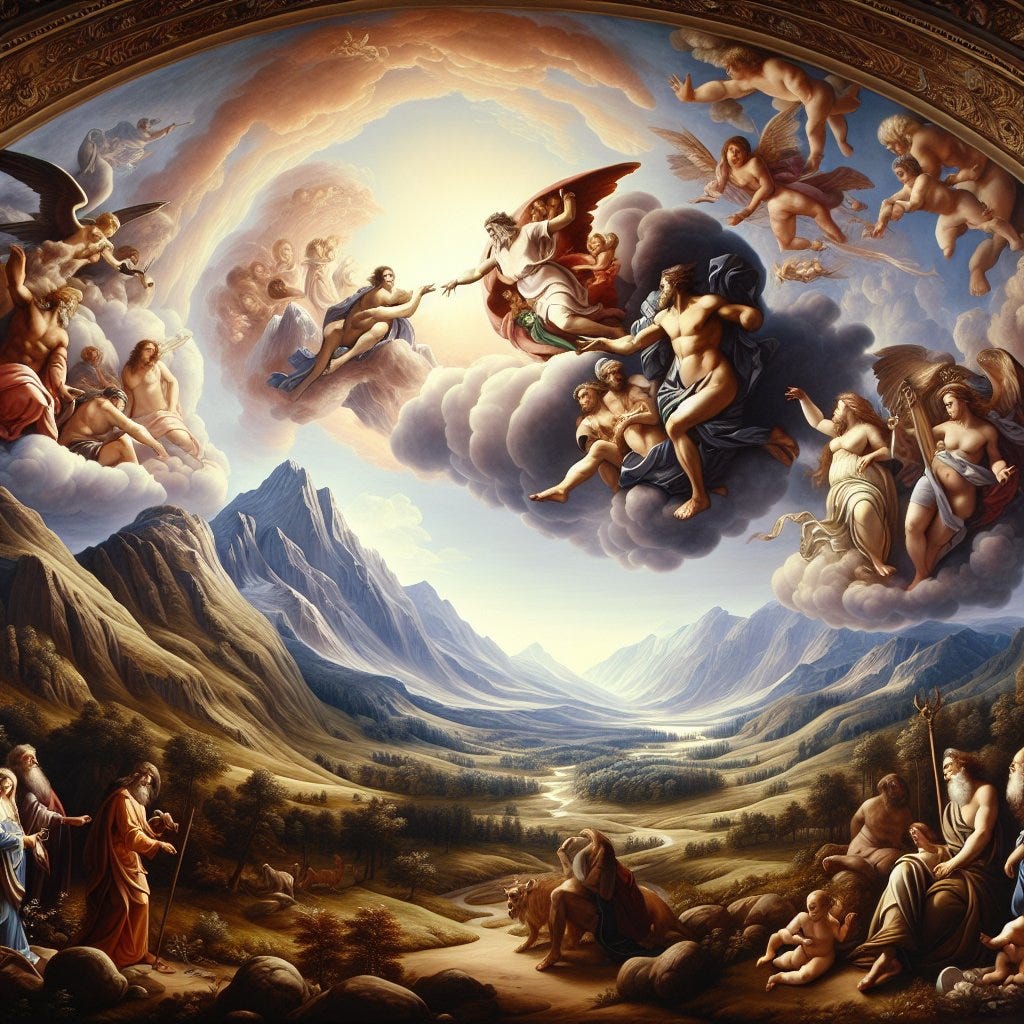
The Book of Genesis opens with two distinct narratives of creation, each offering unique insights into the nature of God, the act of creation, and humanity's role within it. These two accounts, found in Genesis 1:1–2:3 and Genesis 2:4–25, have long intrigued scholars and believers alike, and their inclusion reflects different theological themes and perspectives on the divine act of creation.
The first account, Genesis 1:1–2:3 is the one we typically associate with the “creation of the Heavens and the Earth”. This is the seven days of creation on which God rested at the completition of the work on the seven days. This narrative is often referred to as the Priestly (P) account. It is structured, formal, and orderly, reflecting a majestic view of God as Elohim—the sovereign Creator. This narrative emphasizes the systematic creation of the cosmos over seven days, with a clear progression from light to humanity, the climax of creation. Both male and female are created simultaneously, in God's image, and the repeated declaration that creation is "good" or “very good” underscores a sense of divine power and purpose. God in this narrative is transcendent, above and beyond creation, bringing order out of chaos and establishing a harmonious universe.
Conversely, the second account, Genesis 2:4–25, often called the Yahwist (J) account, presents a more intimate, narrative-driven portrayal of creation. Here, God is referred to as Yahweh Elohim, or "Lord God," and the focus shifts to the personal relationship between God and humanity. The creation narrative we just heard suddenly appears out of order.
“Now no shrub had yet appeared on the earth and no plant had yet sprung up, for the Lord God had not sent rain on the earth and there was no one to work the ground, but streams came up from the earth and watered the whole surface of the ground. Then the Lord God formed a man from the dust of the ground and breathed into his nostrils the breath of life, and the man became a living being.”
In this narrative it appears that man is created prior to sea and land creatures, the stars, and potentially vegetation. In this instance man is definitively created first as opposed to the simultaneous creation of man and woman.
This account emphasizes the relational aspect of creation—between humans and God, and between humans and the land. It presents a more immediate, hands-on involvement of God in the life of creation, highlighting intimacy rather than transcendence.
The existence of these two distinct creation narratives can be better understood through the Documentary Hypothesis, a theory suggesting that the Pentateuch (the first five books of the Bible) is a compilation of different sources, each with its own theological emphasis. The first creation story (Genesis 1) is attributed to the Priestly (P) tradition, likely composed during or after the Babylonian exile in the 6th century BC. This period of Israel’s history was marked by a need to reaffirm God’s sovereignty and order in a time of chaos and displacement, which is reflected in the highly structured and majestic tone of this account.
The second creation story (Genesis 2), on the other hand, is thought to stem from the Yahwist (J) tradition, an older source that dates back to the 10th century BC. The Yahwist tradition is known for its more personal and narrative style, focusing on the direct involvement of God in the world and in the lives of individuals. In this context, the second account of creation emphasizes a more relational understanding of the divine, centering on humanity’s connection with God, nature, and each other.
While these two creation stories differ in style, order, and emphasis, they should not be seen as contradictory. Rather, they are complementary, offering two sides of the same theological coin. The Priestly account in Genesis 1 provides a cosmic, overarching view of creation, one that emphasizes God’s supreme power and the orderly nature of the universe. Meanwhile, the Yahwist account in Genesis 2 zooms in on the personal, relational dimensions of creation, particularly the special role of humanity and the intimate care God takes in forming and nurturing life.
But wait.
Wouldn't the two accounts be contradictory? There is an inherent contradiction of great importance when looking at whether man and woman were created at the same time or whether woman was created from the rib of man to provide him with a companion.
This is a central issue for biblical scholars.
The key tension lies between Genesis 1:27, which states that God created man and woman at the same time ("male and female He created them"), and Genesis 2:21–22, where the woman (Eve) is created from Adam’s rib after he is already formed.
While this difference may seem like a contradiction at first glance, many interpreters view it through several possible lenses, which help reconcile the apparent discrepancy:
The two accounts may serve different literary and theological purposes. In Genesis 1, the creation of humanity is presented as the climax of a seven-day process in which God creates everything from light to land, sea, plants, animals, and finally, human beings. The passage emphasizes equality and dignity by stating that both male and female are created in God’s image, which reflects a universal, egalitarian view of humanity.
On the other hand, Genesis 2 zooms in to offer a more detailed, intimate portrait of the creation of man and woman. The Yahwist account (Genesis 2) seems to focus on the relational aspect between humans and their environment, God, and one another. Adam is created first, and Eve is created later to be his companion, highlighting the interdependent relationship between man and woman.
From this perspective, Genesis 1 provides a theological overview, emphasizing the equality of man and woman in creation, while Genesis 2 offers a narrative expansion, illustrating the specific creation process of Adam and Eve in a way that highlights their mutual need for companionship.
Rather than seeing the two accounts as mutually exclusive, some scholars argue that they are complementary—each providing a different angle on the same event. Genesis 1 describes the simultaneous creation of man and woman as a way to affirm their equal value in the eyes of God, while Genesis 2 adds further detail about how their creation unfolds over time. In this view, Genesis 1 focuses on their shared purpose and divine image, and Genesis 2 focuses on their distinct roles and relationship.
Another perspective takes into account the cultural context of the ancient Near East, where the concept of storytelling was often less concerned with the linear, modern understanding of time and historical accuracy, and more focused on conveying theological truths through symbolism and narrative. In the world of ancient Israel, it would not have been unusual for different traditions to coexist within the same text.
The Priestly tradition (Genesis 1) reflects a highly structured, almost liturgical view of creation, with a strong emphasis on order and hierarchy, while the Yahwist tradition (Genesis 2) provides a more relational and intimate portrayal. These differences could reflect varied theological emphases of the time rather than strict historical accounts.
Some scholars interpret the rib-creation narrative symbolically, suggesting that the creation of woman from man’s rib is a metaphorical expression of the deep connection and partnership between men and women, not necessarily a literal sequence of events. In this view, the rib is chosen to symbolize proximity and equality—woman is not made from man’s head to rule over him or from his feet to be beneath him, but from his side, to be his equal and companion. Let’s not forget the purpose of the rib cage, to protect one’s vital organs including the heart. In this tradition, woman is made from the very thing intended to protect man’s heart.
Thus, the order in which man and woman are created in Genesis 2 can be seen as emphasizing their relationship and the mutual need for companionship and partnership rather than a hierarchy or a contradiction of the simultaneous creation in Genesis 1.
Lastly, the Documentary Hypothesis can provide further clarity here. If we understand the two accounts as originating from different sources—the Priestly (P) and Yahwist (J) traditions—then these accounts reflect distinct theological insights from different communities or periods. The Priestly account (Genesis 1), written during the Babylonian exile, may reflect a need to assert God's supreme order and the equality of humanity in a world disrupted by chaos. The Yahwist account (Genesis 2), from an earlier time, may reflect a more grounded, relational understanding of God’s interaction with humanity, providing a narrative that focuses on partnership and relational roles.
Together, these two accounts provide a holistic understanding of the nature of God and creation. Genesis 1 speaks to the grandeur and scope of God's creative power, while Genesis 2 highlights God's closeness and care for humanity. They balance the transcendence and immanence of God—God is both above and beyond creation and deeply involved in the intimate details of human existence.
Far from being a source of conflict or confusion, these stories reveal the multifaceted nature of God’s relationship with the world. By preserving both accounts, the biblical text allows for a deeper exploration of the divine in just the very first few sentences. In this way, Genesis invites readers to contemplate both the majesty and the intimacy of creation, setting the stage for the immensity of God’s power and mastery over His creation as well as His desire to care for and have a relationship with His creation.
Thanks for reading Traditional Rogue ! This post is public so feel free to share it.
No posts
Comments
Nothing yet. Say the first thing.
Sign in to join the conversation.