
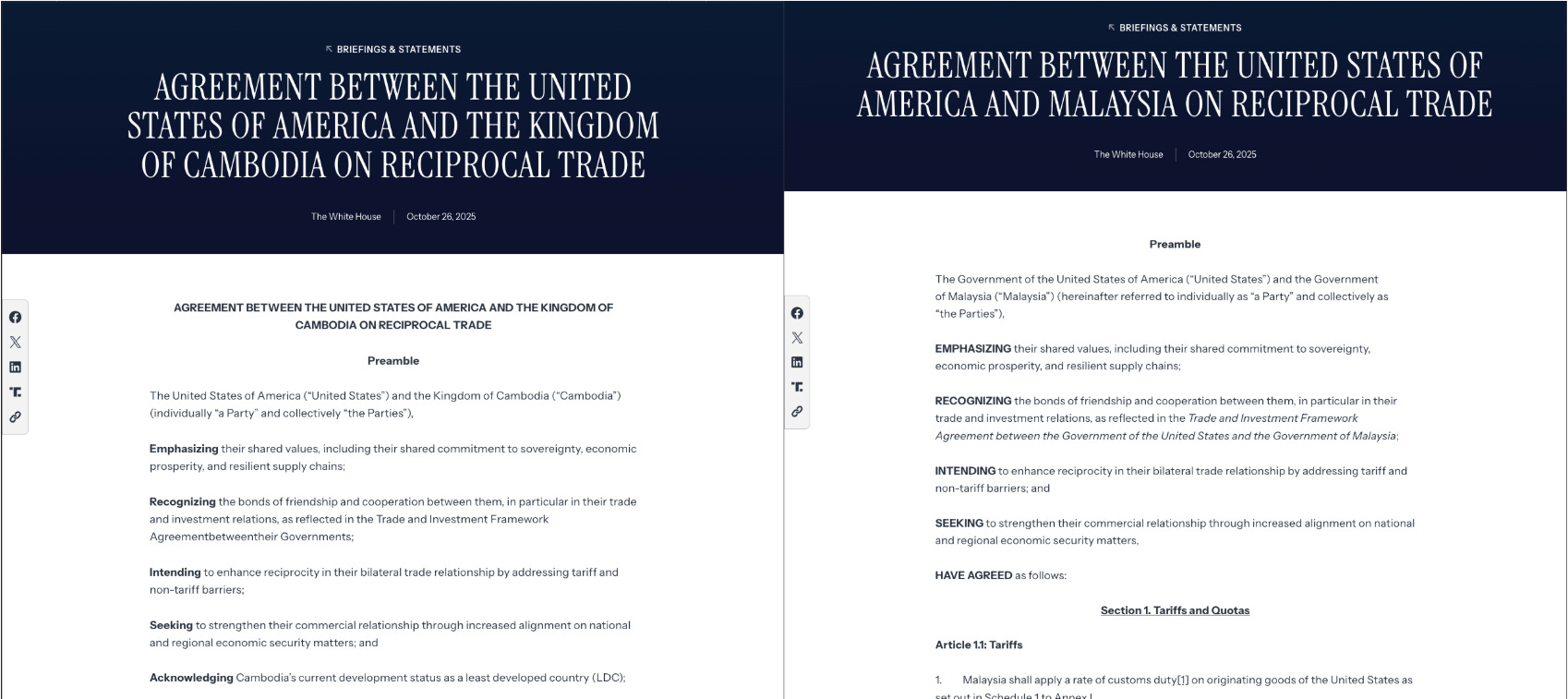
Last weekend the United States (US) signed two new trade agreements - one with Cambodia and one with Malaysia. I’m a bit late to comment - with excellent commentary coming earlier this week from Mona Paulsen, Simon Lester, Peter Harrell, Wendy Cutler and Simon Evenett (here and here). But there are a few of points of interest that stood out to me that I haven’t seen highlighted elsewhere yet.
First, three high-level points:
These agreements stand out from the other Trump 2.0 deals in terms of how much they cover and that they are actually legally binding treaties (notwithstanding the lack of any meaningful dispute settlement mechanism). Still far from WTO-compliance and I’m sure they’ll raise distinct US domestic process issues (but will leave that question to US lawyers).
They are still, though, incredibly one-sided with the majority of the obligations falling on Cambodia or Malaysia only. Mona Paulsen has taken a look at what this might mean for Cambodia, which is worth a read.
There have also been suggestions these two agreements could be a “notional template” for future US deals. If that is the case, it will be very interesting to see what other countries agree are willing to sign on to these kind of obligations and what other divergences we see in future texts.
Moving to the specific provisions in the agreement, there is a lot that is of interest.1 In this post, I’ll focus on the services commitments, requirements around digital trade agreements, and the obligation to mirror certain US trade restrictions. I’ve also focused on the main text of the agreements, although the annexes do have some interesting and far more specific obligations as well.2
On services, the Malaysia Agreement contains a broad article that means any services commitments Malaysia has made or will make in a trade agreement are automatically also given to the US.
[Malaysia Agreement] Article 2.7: Services
This Agreement incorporates, mutatis mutandis, any commitment concerning trade in services that Malaysia has made or hereafter makes in a trade agreement to any third country, jurisdiction, or economy. This Article shall not apply to any commitment to the Association of Southeast Asian Nations (ASEAN) under any ASEAN trade or investment agreement.
Negotiating language that automatically incorporates ‘commitments’ under other agreements (as compared to incorporating a specific provision or giving a guarantee of treatment) can sometimes get bogged down if there’s debate over what is actually being incorporated - e.g. is the ‘commitment’ read as subject to scope carve-outs and any exceptions that apply in the other agreement? How broad is the intended coverage of the language used here when it comes to services commitments is a key question.
Article 2.7 also appears to capture not just scheduled services commitments but also obligations such as domestic regulation or in relation to professional services. I also wonder the extent to which temporary entry/movement of natural persons commitments are intended to be or could be captured.
The article also has a carve-out for ASEAN agreements, which presumably only include those agreements that only ASEAN Member States are party to. If so, this would mean that Malaysia would still be required to provide the US with the services commitments it made under ASEAN’s +1 FTAs and the Regional Comprehensive Economic Partnership (RCEP).3
This article, by the way, is a great way to circumvent a lengthy services negotiation over sector-specific commitments or negative lists by just automatically capturing all the work done by others.4 The fact that this captures past agreements is also a key difference to MFN commitments in agreements like CPTPP, where parties often carve-out existing agreements from the obligation.5
The Cambodia Agreement takes a slightly different approach to this services provision:
[Cambodia Agreement] Article 2.6: Services
Cambodia shall refrain from imposing new barriers that provide less favorable treatment to U.S. services suppliers than the treatment afforded to domestic services suppliers and services suppliers from any third country, jurisdiction, or economy.
This just requires Cambodia to not impose new discriminatory barriers on US service suppliers.6 This would mean that Cambodia could still liberalise regulations on other foreign service suppliers without offering that same better treatment to US suppliers. One question is what would happen if Cambodia imposes a new non-discriminatory barrier on all foreign service suppliers and then a month later gives an exemption to several FTA partners? Although I’m sure Cambodia will not want to be too tricky in how it applies this.
Article 3.3: Digital Trade Agreements
[Malaysia/Cambodia] shall consult with the United States before entering into a new digital trade agreement with another country that jeopardizes essential U.S. interests.
This article is the same across both agreements and obliges Cambodia and Malaysia to talk to the US before entering into a new digital trade agreement that “jeopardizes essential U.S. interests”. This isn’t necessarily a US veto over these countries’ digital trade agreements, but it is still a procedural requirement that could be used to apply some pressure if the US didn’t like the proposed deal.
Key will be what falls within a “new digital trade agreement” and what qualifies as an agreement that “jeopardizes essential U.S. interests”? Presumably at least anything requiring data flows and non-discriminatory treatment with China would meet the latter test. On the former - will amendments to existing agreements be captured?
Malaysia and Cambodia both already have an Electronic Commerce Chapter in an FTA with China under RCEP. The RCEP General Review has also been slated for 2027. Would an upgrade of RCEP’s Electronic Commerce Chapter as part of that review trigger Article 3.3?
ASEAN and China also signed the “3.0 Upgrade” to the China-ASEAN FTA this week. The text isn’t public yet, but reporting refers to it including at least “digital cooperation” provisions. Would future amendments to this get captured by Article 3.3?
Also to note that both China and Malaysia are participating in the WTO Joint Initiative on E-Commerce (aka the Agreement on Electronic Commerce). It’s not clear how or if Article 3.3 might give the US some leverage over Malaysia’s continued support to this agreement (noting the US dropped out of the initiative last year).
Note there is also a separate provision in the Malaysia Agreement that more straightforwardly permits the US to terminate the agreement and reimpose the full so-called reciprocal tariffs from April if Malaysia enters into any new bilateral FTA or “preferential economic agreement” that “jeopardizes essential US interests”:
[Malaysia Agreement] Article 5.3: Other Measures
3. If Malaysia enters into a new bilateral free trade agreement or preferential economic agreement with a country that jeopardizes essential U.S. interests, the United States may, if consultations with Malaysia fail to resolve its concerns, terminate this Agreement and reimpose the applicable reciprocal tariff rate set forth in Executive Order 14257 of April 2, 2025.
Like Article 3.3, this also carves-out RCEP and the ASEAN-China FTA by only applying to new agreements. The question again is does this Article 5.3 apply to any future upgrade or amendment to either of those existing agreements?7
Cambodia’s version of this ‘poison pill’ applies where the US “considers” that the new agreement “undermines” the US agreement with Cambodia or “otherwises poses a material threat to economic or national security”.8 This clearer ‘self-judging’ language contrasts with Article 3.3, potentially giving more leeway for the US to make use of the poison pill as compared to the digital trade agreement provision. Of course, the phrase “jeopardizes essential U.S. interests” is so vague and broad in any case, and there is no real dispute settlement to settle interpretive difference, so this is likely a distinction without a practical difference.
In Malaysia’s agreement there are a few provisions that essentially require Malaysia to mirror US domestic action on a range of trade measures.
First, there provisions on goods produced by forced labour and in relation to shipbuilding and shipping:
[Malaysia Agreement] Article 2.9: Labor
1. … Malaysia may acknowledge U.S. government determinations on entities under Section 307 of the Tariff Act of 1930 and shall take appropriate action to prohibit importation of goods from those companies. …9
[Malaysia Agreement] Article 5.1: Complementary Actions
3. Malaysia shall adopt, through its domestic regulatory process, similar measures of equivalent restrictive effect as those adopted by the United States to encourage shipbuilding and shipping by market economy countries. The Parties shall discuss the structure and effect of such measures, recognizing the Parties’ commitment to address shared economic or national security concerns in the shipbuilding and shipping sector.
And second, a far broader provisions on US trade restrictions:
[Malaysia Agreement] Article 5.1: Complementary Actions
1. If the United States imposes a customs duty, quota, prohibition, fee, charge, or other import restriction on a good or service of a third country and considers that such measure is relevant to protecting the economic or national security of the United States, the United States intends to notify such measure to Malaysia for the purpose of economic and national security alignment. Upon receiving such notification from the United States, Malaysia shall adopt or maintain a measure with equivalent restrictive effect as the measure adopted by the United States or agree to a timeline for implementation that is acceptable to both Parties, to address a shared economic or national security concern, guided by principles of goodwill and a shared commitment to enhancing bilateral relations between the United States and Malaysia.
This essentially obliges Malaysia to adopt equivalent restrictions to, for example, Section 232 measures, when the US “considers” these to be for the protection of its “economic or national security” and notifies them to Malaysia. The Cambodia Agreement also has a similar provision, although with slightly more deference for “Cambodia’s sovereign interests”.
Mona Paulsen notes the potential WTO issues this creates for Cambodia, but I think Simon Lester had the best question in relation to this provision:
“Really?”
I’m sure we’ll see a lot more written on these agreements and the others that some have suggested will follow in their wake.
Perhaps Cambodia and Malaysia are hoping the US will provide some leeway to some of the more broadly worded provisions and not get into the weeds of comprehensive compliance. Then full implementation of the agreements could be dragged out, and meanwhile each country gets a lower, preferential, and hopefully more certain baseline tariff rate from the US.
However, neither agreement has dispute settlement, which means that the US can enforce its view of what each agreement means unilaterally at any time (following consultations “when practicable”). The question then is can each country do enough to avoid this outcome, while also maintaining relationships with other major trading partners?
UPDATE: Malaysia has released a detailed FAQ on its agreement with the US, it is well worth a read for those interested in how this will all work in practice. See also Alan Beattie’s FT article on the deal, with quotes from Malaysia’s Trade Minister, including “We are very clear that any actions taken under the agreement will be based on Malaysia’s interest and under Malaysian law…There’s a consultation process, and if it’s not in our interest to follow the US we won’t.””
Thanks for reading Trade Notes! This post is public so feel free to share it.
I’m refraining from raising some of the looser drafting in the agreements, but will flag in this footnote Article 5.3(4) of the Malaysia Agreement which says: “Malaysia shall not purchase any nuclear reactors, fuel rods, or enriched uranium from certain countries, except where there are no alternative suppliers on comparable terms and conditions.” The term “certain countries” is not defined as far as I can see in the agreement.
This includes obligations on Malaysia to remove a six per cent levy on social media and cloud platforms and stop redirecting DNS traffic to local DNS services (Section 3); and obligations on Cambodia to no introduce a digital competition regime that “unreasonably or unjustifiably restricts” US commerce (Article 2.1).
Although note technically ASEAN is not a separate entity so usually these MFN carve-outs refer to “Member States of ASEAN” or similar language, not just to commitments ‘to ASEAN’, see e.g. RCEP:
RCEP Article 8.6 (Most-Favoured-Nation Treatment)
4. Notwithstanding paragraphs 1 and 2, each Party which is a Member State of ASEAN reserves the right to adopt or maintain any measure that accords differential treatment to services and service suppliers of any other Party which is a Member State of ASEAN taken under an agreement on the liberalisation of trade in goods or services or investment as part of a wider process of economic integration among the Parties which are Member States of ASEAN.
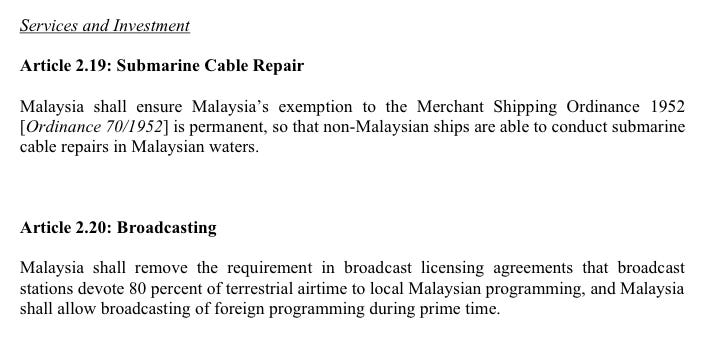
That said, the Annex to the Malaysia Agreement still contains specific commitments on submarine cable repair and broadcasting services that would fit into a typical services schedule:
See, e.g., Malaysia’s entry on MFN in its CPTPP services and investment schedule: “Malaysia reserves the right to adopt or maintain any measure that accords differential treatment to countries under any bilateral or multilateral international agreement in force or signed prior to the date of entry into force of this Agreement.”
Note this applies a national treatment commitment in addition to the MFN commitment discussed here.
[Cambodia Agreement] Article 5.3 Other Measures
3. If Cambodia enters into a new bilateral free trade agreement or preferential economic agreement that the United States considers undermines this Agreement or otherwise poses a material threat to economic or national security, the United States may terminate this Agreement pursuant to Article 7.4.
This paragraph as a two year grace period for implementation.
Comments
Nothing yet. Say the first thing.
Sign in to join the conversation.