
Last week, the Trade and Investment Agreements (Consultation) Bill 2026 (the Bill) was introduced to the Australian Parliament.1 The Bill is meant to “improve transparency and community input into FTA negotiations”, and contains requirements for the government to announce when negotiations start, publish negotiating objectives, obtain independent analysis of agreements, and review agreements after they enter into force. The Bill also obliges the government to advocate for certain issues in negotiations and not sign agreements that contain specific provisions (much of this codifying existing policy and practice).
While legally regulating Australia’s approach to trade negotiations is a significant step, the Bill’s narrow scope will likely blunt its direct impact in the near term.
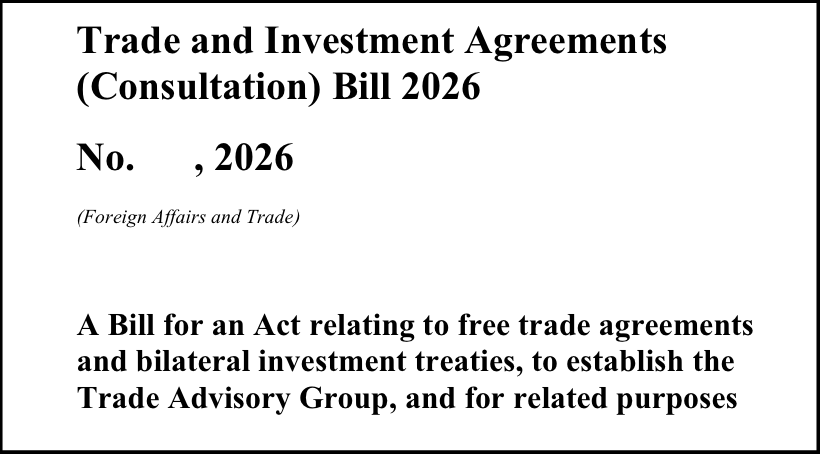
The key features of the Bill are that it:
Establishes a new Trade Advisory Group (TAG) made up of seven to eight members, representing a range of stakeholders, which the government will have to consult with at certain points in trade negotiations (including to obtain its advice prior to finalising negotiations). The TAG will also have access to more detailed and sensitive information relating to negotiations to enable it to perform its role of advising government.
Specifies issues that Australian negotiators must ensure are “advocated” for in a trade agreement negotiation. This includes matters such as trade in goods and services, government procurement, and investment, and also environmental protection, cultural interests, and specific commitments on international labour rights (and that these are subject to consultation or dispute settlement).
Prohibits new trade agreements from containing certain outcomes, including investor-state dispute settlement (ISDS), labour market testing (LMT) waivers (beyond what Australia agreed to in the GATS), and commitments that would “undermine” Australia’s trade remedies regime, “weaken the integrity” of Australia’s Pharmaceutical Benefits Scheme (PBS), or prevent certain government procurement preferences from being applied. The Bill also prohibits the signing of agreements unless they include “provisions that preserve Australia’s ability to regulate in the public interest”. This right to regulate requirement also applies to investment agreements, as does the prohibition of ISDS.
Creates new transparency and review obligations, including for the government to announce when negotiations commence and publish negotiating objectives,2 obtain independent analysis of proposed trade agreements, and undertake an independent review of trade agreements in accordance with set timeframes.
On the requirements regarding the content of agreements, these essentially reflect Australia’s current negotiating practice. The Bill’s division between matters that must be “advocated” for and those cannot be included in an agreement also creates some flexibility for negotiators. For example, clause 15(1)(i) of the Bill requires the Minister to ensure that “Australia’s interests in” environmental protection are “advocated to” the other party/ies. It doesn’t require a specific outcome to be achieved (not to mention that Australia’s “interests” may be subject to a range of interpretations in particular contexts as well).3 The entirely prohibited matters are a mix of clear and explicit provisions (ISDS and LMT waivers) and more ambiguous matters (e.g. to not “undermine the effectiveness” of the trade remedies regime or “weaken the integrity” of the PBS).4
The main value of these requirements would seem to be: (a) signalling to the Australian public what the government will be seeking (and not seeking) in trade agreements, (b) signalling to other parties the seriousness of certain ‘red lines’, and (c) making it more difficult for future governments to shift approaches on certain issues given it would require amending legislation.
The establishment of the TAG follows calls for greater access for external stakeholders to negotiating materials and potential outcomes, including through the granting of security clearances. And the independent analysis and review obligations flow from long running calls in Parliament and elsewhere for more modelling of trade agreements and work to understand whether they live up to the promises made about them during negotiations.
The Bill’s impact may be relatively limited in the short term due to its narrow scope (and also the decreasing pool of potential new trade agreement partners for Australia).
First, the Bill defines “free trade agreement” as an international agreement that is binding on Australia, is between Australia and one or more other parties, and “includes commitments directed at” eliminating or reducing tariffs and other restrictions on all or substantially all trade in goods and “liberalising trade in services” by eliminating or reducing discrimination in the provision of all or substantially all services.5 The Bill also covers substantive amendments to such agreements. The definition explicitly excludes agreements negotiated within the WTO or United Nations, as well as accession negotiations (including if Australia seeks to accede to an existing trade agreement). Although, the TAG’s role is expanded beyond just “free trade agreements” to also enable it to provide advice (on request) in respect of WTO negotiations, accessions and other matters relating to international trade.
The Bill also applies to “bilateral investment treaties”, but with a more limited set of obligations.
The proposed definition of “free trade agreement” excludes a number of significant ‘trade-related agreements’ that Australia has recently entered into. This includes the Singapore-Australia Green Economy Agreement (which, despite its name, is a non-binding instrument), the Indo-Pacific Economic Framework for Prosperity (which would not meet the trade liberalisation requirements), the United Kingdom’s accession to the Comprehensive and Progressive Agreement for Trans-Pacific Partnership (as it was an accession), Pax Silica (which is not a binding agreement), and the WTO’s E-Commerce Agreement (as it was negotiated under the auspices of the WTO6 and also does not meet the trade liberalisation requirements). It would also exclude, for example, any future Australian accession to the Digital Economy Partnership Agreement or Green Economy Partnership Agreement, and likely also any ‘Technology Prosperity Deal’ or similar initiative Australia might sign with the US.
Interestingly, the Explanatory Memorandum says that the definition of “free trade agreement” is intended to exclude “customs cooperation agreements, mutual recognition agreements or digital economy agreements”. While this is its effect where these agreements are done in standalone negotiations, it is slightly incongruous that, for example, whether or not a digital economy agreement is captured will depend on a structural choice of whether it is a part of a comprehensive trade agreement or not. Particularly as a number of digital economy agreements have been negotiated as amendments or protocols to existing trade agreements
While the Explanatory Memorandum makes reasonable arguments for some of these definitional moves, it does seem at least theoretically strange that the government could still sign an agreement that, for example, waives LMT as long as that agreement was separate to a comprehensive trade agreement or is part of an accession negotiation.
Second, there is also a temporal element to the Bill’s scope. Most of the Bill’s provisions only apply to trade agreements that are negotiated after the Bill commences. Trade agreements where negotiations are already underway are only subject to the independent review requirement (at five years after they enter into force), not any requirements around their content or consultations. Trade agreements that are less than five years old are also only subject to the independent review requirement. Trade agreements that are more than five years old (and amendments to those agreements) are not subject to any of the Bill’s requirements.
In practice, if the Bill passes Parliament this year, this means that the only trade agreement that could potentially be subject to all of the Bill’s requirements is the Australia-Gulf Cooperation Council Free Trade Agreement (if negotiations ever commence). Of Australia’s nineteen existing trade agreements, only the Regional Comprehensive Economic Partnership Agreement, and Australia’s trade agreements with India, the United Kingdom and the United Arab Emirates would be subject to the independent review requirement. Further, amendments to all past agreements would be entirely excluded from the Bill’s content, transparency and consultation requirements (including, e.g., the CPTPP’s General Review). This ensures the Bill will not prevent the government from signing amendments to agreements that contain provisions that would be prohibited by the Bill, such as ISDS or GATS-plus LMT waivers.
All in all, the Trade and Investment Agreements (Consultation) Bill 2026 is a significant development in Australia’s approach to trade negotiations. Most of the design choices have rationale explanations behind them. Although some are less clear, for example, why the prohibited provisions clauses isn’t applied more broadly beyond comprehensive trade agreements. It will be interesting to see if there is much debate around the Bill as it makes its way through Parliament. It also remains to be seen how many more “free trade agreements” Australia will be pursuing, this may also point towards needing to expand the Bill’s scope at some point in the future.
Thanks for reading Trade Notes! This post is public so feel free to share it.
The Bill follows a Parliamentary Inquiry into the Australian Government's Approach to Negotiating Trade and Investment Agreements, which made a number of recommendations to improve the transparency and inclusiveness of trade agreement negotiations.
These obligations (in Clause 13 and 14 of the Bill) do not have a timeframe by which the announcement has to be made. Indeed, in relation to announcing commencement of negotiations, Clause 13(2) says “The Minister may make the announcement before, on or after the negotiations start day”. This produces some uncertainty around the value of the obligations. Less so for commencement announcements (which governments aren’t generally shy about making), but more so on negotiation objectives (although I’d be surprised if we see very detailed objectives being published given the Explanatory Memorandum says this is “in line with existing practices” which provide high-level aims such as a elimination of all tariffs and the protection of certain regulatory interests).
Although the treatment of labour rights in this clause is more specific:
The Explanatory Memorandum also says that “The terms used in Clause 16 have generally not been defined within the Bill. It is intended that these terms be interpreted in accordance with the technical meaning which would be expected to be attributed to each term in the context of Australia’s FTAs or the ordinary English meaning of the expression is applied, having regard to the legislative context.”
The Explanatory Memorandum notes this is intended to reflect the tests set out in Article XXIV of the GATT and Article V of the GATS. I assume that while the Bill refers to the agreement including such commitments, this must refer to the intention of the negotiation being to include such commitments as it is not possible to know when negotiations start exactly what the outcomes will be.
The Bill refers to agreements “negotiated or concluded within the institutional framework” of the WTO, which I think would include the E-Commerce Agreement. Although opinions may differ on exactly what the status of that Agreement is given the interim arrangements.
Comments
Nothing yet. Say the first thing.
Sign in to join the conversation.