

Enough folks have messaged me about the recent New York Times conversation between Ross Douthat, perennial haver of bad takes, and Louise Perry, author of The Case Against the Sexual Revolution, that I have to respond.
Here’s the headline of the piece:
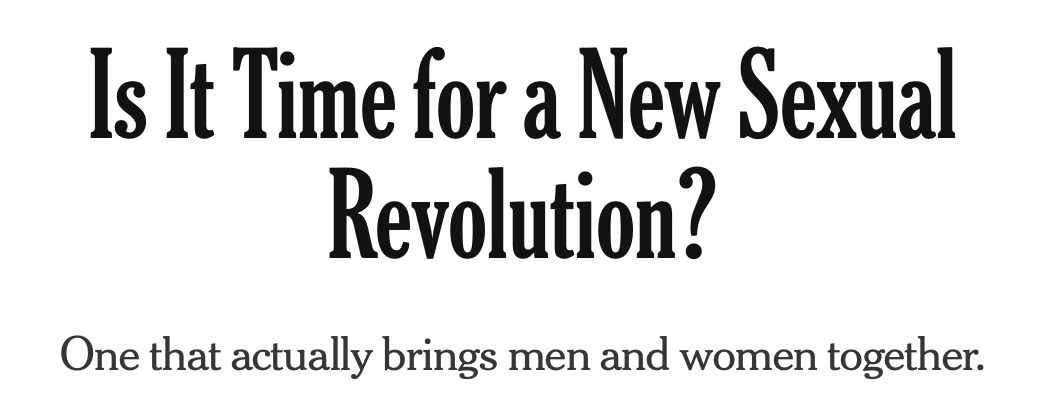
I wasn’t gonna bother, but goddamnit here I am, dutifully rolling up my sleeves to engage with this reactionary feminist nonsense that keeps getting mainstream attention as the Overton window continues to slide rightward.
If only to say loudly and emphatically: No, no, no, no, no. And also: This is so very dumb and dangerous. Here’s a representative quote from Perry:
I am not completely opposed to contraception. I think, though, that women in particular should behave as if contraception doesn’t exist. If you would not have sex with this man if you weren’t using contraception, then you should not have sex with him at all — I mean, in choosing the man rather than the moment. If this man wouldn’t make a potentially good father to your children, then you shouldn’t have a sexual relationship with him.
At one point, she tells Douthat in all seriousness that “there is no better arena” than marriage for becoming “genuinely fond of the opposite sex.” Perry—a fan of biological essentialism who has previously complained about how easy it is now to divorce—believes that in marriage the “differences that clearly exist between men and women” can be discovered to be “charming and interesting and funny,” actually, as opposed to “antagonistic.”
Ah yes, domesticity, that famous arena of increased fondness—especially when you feel unable to leave.
But Perry’s main argument is that women should be sexual gatekeepers in order to protect themselves from the consequences of sex. (But also to save the whole of society while they’re at it.) It’s the same argument that she makes in her book—and the same argument that has been used to control women’s sexuality for centuries. My essay last year on her work stands in as a response to this New York Times conversation, which is why I’m recirculating it below.
It’s a time-tested guide to understanding and refuting these kinds of reactionary feminist arguments.
This week, I was browsing new book releases online and came across an intriguing title: A New Guide to Sex in the 21st Century. Ooh, I thought. What’s this? “The bestselling feminist book, now adapted for a young adult audience,” the description started.
Well, that was odd. A bestselling feminist book that I’d never heard of before? But how fantastic, a feminist guide to sex for young people!
Then I saw the author: Louise Perry. She’s a British writer and self-described feminist who has appeared on Jordan Peterson’s podcast and spoken at the hard-right National Conservative Conference. Perry recently called “transgenderism” an “embarrassing fashion trend” that is now over. She’s anti-porn and anti-BDSM; a big fan of evolutionary psychology, biological essentialism, and heteronormative marriage.
Most notably, in 2022, she wrote The Case Against the Sexual Revolution, a book arguing against the “amoral libertinism and callous disenchantment of liberal feminism and our contemporary hypersexualised culture.”
Turns out this new book is a version of The Case Against the Sexual Revolutionspecifically adapted for teenagers. Having already skimmed the adult version, I hardly think a YA version was necessary, but it’s interesting to see an already dumb argument boiled down to its most essential dumbness.
I also think that Perry’s YA adaptation is a great case study in the many ways that disillusioned young women are being sold traditional “family values” under the label of feminism, and in direct opposition to equality, justice, and liberation. It’s sneak-attack conservatism that feels of a piece with celebrity gossip becoming an alt-right pipeline. Let’s discuss!
Perry’s book does zero in on a real problem: many young women are dissatisfied with the status quo of heteronormative love and sex, particularly when it comes to hookup culture. She points to confusing, disappointing, and unenjoyable encounters, some of which are later experienced as regrettable or shameful.
Perry doesn’t seem all that concerned about pleasure or the orgasm gap, although she does write of today’s young woman, “She pretends to orgasm, pretends to like anal sex, and pretends not to mind when the ‘friends with benefits’ arrangement causes her pain.” Perry also talks about the problem of sexual assault and rape.
She argues that women are not being well served by our sexual culture, which is so obviously true! Of course it’s true. It’s why young women will buy her book. It’s why their parents will buy her book for them.
Perry has identified a real problem, but she points to false culprits: “liberal feminism,” the sexual revolution, the Pill, hedonism, and porn. Instead of zeroing in on patriarchy, or the fact of an unfinished revolution, she attacks sexual “freedom.” She writes, “The technology shock of the Pill led liberals to think that our society could be uniquely free from having sexual rules that constrain us.”
Among the constraints she thinks that young straight women need: waiting a few months before having sex with a new boyfriend and only sleeping with men who would make good fathers. These are ways to ensure that they’re only getting involved with men who are trustworthy, she says.
She also suggests that women curtail their own behavior to avoid getting raped—for example, refraining from going to nightclubs, being alone with men they don’t know, and drinking in mixed company. Why not target the behavior of men who rape, you might ask? Well, she goes to great lengths to argue that a small percentage of men are basically biologically destined to rape. Plus, she says, “consent workshops are mostly useless.”
Beyond the victim-blaming is her biggest prescription of all: monogamous marriage and the family.
She spends a good amount of time sounding like J.D. Vance, complaining about the relaxing of divorce laws and sighing about the plight of children raised by single mothers. For women, marriage provides better protection, security, and support than the “back-up husband” of the welfare state, she says. (Queer people do not factor into her argument hardly at all.)
One of her chapter titles is, “MARRIAGE IS GOOD.”
She doesn’t deny the copious possible dangers and displeasures within heteronormative marriage. Perry acknowledges the existence of domestic violence, that marriage has “historically been used by men to control women,” that “most marriages do not live up to a romantic ideal,” and that “monogamous, lifelong marriage is in a sense ‘unnatural.’” But marriage, she says, is simply the best option we’ve got.
What a pitch.
You might wonder why I’m bothering to engage with any of this. I have asked myself this, too. The reason is this: Perry is one of many reactionary feminists who occasionally point to real problems in young women’s lives while offering false solutions, and I’m afraid that it’s an unfortunately effective source of radicalization.
The researcher Jilly Boyce Kay, explains that reactionary feminism “views ‘liberal feminism’ and progressive politics as catastrophic for women, claiming that they deny the ‘truths’ of women’s biologically-based, evolutionarily-determined ‘interests’—which are based on their apparently ‘natural urges toward seeking commitment, affection, and protection.’” In a recent Diabolical Lies podcast episode, Katie Gatti Tassin noted that reactionary feminists “only are interested in heterosexual family-unit interdependence, not communal, socialized interdependence.”
Another example of reactionary feminism, one that is similarly rife with TERFY-y, SWERF-y, and evo-psych nonsense: Female Dating Strategy, a subreddit founded in reaction to the notoriously misogynistic The Red Pill in an attempt to help women navigate a hellish romantic landscape—by not “putting out,” for example. As I wrote in an article on FDS several years ago, “Withholding sex, and generating ‘mate competition,’ is a key way for women to get what they want from men, whether it’s money or marriage, says FDS.”
Kay warns that while reactionary feminism may sometimes “seem to resemble feminist critiques of neoliberalism and postfeminism,” it is actually “based upon a rejection of social justice.”
What’s tricky here is that feminist critiques of neoliberal narratives are totally necessary. I did a fair amount of that in my first memoir, Want Me, writing about how these narratives emerged in the nineties and “emphasized young women’s potential for empowerment through individual choice and striving.” I wrote about how “the improvement of women’s sexual experiences has now been detached from imperatives of social justice and collective struggle,” and empowerment has been “cast as a personal problem, which places pressure on individuals to successfully navigate systemic disadvantages.”
Crucially, it’s those “imperatives of social justice and collective struggle” that are entirely missing from reactionary feminists’ supposed critiques of neoliberal feminism. It’s just a different set of personal solutions. Reactionary feminism is deeply disdainful of “social hope and feminist utopianism,” Kay explains, and it’s “profoundly fatalistic.” And all while trying to portray “heteropatriarchal marriage and the private family as being in women’s interest,” Kay notes.
It’s really something to read Perry’s book right now in the United States. We’re currently witnessing an authoritarian power grab, unlawful ICE arrests, an influx of alleged sexual abusers into the White House, unprecedented assaults on trans rights, and on and on. We’ve seen a deadly rollback of abortion rights, a surge in unapologetic misogyny, and attempts to curtail no-fault divorce. In the midst of all this, A New Guide to Sex in the 21st Century looks at unhappiness in the hetero sex and dating landscape and declares: Too much freedom!
My impulse, always, with a book like this one is to say that this kind of “feminism” isn’t feminism. You’re not a feminist! You’re a fake! A liar! I feel that deeply. But Sophie Lewis’s new book, Enemy Feminisms: TERFS, Policewomen & Girlbosses Against Liberation, does a beautiful job of arguing against—or beyond—this impulse. “What we need now is a bestiary of enemy feminisms, to jolt us into understanding that a woman’s cry for women’s power is sometimes part and parcel of the oppressor’s program,” she writes. “We need to be discerning about any given feminism precisely because feminism is so capacious that it comprises, within itself, its own mortal enemies.”
These days, it’s especially clear that the ability to recognize and understand the enemy “on your side” is a skill that will be very useful—in feminism and beyond.
No posts
Comments
Nothing yet. Say the first thing.
Sign in to join the conversation.