


Two weeks after a Pulaski County jury cleared Capital City Tree Service and its owners of nearly everything the Attorney General’s office accused them of, the case moved into a new phase: a fight over remedies. Behind the scenes is a fight over how the public came to understand a case where the trial record was narrower than the story now being told about it.
Capital City Tree Service was cleared of claims involving price gouging, false representation, false advertising, bait-and-switch tactics, targeting the elderly, and insurance misrepresentation. Owner Charles Shaw and general manager Matthew Shaw were cleared of every claim against them. Office manager Janet Shaw was dismissed by directed verdict before the case reached the jury.
The company itself was found liable on a single count under the Arkansas Deceptive Trade Practices Act’s catch-all provision prohibiting unconscionable business conduct.
In its post-trial brief filed June 29, the state asked Circuit Judge Cathleen Compton to award:
$470,000 in civil penalties — the statutory maximum of $10,000 per violation, applied across a count of 47 separate violations that the state says the record supports;
$143,045.34 in restitution, representing the full amount consumers paid, without adjustment for the value of work performed;
A permanent injunction changing how Capital City Tree Service bills customers, collects debts, and discloses contract terms;
An order preventing the company from collecting on unpaid invoices from four named consumers.
The verdict form only required a yes or no answer on the allegations, so there is no record of what conduct the jury found unconscionable or for how many counts. The state’s calculation appears to require treating conduct tied to theories the jury rejected as part of the unconscionability finding.
Capital City Tree Service’s response, filed July 13, argues that the state is attempting to transform a limited jury finding into a broader judgment than the jury actually returned:
“The State will argue that Count 6 unconscionability is broad enough to encompass all of the conduct alleged in the Amended Complaint — that the jury’s unconscionability finding effectively ratifies every factual allegation as a remedy predicate. That argument collapses the distinction between allegations and findings. The State pleaded deception, omission, insurance misrepresentation, and price gouging as separate counts precisely because those theories require separate elements and separate proof. ... The jury then resolved those disputes — and did not find for the State on them. The State cannot now treat its own rejected theories as subsumed within Count 6 simply because it finds the verdict inconvenient at the remedy stage. Allegations are not findings. Rejected theories are not proven conduct. And a limited verdict does not become unlimited because the State wishes it were.”
That is the central dispute. The AG’s Office lost on six counts and is now asking the court to determine whether the seventh can carry the weight of the theories that did not prevail, based in part on conduct the jury already considered and did not find actionable under those separate claims.
The Arkansas Democrat-Gazette published a story July 5 about the post-trial fight built largely around the AG’s position. The story relied on information contained in the state’s post-trial filings that are not available through the publicly accessible online case file.
Four consumers are identified in the article: Hannah Crutcher, David Eifling, Jim Kirkland, and Neda Sue Streepy.
None of those four consumers testified before the liability jury during the five-day trial, which I attended. The consumers’ names appear in the affidavits submitted by the state in its initial complaint. The AG’s Office tried to enter the affidavits into evidence at trial. The defense successfully objected to the submission of those affidavits at the time and renewed its objection to their use in its response to the state’s post-trial brief.
The article presents these accounts in the same narrative voice as trial testimony, without distinguishing between evidence heard by the jury and the affidavits. An affidavit is not the same thing as testimony presented in open court and tested through cross-examination.
At least one detail was also attributed to the wrong consumer.
The article states that David Eifling testified that losing $30,000 on the tree removal bill forced him to “cut back on eating” to survive the debt. The testimony about cutting back on eating came from Robert Brown, not Eifling.
Brown testified about severe financial hardship during the trial, and Senior Assistant Attorney General Brittany Edwards referenced his circumstances during her closing arguments, specifically as evidence that Capital City targeted older consumers. Eifling’s affidavit does not contain the statement attributed to him.
The record does not show how that attribution changed. It does show that a significant piece of live courtroom testimony was attached in print to a different consumer who was not the source of that testimony.
The story states that Capital City “reportedly made $1 million in profits” from emergency storm work. That figure does not come from trial testimony. The case had not reached a penalty-phase hearing, and no evidence regarding the company’s finances was presented to the jury during the liability trial.
The figure also does not appear in any publicly available document that allows the public to independently evaluate the claim. The state’s post-trial brief containing financial arguments is not available through the publicly accessible online case file, and the financial exhibit underlying the state’s argument was designated confidential pending further proceedings.
An unvalidated figure became a statement of fact in print.
Whether the reporter reviewed the brief and exhibits directly or whether the information was provided through a characterization from the AG’s communications office cannot be determined from the outside.
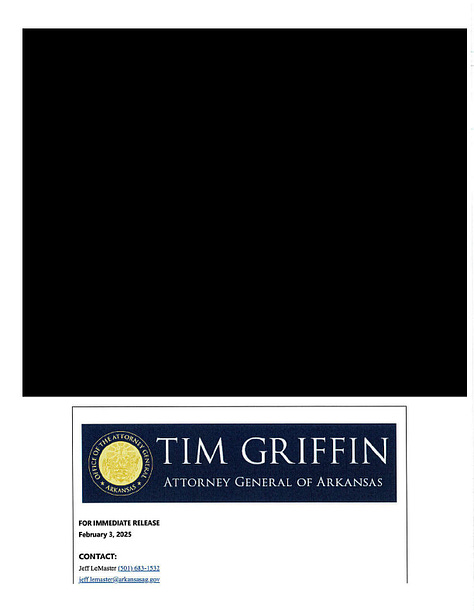
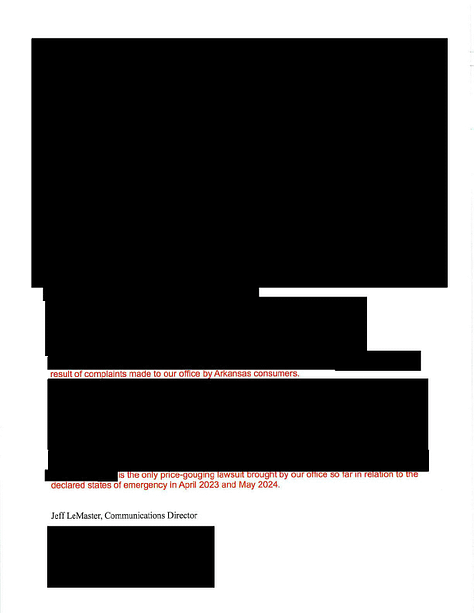
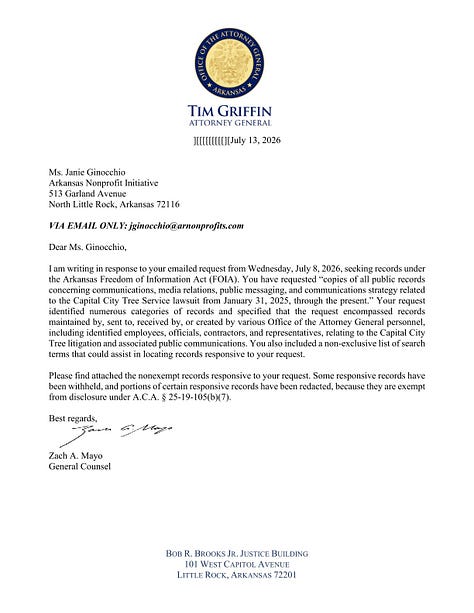
I filed a public records request seeking communications, media relations material, and communications strategy related to the Capital City Tree Service case. What came back was, functionally, a stack of black boxes.
Nearly every substantive portion of the production was withheld or redacted, with the office citing a single exemption:
Arkansas Code § 25-19-105(b)(7): “unpublished memoranda, working papers, and correspondence” of the Attorney General.
The response provided no record-by-record explanation, description of the records withheld, or explanation of why each communication qualified as “unpublished” after leaving the office. The exemption was applied broadly across the production.
That approach raises a separate issue under FOIA: the burden is not on the requester to disprove an exemption after the government invokes it. The burden is on the custodian claiming the exemption to establish that the records actually fall within the exemption being asserted. The Arkansas Supreme Court held exactly that in Young v. Rice: the burden of proving a FOIA exemption applies rests with the keeper of the requested records claiming it. A reference to an exemption, standing alone, does not satisfy that burden.
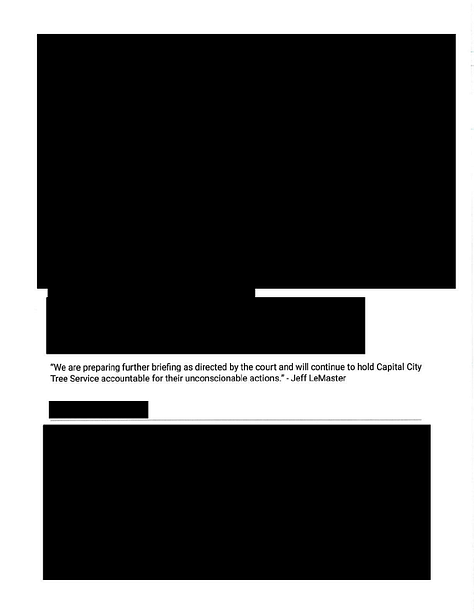
A few lines were left unredacted. One is a quote attributed to AG’s Office Communications Director Jeff LeMaster, evidently provided to a reporter and published in a June 19 Democrat-Gazette article: a statement that the office was “preparing further briefing as directed by the court” and would “continue to hold Capital City Tree Service accountable.”
It appears on a page that is otherwise blacked out in full. Whatever additional information was contained in that same communication with the reporter remains withheld.
At issue is whether the AG can characterize the rest of the same communication as “unpublished” after voluntarily sending it to a reporter for purposes of public coverage.
The office’s apparent position is that only the exact words that later appear in print lose their exemption, while every other sentence sent in the same exchange remains permanently “unpublished.” Under that interpretation, an agency could provide a reporter with 10 pages of material, see one sentence quoted in a story, and claim the remaining pages remain secret indefinitely. That is not the ordinary meaning of “unpublished.”
The act that makes correspondence published is not that a specific sentence later appears in a specific news story. It is that the office intentionally sent the correspondence to a reporter for the purpose of informing public coverage of a lawsuit brought in the public’s name. A reporter’s editorial choice about what to use does not determine whether the government published the material it voluntarily transmitted.
The statute does not exempt all of the AG’s correspondence. It exempts unpublished memoranda, working papers, and correspondence. The question is whether the office can describe correspondence as “unpublished” after it intentionally distributed that correspondence outside the office for public dissemination.
Arkansas courts and the AG’s office have not always taken the same approach to the meaning of “unpublished” in § 25-19-105(b)(7). The reasoning behind those positions matters.
In Opinion No. 92-129, issued in June 1992, then-Attorney General Winston Bryant addressed whether a state senator’s letter that had been provided to a deputy prosecuting attorney remained exempt under the working papers exemption.
To interpret the undefined word “unpublished,” the opinion applied ordinary rules of statutory construction, beginning with the plain meaning of the word. Citing Arkansas Supreme Court precedent, including Bolden v. Watt and Simmons First National Bank v. Abbott, the opinion concluded that statutory words should be given their ordinary meaning unless the context requires otherwise.
Applying that approach, the opinion looked to the ordinary meaning of “publish” and concluded that correspondence loses its unpublished status once it has been issued or circulated outside the originating office:
“Once the senator’s letter was issued to the deputy prosecuting attorney, it was published and the exemption is no longer applicable.”
A later opinion, Opinion No. 92-346, reached a different conclusion regarding letters sent to the Governor’s office. But it did not engage in the same plain-language analysis of “unpublished.” Instead, it relied on the Arkansas Supreme Court’s decision in Bryant v. Mars, concluding that the court had resolved the question by extending the exemption to correspondence received by the AG.
The problem is that Mars resolved a different issue. The court held that the exemption applied beyond the AG personally, to staff and consultants.
The case did not decide whether correspondence remains “unpublished” after it leaves the office or is transmitted to another party. It did not address whether incoming and outgoing correspondence have different meanings under the ordinary definition of “publish.” And it did not decide whether a document intentionally distributed outside the government for public dissemination remains unpublished.
That distinction matters because FOIA exemptions are not interpreted in isolation. The Arkansas Supreme Court has repeatedly held that the FOIA should be broadly construed in favor of disclosure and that exceptions should be narrowly interpreted to prevent government agencies from using exemptions as a shield against legitimate public access.
In this case regarding the AG’s Office communications with the media, the current AG’s interpretation of unpublished creates a particularly broad secrecy rule: correspondence sent to a reporter for the purpose of informing public coverage of a public lawsuit can remain “unpublished” forever unless the reporter reproduces every word of it.
That reading does not protect the narrow category the statute describes. It protects the government’s ability to control the public record of its own communications.
Here, the AG lost six of the seven counts it brought against Capital City Tree Service. It is now asking the court for $470,000 in penalties, full restitution, and a broad injunction based on a single count, while simultaneously refusing to disclose the communications record showing how it described that litigation to the media for public consumption.
The visible portion of the record already shows the communications office presenting the case through a public accountability message. In terms of public accountability for the AG’s Office, the question is whether the public should be allowed to examine the rest of that communication and compare the government’s messaging with the narrower result reached by the jury.
The dispute over what qualifies as “unpublished” correspondence is not limited to this case.
Law professor Robert Steinbuch, author of a widely cited book on the Arkansas FOIA, raised a similar issue in an October 2024 Democrat-Gazette column involving Supreme Court Justice Courtney Hudson’s communications with the state’s attorney-discipline office. The question there was whether emails sent from the justice’s chambers to another government entity became “published” once they left her office.
Steinbuch argued that they did. The Arkansas Supreme Court majority reached a different conclusion and treated the communications as exempt, a decision Steinbuch criticized as insufficiently explaining why the ordinary meaning of “published” did not apply.
The broader point is not that every outside communication automatically becomes public. It is the same statutory question that continues to arise: when government correspondence intentionally leaves the office that created it, when does it stop being “unpublished”?
The AG’s office has taken the position in multiple contexts that § 25-19-105(b)(7) protects correspondence that has moved beyond the walls of the originating office. But that interpretation creates a tension with the statute’s actual language, which only exempts unpublished correspondence.
In this case, the issue is even simpler: is a government communications operation allowed to provide information to a reporter to shape public coverage of a lawsuit and then claim that the same communication is legally invisible when the public asks how that message was created?
The court still has to decide what the jury’s single finding is worth: how many violations the record supports, what restitution should include, and whether the injunction requested by the state fits within the verdict the jury actually returned.
Separately, the public still has a different question: how did the public’s understanding of this case develop after the verdict?
The only widely available account of the post-trial dispute relied on information that was not available through the public online case file, included consumer accounts that were not presented as live testimony before the liability jury, contained at least one apparent misattribution of trial testimony, and repeated a financial figure that was not established through trial evidence or a publicly accessible penalty-phase record.
A government office cannot ask the public to trust its version of a lawsuit brought in the public’s name while refusing to disclose the records showing how that version was communicated.
Transparency does not require the government to disclose every internal thought or draft. It does require the government to meet the burden of proving when an exemption applies — and to recognize that information voluntarily sent to the public through the press is no longer unpublished simply because the government later prefers to keep the rest of the conversation private.
We’re currently suing the AG and Arkansas Children’s Hospital for alleged FOIA violations regarding their refusal to release records related to a $50 million donation of opioid settlement funds. To support our legal efforts, please donate to and share our GoFundMe. This is active citizen advocacy in real time for Arkansans.
Comments
Nothing yet. Say the first thing.
Sign in to join the conversation.