
Walk south from Elephant and Castle station and the skyline changes shape without warning. Above the traffic and the market stalls, a white tower rises in a slow taper, wider at its base and narrowing as it climbs, until it ends not in a spire or a flat roof but in three enormous fan blades, fixed into the crown of the building like the head of a razor. Most people who pass beneath it every day on the bus or the Northern line have never once seen those blades turn. Ask a local what they are for and the answer is usually a shrug, or a joke about a hairdryer for giants.
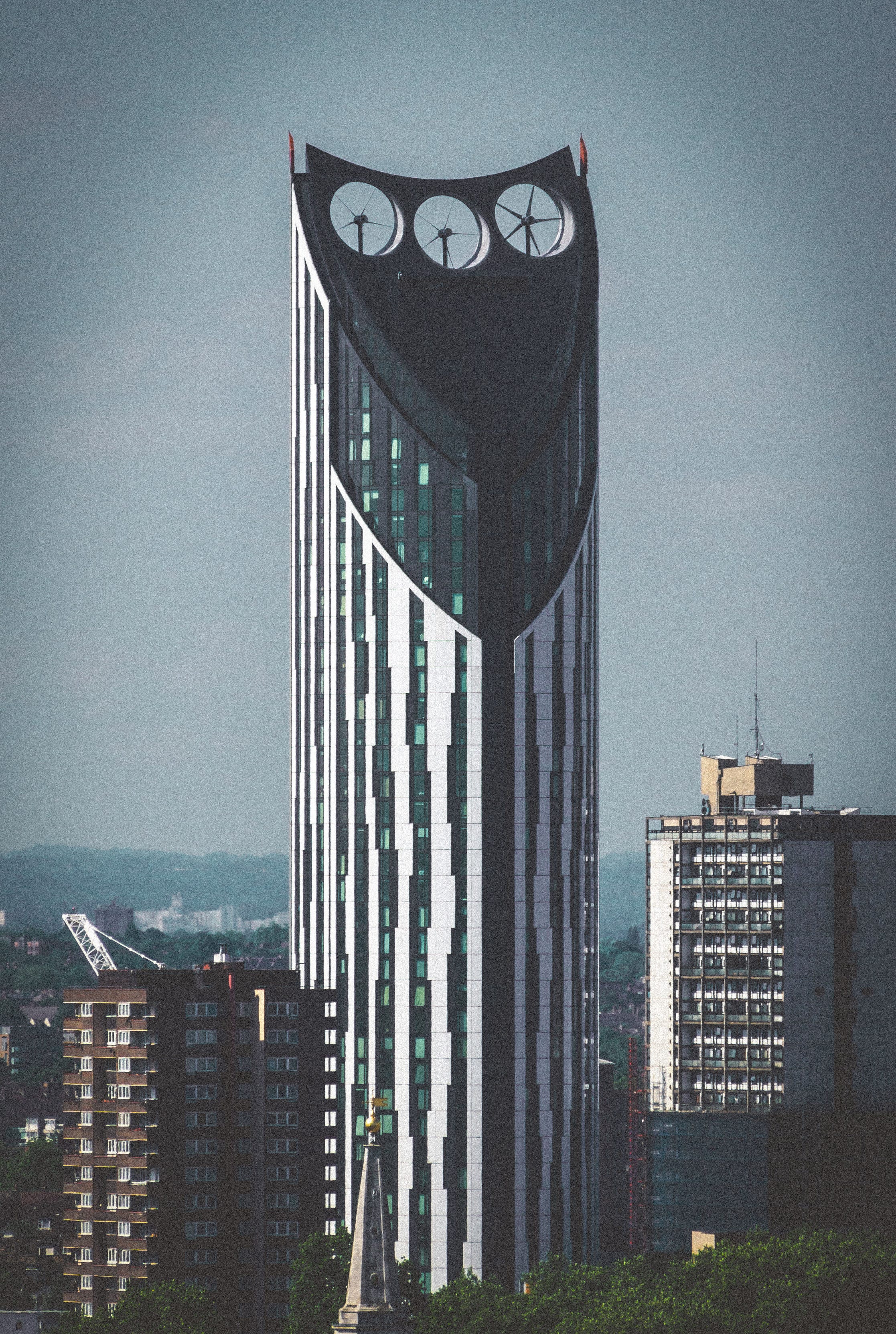
The tower is Strata SE1, and the fans are wind turbines, not decoration but working machinery, or at least machinery that was built to work. When it was finished in 2010, Strata was the tallest purely residential building in London, standing 147 metres over 43 storeys, and it carried a genuine claim to fame: it was the first skyscraper in the world to have wind turbines built into the fabric of its structure, rather than bolted on afterwards as an afterthought. The turbines were meant to supply around eight per cent of the building’s energy needs, a modest but symbolic figure, proof that a modern tower could generate some of its own power from the wind that battered its upper floors.
What stood here before
Before Strata, the site belonged to Castle House, a mixed office block put up in the early 1960s as part of the first great rebuilding of Elephant and Castle after the war. Castle House was unglamorous but well used. It housed a Chinese restaurant, an aquatics shop selling fish tanks and pond supplies, a snooker hall that later became a Latin bar, and, most fondly remembered by locals, Castello’s pizzeria. It stood alongside Draper House, a twenty five storey tower named for the Drapers’ livery company, whose almshouses had once occupied a nearby site before being moved to Brandon Street.
That whole stretch of Southwark had been shaped by a familiar London rhythm: bomb damage in the war, ambitious concrete rebuilding in the 1960s, decades of decline, and then, from the mid 2000s, another wave of demolition and regeneration. Southwark Council committed to a fifteen year, £1.5 billion transformation of Elephant and Castle, which eventually swept away the 1960s shopping centre, the Heygate Estate, and Castle House itself. Strata rose in its place, the first significant new building to open as part of that programme, intended as a statement piece for the whole regeneration.
A landmark, on purpose
Southwark’s planning officers were candid about what they wanted from the site. Their report on the application noted that the turbines would create a dramatic and highly recognisable form, a landmark that could act as a signifier of Elephant and Castle on the wider London skyline. The building was never meant to be quiet or modest. It was meant to be seen from miles away, and it is.
That visibility became a problem almost immediately. Critics found the tapering white tower, patterned with a dark, barcode like cladding, difficult to love. Journalists tried out nicknames during construction: the Razor and the Electric Razor for its shaving head silhouette, while Boris Johnson, then Mayor of London, preferred the Lipstick and praised it as a building with a bit of oomph. None of the names caught on with the people who actually lived nearby. In 2010, Building Design magazine awarded Strata the Carbuncle Cup, its annual prize for the worst new building in Britain, and the judging panel singled out the turbines for particular scorn, describing them as the very worst kind of greenwashing.
The fans that stopped turning
The complaint was not simply aesthetic. Each of the three turbines was designed to generate around 19.5 kilowatts, a useful but unspectacular amount, roughly ten times what a single washing machine draws in an hour. Once residents moved into the penthouse flats directly beneath them, on floors that had sold for well over a million pounds on the promise of unbroken views over the Houses of Parliament and Tower Bridge, they discovered that spinning turbines produce noise and vibration that carries straight down through a concrete frame. Engineers tried mounting each turbine on a heavier base with anti vibration dampers, but the shaking was never fully solved. Reports from residents suggested the turbines should be switched off overnight to give the top floors any peace at all. In practice, they were switched off far more often than that, and for long stretches they have not run at all.
The result is a piece of architecture that still performs its symbolism even though it no longer performs its function. The three blades remain fixed at the top of the tower, visible from across the river and from trains pulling into Elephant and Castle, a permanent gesture towards a sustainability story that mostly stopped happening not long after the ribbon was cut. Southwark’s own planning documents once argued that the turbines were not merely decorative. Fifteen years on, for most practical purposes, that is exactly what they have become.
Strata still stands on the site where Castello’s once sold pizza to office workers from Castle House, in a corner of London that has spent sixty years being knocked down and rebuilt in the name of the future. The elephant statue that gave the area its name has itself been moved twice during the current regeneration, most recently to a new square nearby. The three fans on the Razor’s crown do not move nearly as often, but they are, in their own way, just as fixed a part of the skyline as the elephant ever was: a monument less to wind power than to how a building can end up famous for the very thing it was built to hide.
Comments
Nothing yet. Say the first thing.
Sign in to join the conversation.