
On 10 March 1987 private investigator Daniel Morgan left The Golden Lion pub in south London after a drink with a colleague.
As he strolled across the car park to his vehicle, Daniel was attacked from behind with an axe.
In today’s Substack I tell the full story and how it was intrinsically linked to police corruption, the News of The World and the Leveson Inquiry.
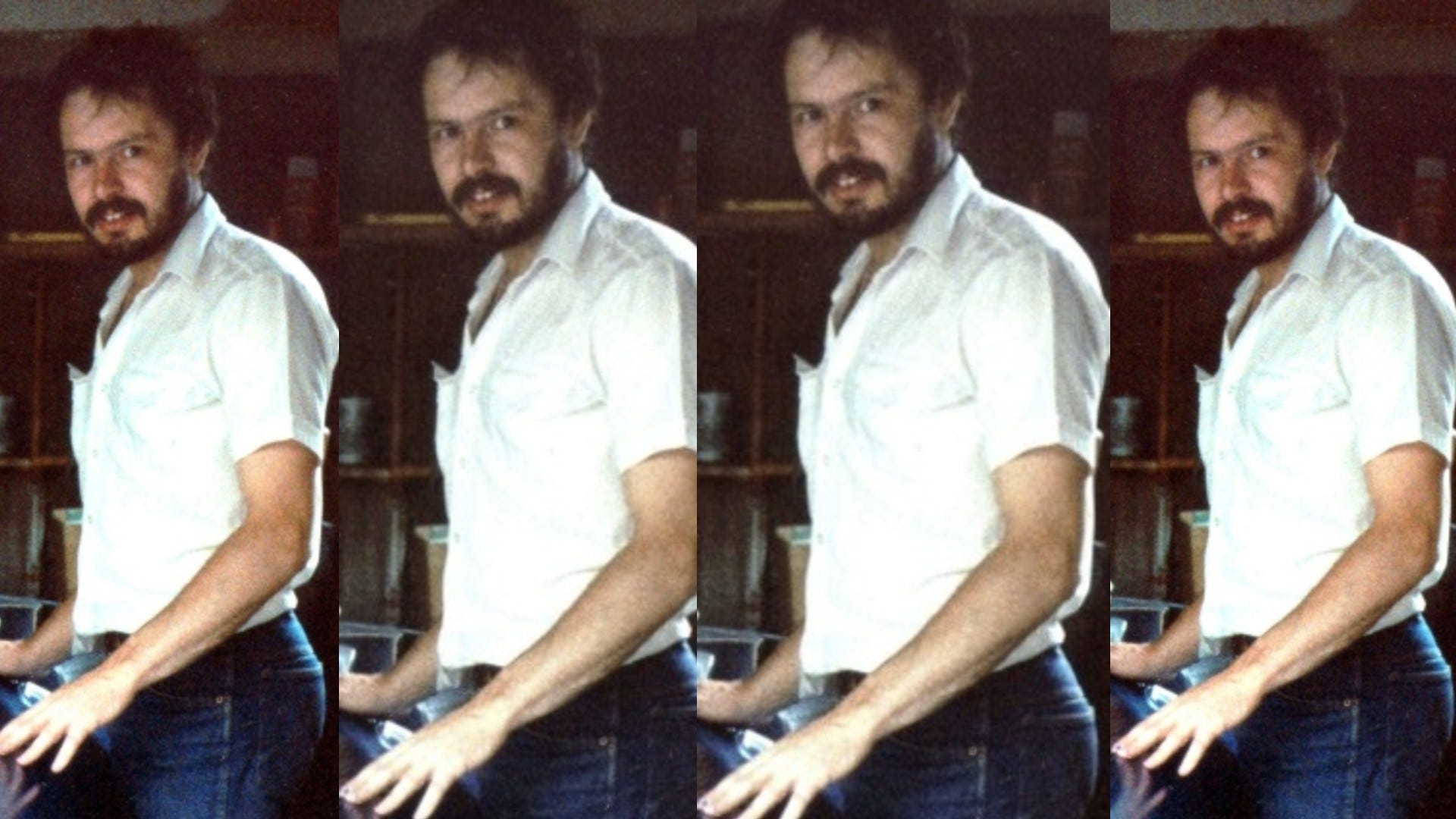
When I was a young reporter, at the Petersfield Herald – a weekly paper in a sleepy market town in Hampshire – I bumped into Daniel Morgan’s younger brother Alastair.
This would have been around 1990 or 1991.
He was doing some work experience at the Herald, in our tiny office.
It was just the three of us for a few days – me, Alastair and my colleague Linda Daubney, who was in her late 40s or early 50s and had been at the paper for years.
Alastair and I were both in our early 20s and should have had a lot in common, but Linda had already told me what had happened to his brother only a few years earlier.
When I met him I immediately sensed a deep grief and a distrust of everyone oozing out of Alastair’s every pore.
He eventually decided not to become a journalist, and later carved out a career as a professional translator, specialising in Swedish.
But Alastair has spent the past 40 years campaigning – along with his mother – for the truth about his brother’s death, and along the way has discovered how tabloid journalism could have played a part in his death.
His mother, Isobel, died in 2017, four years before an independent panel published a damning report into the police’s investigations over the years.
But let’s go back to the start of the story.
At around 9 o’clock on the evening of the 10th of March 1987 private investigator Daniel Morgan left The Golden Lion pub in south London after a drink with a colleague.
As the 37-year-old strolled across the car park to his vehicle, he was attacked from behind with an axe.
Daniel’s body, with an axe still embedded in his head, was discovered around 9.40pm when a man drove into the car park. He ironically worked for the BBC, although he was not a journalist.
The news was broken to Daniel’s wife, Iris, and their two young children – Sarah, and Daniel junior.
A murder inquiry began and the Metropolitan Police questioned Daniel’s colleague, and boss, Jonathan Rees, who he had been drinking with that night.
Rees had an alibi, of sorts – he had left the pub at the same time as Daniel and was seen at 9.30pm in a pub called the Beulah Spa in Crystal Palace with Paul Goodridge, who worked as a bodyguard.
Rees owned a company called Southern Investigations, which also employed Daniel.
On the 3rd of April 1997 six men were arrested and questioned but the police released them, saying they did not have enough evidence to charge any of them.
It would later emerge that among the six who were arrested were Rees, and his brothers-in-law Glenn and Gary Vian.
But most fascinating of all, also arrested was a man called Sid Fillery.
Detective Sergeant Sid Fillery.
And get this – he had been put on the murder investigation until his bosses realised that he knew Rees and probably the Vian brothers too.
In fact it would later emerge that Sid Fillery had been moonlighting from the Met, working for Southern Investigations, which had close connections with sections of the tabloid press.
In May 1987 a man called Bryan Madagan, who knew Daniel well and used to employ him, told the Met he believed Daniel was trying to sell a story about police corruption.
The following year an inquest was held and Kevin Lennon, who had been Southern Investigations’ accountant, gave evidence that Rees and Daniel had fallen out. Mr Lennon said he believed Rees was “determined” to have Daniel killed.
At that same inquest Rees denied the accusation, and Mr Lennon’s evidence was slightly tarnished when it emerged he had been convicted of tax fraud.
Later in 1988 Fillery left the Metropolitan Police altogether and started working full-time for Southern Investigations.
With no sign of anyone being charged with the murder, Hampshire Police were brought in to conduct a probe into the original investigation to see if they could unearth evidence of police corruption.
Nothing came of it, but in February 1989 two people were charged with the murder.
They were Rees and Paul Goodridge – remember him, the bodyguard who had been drinking with Rees in the pub in Crystal Palace shortly after the murder?
Goodridge’s girlfriend, Jean Wisden, was charged with perverting the course of justice.
But three months later charges were dropped against all three.
In March 1990 Hampshire Police produced their report. It was a whitewash, claimed Alastair.
It said there was no evidence to back up any of the claims against Rees or Fillery and (I quote) “no evidence to suggest any member of the murder investigation team took deliberate action to prevent the murder being properly detected”.
That was it.
For a few years.
Throughout the 1990s Rees and Fillery worked closely with the News of The World, carrying out investigations into celebrities and others who Rupert Murdoch’s newspaper had chosen to target.
In May 1997 the Labour Party win a landslide election victory – booting out the Conservatives – and Alastair Morgan’s local MP, Chris Smith, becomes a Cabinet minister.
Suddenly Alastair had a bit of political heft.
Chris Smith was assured by the then Commissioner of the Met, Sir Paul Condon, that Daniel’s case would be reviewed.
The Met did then bug the office of Southern Investigations and what they picked up would send Rees to jail, but not for murder.
This story within a story begins with a man called Simon James, who was desperate to get custody of his child.
James came to Southern Investigations with his problem, and Rees cooked a plan to frame Simon James’ wife Kim, a model.
They would obtain a large amount of cocaine, plant it in her car and then tip off their friends in the police.
It almost worked, but the bug uncovered the plot and Rees, James and Detective Constable Austin Warnes were all convicted of perverting the course of justice.
Rees was jailed for seven years.
But the bugging operation had failed to uncover anything which incriminated Rees when it came to the Daniel Morgan murder.
The police, and the Morgan family, were back to square one.
In 2001 the Met launched a new investigation, called Operation Abelard, but it got nowhere.
Although Abelard was led by Detective Chief Inspector David Zinzan, the man doing most of the work was Detective Chief Superintendent Dave Cook, a well-respected Scotsman.
DCS Cook was portrayed by Robert Carlyle (pictured below, in the role) in the recent ITV drama The Hack.
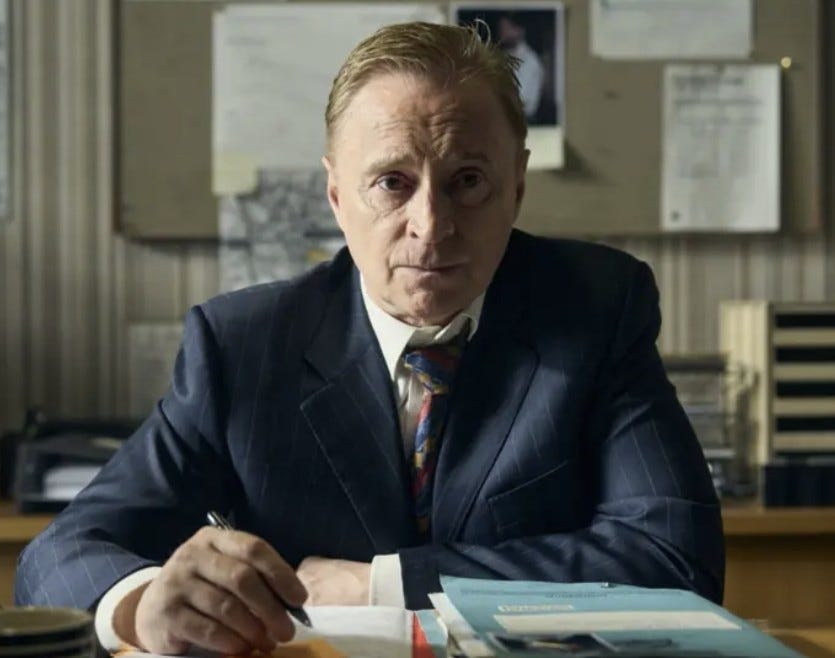
DCS Cook was, by general agreement, a straight-as-a-die cop who was determined to get to the bottom of the case and get Daniel’s killers convicted.
He was also married to Jacqui Hames, a Metropolitan Police officer who also doubled as a presenter on the TV show Crimewatch UK.
In June 2002 Crimewatch ran a cold case appeal by DCS Cook, seeking information from the public which might help catch Daniel’s killers. A £50,000 reward was offered.
The appeal – and an interview with DCS Cook – can be seen 24 minutes into this YouTube clip, and it did provide some new leads.
In August 2003 the Crown Prosecution Service told DCS Cook there was insufficient evidence to prosecute Rees, the Vian brothers or James Cook for the murder or any other offences.
But the dogged DCS Cook was not done.
He organised the bugging of Glenn Vian’s home in south London and also obtained key evidence from an informant.
In April 2008 Jonathan Rees, his brothers-in-law Glenn and Garry Vian, and an associate, James Cook, were charged with Morgan’s murder, while former police officer Sid Fillery was charged with perverting the course of justice.
But when the trial reached the Old Bailey it hit legal problems.
The murder case against Cook was thrown out first, then charges of perverting the course of justice against Sid Fillery.
The saga dragged on for ages and I remember going to several legal hearings at the Old Bailey throughout 2009 and 2010.
Finally in March 2011 the prosecution were forced to admit defeat and Rees and the Vian brothers walked free.
Daniel Morgan’s brother, Alastair said: “My family is devastated by this news.”
The family issued a statement which stated: “The criminal justice system is not fit for purpose.”
But Rees said: “I should never have been prosecuted.”
“My sympathy goes out to Danny Morgan’s family,” he added.
You can imagine how those words sounded to the Morgan family.
Glenn Vian gave an interview to his local paper, the Croydon Guardian, saying he was glad the “nightmare” was over.
He said he was at home looking after his three small daughters on the night of the murder, while his wife was out working.
“I don’t think me and my brother would have been arrested if my sister had not been married to John Rees,” he told the paper.
“All of the evidence was based on hearsay and second-hand information. There was no forensic evidence, no ID and no fingerprints,” Vian said.
He also pointed out that none of the 63 witnesses who were in the Golden Lion pub could identify either of the Vian brothers as being there that night.
That last point does not really hold a lot of water, as there is no suggestion that whoever wielded the axe ever came into the pub itself.
In 2019 a High Court judge ruled that Rees and Glenn Vian should each receive £155,000 in compensation, and Garry Vian should get £104,000 after they won an action against the Metropolitan Police, claiming malicious prosecution.
So why did the Old Bailey trial collapse?
It came down to a supergrass called Gary Eaton, and what is known as “disclosure”, which can sometimes be fatal to criminal trials.
Eaton was due to be a crucial witness for the prosecution in the Daniel Morgan trial.
The Court of Appeal later said: “He [Eaton] said that, on that evening, he had followed Garry Vian (whom he called “Scott”) into the car park from the pub lavatory and saw Cook in the driver’s seat of a car with Glenn Vian in the front passenger seat.”
“He said he saw Morgan’s body on the ground close by with an axe embedded in his head. He did not directly implicate Rees, save to say that (as Rees himself had admitted) he had been in the pub on the night in question,” it added.
But Eaton – played by Paul Kaye in The Hack – was an unreliable witness, a sleazy career criminal with substance abuse issues.
In October 2008 Eaton was caught red-handed with a large consignment of drugs and a mass of evidence of his involvement in a separate murder plot.
He pleaded guilty to 20 offences, with 32 others “taken into consideration” (what are known as “t.i.c’s.”)
So instead of getting 27 years jail for conspiracy to murder, bribing police officers, blackmail, possessing firearms, robberies, burglaries and conspiracy to supply cocaine…Eaton got just three years.
He then appeared on the Old Bailey witness list for the Daniel Morgan trial. The defence teams had a field day.
After much legal argument, Mr Justice (David) Maddison excluded Gary Eaton’s evidence in February 2010.
But the Crown Prosecution Service and the Met desperately tried to soldier on without Eaton.
Eventually in March 2011, Judge Maddison tossed the case.
The Crown Prosecution Service issued a statement which said: “We have decided that a prosecution cannot continue in these circumstances. We cannot be confident that the defence necessarily have all of the material that they are entitled to.”
“This point would be raised by the defence during any trial, so we are no longer satisfied that there is sufficient evidence for a realistic prospect of conviction,” it added.
In September 2011 – six months after the Daniel Morgan trial was thrown out – another trial collapsed because Eaton had been discredited.
That trial involved the yacht, Double Dragon, which sank in Brighton marina in 2004, after holes were drilled in its hull.
Eaton claimed Mandy Fleming, from Sheerness, Kent, had offered him money to kill her estranged husband, Adam, a keen yachtsman and the owner of the Double Dragon.
The man in charge of that trial, Judge Richard Hone said Eaton was not just unreliable but his evidence was “false and highly dangerous”.
“Gary Eaton is a person who is capable of inventing detailed accounts of events which never happened and shows either blatant untruthfulness or alternatively is a component of his personality disorder typified by folie de grandeur and self-aggrandisement,” Judge Hone said.
He said Eaton was prone to “fabrication and fantasy”.
“In short, Gary Eaton’s propensity to lie is pathological and can be extremely persuasive, “ Judge Hone said, giving the example of a psychiatrist who had fully believed Eaton’s story that his mother had died.
By the way, Mandy Fleming was not wholly innocent.
She was cleared of conspiracy to murder but was jailed for 18 months after admitting recklessly endangering her husband’s life by damaging the Double Dragon.
“You were a manipulative, angry and troubled individual,” Judge Hone called her.
At the risk of going off at a tangent – an interesting line in the case is that Mandy Fleming had been due to have a “menage-a-trois” with her lover David Brown, and his wife Nemone, on the Double Dragon.
But she lost her temper when she saw several new items on the yacht which her husband had bought, despite claiming to be skint.
Anyway, going back to the Daniel Morgan case, Gary Eaton was a terrible witness and without him the prosecution did not have enough.
Relying on him was a mistake, and his handling was also open to criticism.
In 2018, the Court of Appeal said: “The Senior Investigating Officer Detective Chief Superintendent David Cook was found to have compromised the de-briefing of Eaton by making and receiving an extensive number of unauthorised direct contacts with Eaton in the period leading up to Eaton’s making of his statements, in contravention of express procedures for keeping a “sterile corridor” between the debriefing officers and the investigation team.”
“In the course of the debriefing process, Eaton moved from being unwilling to name directly any of the participants in the murder to naming the three appellants and giving his graphic (as it turned out obviously inaccurate) description of the murder scene,” it added.
In July 2019, ruling in the compensation case, Mrs Justice [Bobbie] Cheema-Grubb said Judge Maddison had ruled Eaton’s evidence was inadmissible because DCS Cook “had compromised the integrity of the evidence Mr Eaton proposed to give by initiating or allowing extensive contact with the witness in contravention of express agreements and accepted procedures”.
But she had more.
“In my judgment exemplary damages are required,” said Judge Cheema-Grubb. “This award is to highlight and condemn the egregious and shameful behaviour of a senior and experienced police officer, DCS Cook.”
“He oversaw the investigation at the relevant time. He was warned about his behaviour on several occasions and misled superior officers. Axiomatically, honest belief in guilt cannot justify prosecuting a suspect on false evidence,” she added.
That was harsh criticism of David Cook, and it seems unfair that he has never been given a right to reply, other than in the ITV drama, The Hack, where he was portrayed sympathetically.
The end of the trial might have been good news for Rees, but it was the beginning of the end for his erstwhile employer, the News of the World.
The Daniel Morgan trial collapsed on Friday 11th March 2011.
But the end was looming fast for the News of the World, the paper which had paid Jonathan Rees and Sid Fillery so much money over the years for their work on its celebrity “exclusives”.
That same day, 11th March 2011, Nick Davies, an investigative journalist with The Guardian, wrote a long and detailed article about the dark arts of journalism as practiced by the News of the World.
In it he stated that Jonathan Rees was paid £150,000 a year by the News of the World and quoted him as saying: “No one pays like the News of the World do.”
The News of the World, or the “Screws” as it was universally nicknamed in Fleet Street, was wobbling.
But on 4 of July 2011 Nick Davies landed the knockout blow.
He published a world exclusive - the News of The World had hacked the phone of missing schoolgirl Milly Dowler.
In March 2002 Dowler, who was 13, had gone missing on the way home from school in Walton-on-Thames.
Her remains were found later that year and eventually serial killer Levi Bellfield was arrested and convicted of her murder.
But for several months in the spring of 2002 the Dowler family had hopes she was still alive and had perhaps just run away from home.
It was during that time that they learned the Milly’s voicemail messages had been listened to, and it gave them false hope – that Milly was alive and had listened to the numerous messages they had left for her.
But the person listening to the messages Glenn Mulcaire, a private investigator – like Jonathan Rees – who worked for the News of The World.
Mulcaire specialised in hacking into phones and he had done it, on the orders of someone at the News of the World, in the hope of gleaning some titbit of information which the paper could sell as a world exclusive, like they did so many times before, concealing the source of their information.
The Milly Dowler revelation – which Rupert Murdoch’s News International group did not deny – was just the tip of the iceberg of industrial-scale phone hacking by the News of the World.
Several of the paper’s biggest advertisers announced they would no longer put ads in the News of the World.
Suddenly Rupert Murdoch pulled the plug on what had been Britain’s biggest selling Sunday newspaper – a paper that sold almost three million copies a week at the time.
The edition of 10 July 2011 would be its last.
It would later emerge that in the summer of 2002 – shortly after Cook had appeared on Crimewatch making that fresh appeal in the Daniel Morgan case – the News of the World had hired people to put Cook and his wife, Jacqui Hames, under surveillance. Geoff Mulcaire had also obtained personal information about Jacqui Hames, including her police payroll number.
The paper’s managing editor, Rebekah Brooks, would later claim the News of the World had been following up a tip-off that Hames – a famous face from Crimewatch – was having an affair with a police officer called Cook.
Clearly that was not the case as they were already married.
I will leave you to speculate about why, in 2002, the News of the World was carrying out surveillance on a senior police officer who was investigating Jonathan Rees, one of the paper’s main editorial sub-contractors.
Anyway the News of the World collapsed and Rebekah Brooks was put on trial, along with Andy Coulson – the paper’s former editor, who had gone to work as director of communications for the prime minister, David Cameron.
Brooks was acquitted but Coulson was jailed.
Cameron then put Lord Leveson in charge of a public inquiry into the press.
There were originally meant to be two phases of the inquiry. The first phase, looked at the culture and ethics of the British newspaper industry, heard from alleged phone-hacking victims and took evidence about whether self-regulation was working.
The second phase was supposed to look at connections between the press and the police.
The first phase lasted from November 2011 until November 2012.
But in January 2017 – with no sign of the second phase – Daniel Morgan’s family urged the then Prime Minister, Theresa May, to confirm it would go ahead.
Just an aside, the following month - February 2017 - I was in the Argentinian capital, Buenos Aires, on holiday when I noticed a familiar face in a bar.
I strolled up to him and said: “Are you Nick Davies?”
He was. It turns out he was on holiday there too.
We ended up spending a whole evening, drinking beers and discussing journalism and life.
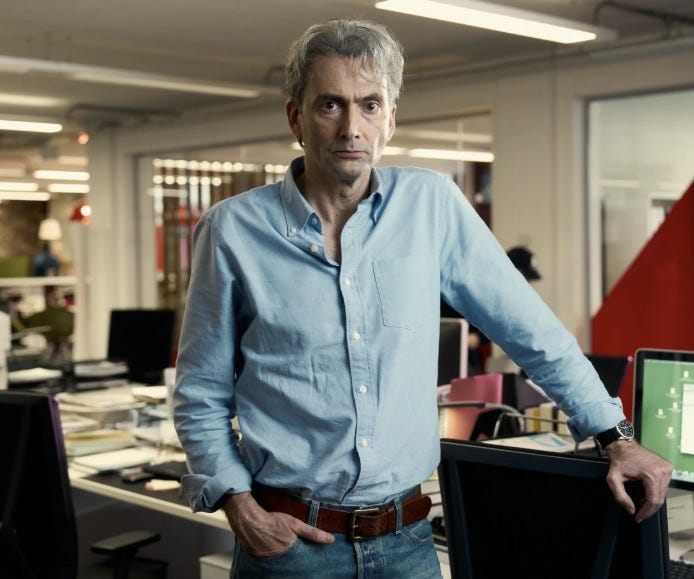
Nick Davies was played by David Tennant in the ITV drama The Hack (pictured below) and I think he did an excellent job of portraying Davies and his mannerisms.
That same year Alastair published a book, co-written with Peter Jukes, called Untold: Exposing the Truth About the Daniel Morgan Murder.
Glenn Vian is understood to have died of natural causes in June 2020.
Two years earlier Theresa May’s government – which was mired in the Brexit fiasco - scrapped plans for the second phase of the Leveson Inquiry.
The National Union of Journalists (NUJ) – of which I am a member – condemned the decision.
Three years later, in June 2021, the Daniel Morgan Independent Panel published a report which said the Metropolitan Police had been “institutionally corrupt” in its handling of the Morgan case.
The 45-page report is pretty dry stuff – unless you love police management jargon – but it has some key nuggets in it.
It begins by saying: “Between 1987 and 2011, the Metropolitan Police Service (MPS) and other forces arrested 67 people in connection with the murder. Eight of those arrested had been police officers. Sadly, no one has yet been brought to justice for Daniel Morgan’s murder.”
“The MPS is deeply sorry that no one has been brought to justice and for the way the first investigation into the murder of Daniel Morgan was impacted by corruption,” it adds. “The MPS is fully committed to preventing, identifying, and rooting out corruption.”
The NUJ welcomed the panel’s report and said, I quote – “The National Union of Journalists believes the failure to enact Part 2 of the Leveson Inquiry means that to date the relationship between the police, politicians and the media have never been examined or publicly scrutinised.”
A month after the independent panel’s report was published, Alastair Morgan was asked about the case at the London Assembly’s Police and Crime Committee.
The exhaustion and stress showed on his face as he said: “We’ve been through five investigations, one of which lasted six years, and one which I have latterly been told was not actually an investigation into my brother’s murder.”
“We’ve also been through an inquest, a two-year High Court disclosure battle, the longest pre-trial hearing in British criminal history lasting nearly two years before the collapse of the last prosecution, and then on top of that, we’ve had this eight-year inquiry.”
“The only way I can describe all of this is to say that the Met has colonised my life for the last three-and-a-half decades.”
Five years later people are still talking about the Daniel Morgan case and writing about it.
Some of those have questioned why the police focused on Jonathan Rees and the Vian brothers.
Ciaran Goggins, who has explored the Daniel Morgan case on his Goggzilla blog, told me: “The use of Rees as a scapegoat typifies the lazy and grossly incompetent policing which beset the golden hour at the Golden Lion and after.”
“Much as a poor crime writer would opt for ‘the butler did it’ the Met went for ‘the business partner did it’,” he claimed.
There have been other theories floated about why Daniel Morgan was killed.
Some suggest he was having an affair with a woman whose husband found out and had him killed, while more lurid theories involve Colombian cocaine and a Maltese drugs cartel.
When I contacted Daniel’s brother Alastair last year he told me he was not in a position to talk about the case.
So will we ever get to the truth about Daniel Morgan’s murder, which took place in 1987 - around 100 years after the Jack The Ripper murders?
Or will the Sydenham axe murderer go free and unidentified, just like the Whitechapel ripper a century before?
Stay tuned: Next month I will be publishing another Substack about the News of the World and their infamous investigative journalist Mazher Mahmood, aka “The Fake Sheikh”, and another Old Bailey trial.
No posts
Comments
Nothing yet. Say the first thing.
Sign in to join the conversation.