
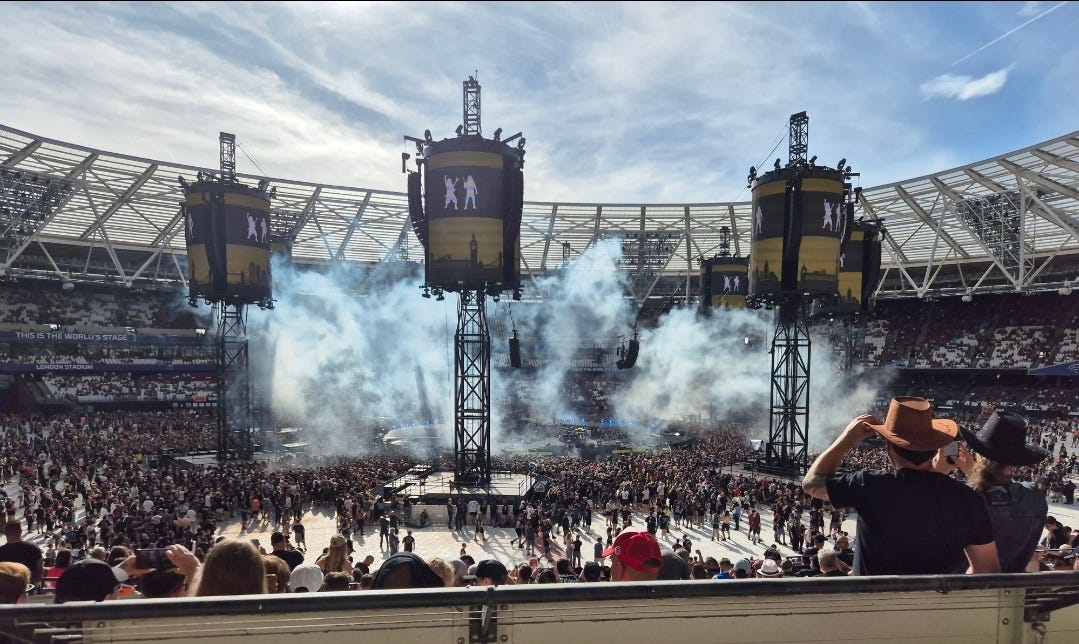
I recently attended a Metallica gig at the London Stadium, where the chief support act was Pantera, and it got me thinking about an infamous shooting.
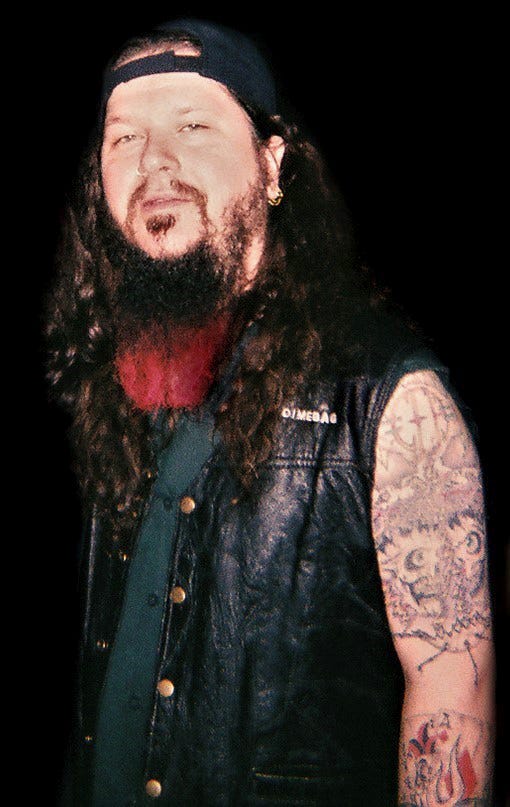
On 8 December 2004 “Dimebag Darrell” Abbott, a former lead guitarist with Pantera, was shot dead on stage at the Alrosa Villa nightclub in Columbus, Ohio.
In today’s Substack I recount why Dimebag Darrell was killed and explore some other grisly cases, like the Bataclan attack in Paris, and a fire during a live set by Great White in Rhode Island which killed 100 people.
In 1981 Darrell, a guitarist, and his brother Vinnie Paul, a drummer, founded Pantera – a heavy metal band - in their native Texas, and eventually recruited singer Phil Anselmo and bass guitar player Rex Brown.
They hit the big time in 1990 with their breakout album, Cowboys From Hell.
The music was thrash metal – the kind of music every teenager’s mum and dad hates, unless they are themselves thrash metal fans.
One of the comments on this YouTube video sums it up.
Dad: “Turn that off”
Me: “Why?”
Dad: “We’ve got bigger speakers downstairs”
Pantera had more success with the albums, “Vulgar Display of Power” and “Far Beyond Driven”.
But in 2003 the band broke up because of a row between Anselmo and the Abbott brothers.
The Abbott brothers went off to form a new band, Damageplan, and in February 2004 they brought out their first album, “New Found Power”.
They took the album on the road – and also played old Pantera hits - but two nights before the end of the tour, disaster struck in Ohio.
Damageplan were nowhere near as successful as Pantera and only 250 people turned up for the gig in Columbus, at a venue which held 600.
But Nathan Gale, a former US Marine, was in the audience at the Alrosa Villa nightclub and he was hellbent on violence as Damageplan came on stage and began their first track.
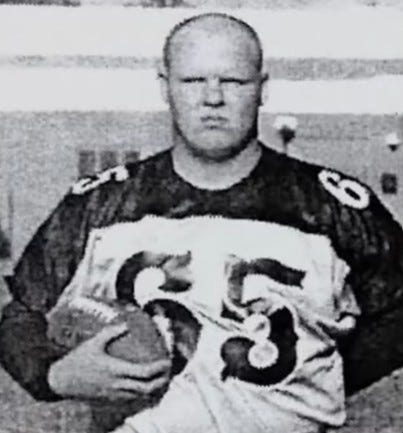
Then Gale (pictured above) climbed on stage and ran towards Dimebag, shooting him multiple times with a Beretta handgun.
But Gale was not done.
He wanted to kill Vinnie but he had fled to the safety of the tour bus.
So Gale turned the gun on a roadie, and on the band’s head of security, Jeff “Mayhem” Thompson.
Thompson was shot dead, along with roadie Erin Halk.
Nathan Bray, a fan of Pantera and Damageplan, who had bravely climbed on stage and attempted to give CPR to Darrell was also killed.
By this stage James Niggemeyer, a police officer, had reached the venue and he gunned down Gale.
The last words Dimebag (pictured below) uttered were reportedly “Van Halen”, which was a codeword he used with his brother before each gig as if to say “Good luck, and enjoy yourself.”
Gale is believed to have been suffering from a psychotic episode at the time of the shooting and there are conflicting reports about his motivation.
One report suggests he blamed the brothers for his beloved Pantera breaking up, and another indicated that he actually thought Pantera were “stealing his thoughts”.
Vinnie is said to have never recovered from the shock of witnessing his brother being killed on stage and he died in 2018 aged 54, as a result of cancer.
The Alrosa Villa nightclub was demolished in 2021.
Immediately after Dimebag was killed, Anselmo gave an interview in which he said: “This is not about me, or some motherfucking psycho that happened to destroy the most beautiful person, one of my best friends in the world.”
In 2022 Anselmo told another interviewer: “I think Dime and Vince would want the legacy and the name of Pantera to go on and on and on, and in everyone’s damn face, and I know that for sure…That would be their biggest dream.”
And that same year, almost 20 years after it broke up and folded, Pantera reformed with Anselmo and bassist Rex Brown being joined by Ozzy Osbourne’s former lead guitarist, Zakk Wylde, and drummer Charles Benante.
On Pantera’s website, a message about Dimebag was posted on 8 December 2025, which read: “It’s hard to believe that you have been gone for 21 years. Your influence & energy is still very much alive. We feel it daily. Thanks to all our fans for keeping Dime’s legacy going!”
Pantera supported Metallica at their gig at the London Stadium on 5 July. I was there, and can assure you they are in fine fettle.
Their next gig is next month in Louisville, Kentucky.
But the new Pantera have not released any new albums, and continue to play their old songs.
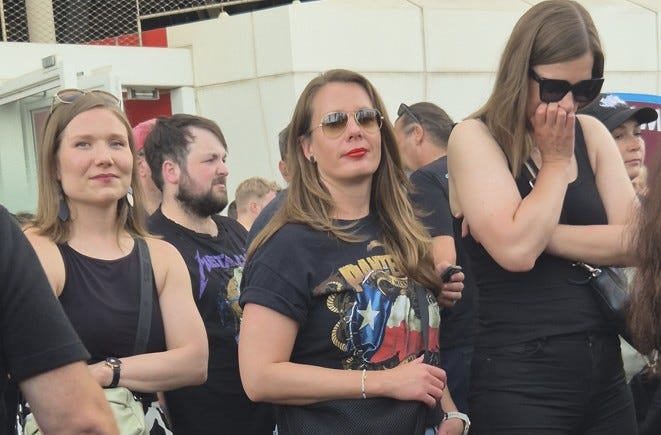
Now the murder of Dimebag Darrell Abbott and the three other people at that Damageplan was a horrific incident, but it pales in comparison to two other attacks which had a much higher death toll.
Firstly, I am going to recall the infamous terrorist attack on the Bataclan, a Paris venue popular with rock bands.
On Friday 13th of November 2015, a US band, The Eagles of Death Metal, were playing a gig at the Bataclan.
They had ironically just started playing the song “Kiss The Devil” when, at 9.47pm, three Islamic extremists armed with Kalashnikov rifles and other weapons burst into the Bataclan and began firing at concertgoers.
By the end of the night 90 people were dead.
Lead singer Jesse Hughes and the three other members of the band managed to hide backstage or in the dressing rooms, sheltering with a number of their fans.
The band returned to Paris only three months later to perform an emotional gig, which was the centrepiece of a 2017 Netflix documentary.
But in March 2016 Hughes triggered an outraged reaction after he claimed several security guards at the Bataclan had not turned up for work on the night and told the Fox Business Network: “It seems rather obvious that they had a reason not to show up.”
“Jesse Hughes spread some very grave and defamatory accusations against the Bataclan teams,” said a representative for the venue, who called his claims “insane”.
Hughes later apologised for the remarks in March, saying that his allegations were “absurd” and blaming the trauma he had undergone.
But in May 2016 he gave an interview with Taki’s Magazine, in which Hughes said: “I saw Muslims celebrating in the street during the attack. I saw it with my own eyes. In real time! How did they know what was going on? There must have been coordination.”
A subsequent French judicial investigation ruled out any complicity by security guards at the Bataclan, but a parliamentary commission said there had been a “global failure” by French intelligence agencies.
The Eagles of Death Metal – whose name is meant to be a joke, as they are not really a death metal band – recently announced a tour of Europe and the UK, which will include dates in Paris (on 3 November), Manchester, Glasgow, Birmingham, Leeds and London and will end at The Cheese & Grain venue in Frome, Somerset!
It will be known, bizarrely, as the “Death By Sexy” tour.
Josh Homme, who was part of the band’s original line-up, is better known as the lead singer of Queens of The Stone Age.
In 2023 Homme discussed with comedian Neal Brennan whether people should have made jokes about the Bataclan attack.
Another horrific incident during a live music event was the fire at The Station nightclub in West Warwick, Rhode Island.
When a pyrotechnic display triggered a fire which rapidly spread through the dilapidated venue as rock band Great White played, 100 people died.
John Barylick, an attorney who led the prosecution team in the aftermath of the fire, later wrote a fantastic book about it, Killer Show, which I highly recommend.
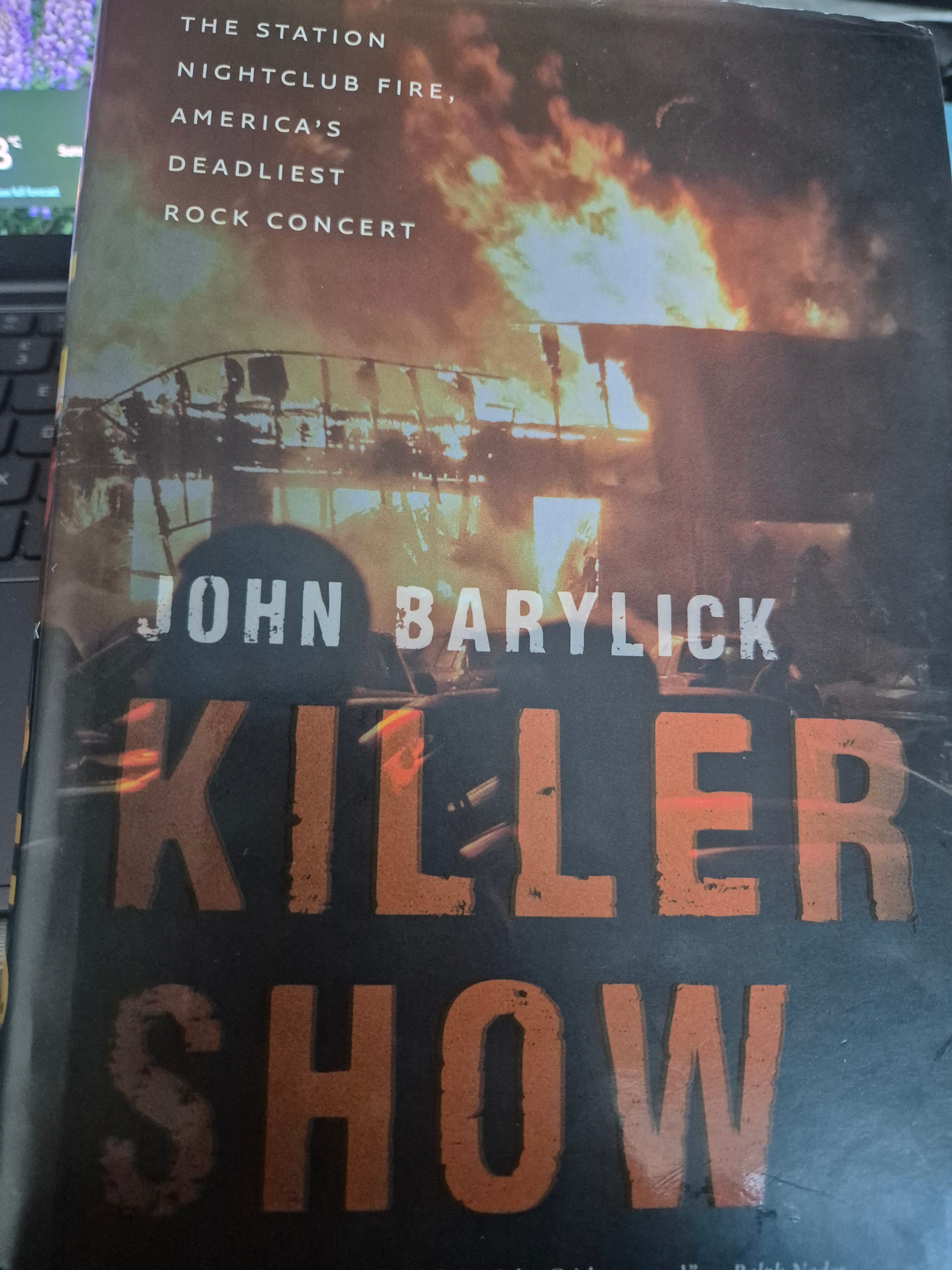
Barylick quoted local radio executive, Stephen Scarpetti, as describing The Station nightclub as being: “a place where good bands go to die.”
Among those who died was Ty Longley, Great White’s rhythm guitarist.
While most of the band members fled out of the stage entrance, Longley spotted his friend Bill Long and jumped down to join him, saying: “C’mon, let’s get out of here, bro.”
But they got trapped in the smoke, and although Long made it out alive, Longley perished.
The most chilling thing about The Station nightclub fire is that it was all filmed, and the footage is still on YouTube.
But the 13-minute film really is quite terrifying, and I strongly advise you not to watch it if you are the least bit sensitive, or afraid of fire or crowds.
Around 2011, when I read Barylick’s book, I became a little bit obsessive about it and even worked it into this BBC article about plans to deregulate live music venues which hold less than 5,000 people.
As I clumsily wrote: “The dangers posed in venues holding under 5,000 people was illustrated most graphically in the United States in 2003 when 100 people died in a fire caused by a heavy metal band’s pyrotechnic display.”
“In 2008 the band’s insurers agreed to pay $1m (£564,000) to survivors and relatives of the victims of the fire at the Station nightclub in Rhode Island,” I wrote.
There is an interesting interview with Great White’s lead singer, Jack, on YouTube and around the 34 minute mark, he addresses the issue of the fire.
He denied the pyrotechnics – which he described as “indoor fireworks” – were his idea but said his tour manager, Dan Biechele, thought they might “spice up the show”.
Russell said the problem was that the roof of the venue was made of an inflammable acoustic foam, which was illegal but had not been spotted by the local fire marshall.
Biechele pleaded guilty to 100 counts of involuntary manslaughter and was jailed for 15 years, although he only served 16 months.
The Station’s co-owners, brothers Michael and Jeffrey Derderian were also jailed for involuntary manslaughter. Michael spent 27 months in prison but Jeffrey was given community service.
Russell was never charged.
Great White continued to tour for years but then split into two bands – Great White and Jack Russell’s Great White.
Russell died in August 2024, aged 63.
Great White are still going, and according to their website are currently on tour.
Their next gig is in Sturgis, South Dakota on August 11.
Over the years there have, of course, been a number of famous musicians who have been murdered off-stage.
The most famous was the assassination, in 1980, of the 40-year-old former Beatle, John Lennon, as he approached his apartment in New York’s Dakota Building.
The murder ironically took place on the same day – 8 December – as the killing of Dimebag Darrell Abbott.
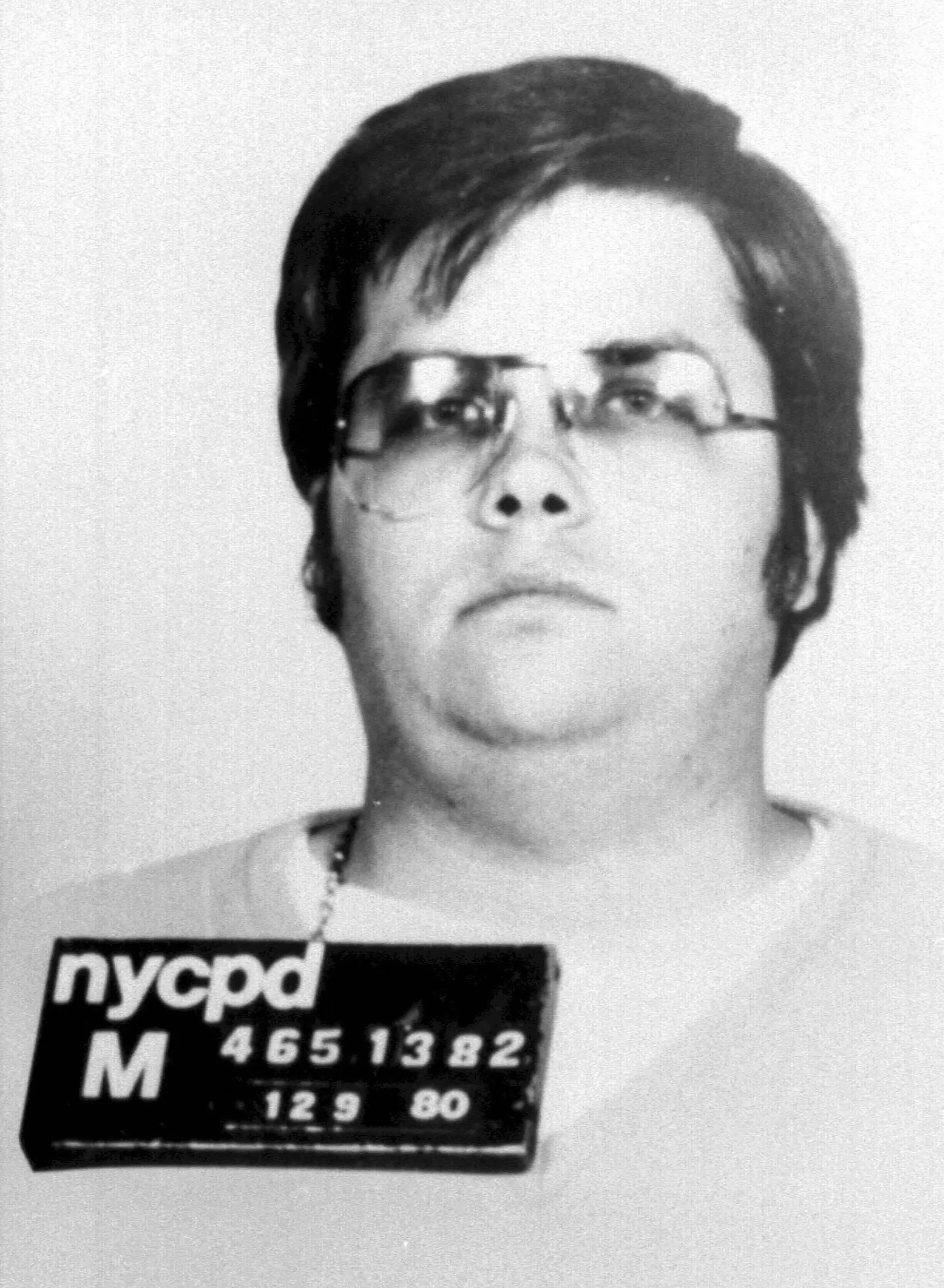
Lennon’s killer, Mark Chapman (pictured above), was mentally ill and suffered from various personality disorders.
He gave various reasons for the murder. At one point he said a “demonic power” had been at work, but on other occasions he linked it to his obsession with The Catcher In The Rye, a novel by JD Salinger which involves a protagonist who is convinced most adults are “phoneys”.
In one interview Chapman said he bought a biography of Lennon, which portrayed him as a hypocrite who professed peace and love but had a huge fortune.
“So I brought the Lennon book home, into this The Catcher in the Rye milieu where my mindset is Holden Caulfield and anti-phoniness,” he said.
Chapman has now spent more than 45 years behind bars, and was denied parole again last year, upon his 14th application.
Other famously slain music stars include Selena, the 23-year-old Texan singer, who was shot dead by Yolanda Saldívar, the president of her fan club, on 31 March 1995.
Selena – who sang a popular Tex-Mex fusion style known as Tejano music - was shot dead at a Days Inn motel in Corpus Christi, Texas by Saldivar, who had been exposed by the star’s family for stealing embezzling money from her fan club and clothing merchandise brand.
After the shooting, Saldivar was besieged by police for nine hours before she surrendered.
Saldivar will be eligible for early parole in March 2030.
The 1960s soul star Sam Cooke was shot dead in a case which was ruled “justifiable homicide”.
Cooke, 33, burst into the office of the Hacienda Motel in Los Angeles on the night of 11 December 1964 and demanded the manager, Bertha Franklin, tell him what had happened to his female companion, Elisa Boyer, who had just left his room.
After a physical confrontation, Franklin pulled out a gun and shot him three times.
Boyer would later claim she fled the room after Cooke tried to rape her.
But this article argues that Cooke was wrongfully accused, and may have been murdered by Franklin.
Another slain star was Carlton Barrett, a former drummer with Bob Marley and The Wailers.
Barrett was shot dead in Kingston, Jamaica, in September 1991.
His wife Albertine, her lover Glenroy Carter, and the hitman Junior “Bang” Neil, were later convicted of conspiracy to murder.
Soul legend Marvin Gaye was shot and killed by his father, Marvin Gay Sr., in April 1984.
In the 1990s a feud between West Coast and East Coast rappers in the United States led to two infamous murders.
In September 1996 Tupac Shakur was shot dead in Las Vegas and then in March 1997 his rival, Biggie Smalls, was gunned down in Los Angeles.
Biggie’s murder remains unsolved while Duane Keith Davis, aka Keefe D, is due to go on trial this month for Tupac’s murder.
Last but not least Jam Master Jay (real name Jason Mizell) of Run DMC fame, was shot dead at a recording studio in the Jamaica district of Queens, New York in October 2002.
In April this year Jay Bryant pleaded guilty to orchestrating the murder, which was allegedly committed by Ronald Washington and Karl Jordan Jr.
Jam Master Jay was involved in drug dealing and the murder was linked to a dispute over a consignment of cocaine.
PICTURE CREDIT - Photograph of Dimebag Darrell Abbott, courtesy of April Ashford-Forsythe.
No posts
Comments
Nothing yet. Say the first thing.
Sign in to join the conversation.