
Since it’s Simcoe Day today, I thought I’d share an old post about the Simcoes in the days before they founded our city (on this land where people had already been living for thousands and thousands of years). I first wrote a version of this back when I travelled to the UK in 2014. And then bits and pieces of it made their way into both The Toronto Book of the Dead and The Toronto Book of Love…
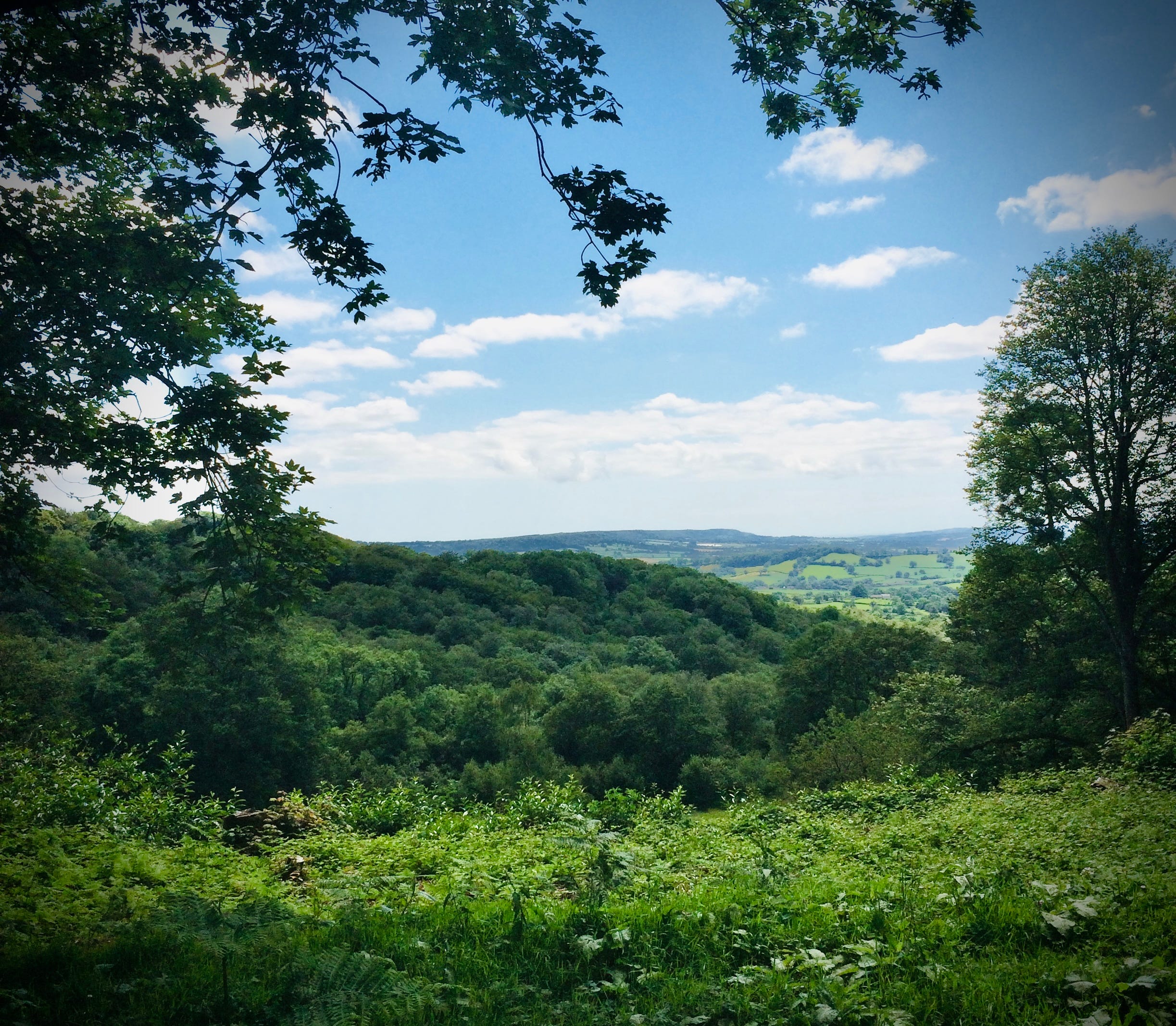
These are the Blackdown Hills of Devon. They’re one of England’s official “Areas of Outstanding Natural Beauty,” filled with rolling green hillsides and bright fields and ancient trees that line roads so old deep grooves have been worn into the earth. It’s a land of magic and of myth: of pixies and fairies, of warrior ghosts and witchcraft, of Druids and Romans, of poachers and smugglers, of Iron Age hill forts, Bronze Age burial mounds and Stone Age earthworks. And it’s here that the founders of Toronto fell in love.
The story of the Simcoes starts with a man named Samuel Graves. He was an admiral in the British navy and spent much of the 1700s at war. He captained a ship during the Seven Years’ War (that’s the one with the Battle of the Plains of Abraham) and he was in charge of the whole North American fleet during the early days of the American Revolution. That mission didn’t go very well; he was ordered to control the entire east coast of the United States with only about two dozen ships. It’s gone down in history as one of the most impossible tasks ever asked of a naval officer. Graves was doomed to fail. He was eventually replaced and headed home to his country estate, where he’d live out the rest of his days in relative peace and quiet.
His house — Hembury Fort House — was in the Blackdown Hills. In fact, it still is today; it’s a retirement home now. And while Admiral Graves didn’t have any children of his own, he did have a niece. Her name was Elizabeth Posthuma Gwillim.
Elizabeth was an orphan from the beginning. Her father had been a military man, just like Graves. Thomas Gwillim fought in the Canadian colonies during the Seven Years’ War, as aide-de-camp to the legendary General James Wolfe. He was there at the Battle of the Plains of Abraham, one of the most famous moments in all of Canadian history. Unlike Wolfe, he survived. But the Seven Years’ War was waged on battlefields all over the world. It’s been called the first truly global war; one of the bloodiest conflicts in human history. So, after Canada, Gwillim was sent to Germany. And it was there, for a reason lost to history, that he died.
Thomas never even knew his wife was pregnant. It was a complete surprise. She was 38 and they’d never had any other children. It wasn’t until six months after his death that his daughter was born.
Elizabeth’s mother, Elizabeth Spinkes, didn’t live much longer than that. She soon followed her husband to the grave. There were complications during the labour. She lived just long enough to see her baby girl before she passed away. She was buried the day after her daughter was baptised; her funeral was held in the very same church.
And so, with both of her parents dead, the infant Elizabeth was given a morbid middle name: Posthuma, because she was a posthumous child.
Growing up as an orphan, young Elizabeth spent her childhood living with relatives. Some were in Northamptonshire, where she was born; “the county of spires and squires” in the middle of England. Some of her family was in the verdant Wye Valley, on the border with Wales. But it seems most of her time was spent with her uncle, Admiral Graves, in the Blackdown Hills. She became the daughter he never had.
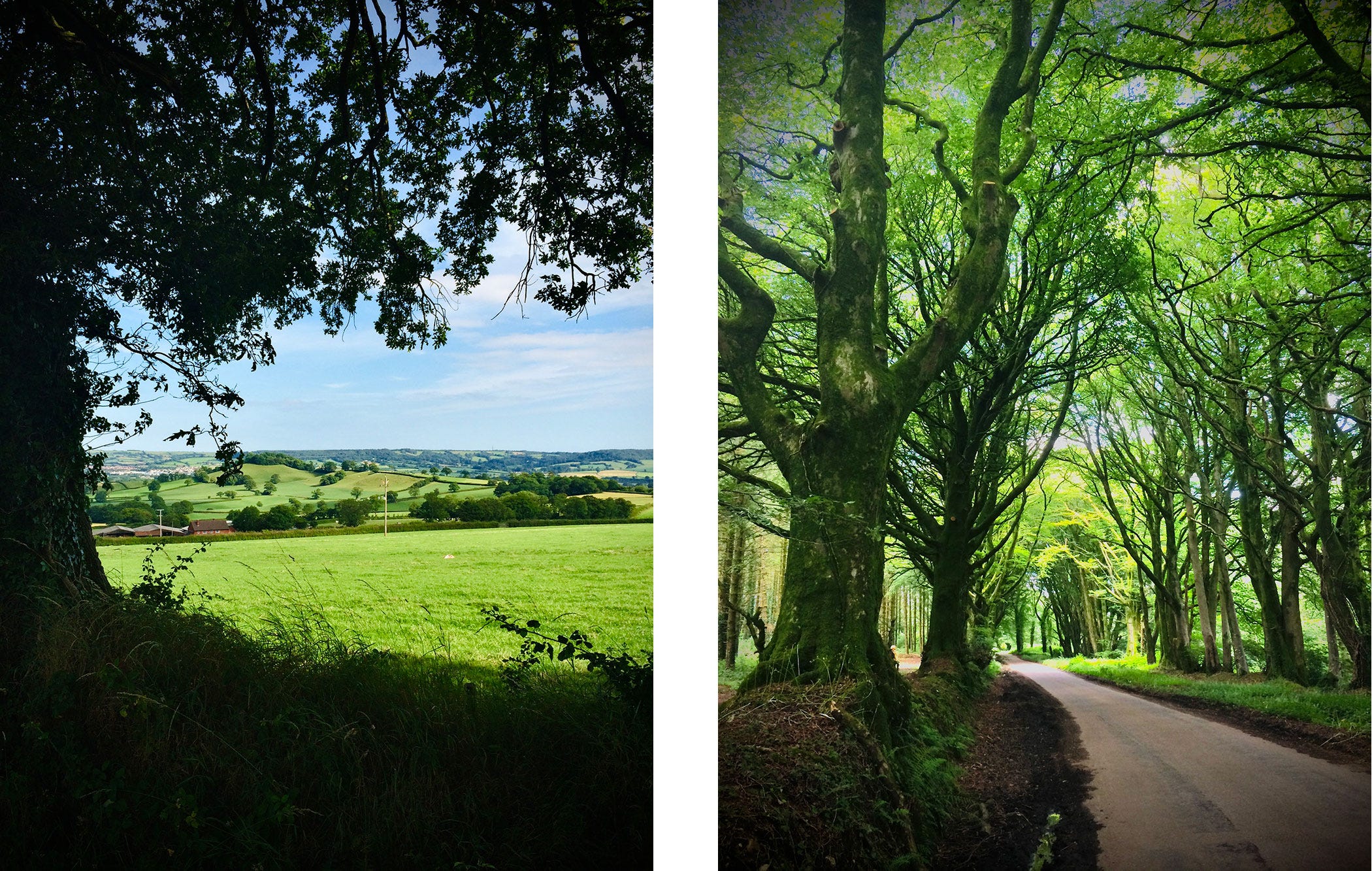
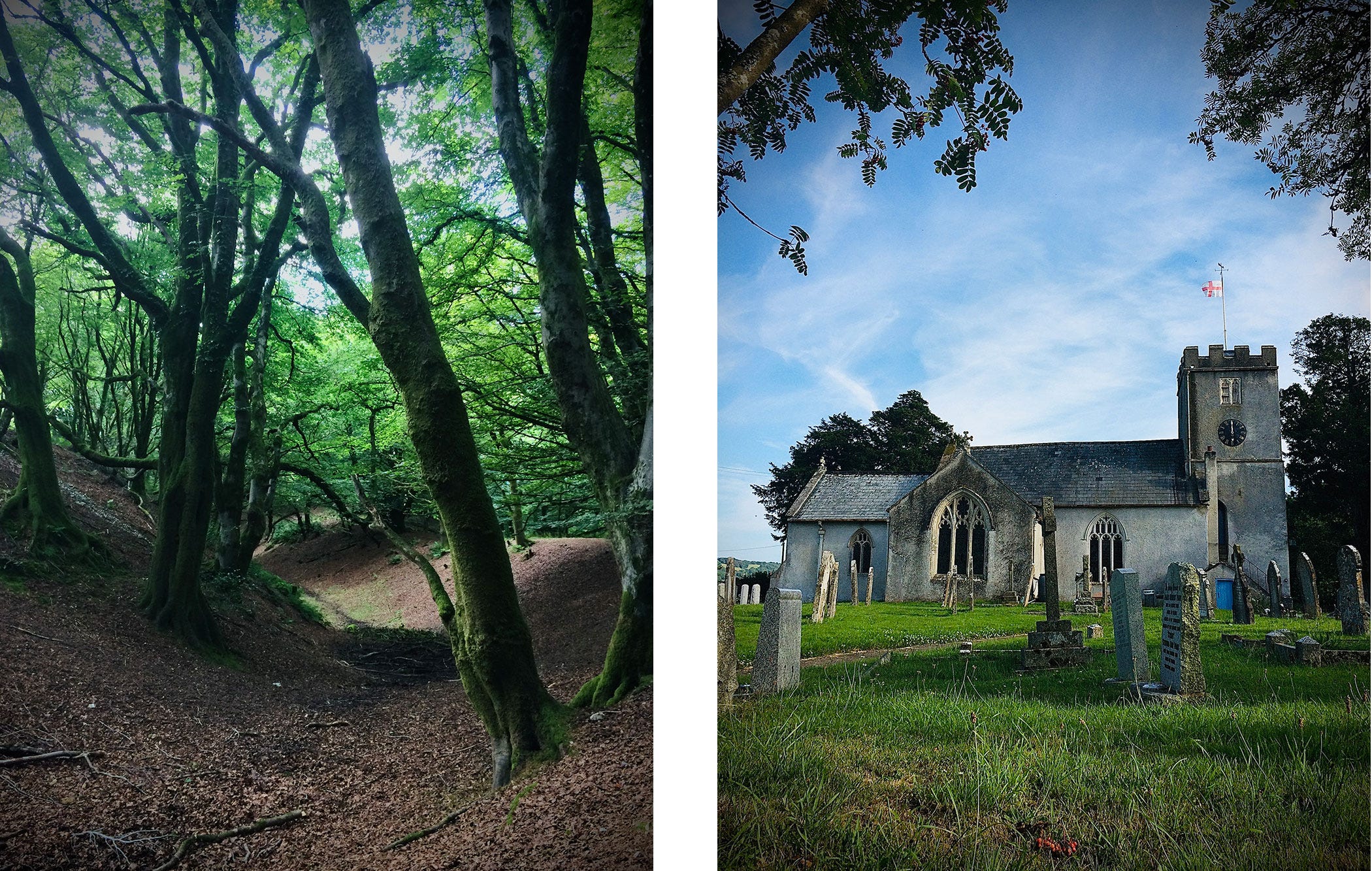
“Elizabeth fell in love with the beautiful Devon landscape,” her biographer, Mary Beacock Fryer, writes, “which she grew to regard as her spiritual home. She roamed the rolling countryside, and the moor rising above the green fields with their underlayer of red sandy soil.” Elizabeth went for long rides and walks through the hills, sketching the countryside and collecting plants. At home, she turned those sketches into watercolours and stayed up late reading or chatting with her best friend. Those same artistic skills would eventually earn her an important place in the history of our city; her diary, drawings and paintings provide a remarkable record of the founding of Toronto.
But Elizabeth wasn’t the only young person who shared the affections of the old admiral. During his days in the Royal Navy, Graves had become friends with the captain of another ship, a man whose name was Captain John Simcoe.
Simcoe, too, had fought in the Canadian colonies during the Seven Years’ War. He was there for the Siege of Louisbourg, as the British captured the French fortress in Cape Breton. But he caught a fatal case of pneumonia just as the fleet began to sail up the St. Lawrence to attack Quebec City. He died just a few months before the Battle of the Plains of Abraham. He was buried at sea near the mouth of the great river, leaving a wife and two sons behind. One of the boys had been named after him, with a middle name chosen in honour of the boy’s godfather, Admiral Graves. And so, that son was called John Graves Simcoe.
The young Simcoe followed in the footsteps of his father and of his godfather, fighting for the British in North America. This time, it was during the American Revolution, where he quickly made a name for himself as a successful military commander. He adopted guerrilla-style tactics and never lost a battle, making himself a hero to the British and a villain to the Americans.
He also fell in love during that war. While living with an American family who’d been forced to take him in, he developed a crush on their teenage daughter, Sally Townsend. They began spending a notable amount of time together. And when February rolled around, Simcoe even sent her the very first valentine in North American history. It was a bit of poetry along with a sketch of two hearts with their initials inscribed upon them, both pierced by cupid’s arrow.
But Sally would never be his valentine. Historians believe the real reason she was spending all that time with Simcoe was that she was trying to overhear his conversations with other British officers. Sally Townsend was a revolutionary spy.
And that heartbreak wasn’t the only trouble Simcoe was facing. He would soon be wounded in battle, captured by the Americans rebels and spend months inside a revolutionary prison. Even worse, he received devastating news from home. His mother had died. He was still in his twenties and now he was an orphan, too.
He would eventually be released from American custody as part of a prisoner exchange and was sent back home to England to nurse his wounds. Since he didn’t have any immediate family left, he headed to his godfather’s house in the Blackdown Hills.
There’s a chance he might have already met Elizabeth before that point. But even if he had, she would have made an entirely new impression on him now. She was nineteen years old, pretty and slight, just about five feet tall. She could paint and draw and do needlework, was well-read and spoke three languages. And for his part, Simcoe was a dashing young officer in his late twenties, a war hero with political ambitions and a passionate interest in the distant Canadian colonies.
Simcoe, too, fell in love with the Blackdown Hills. He was fascinated by the history of the place — those stories of fairies and ghosts and smugglers. As soon as he had healed enough, he began to join Elizabeth on her long walks through the countryside, up and down those big green hills. They would both make sketches of the picturesque landscape and turn them into full paintings when they returned home to Hembury Fort House. And while at first, they were accompanied by the admiral’s wife — who was skeptical of the young relationship — soon, she let them go out on their own. They would stride down those ancient, sunken roads, with Elizabeth having to run every few steps in order to keep up with the tall soldier.
“From walks the couple graduated to long rides each morning before breakfast,” Fryer writes in her biography. “To Mrs. Graves’ chagrin, she found herself looking on, helpless, as the two were obviously falling in love. Admiral Graves was delighted with the train of events, and sought to give the couple every encouragement.”
It worked. Just a few months after Simcoe arrived in Devon, the two were engaged. It was the summer of 1782. That December, they made the short trip down the hill from Hembury Fort House to a nearby church in the tiny village of Buckerell. There, they were married in front of their friends and their surviving family members. With Elizabeth’s inheritance, they bought a beautiful estate of their own, just across the fields from Hembury, where they would raise their own family. They spent much of the rest of their lives in the very same hills where they’d first fallen in love.
Except, of course most notably, for one long trip to the Canadian colonies, founding a new city in another land they grew to love.
I’ve written about the Simcoes in the newsletter many times over the years, including:
John Graves Simcoe’s strange and complicated relationship to slavery
His crush on Sally Townsend and his historic valentine
The story of their big Newfoundland dog, Jack Sharp, and how he almost got eaten
John Graves Simcoe’s fight over manure
Thanks so much to all of you who support The Toronto Time Traveller with a paid subscription! It’s only because of you that this newsletter exists — and by keeping it going with a few dollars a month, you’re keeping it free for thousands of other people and supporting all the other work I do. If you haven’t already joined the heroic 4% of readers who do support the newsletter with a paid subscription and want to make the switch yourself, you can do that right here:
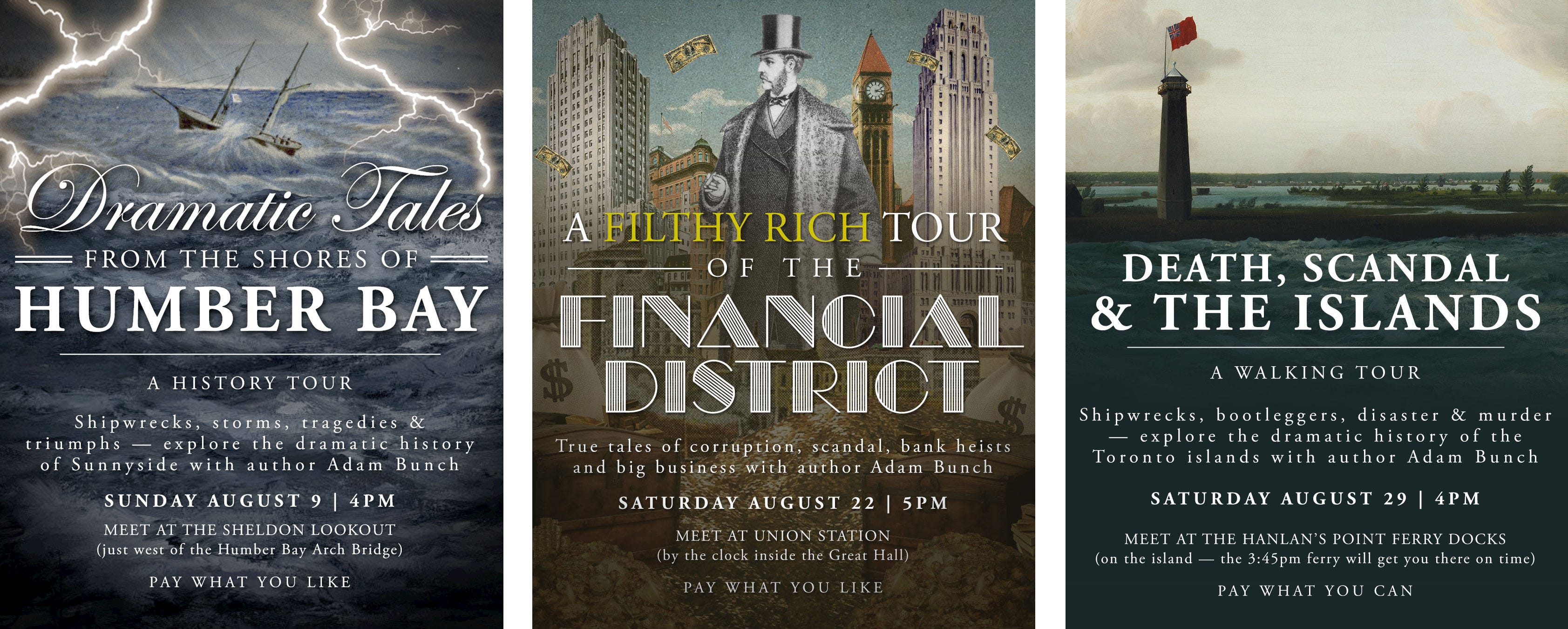
There is a whooooole lot of summer left and I’m planning to fill it with as many walking tours as possible — including three before the end of the month! You’ll find all the details below.
We’ll begin by following up my waterfront tour with another walk along the lake shore. This time, we’ll be exploring the history of Humber Bay…
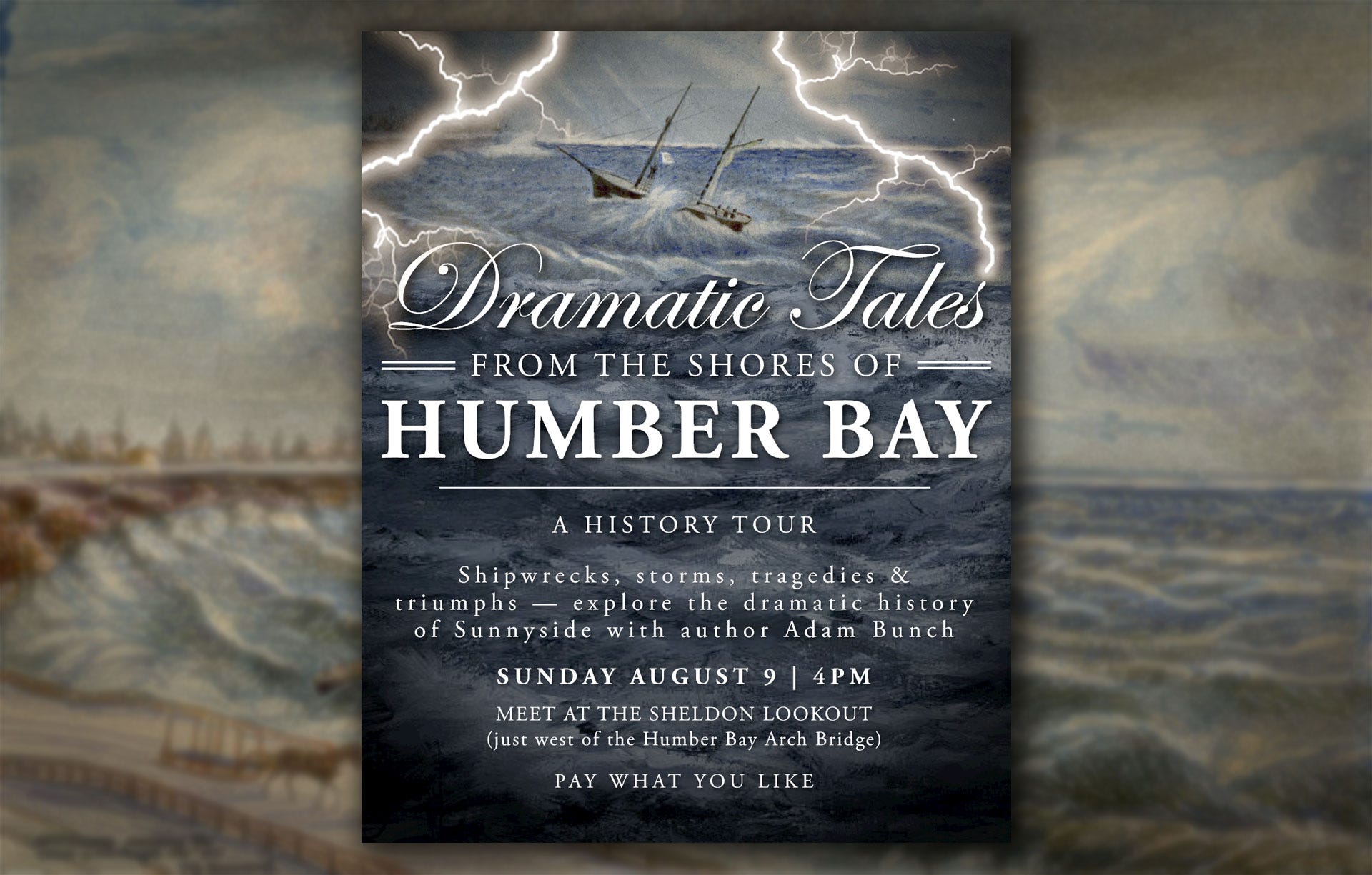
Description: From storms and shipwrecks to blazing infernos and triumphant victories, many dramatic tales have played out on the shores of Humber Bay. On this tour, we’ll explore that history while walking around the mouth of the river and along the Sunnyside Boardwalk.
When: Sunday, August 9 at 4pm.
Where: Meet at the Sheldon Lookout. (It’s just to the west of the Humber Bay Arch Bridge.) We’ll end near the Sunnyside Bathing Pavilion.
Length: About 2 hours.
Price: Pay what you like!
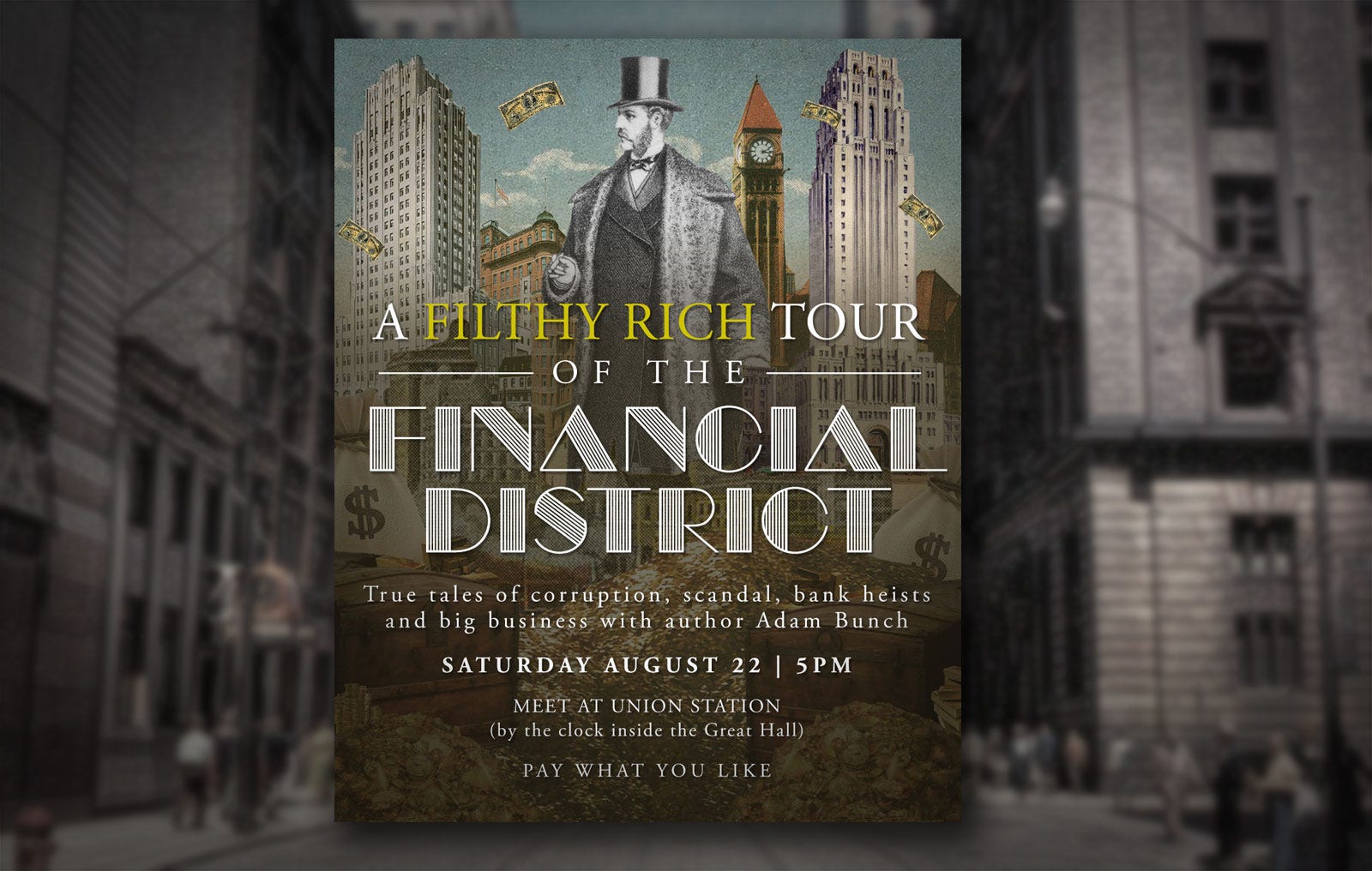
Description: This tour is all about money and corruption. We’ll walk through the neighbourhood of skyscrapers that stands at the heart of the Canadian business world. And along the way, we’ll uncover tales of backrooms deals, crooked tycoons, scandalous millionaires and daring bank robbers — while exploring the ways in which they’ve shaped the history of our city.
When: Saturday, August 22 at 5pm.
Where: Meet at Union Station, by the clock inside the Great Hall. We’ll end near Queen & Bay.
Length: About 2 hours.
Price: Pay what you like!
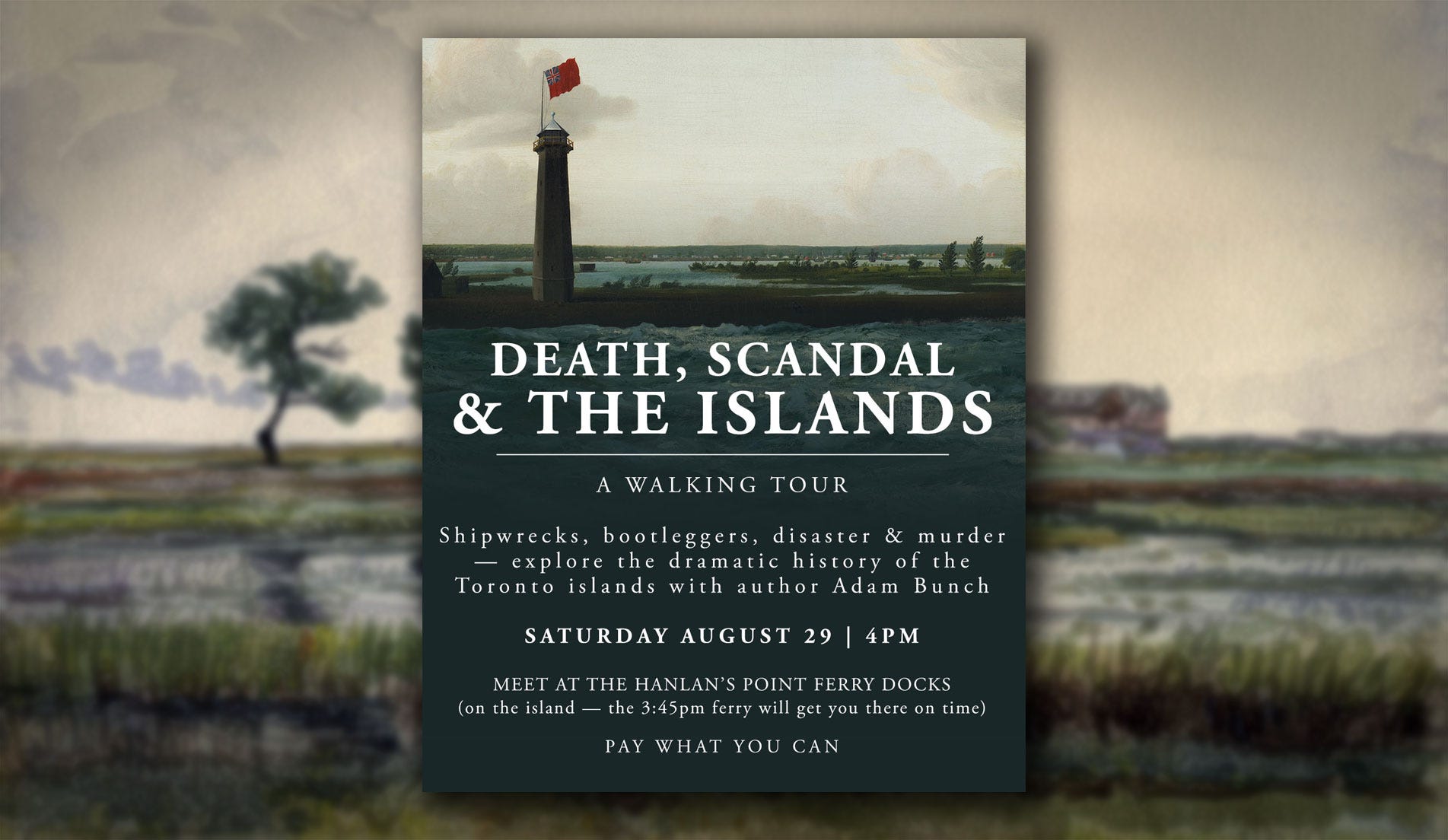
Description: The Toronto islands haven't always been a peaceful place. They've witnessed many of our city's most dramatic events — from deadly shipwrecks and heroic rescues to heart-breaking disaster and bone-chilling murder. We'll uncover the fascinating hidden histories of the islands on a walk from Hanlan's to Gibraltar.
When: Saturday, August 29 at 4pm.
Where: Meet at the Hanlan’s Point ferry docks on the island. If you’re on the ferry leaving the Jack Layton Ferry Terminal at 3:45pm, you’ll be on time. (If you miss it, there are also water taxis available from the docks at the foot of Yonge Street, just around the corner from the ferry terminal.)
We’ll end at the Gibraltar Point Lighthouse (which is halfway between the Hanlan’s Point and Central Island ferry docks — each is about a 25–30min walk).
Length: About 2.5 hours.
Price: Pay what you like!
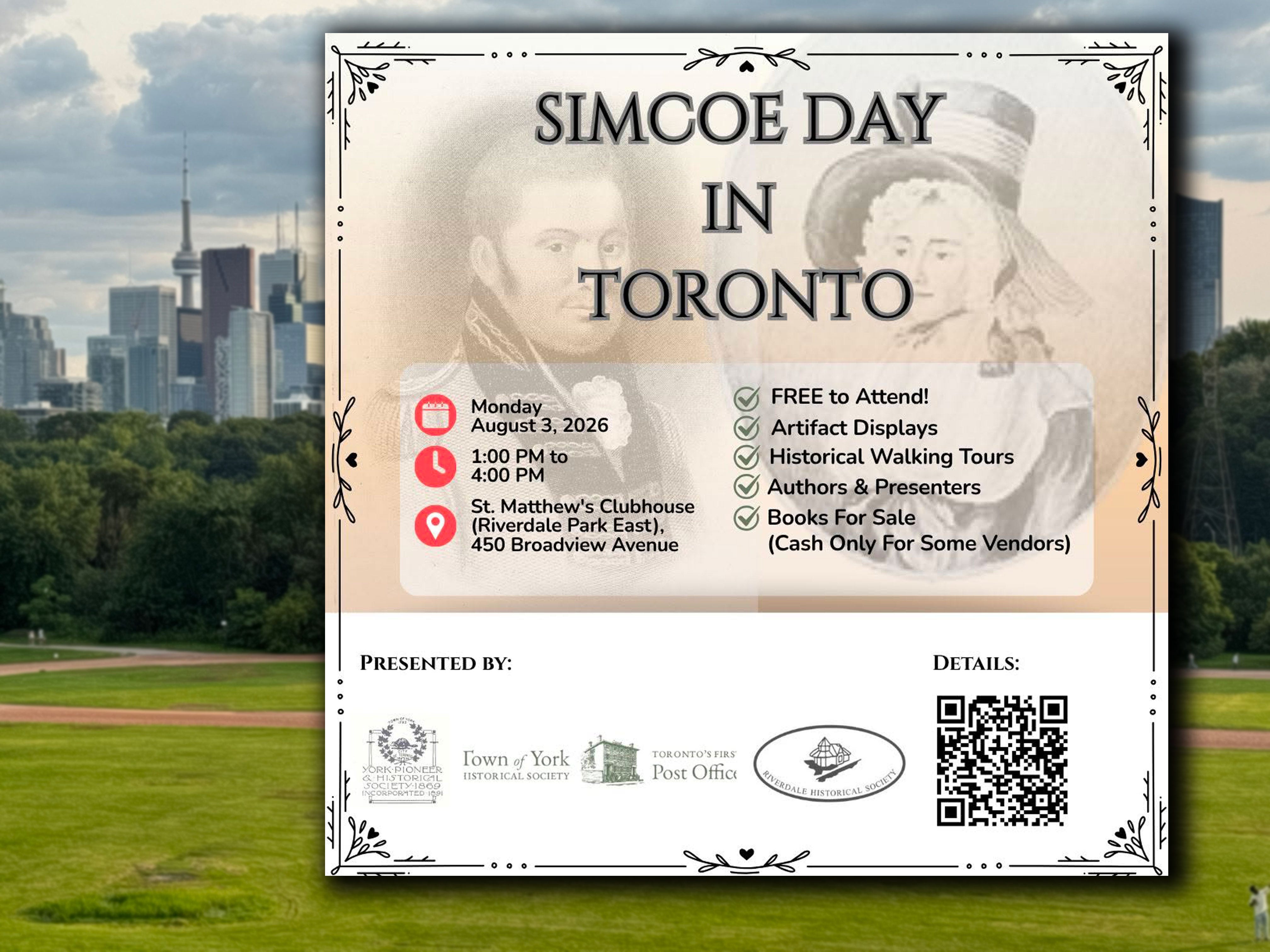
It’s now a tradition going into its third year: a Toronto history event in Riverdale Park every Simcoe Day! Co-organized by three powerhouses of local history — the York Pioneer & Historical Society, Toronto’s First Post Office, and the Riverdale Historical Society — this year’s guests include lots of friends of the newsletter, like Bob Georgiou, Jeremy Hopkin, Adam Waiser from the Muddy York podcast, authors Lorna Poplak, Elizabeth Gillan Muir, Susan Grundy, and more.
“Come celebrate Toronto’s history and the people who help keep its stories alive Celebrate Simcoe Day 2026 with Toronto history authors, booksellers, podcasters, and historical societies… Browse curated artifact displays, meet and chat with local authors and podcasters, connect with historical societies, and take part in guided neighbourhood walks. Whether you’re a lifelong history enthusiast or simply curious about Toronto’s past, you’ll discover something new and meet others who share your interest!”
When: Monday, August 3 from 1pm to 4pm.
Where: The Matthew’s Clubhouse in Riverdale Park East.
Price: Free!
The best of everything else that’s new in Toronto’s past…
EMANCIPATION DAY NEWS — In The Toronto Star, Shellene Drakes-Tull writes about the history of Canadian slavery and the fact that history is too little remembered. “We need to disabuse ourselves of the idea that Canada has only been a refuge for enslaved people. Canada has its own dark history of slavery, discrimination and anti-Black racism.” And she mentions one effort to better remember that history: the annual “Emancipation Day Underground Freedom Train Ride, hosted by the TTC in partnership with the Blackhurst Cultural Centre.” Read more.
CARNIVAL NEWS — On the TVO website, you can stream the documentary Carnival: They Can’t Steal Our Joy by Ugandan-Canadian filmmaker Ian Mark Kimanje — for free. It’s all about the history of the Caribbean Carnival and its roots in slavery and emancipation. Watch it here.
1970s PRIDE NEWS — On BlueSky, Amelia Smith shares footage of the 1973 Toronto Pride Parade. Watch it here.
CENSORED NEWS — On Letterboxed, Eric Veillette (of The Downtown Theatre newsletter) has created a list of films that found themselves on the wrong side of the Ontario Board of Censors during the 100+ years that organization “made life very difficult for filmmakers, distributors, experimental film & video artists & the movie-going public.” Read more.
PODCASTS RECORDED IN 232 YEAR-OLD CABINS NEWS — An all-star edition of the Toronto Mike’d podcast was recorded inside Toronto’s oldest building, Scadding Cabin. It featured historian Jeremy Hopkin, along with “Bob Georgiou from the York Pioneer and Historical Society (YPHS), Shayda Spakowski with the Canadian National Exhibition and Fred Robbins, Lord of the Moustache.” Listen here.
VACCINES & DEMONS NEWS — On the most recent episode of the Muddy York podcast, they talk about public health leader Gerry FitzGerald and Connaught Laboratories. “FitzGerald turned Toronto into a world leader in public health, producing vaccines and medicines that saved tens of millions of lives. Unfortunately, he would be destroyed by his own demons and by his era's backwards attitude towards mental illness.” Listen here.
MAP NEWS — Eric Sehr has a new post in his project about the history of Brockton Village, mapping the area’s landowners from the 1820s to 1840s. Read more.
SPECTACULAR VIEWS NEWS — For blogTO, Jack Landau shares the stories of eight lost observation decks that used to give Torontonians and tourists spectacular views of the city from above. Read more.
RAILWAY HOTEL NEWS — Landau also writes about the future of the old Canadian Pacific Building at Yonge & King. Once one of the city’s most spectacular skyscrapers and currently home to a Shoppers Drug Mart, it looks like it will soon be turned into a luxury hotel. Read more.
THE 2026 TORONTO HISTORY LECTURE
August 4 — 7:30pm — Zoom — Toronto Branch, Ontario Genealogical Society
“This year’s lecture will be: ‘A Grocery Store, a Library, and the Struggle for Space: Black Community-Building in Toronto, 1920s–1960.’ Presenter Dr. Melanie Knight will tell us about her research on the Home Service Association.”
Free! Registration appreciated.
BEFORE THE BLUE JAYS: PROFESSIONAL BASEBALL IN TORONTO PRIOR TO 1977
August 6 — 6pm — North York Central Library
“Harvey Sahker presents his book, “Before the Blue Jays“ (Dundurn, 2026). Discover the fascinating history of professional baseball in Toronto before 1977, when the Blue Jays first took flight. Learn about the major events, venues, and people who trail-blazed the way to the arrival of Major League Baseball in Toronto.”
Free!
KINGSTON ROAD WALK
August 8 — 1pm — The Beach & East Toronto Historical Society
“The Beach & East Toronto Historical Society presents walking tours with historian and Beach Metro News columnist Gene Domagala.”
Free!
WAR & TERROR IN THE TOWN
August 14 — 7pm — Toronto’s First Post Office
“Explore the Town of York on foot with our Museum Coordinator! In this walking tour, join us as we explore the beginnings of the area that would become the Town of York, the events leading up to the War of 1812, the Battle of York, its aftermath, and everyday living conditions while we walk the original 10 blocks of the early city.”
$22.63
FIELD OF DREAMERS: COMMEMORATING THE CHRISTIE PITS RIOTS
August 15 — 2pm — North York Central Library
“CeCe Fortier, scholar and author, brings together organizers of the Field of Dreamers Cooperative Softball Association to commemorate the 93rd anniversary of the Christie Pits riots and discuss what they mean for queer/trans, Black, Jewish, and other communities today.”
Free!
THE GRIM HISTORY OF THE DEATH PENALTY IN CANADA
August 26 — 7pm — Deer Park Library
“Death by hanging was a grim realty within the Canadian criminal justice system until its abolition in 1976 (now 50 years ago). But what did capital punishment look like in Canada? Author Lorna Poplak will discuss the history of the death penalty in Canada, with a focus on topics such as the inconsistent application of the death sentence, the treatment of women, wrongful conviction, the difficult journey toward abolition, and the last two hangings at Toronto’s notorious Don Jail.”
Free!
BLACK CULINARY CULTURE IN EARLY TORONTO — NEIGHBOURHOOD TOUR
August 29 — 10am & 12pm — Mackenzie House
“Mackenzie House’s "Black Culinary Culture in Early Toronto" neighbourhood tour considers the influence of the Black community on food culture in Toronto from the 1830s - 1860s. From grocers to caterers to purveyors of fine dining, each of the histories represents a different aspect of foodways. The tour begins at the Northeast corner of King & Church Streets and ends at Mackenzie House, with a tasting of Trinidadian snacks provided by Pelau Catering.”
Pay what you can
SUMMER OF FEAR ’77: THE MURDER OF SHOESHINE BOY EMANUEL JAQUES
September 15 — 6:30pm — Toronto Reference Library
“Investigative journalist Robert J. Hoshowsky (Outraged: the Murder of Shoeshine Boy, Emanuel Jaques) examines the shocking abduction and murder of a 12-year-old boy that enraged a nation and forced the shutdown of Yonge Street’s sex trade. The discovery of Emanuel Jaques’ remains on the rooftop of a Yonge Street massage parlour on August 1st, 1977, ignited a firestorm. Within a few days, thousands descended on Toronto City Hall demanding the reinstatement of capital punishment, which had just been abolished a year earlier. Fed-up with countless sex shops, strip clubs and X-rated movie theatres, the public, politicians and businesses demanded change. This resulted in the most sweeping clean-up in Canadian history, which remains controversial to this day.”
Free!
A WALK THROUGH TORONTO’S OLD TOWN
September 25 — 10:30am — Toronto’s First Post Office
“Explore the Town of York on foot with our Museum Coordinator in celebration of Ontario Culture Days! Imagine a Toronto where the tallest building is only three stories high, where Lake Ontario reaches Front Street, where the wagon wheels grind through the muddy roads, the air smells of smoke and animal, and the surrounding lands is farms, fields, and forests. In this walking tour, explore the surviving built environment of the original 10 blocks of Toronto and learn about what life was like for its early residents in celebration of Ontario Culture Days!”
Donations encouraged
BOOK LAUNCH: YORKVILLE BY MIKE DALEY
September 30 — 7pm — Church of the Redeemer
“Please join us in celebrating the release of Mike Daley’s much-anticipated book, Yorkville: How a 1960s Coffeehouse Scene Rewrote Popular Music. Admission is free, but you can add on a book and/or a small donation to Church of the Redeemer’s Common Table homeless outreach programme. The event will feature a book reading, a live interview with Rob Bowman, a Q&A, book signing and reception. Books will be available for purchase at the event.”
Free! Donations welcome.
JEAN LUMB: BRIDGING THE CHINESE COMMUNITY IN TORONTO
September 29 — 7pm — S. Walter Stewart Library — East York Historical Society
“Jean Lumb was an extraordinary community leader who was the first Chinese Canadian woman to receive the Order of Canada. Her courage and determination defied the odds and overcame challenges to make a lasting difference for Chinatown and the Chinese community in Toronto. [Speaker] Arlene Chan is an award-winning author of seven books and Chinatown historian who brings to life the history, culture, and traditions of the Chinese in Toronto. She serves as the president of the Jean Lumb Foundation that administers a national scholarship program and as an advisor for Toronto Public Library’s Chinese Canadian Archive.”
Free!
HERITAGE TORONTO WALKING TOURS
Various dates and locations until November — Heritage Toronto
“Our 2026 Tour Season will run from May to November, presenting over 60 experiences throughout Toronto. This year, we’re bringing back some of our greatest hits: the best-selling and most beloved tours that people have returned to time and again. From walks uncovering Black history along King Street to explorations of the bustling streets of Little India, we invite you to experience some of Toronto’s most compelling stories. Alongside our classics, we’re also introducing a range of new tours that offer fresh perspectives on the city’s heritage: from stories of food and migration in Little Manila, to explorations of Toronto’s architectural legacy, to journeys through the natural heritage of Toronto’s beaches. We hope to see you this season!”
50 YEARS OF ETOBICOKE CIVIC CENTRE ART GALLERY
Until August 8 — Monday to Friday (8am–6pm) — Etobicoke Civic Centre Art Gallery
“Visit us to discover the history of art at the Etobicoke Civic Centre with artifacts, archives, and paintings pulled from the City of Toronto’s permanent collections. Celebrate the present by witnessing a commissioned piece by early career artist Lise Round. Envision the future with new designs of the updated Etobicoke Civic Centre Art Gallery. Established in 1976, the Etobicoke Civic Centre Art Gallery has served the local community for 50 years. Etobicoke Civic Centre Art Gallery has presented more than 500 exhibitions and continues to nurture emerging talent, spotlight established artists and celebrate creativity at the community level. To celebrate this milestone, the City of Toronto’s Arts and Culture Services have created an exhibition that honours the past, celebrates the present, and looks forward to the future of the gallery.”
Free!
THE T.O. YOU DON’T KNOW — MUSEUM OF TORONTO
Until December 30 — Tuesday to Friday (12–6pm), Saturday (10am–6pm) — Museum of Toronto
“Discover how interesting Toronto really is, through a new exhibition that reveals the city’s hidden stories. The T.O. You Don’t Know uncovers hidden stories Toronto has long overlooked—through 50+ historic sites, forgotten events, and fascinating local narratives and unique objects. It surfaces the ignored, the hyperlocal, and the quietly radical, reinforcing that history is not fixed, but layered and still unfolding.”
Free! Donations welcome.
No posts
Comments
Nothing yet. Say the first thing.
Sign in to join the conversation.