
Among people I generally consider intelligent and clear-thinking, one of the most common mistakes I observe looks like the following:

Jean-Paul: “I’m living in Saint Denis at the moment; gentrification is such an interesting process. There are these weird pockets of wealth in otherwise poor areas, and strange, arbitrary dividing lines.”
“Yeah, some people just hate it when anyone gets richer,” Edgar insists.
Jean-Paul: “Yes, I’m sure… It’s interesting how the economics work out as well. Look at the house prices: 15 mins from Paris centre for 100k! If you can buy a house during the process of gentrification, you’ve really hit the jackpot.”
“Why can’t people see that ‘gentrification’ is obviously just progress?” retorts Edgar with disgust.
It quickly becomes clear that Edgar is discussing not with Jean-Paul, his erudite and clear-thinking companion, but with an imagined and slightly foolish interlocuter.
This is sadly true of a few of my friends and acquaintances; when they tell me about their recent intellectual or political thinking, they frame their arguments in opposition to a super naive degrowth leftist; an e/acc (effective accelerationist) or a fundamentalist Christian. This often continues to be true even after we’ve identified the more relevant and interesting questions that intelligent, good-faith people may argue over.
The ghost of their out-group—the accursed “other” they frame their views in opposition to—continues to haunt the conversation.
Your in-group and out-group determines a lot of your identity, and I’m no exception. It’s a bit embarrassing tracing back through my life story and tracking how many decisions I've made purely out of opposition to people I disliked.
When I was a teenager, I deliberately lost my Lancashire accent because I didn’t want to sound like the boys who relentlessly mocked me because of my hairstyle, dressing habits, behaviour, and shamelessly smart-arse attitude. I chose more artsy/social science subjects over hard sciences in college and uni in opposition to my “STEM-chauvinist” brother and his friends.
It’s also the case with my worldview. It’s easy to develop a cluster of loosely correlated opinions about individuals or political policies in blanket opposition to an outgroup. In an earlier life, I’ve found myself tacitly supporting authoritarian or communist ideas in opposition to the hated American or conservative outgroup. After I learned about economics, and became more favourable to free markets, I’ve often caught myself backing market-distorting monopolies just because it felt like the opposite of the “all corporations are evil” knee-jerk stance.
I suspect this dynamic is hard to avoid. Strong opinions almost always presume a counter-party that disagrees. This is why you get so passionate about them. But I still think it’s worth understanding and cultivating the boundaries of these imagined groups, so that you don’t find yourself building a worldview in opposition to fools or knaves.
Expanding on Scott Alexander’s classic post on this topic, I’ve developed a typology here. The world is filled with four layers of people: the in-group, the near-group, the out-group, and the far-group.
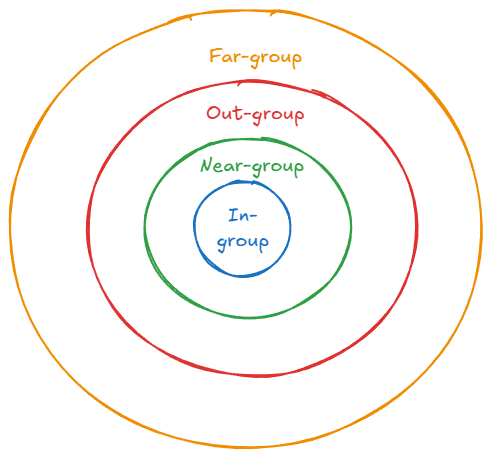
The in-group: These are people with whom you generally share the same worldview, axioms and values. Any difference of opinion is about the minutiae. Maybe we both care deeply about farmed animal welfare, but I think we should prioritise improving the lives of aquatic animals in China, you think we should focus on stopping factory farming in Africa. Perhaps we’re both concerned about human extinction, but I think that preventing astronomical suffering should take priority.
The near-group: These are people who align with you on a lot of your ways of thinking about the world, but who have such opposing views on a few important areas that your debates on these topics become important.
The out-group: These are the people on the other side of the fence; you’re part of the same debates, but you almost always find yourself on the opposite side. For me, this could be an e/acc who thinks about AI a lot but dismisses AI risk entirely, or someone who talks about China-West relations from a hardcore war-hawk perspective.
The far-group: This is for people whose views are so far removed from your own that you generally don’t even feel the need to engage with them. If you’re from an atheist family in Liverpool, it’s supremely weird to form your worldview in opposition to Hindu nationalists or Kurdish separatists.
We should really take care who we’re putting into each category, and not let fate determine who we shape our views in opposition to. Four main tips:
Embrace the in-group with caution! The in-group are clearly the coolest people in the world—they’re nice to be around, they’re your natural allies who’ll support you whenever you need intellectual or moral support, and you won’t waste your time on pointless arguments with them. The best way to use your in-group is to test Aumann’s disagreement theorum—the idea that two rational people with the same axioms and information should reach agreement on any topic. The main peril here is groupthink—getting entrenched within a mutually reinforcing worldview, where your axiomatic moral truths start to blur with your arbitrary aesthetic preferences.
The near-group should help you test and refine your axioms! These are a group of serious interlocutors. They’re people who inspire and test you, but whose underlying value differences may branch out like fractals into entirely different worldviews. A good near-group should be used to test your broader worldview without pointless bickering. And, while these are not your true intellectual rivals, it’s worth letting yourself get more passionate about those arguments, instead of saving all your fire for (less fruitful) out-group debates.
Narrow your out-group! The out-group should boil your blood, but justifiably. They are your worthy intellectual adversaries, who you’d relish taking to the debate stage with. These are the people who’ll you’ll feel super passionate about arguing against, despite only rarely reaching points of agreement. For the out-group, you might be willing to draw battle-lines and make the occasional compromise on your epistemic virtues. But, crucially, this group shouldn’t be composed of people you consider stupid, or dishonest. Your life situation will force you into opposition against people who use motivated reasoning, poor thinking, and horrible argumentation norms, but you should avoid viewing these people as your out-group, lest you spend your days arguing with the latest troll to provoke your ire.
View the far-group with compassion and anthropological curiosity! The far-group is the beautiful tapestry of humankind, from an Inuit shaman, to an Andean farmer, to a Chinese police officer, to a Nigerian preacher, to a perpetually online MAGA supporter. There are loads of reasons to enter in discussions with people from hugely different backgrounds, and that’s totally fine. It can be enlightening to discuss family values with a rural Laotian family, but you will probably not find yourself shaping your worldview in alignment with or in opposition to these views. They might have weird, even abhorrent perspectives, which, were you to suddenly adopt them, would lead your own social circles to reject you. But this shouldn’t lead you to dislike or disparage the far-group. You can be in strategic opposition to them (e.g. if you’re canvassing for an election) but you should never consider them an actual intellectual adversary. Instead you should cultivate curiosity and positive vibes.
For the vast majority of people, you should be trying to move people away from the out-group—towards to near-group if you think they’re intellectually honest, towards the far-group if you don’t.
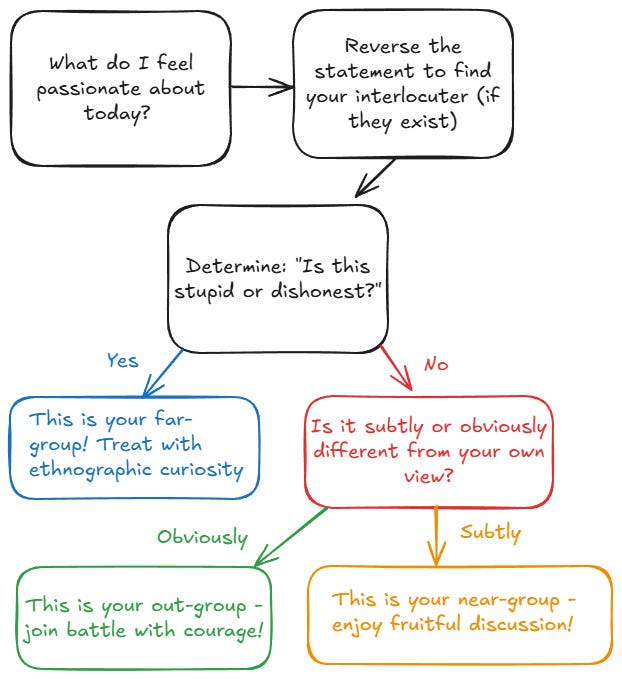
The first step is asking yourself: What opinion do I feel passionate about today? Let’s say (topically, for me):
AI 2027 was valid, responsible and appropriate, and its writers were intellectually honest and upfront about the nature of the text.
It’s easy to now analyse the role of the outgroup here—I appear to have developed my passionate view in opposition to people who think that:
AI 2027 was invalid, irresponsible and inappropriate—its writers were intellectually dishonest and deceptive about the nature of the text.
Now, remembering that the outgroup should not be composed of people I think are stupid or dishonest, do I think people who believe this about AI 2027 are stupid or dishonest?
Yes, I probably do—probably leaning dishonest. I’ve read the explanations, listened to Daniel Kokotajlo describe his uncertainties, and engaged with the serious counterarguments.
I definitely don’t think people are stupid or dishonest just for doubting the conclusions or premises, or thinking that it’s boring or badly written. But crucially, I’m not feeling passionate about: “AI 2027 is beautifully written and an entirely plausible future I expect to unfold”.
In this case, I can smoothly move a subset of people who believe the category of stuff I consider to be stupid or dishonest about AI-2027 into the far-group. This allows me to put them in the same category as an Inuit shaman, or an Indian farmer—expanding the compassionate curiosity to the world, and narrowing my passionate disagreement to those who I consider worthy of it!
If, instead of the “intellectually dishonest” accusations, I’m feeling passionate about honest and subtle AI-related disagreements on, say, whether we should expect exponential or super-exponential growth, or whether the geopolitics in the scenario make sense, then I will eagerly anticipate a good-faith debate. That’s the sort of exchange that belongs with my near-group or in-group.
And if the discussion turns to a substantial, but intellectually-honest disagreement about whether current AI could even lead to artificial superintelligence, I might well put you in the out-group and join the spirited defence. This should make sure that the arguments I get worked up about are actually worthwhile, and that my passions are not wasted on the wrong people or the wrong debates.
This is a quick flow-chart to illustrate:
I hope this way of looking at things is useful.
I can’t always manage it myself, and I still end up entangled in pointless debate now and again. But this framework tends to help.
No posts
Comments
Nothing yet. Say the first thing.
Sign in to join the conversation.