
I think that I have fairly conventional EA values. To most people in society, I probably have strange values.
I find other people’s value systems interesting, so I’m writing this in the hope that other people might find mine interesting as well.
I’m a utilitarian
Uncontroversially, I think that happiness is good, and suffering is bad.
More controversially, I also think that this is the basis of all morality, and literally everything else people place value on, from honesty to biodiversity to not lifting dogs above head height to equality to loyalty to openness to filial piety, should be in service of this.
I take it pretty far and will probably bite whatever bullets you fire at me.
If you pose any controversial thought experiment involving pushing people onto train tracks, creating trillions of lives “barely worth living”, chopping up healthy people to donate organs, being mugged by someone pretending to be able to generate infinite suffering, or duplicating the universe an infinite number of times—you don’t even need to ask me for my response. You can just ask yourself, in this hypothetical world you’re posing, which action would be expected to generate more happiness and less suffering?
My answer: “Yep, that one.”
I care about conscious lives capable of suffering
There are many kinds of lives that some people think may or may not be important — animal lives, digital lives, lives of far future people, or aliens. I simply use the “can they suffer/experience pleasure?” question to determine whether their lives have intrinsic value.
This is incredibly hard to answer for lots of life-forms and this is a major source of uncertainty in my worldview. I try to think probabilistically, from the slightly flawed basis of “I’m pretty sure I’m conscious and capable of suffering, and expect that beings with similar brains, behaviours, and/or thought processes to mine are conscious and capable of suffering”. For animals, I try to use research from orgs like Rethink Priorities to get a better sense of what their welfare ranges might look like.
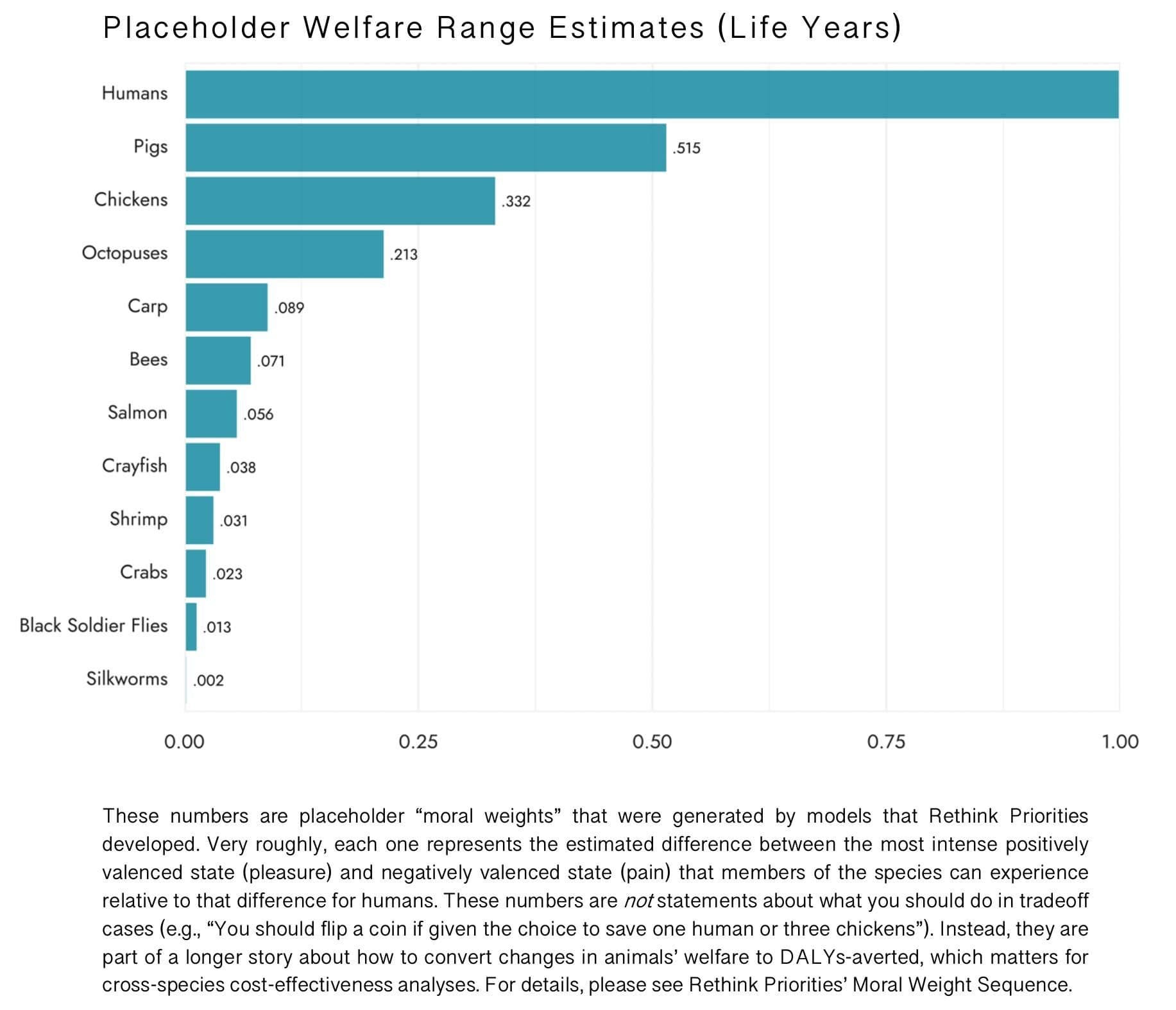
I use these numbers to get a broad sense for what these animals experiences might be like.
It only affects my day-to-day life in that I don’t eat any of these animals and donate some of my income to charities that work to improve the welfare of the smaller and more numerous of these animals.
I think the world is probably net-negative
I’ve come to the conclusion over the last two years or so that the world is currently net-negative, meaning that it is ethically bad that the world continues to exist, assuming it remains how it is now in the future.
This might not be true if we’re only considering humans as the relevant population. Most humans tend to live much of their lives in a state that they tend to rate as worth living, and lives tend to be improving. I take counter arguments seriously, but probably lean towards most human lives being net-positive.
It is almost definitely true if we’re counting farmed animals. Farmed animals, particularly small-bodied animals, from farmed chickens to insects, are kept in horrific conditions and experience lots of their life in pain. They experience very little pleasure to compensate.
It’s also almost definitely true if we’re counting wild animals. The median animal to exist, as well as the median hour of existence lived, is something like a baby starving to death or suffering from exposure to the elements. This is really fucking horrible.
I still think we should try to save the world
Despite thinking that the world is net-negative, I don’t think we should be trying to destroy it. In fact, I think that trying to destroy the world is a bad thing to do.
I think this for two main reasons.
The first reason is that a net-positive world is probably possible, and humanity looks like it may be making baby steps towards it, albeit on a path above a gaping ravine. If we continue the moral progress of the last couple of centuries, accelerated through a process like coherent extrapolated volition (the idea that an AI, or human-AI hybrid system, could consistently ask itself what it should want if it were morally better), this could result in the best possible moral being appearing within a generation. I believe that a universe ruled by such beings would not only be net-positive, but could be so magnificent and full of joy that it would make all the suffering in our universe’s history worth it.
The second reason we should not want to destroy the world is that destroying the world is not a robustly good thing to strive towards. If you try to save the world but fail to move the needle, you’ll still end up doing things that make the world better in the process, such as striving towards peace between great powers, making viral pandemics, nuclear war, and environmental crises less likely, or making sure that narrow AIs are superficially aligned and generous. You’ll also be allies with the caring people doing all these nice things, and building on each others strengths. If you try to destroy the world and fail, there are countless ways that you could end up generating more suffering in the attempt.
Saving the world might be hard
I’m not an archetypal “doomer”. On a good day, I think we’re more likely than not to survive this century.
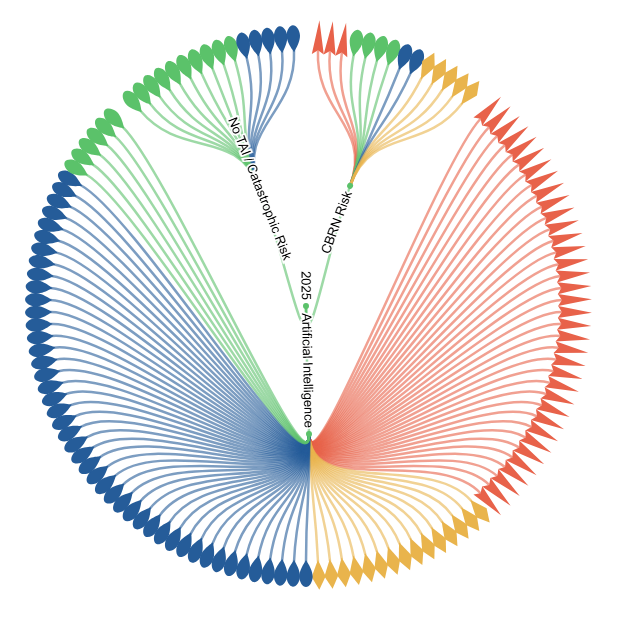
I don’t have a very carefully calibrated worldview, but my predictions for the state of humanity in, say, 2075 looks something like the above diagram (created using the possible worlds tree). The red outcomes are extinction or anything obviously worse. Blue is flourishing, yellow is catastrophe, green is sustenance/survival. So I see an 80+% chance we’ll develop genuinely god-like ASI in the next 50 years, and that this will probably lead to “non-normal” outcomes.
The “extinction” parts of the map are mostly explained by the classic Yudkowskian view that If Anyone Builds It, Everyone Dies, and the flourishing parts of the map are the worlds where we either rise to the challenge or get incredibly lucky. Some outcomes are much worse than extinction.
I also think that AGI, or at least fully automated machine-learning research, is coming very soon. This makes it hard to know what to do with my life.
I now have a job for an AI safety fieldbuilding organisation and an 18-month-old toddler.
Virtues
Being a utilitarian doesn’t necessarily mean that expected value calculations are always the best way to think about morality. As flawed humans who need heuristics, it’s probably better to cultivate certain virtues that allow us to be better moral thinkers and actors than to calculate everything from first principles.
For any utilitarian decision there is a corresponding virtue that will allow us to better make that decision. Actually doing good in the world is often more dependent on having good moral habits than calculating correctly.
When I have done good in the world, it has usually been a function of virtuous habits and the correct moral maths. e.g. my decisions to donate to effective charities or work on effective cause areas are equally due to the virtues of thoughtfulness and self-reflection.
When I have failed to do good in the world, or caused harm in the world, it has mainly been because of my failure to cultivate these virtues and habits. I sometimes have bad habits related to indecisiveness, lack of agency, thoughtlessness and lack of moral and intellectual seriousness.
I can but repent for my sins, and try to become better.
Aesthetics vs. underlying values
The biggest moral mistake I see is people confusing their aesthetics and their underlying values.
My aesthetics are not at all in line with my values.
I aesthetically appreciate nature and wild animals. Rainforests and coral reefs fill me with joy.
I often disdain simple pleasure seeking. I write songs about dystopia, and regularly seek out things that create negative emotional valence.
I often feel a mild distaste for things that make people innocently happy, perhaps this is a lingering trait from a more misanthropic youth.
I’m obsessed with religious and quasi-religious ritual and penitence. I have a persistent attachment to Victorian moralising and veneration of self-sacrifice. I’m moved by Nietzschean proclamations, like “you must be ready to burn yourself in your own flame; how could you rise anew if you have not first become ashes?”
I also eat paste-like food every day. Just vegan protein powder and water. I may add some raisins.
No posts
Comments
Nothing yet. Say the first thing.
Sign in to join the conversation.