
A few years ago I flew to Paris to meet Carlos Moreno. My late wife Ximena came with me — she’s Colombian, and Carlos is Franco-Colombian, so there was an instant familiarity between them that had nothing to do with urban planning.
What I remember most from that trip isn’t the meeting. It’s the walking. We walked everywhere — bought coffee and bread from people who recognized us by the third morning, sat outside, listened to birds in the middle of the city, ran into the same faces. I watched people of every age and background co-existing in harmony: sunbathing, playing sports, kids moving between all kinds of activities for all different walks of life. By day four I noticed something in my body had changed — a kind of settling I hadn’t felt in Miami in years, and I couldn’t attribute it to anything I had done. I hadn’t worked on myself. I hadn’t downloaded an app. I had simply been placed inside a different design.
And just last week I was in Paris once again meeting with Carlos following a virtual conversation we had during the Generation Regeneration Online Global Summit, and I got the opportunity to do something I’ve been dreaming about for 25 years...
The Loneliness Fix — Regenerative Placemaking & the Tools for Real Connection
Join me next Friday for a conversation with the Future of Cities community where we’ll be exploring just how the places we build profoundly shape our health, happiness, and sense of belonging.
Friday, August 7th, 2026
12:30pm-1:45pm EST
I walked Paris with Carlos through his lense. The professor at the Sorbonne who invented the 15-Minute City. The mind quietly influencing Anne Hidalgo, Milan, Barcelona, Bogotá, Buenos Aires and every mayor rethinking modern urban life 👇 And here’s all the places we got to tour & explore together…
📍 The Clichy-Batignolles eco-district 54 hectares in the 17th arrondissement, built on abandoned SNCF railway yards. Today one of the most alive neighborhoods I have ever set foot in.
🏘️ 3,400 homes, 50% social housing Not a token amount. Half. Woven directly into the same buildings, the same streets, the same shared park. Wealth and background disappear into one shared commons.
🌳 A 10-hectare park at the centre of it all Martin Luther King Park. Playgrounds, sports courts, wetlands, cherry blossoms. Every generation and income bracket sharing the same green heart every day.
🚶 The 15-Minute City in practice Schools, groceries, transit, culture, work, all within a 15-minute walk. What the world’s leading urbanist has been quietly proving for a decade. It works.
🛡️ And here is what stopped me This park has some of the lowest crime around. Not because it is policed. Because it is loved. When every kind of person feels genuine pride and ownership of a place, they protect it themselves.
Belonging is the best security system a city can build. When you design for Nature, Community and Culture, wellbeing isn’t an amenity. It’s the outcome.
We are living through what public health officials have formally called an epidemic of loneliness. And almost every conversation about it treats it as a personal failure of effort — you should join something, put your phone down, be more vulnerable, reach out. Self-improvement advice for a structural condition.
I don’t buy it. I think loneliness is largely a design outcome. We built it. And if we built it, we can deconstruct it.
When Carlos joined us for the closing day “Reimagine” of the Generation Regeneration Summit, he put it more sharply than I ever have:
“The essential point is, in fact, to be aware that for seven decades we have accepted the unacceptable.”
He traced it back to the Athens Charter and Le Corbusier — the doctrine that a city should be sorted into zones. A place to work. A place to live, sorted further by social category. A place for culture. A place for administration. And then, necessarily, a way to move between them:
“We had totally constraint to have a mobility essentially by individual cars. We have accepted the unacceptable because we have accepted to live in a city disconnected of the human social needs.”
He named the forces that kept it in place — the real estate lobby, the automotive lobby, the fossil energy lobby — and then he said something I haven’t been able to shake:
“I wrote very often in my research that we have accepted to become the modern centaurs, half human, half cars.”
Half human, half car. That’s the design. And once you see it, the loneliness stops looking mysterious. You cannot bump into a neighbor at 45 miles per hour. A drive-through has no third place. A cul-de-sac forty minutes from anything you need is not a place where community can form, no matter how much effort you personally invest in it.
Modern centaurs. That’s what stayed with me after Carlos said it. And it’s the same conclusion Enrique Peñalosa reached a generation earlier, halfway around the world, when he was mayor of Bogotá. Peñalosa didn’t theorize about it — he removed tens of thousands of cars off the sidewalks and gave the sidewalks back to the people who actually lived there. He called it the sidewalk revolution...
His whole philosophy comes down to one move: stop designing for cars, or businesses, or efficiency, and start designing for people. That’s it...
“We have made a city much more for people and less for cars. I took tens of thousands of cars off the sidewalks and we made new sidewalks. We had TV commercials explaining sidewalks are for talking, for playing, for doing business, for kissing. We´ve started a sidewalk revolution.”
We optimized our cities for efficiency and convenience, and we got isolation as the byproduct. Not because anyone wanted that. Because nobody was measuring for the thing we actually needed.
Here’s why I keep pointing people to Carlos’s work: it isn’t a thought experiment. Paris ran the test.
“Less than 20% of Parisians today have a car... We have built more than 1000km of protected bike lanes.”
Twenty years ago, the pollution maps of Paris were red. Today the city breathes. And when Carlos and Mayor Anne Hidalgo pushed for it, the concept was — in his words — unpopular. He was attacked. Not debated. Attacked. He told us he lived with threats for months, alongside climate scientists getting the same treatment during what researchers have started calling the Dark Enlightenment.
“We have shown worldwide that we have won the battle of the sky in 20 years.”
I want to be honest about that part, because it matters for anyone doing this work. Proposing that a neighborhood contain the six essential functions of a life — to live, to work, to supply, to educate, to enjoy, and to care — got a mathematician turned urbanist labeled an authoritarian. Proximity got called a conspiracy.
It was never about control. It’s about whether a fourteen-year-old can get to a library, whether an eighty-year-old can get to a pharmacy, whether a parent can get to a job and back in time for dinner — all without needing a car and thirty thousand dollars of debt to participate in their own neighborhood.
And for those who don’t live in a dense metropolis: Carlos and his colleagues have extended this into the 30-minute territory, working with UN-Habitat and UCLG through the Global Observatory of Sustainable Proximity, in towns of five and ten thousand people across France, Poland, Romania, Hungary. He’s proposed we stop arguing about the number and just call it the x-minute city — pick the number that fits your place. Copenhagen says five. Utrecht says ten. Scotland says twenty. The number was never the point.
Now, you can build the perfect walkable block and still produce a lonely place. I’ve watched it happen. Which brings me to Bill Reed, my mentor, co-founder of LEED, and one of the reasons I understand any of this.
Bill said something on day one of the Generation Regeneration Summit that reorganized the room:
“Your project or the project is not the project. The project is life. That’s really what we’re working with now. Your project will then emerge from that understanding.”
Bill’s practice at Regenesis doesn’t start with design. It starts with months of small conversations. Not a town hall — small groups, and then coming back.
“Once you come back to the same people a second time, you’re now in relationships, no longer a cold call. You come back a third time, your buddies, and even if you disagree, your buddies.”
Then he described what he does with a community’s activist groups — the climate people, the housing people, the water quality people, the environmental justice people, all of them siloed and competing for the same grant dollars. He buys them lunch. That’s it. Repeatedly, for about a year.
“People start with the barriers, start breaking down. Wait a minute, I didn’t know you were doing that. We’re kind of working on that, too. Maybe we should collaborate.”
He calls what forms a field. And he was blunt about the mechanism underneath all of it:
“If you’re a jerk, you’re not going to save the world.”
There’s no way to design isolation out of a city while designing it into the process that makes the city. The inner work isn’t a spiritual garnish on top of the technical work. It’s load-bearing.
We took two years to listen before we built in Jacksonville — which, if you know real estate, sounds counter-intuitive. It cut our entitlement timeline roughly in half. We’ve since accessed grants at the local, state, and federal level because people trusted us. Success moves at the speed of trust. I say it constantly because I’ve watched it price out.
The third voice I keep returning to is Arthur Mamou-Mani, who opened the summit. Arthur builds with bio-based materials and large-scale 3D printing, and he’s built temples at Burning Man that thousands of strangers weep in together. So when he talks about how a place gets made, I listen:
“It all starts with listening — to the people that live there. They’re the experts of their place.”
On the THQ tower in Bali, he discovered unused colonial jetties made of ironwood that had survived three hundred years in the ocean. He threw out his design. When someone offered to polish the wood and epoxy it smooth, he refused — he wanted a more wabi-sabi spirit, a tolerance for imperfection, because “in a world where you need to let things grow, it’s bound to have differences.”
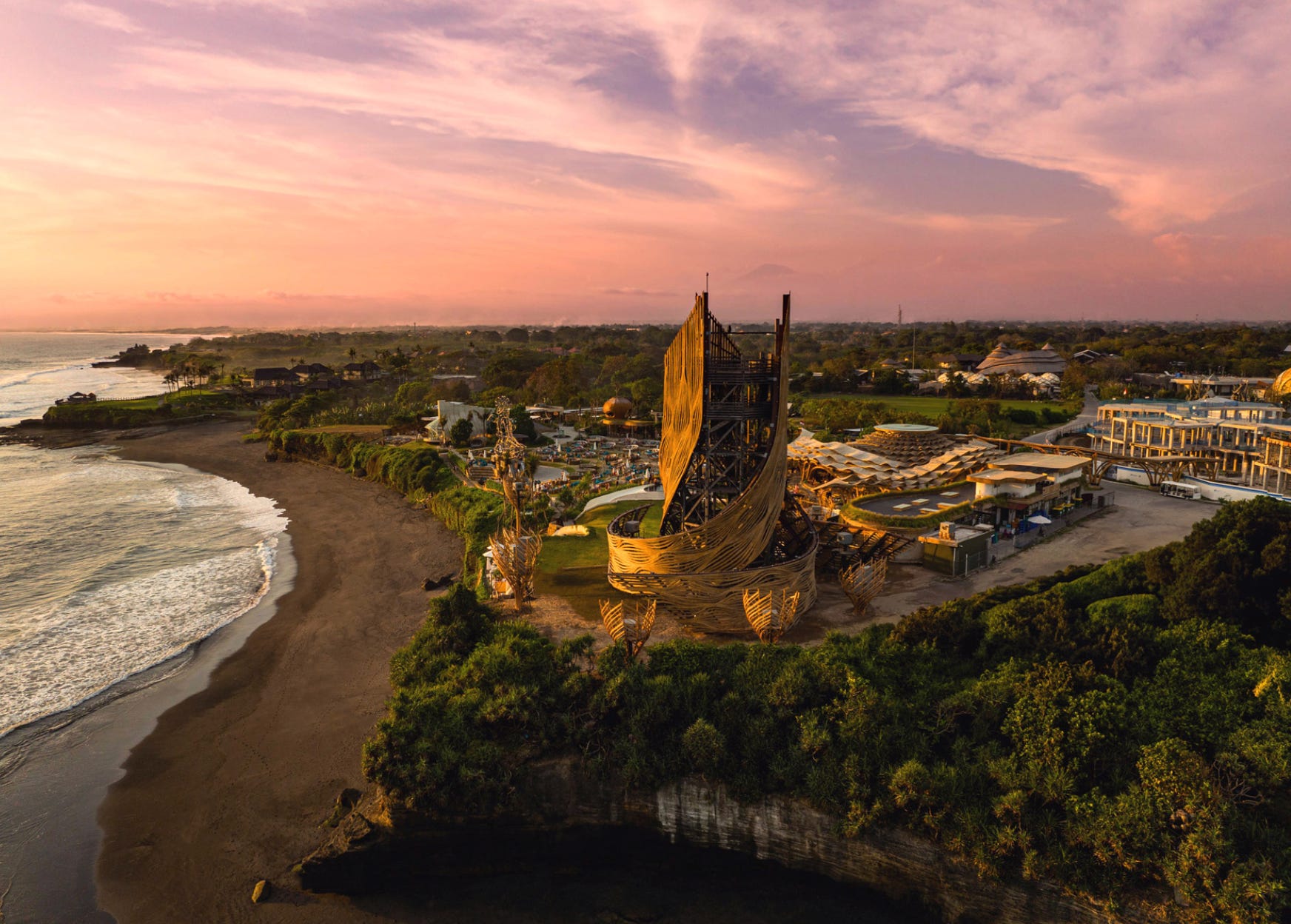
I think our neighborhoods have the same problem as that polished wood. We sanded them into strip centers with identical tenants, productized them, sold them on Wall Street. Perfectly efficient. Nothing to belong to.
Arthur left us with the image I’ve been carrying since:
“My hope is we create these new temples — places where we celebrate nature and people — reconnecting cities with the things we pushed outside them.”
If you’re feeling isolated, the design is not your fault. That’s the first thing, and I mean it. But there are moves available at every scale:
As a resident. Audit your own six functions. How many of them can you reach without a car? Wherever the answer is none, that’s not a character flaw — that’s a zoning map. Then go be a regular somewhere. Same coffee counter, same time, three weeks. Manufacture the proximity your neighborhood withheld from you.
As a builder or developer. Stop treating community engagement as a permitting obstacle. Bill’s four cascading points are respect, connect, reflect, direct — and in the West we start at direct and wonder why we end up with lawyers. Reverse it.
As a citizen. Show up for the boring stuff. Mixed-use zoning. Protected bike lanes. Transit funding. Fifteen-minute cities don’t work without public transportation — that’s infrastructure, and infrastructure is a vote.
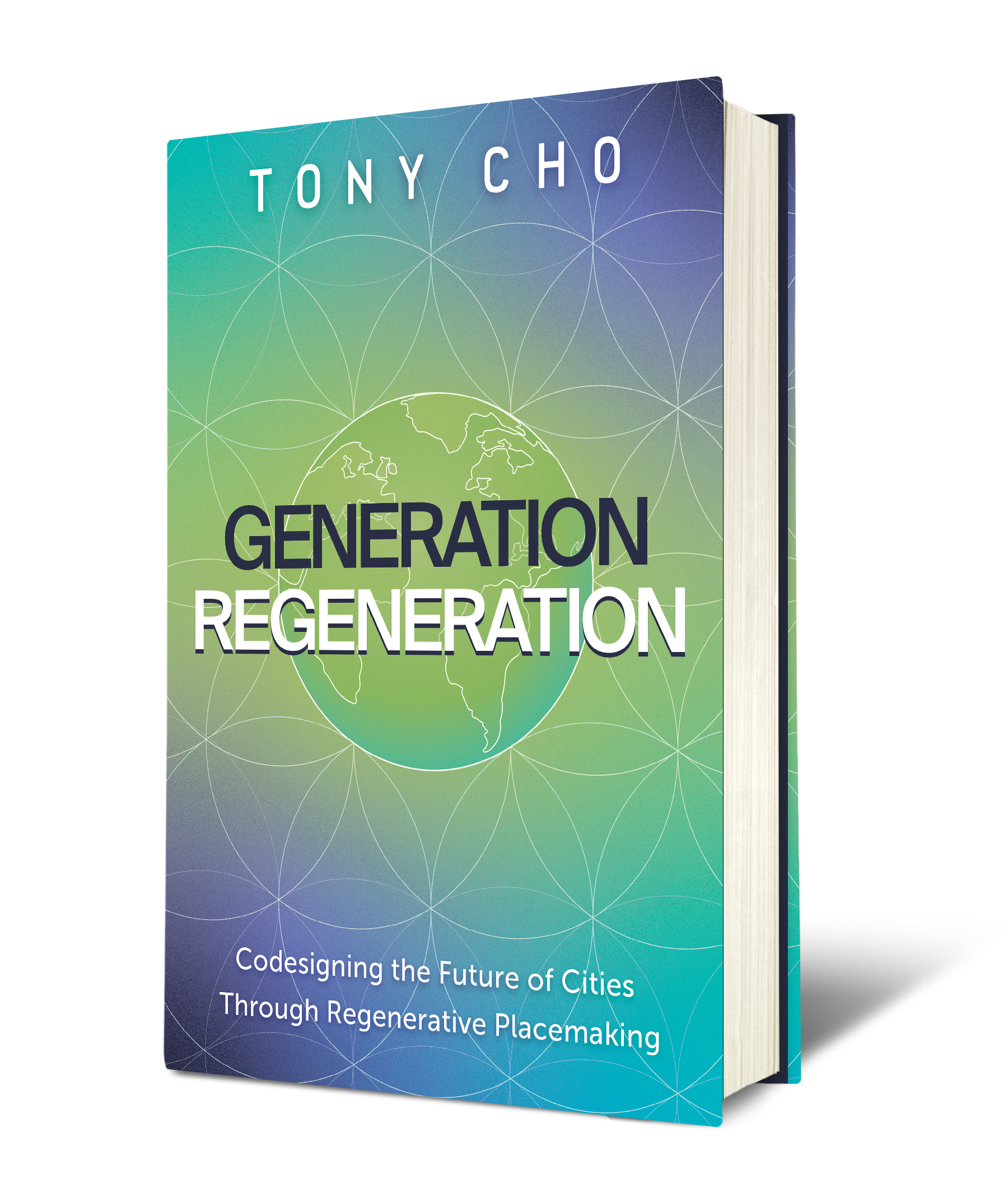
I believe we’re entering what I call the Regenaissance — a golden era like the Renaissance, but powered by regenerative thinking, whole systems thinking, and yes, technology. I’m optimistic. Not because the trend lines are good, but because I’ve now watched and joined enough humans gathering in enough places to help to heal it to know it IS possible. (And its the why behind why I even wrote my book Generation Regeneration coming out on Aug 11th). To share what I’ve learned and who I’ve met along this path that have changed my mind completely around the possibilities of regeneration.
Bill said the thing that stays with me most, and it’s really the whole argument of this piece:
“And basically we help people fall in love with life. And that is a much better motivator than guilt or even money.”
You have not failed at connection. You have only been placing it inside a design that made connection expensive, inconvenient, and optional. That design was a choice. Another choice can now be made.
Let’s go build what comes next together,
tcho
Tony Cho is the founder of Future of Cities and author of Generation Regeneration: Codesigning the Future of Cities Through Regenerative Placemaking. The sessions quoted here — with Carlos Moreno, Bill Reed, and Arthur Mamou-Mani — are from the Generation Regeneration Global Online Summit. The full conversations can be found HERE.
Comments
Nothing yet. Say the first thing.
Sign in to join the conversation.