
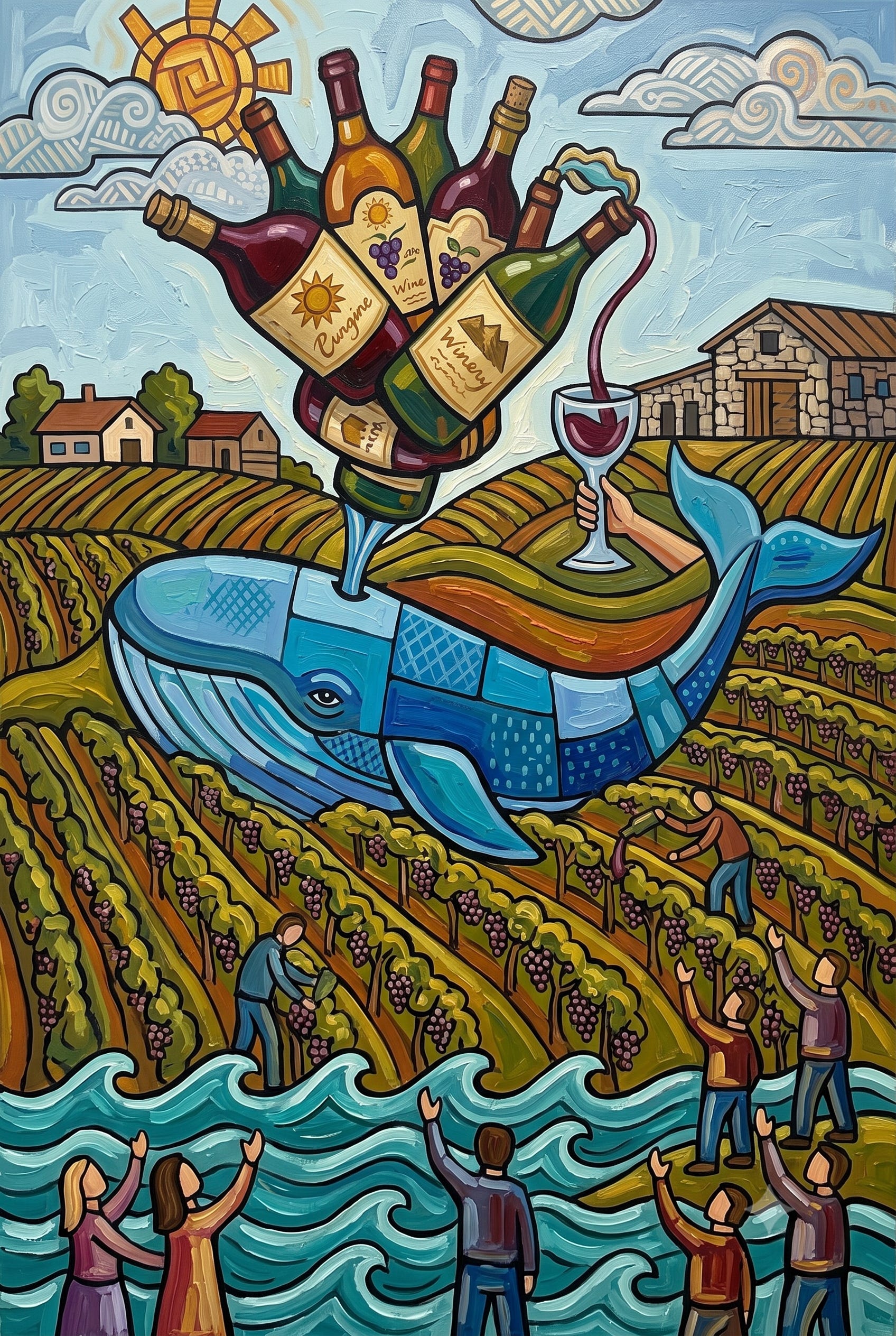
Are you now or have you ever been a whale? Someone wants to know.
I’ve never been a whale. Yes, I’ll admit to being a fellow traveller of the whales. I’ve swum in the same pools where the whales frolic, and I’ve even led some whales to feeding grounds. But if the truth be told, I’ve always been much more of a cod or even a bottom-feeder.
Adrienne Smith has no interest in me or my feeding habits, but she is very keen to understand the motivations, habits and thoughts of those folks I and some others in the industry fondly call “the whales”: the people—largely older men—who routinely spend $100 or more (often much more) on bottles of Napa Valley wines and build a collection of 1,000 bottles or more.
A managing partner of Parallel, a small Napa Valley winery, Smith was inspired by the research behind The Seven Faces of Philanthropy, which identified seven distinct donor profiles and transformed how nonprofits understood and communicated with their most valuable supporters.
So, she embarked on the Napa Valley Wine Study. It’s remarkably simple. Smith would find 250 whales who buy Napa Valley wines, interview them extensively, and create a report or book that details what motivates and moves them. What causes them to join (or leave) wine clubs, what instance, moment, or revelation first brought them into the whale pod, and much more. Her goal is to interview 250 whales. She currently has 85 under her belt and she is looking for more.
Before we go any further, I want to lay out a little more substantively what I think of as a “whale”. I want to disclose my assumptions. My experience and my prejudices have led me to assume that the Napa Valley species of whales were 1) wealthy, 2) hoarders of wine, 3) closely acquainted with and driven, in part, by the opinions of top critics, and 4) very committed to drinking wine regularly. Additionally, my encounters with Napa Valley whales have been almost entirely positive, primarily due to the fact that as a pod, these folks tend to be remarkably generous and encouraging.
However, Smith’s findings are dismantling some of my views of those who routinely spend $100 or more on Napa Valley wines. I asked her what findings have most surprised her as she moves into her 85th Interview.
“Income barely predicts anything….The expertise is real but the credentials are optional: two of every three buyers have no formal wine education at all….I ask every participant about critic scores, and only five of 84 buy on them. The industry still runs on the number; its best customers largely stopped waiting for it.”
Let this be a lesson to us all. Proximity to or travelling alongside a defined group of folks who are different from you is as likely to result in false assumptions as it is to unveil insight.
One of the features of the whale—one that has been, from time to time, observed as a symptom of larger societal structures—is that the vast majority of whales are men. I asked Smith what her study has found on this score and what she makes of this gender breakdown. So far, 15% of her whales have been women and
“the psychologies [of whales] are not gendered. The women in the study distribute across the same six buyer psychologies as the men — same doors in, same loyalty logic, same exit triggers. Nothing yet suggests a distinctly female buying psychology, though thirteen is a small base and I'd like it larger before saying anything stronger.”
My own experience tells me that when Smith has finally undertaken the 250 interviews she is seeking, the women whales will number somewhere between 15% and 20%. While Smith correctly chooses not to draw any conclusions about the maleness or femaleness of buying expensive Napa Valley wines, she is willing to speculate.
Within a couple or marriage, it tends to be the man’s name that goes on the wine club application, the mailing list or the auction paddle, despite the woman being equally involved in the selection of what is purchased, Smith speculates. On the other hand, Smith notes that many of those interviewed are in their sixties and entered the whaling game at a time when the arena was “male-coded”—meaning much of the social infrastructure of high-end collecting of Napa wines revolved around and layered upon male spaces such as the golf course, business dinners, etc.
I buy the former, but think the latter explanation doesn’t capture the male trait of using things like a collection of high-end wines much like a male peacock uses their colorful train of feathers or uses a collection of high-end watches to display status. Additionally, despite the demise of the traditional “men’s club”, I believe men still desire access to a masculine setting or group and the wine-collecting space seems to be that.
But what interests me most about the cohort that Smith is studying is the initial motivation. What turned a wine-curious person into a collector? What was the catalyst? According to Smith, it tends not to be a gradual process but rather a moment of revelation:
“When buyers tell me the story of the bottle that converted them, the bottle is never alone. Three things converge: a wine good enough to make the quality gap suddenly audible, a person who gives it meaning — the friend who chose it, the story attached — and a listener at a receptive point in life, whether that's new income, a milestone, or just an occasion with some weight to it. One participant can tell you the exact date and dining room of the bottle that started his collection more than twenty years ago…great bottle, trusted hand, ready listener. Any two without the third produces a nice evening. All three produce a collector.”
If nothing else, Ms. Smith’s interviewees are pretty self-aware. In one of her regular disclosures on social media on her findings, she quotes a whale this way:
“High-end wine is, like, wine for assholes—and I am an asshole that drinks it…stuff that’s expensive for the sake of being expensive.”
It’s hard to know what to make of this kind of disclosure. It’s even more difficult to blanket the sentiment on top of all whales in a rational way. It sounds a lot like a friend of mine who is known for saying, “I don’t date fat women, I’m a fattist. And I’m the worst kind of fattist, I’m a fat fattist”.
In the end, Smith’s goal is to provide those people who sell to and cater to the whales with insights into what their best buyers are looking for. Smith has already disclosed what might end up being the most important finding of her 85 interviews: The connection a whale has to a winery is directly related to an individual. It might be the person who hosted them at the winery or the owner or the winemaker or someone else connected to the winery, but the loyalty a whale has to a particular winery is directly connected to a person. Moreover, if that person leaves the winery, no additional discount or perk is likely to keep the whale in the club. They are likely to move on with their connection.
At 85 interviews, Adrienne Smith is about one-third of the way through her study. She is looking for more subjects who spend $100 or more per bottle on Napa wine. Cellar size is not a criterion — participants range from a few dozen bottles to several thousand. Are you a Whale? Are you willing to speak with Ms. Smith, who is an absolutist on anonymity and discretion? HERE IS WHERE YOU NEED TO GO to join the study. Smith went part-time at Parallel in January to run and focus on the study, which is independent, unpaid, and self-funded.
I would never qualify for this study. In the first place, despite living in Napa and just over the hill in Sonoma for many years, and now in the Willamette Valley among great Pinot Producers, I bought $100 bottles of wine very irregularly in my life. And like the asshole quoted above, I was aware that I could find very satisfying and delicious Napa Valley wines from less than $100 per bottle.
I’ve always been more of a bottom feeder, to be honest. I’m the guy who has a saved search query at WineBid.com that identifies bottles of wine priced $40 or less that have received 92 points or more from a select group of critics. Then again, I’m also the guy who went on a quest to obtain every vintage of Stoney Hill Chardonnay ever produced.
Also published by Tom Wark…The Spill, a free, daily newsletter that curates the best consumer wine content on the web. Videos, articles, substacks, podcasts…in your email box every morning.

No posts
Comments
Nothing yet. Say the first thing.
Sign in to join the conversation.