
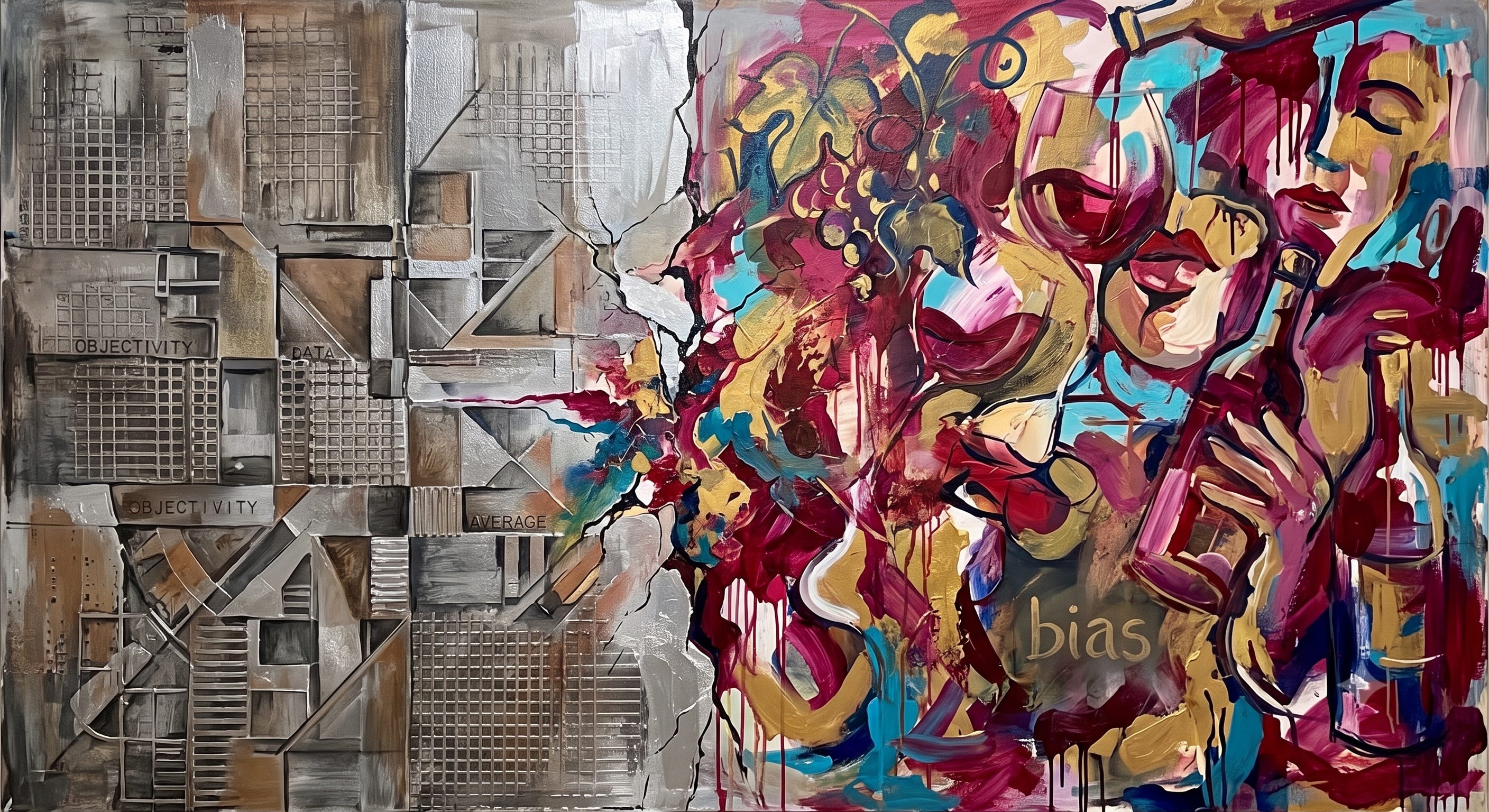
Just the other day, I came across a writer whose article was asking, “Are wine reviews biased or objective?” This is a question that dorks and geeks have long pondered, if only to have something to argue and talk about among other wine geeks and dorks. But today especially, this kind of question reveals an important truth.
The presence of bias in wine reviews, wine scoring, and wine content in general is really the only sure sign that human authenticity is at play.
As to the substance of this old question, it has always been my contention that while some form of objective assessment of a wine is possible, objective wine reviews are the last thing anyone needs. However, objective information (“This wine is relatively sweet”) within the context of a subjective review (“…and I really hated this wine”) is really what we ought to be looking for. There, case closed.
But more importantly, today, when Gemini, ChatGPT, Claude, or Grok can be coaxed into writing reviews of wines and do so in convincing fashion, the safeguard against homogeneity within the genre of wine assessment is real, genuine bias. If you don’t find bias in reviews of wine, you don’t want to keep reading that person’s (?) reviews of wine.
And by the way, you do want the wine content creators among us to review wines, and you DO want to read wine reviews. Unlike others who have argued that reviews of wine (and scores in particular) are of no value, I know they are of value. They are stories. Mini stories for sure, but stories nonetheless. And when done well and not formulaic (that’s not easy), they are both educational and good reading.
But back to bias. You want bias. You need bias. Opinion and bias is the font of all human creativity. We dont read objective educational material for the pleasure of it. And the very best wine content and wine writing might be educational, but when compelling, it’s not the education that makes it so, it’s the bias and the opinion that draws us in and keeps us coming back.
“Boring” isn’t an option today if you are a critic or a plain old writer. Boring has been automated. Boring can be manufactured in bulk today. The educational can be created and disseminated by the least capable AI systems. You want boring? Go to Gemini or ChatGPT and ask them to describe a wine. Ask them to tell you about the history of winemaking in the Duoro or Sonoma Valley. Ask them how red wine is made. Ask them about the history of the glass wine bottle. You’ll get what you need. What you won’t get is opinion, bias or insight.
Im afraid objectivity has been delegated to the artificial models that are improving on a daily basis. Boring, objective and educational has been outsourced to the circuitry. What’s left is bias and opinion.
But the fact is, I’ve always been suspicious of those who demanded objectivity in thier wine reviews and critics. What is it about these people that compels them to demand the impossible from another human being?
So, here’s what I’m looking for from the dedicated wine content creators among us. Lean into opinion! Lift up your bias. Spotlight your subjectivity. Demonstrate your humantiy. Center the thing that separates humans from machines.
Do wine drinkers really want a wine review that informs that “this wine had higher than average tannins. It smells like roses and cherries.” Great! Wonderful. No. What you want is, “This wine blew me away. The obnoxious whiff of putrid cat piss blew off and uncovered a bevy of Australian Fingeer Limes. Get at this. Buy a dozen bottles or be sorry.”
If you bias and opinion creates controversy, then you’ve done your job. No one ever developed a following or delivered real benefits to consumers of wine content by describing the ratio of tannin to acid. We have machines for that kind of objectivity.
If you are looking for a daily dose of the best wine content on the web, consider subscribing to The Spill. It’s free. It’s daily. It’s curated by me, not AI.
No posts
Comments
Nothing yet. Say the first thing.
Sign in to join the conversation.