

The fragility of the form and the shortness of the scope usually covered in a short story doesn’t lend itself easily to the use of Free and Indirect style, but that doesn’t mean that it can’t be used to great effect in any form of narrative. Let’s again take a look at Campbell’s story “World of Gas.”
In this seven-page story, the protagonist, Susan, works for a propane company in Michigan. The story centers on her selling and giving her brother-in-law, Mack, a discount on propane supplies, as she juggles her anger over a call from her son’s high school principal about her son’s pending suspension. The brilliant use of free indirect speech in this story is tied to its theme, making it imperative that the reader hear, as directly as possible, Susan’s thoughts and feelings, thereby avoiding the common cliché that men and women do not understand each other. But Susan isn’t a cliché or a stereotype, and Campbell creates an intimacy between reader and character in such a short space by allowing Susan to speak for herself as she seethes with anger while processing Mack’s order.
Men didn’t understand that you couldn’t let yourself be consumed with passion when there were so many people needing your attention, when there was so much work to do. Men didn’t understand that there was nothing big enough to exempt you from your obligations, which began as soon as the sun rose over the paper company and ended only after you’d finished the day’s chores and fell exhausted into sleep against the background noise of I-94. (Campbell 3)
Here Susan is, mad at the principal who is also a man, and cynical about Mack’s zeal to stock up in fear of a world meltdown during Y2K, ironically allows herself the freedom to take just a second from her hard life to not merely complain to the reader, but to show the reader that she’s a human, like any other man or woman, who can’t see a life past her obligations and work. This is something most of us can relate to, and we can relate even more to it, because it’s not given to us as a moral from the author, but because it comes from deep within this character, a character we’ve only known for 1 ½ pages before Campbell uses the free indirect style. Notice that though these are Susan’s thoughts and feelings, they are still reflected through the narrator in the fact that Susan is halfway into a rant, and the reader is still discovering things about Susan’s character. She is becoming more rounded by telling us not about what her work is like, because the story itself will portray these details, no more importantly, Campbell subtly allows Susan to tell us what her life is like at home, giving the reader a glimpse into Susan’s full life. She’s not just another office worker; she has a home and kids and, unfortunately, lives too close to the interstate.
I think it’s also important to note the method in which Campbell drifts the reader away from the closeness of the free indirect description of Susan’s thoughts, by moving even closer to her character by using directly stated dialogue in the next paragraph. Then Mack speaks, followed by a description of the setting. Only now does the narrator fully take back the narrative from Susan, allowing the reader to follow a seamless transition and avoid the jarring effect of the camera point of view jumping from a close-up on Susan to a long-distance shot of the office where she works. And now that we’ve heard from Susan and become as intimate with her plight as the reader can in a seven-page story, Campbell allows the narrator’s voice to control the narrative’s texture for the rest of the story.
Campbell used the free indirect style to great effect, allowing the reader to have a few intimate moments with Susan, long enough to create empathy for the character, thereby encouraging the reader to continue reading the story.
So now that we’ve seen a few examples, the question is: how do we make the most use of this technique in our own writing? The first step is knowing our characters intimately enough to conjure the rhythm and sound of their voices on command. We have to remember that for this brief glimpse into the character’s mind, we have to allow the reader to get as close to the character as they could if the story were written in first-person point of view. We therefore have to use the same techniques we would use if we were writing the entire story in this first-person point of view. Though the language is indirectly reflected through the narrative voice of the entire story, the sections where we enter the character’s mind must reflect the choices that character would make in diction, syntax, and tone to create a truthful portrayal of that character’s thoughts.
If the character is from Jamaica, the way we present their thoughts should differ from that of a Professor from Yale or a Dock worker from Chicago. By documenting these subtleties of character in our prose, we can create well-developed, interesting characters and diminish the distance between the reader and the character over the course of the narrative. Once we’ve figured out who our characters are at their most intimate, we still have the work of putting that character’s thoughts on the page without disrupting the balance of the rest of the narrative: dialogue, exposition, action, and description.
One way we can commit to eliminating distance and using the Free and Indirect style is to unclutter our manuscripts. How often are you reading along, only to have the author pull you out of the vivid dream of the story by obsessively using dialogue tags, italics, or clunky expositional phrases alerting the reader to pay attention, because the character is about to think something through?
As writers, we should know that our readers have enough to pay attention to with the plot and character development. It’s our job to eliminate as much distance as necessary for the narrative. With the use of Free and Indirect Style, the writer can largely eliminate the use of italics and the use of “he thought” to indicate when a character is thinking on the page. We can see the advantages of this in David Long’s example.
There’s a line from “Blue Spruce,” for instance: “Laurel had no intention of staying on in Montana, much less with Eva. Good lord, what an arrangement.” So you’ve got two sentences. The first is a general exposition sort of sentence, and the next one is down inside Laurel’s thoughts. I could have written: “Good Lord, she thought, what an arrangement.” But it was quicker and more supple to just dip down inside. (Long 5)
What Long is getting at is that the writer needs to be ever vigilant in creating a way for the reader to stay within the story and committed to the plight of the character at all times in order to ensure John Gardner’s “continuous vivid dream.” (Gardner 6) Why should our characters’ thoughts be filtered through the expositional language of the narrator? Why does the narrator deserve this level of control? Why can’t the character break into the narrative with their thoughts? (One reason is the desire to constantly interject the character’s feelings, when this can be shown in action) But otherwise, why do we need the narrator to stage the characters’ thoughts? What do we gain or lose from “I bet she’s lying, he thought.”? This extra filtering creates a larger distance where Janet Burroway says, “we ask the reader not directly to observe the action through the character, but rather we are looking at the character looking at the object.” (Burroway 7 ) The moment of action has been distilled by creating a Russian-nesting-doll effect of multiple lenses, until the object is too far away for us to make the close observations necessary to feel part of the story.
It should be noted that the Free Indirect Style, though versatile in eliminating distance, is not always easy to create, and not every story can handle this degree of intimacy with its characters. Nor can every writer know their character intimately enough to transcribe their character’s thoughts truthfully. There is also a tendency to rely too heavily on the character’s thoughts, taking the reader too far into another person’s mind to the point that the internal monologue hijacks the story, leaving no plot or sufficient action. These, though, should not be the fear of the writer in the first drafts of a new story. Every time we create a character, there is the risk of including too much or too little, but if the writer continues to create roadblocks to the simple telling of the story, the reader will feel too distant from the characters, and a lack of empathy will ensue. Empathy, after all, is all we can ask of our readers.
Notes
1. “free indirect style.” The Oxford Companion to English Literature. Ed. Margaret Drabble. Oxford University Press, 2000. eNotes.com. 2006. 19 Apr, 2010 <http://www.enotes.com/oce-encyclopedia/
free-indirect-style>
2. David Jauss, “From Longshots to X-Rays: Distance and Point of View in Fiction,” Alone With All That Could Happen (Cincinnati: Writers Digest Books, 2008) 46-47
3. Bonnie Jo Campbell, “World of Gas,” American Salvage (New York City: W. W. Norton and Company 2009) 35
4. Richard Yates, Revolutionary Road (New York: Vintage/Random House 1989) 47
5. David Long, “Writing Advice,” The Glimmer Train guide to Writing Fiction (Cincinnati: Writers Digest Books, 2006) 19
6. John Gardner, The Art of Fiction ( New York: Vintage/Random House 1991) 31
7. Janet Burroway, Writing Fiction: A Guide to Narrative Craft, 6th ed. (New York: Longman 2003) 81-82
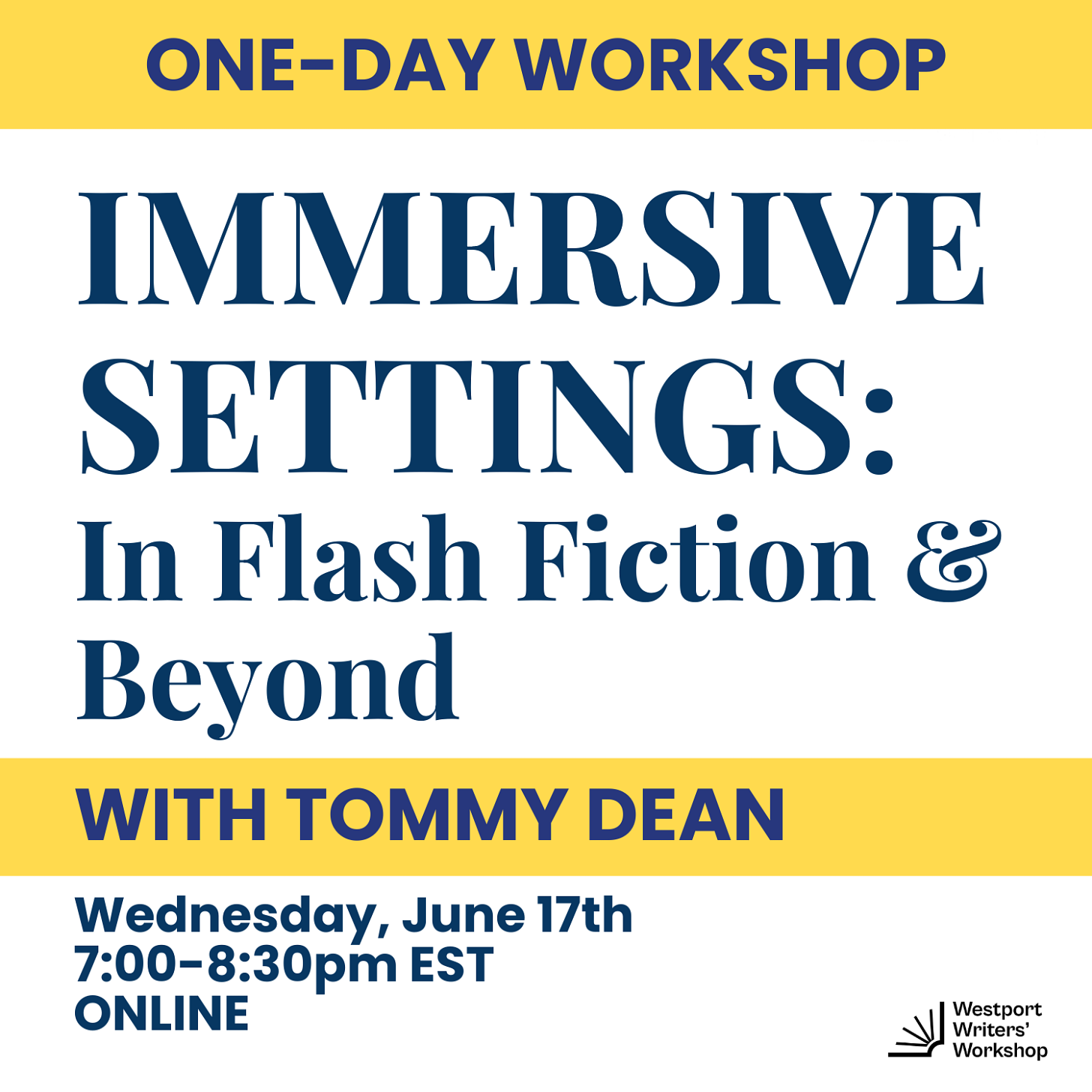
Wednesday, June 17th
7:00-8:30 PM EST
We’re thrilled to offer this special evening with writer, editor, and Literary Agent Tommy Dean for a ninety-minute generative writing session focused on creating dynamic and immersive settings for flash and microfiction! We’ll look at model texts and hopefully get inspired by the writing prompts! Participants will have the opportunity to start multiple drafts during this session. Flash word count/space limits pressure the writer to create and/or/reveal the setting quickly, but specifically and uniquely if they want to form dynamic and affecting stories. Readers want stories they can experience, and dynamic settings can add depth to any story!
Select Upcoming Appearances
The 2025 Writing Workshop of Chicago
June 20, 2026 9:00-5:00 Central Chicago, IL
Have you checked out my editing services? I’ve added some discounts to help writers start with agent-ready queries and novel openings!
If you enjoy what I do, consider supporting me on Ko-fi! Every little bit means the world! https://ko-fi.com/tommydeanwriter
This Substack is reader-supported. To receive new posts and support my work, consider becoming a free or paid subscriber.
Comments
Nothing yet. Say the first thing.
Sign in to join the conversation.